
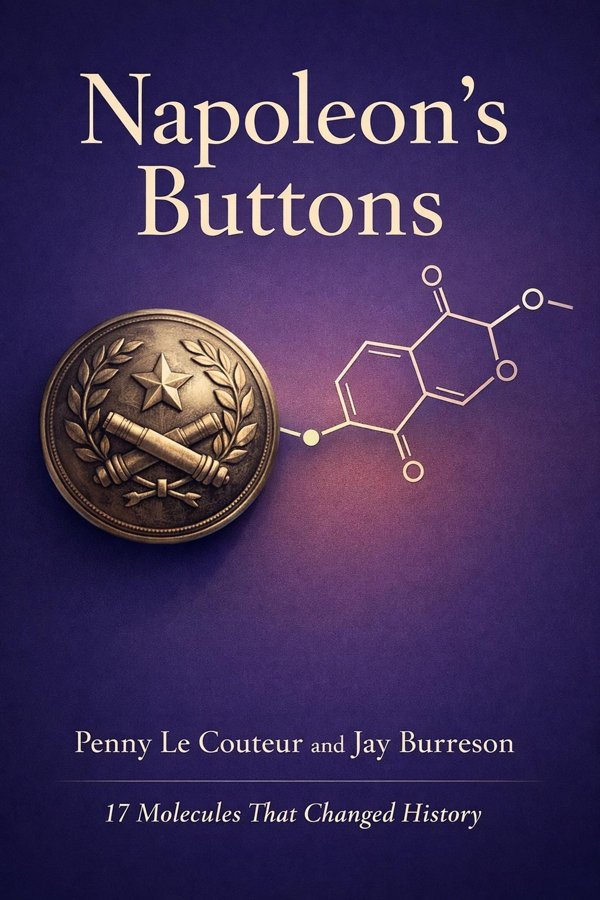
Napoleon's Buttons: 17 Molecules That Changed History: Summary & Key Insights
by Penny Le Couteur, Jay Burreson
 10 min9 chaptersAudio available
Key Takeaways from Napoleon's Buttons: 17 Molecules That Changed History
History is often told through kings, revolutions, and battles, yet many turning points begin at a much smaller scale.
A simple seasoning once determined the strength of nations.
Luxury can reshape the world as powerfully as necessity.
Many scientific revolutions begin with imitation.
A molecule that makes life easier can also make societies dangerously dependent.
What Is Napoleon's Buttons: 17 Molecules That Changed History About?
Napoleon's Buttons: 17 Molecules That Changed History by Penny Le Couteur and Jay Burreson is a popular_sci book. What if the rise and fall of empires, the growth of global trade, and even the outcome of wars could be traced to the hidden power of molecules? In Napoleon's Buttons, chemists Penny Le Couteur and Jay Burreson tell world history through 17 remarkable substances, showing how chemistry is not just a laboratory science but a force that has shaped civilization. From salt, spices, and sugar to silk, explosives, dyes, and synthetic materials, the book reveals how molecular structures influenced politics, economics, medicine, fashion, and technology. What makes this book so compelling is its ability to connect everyday materials with dramatic historical consequences. A molecule becomes more than a formula: it becomes a driver of conquest, wealth, addiction, innovation, and social change. Le Couteur, a chemistry professor, and Burreson, a chemist and science writer, bring both scientific authority and narrative flair, making complex ideas accessible without oversimplifying them. This is a book for readers who want to understand history from a fresh angle. It shows that chemistry is woven into every human story, and that sometimes the smallest structures can have the biggest consequences.
This FizzRead summary covers all 9 key chapters of Napoleon's Buttons: 17 Molecules That Changed History in approximately 10 minutes, distilling the most important ideas, arguments, and takeaways from Penny Le Couteur and Jay Burreson's work. Also available as an audio summary and Key Quotes Podcast.
Napoleon's Buttons: 17 Molecules That Changed History
What if the rise and fall of empires, the growth of global trade, and even the outcome of wars could be traced to the hidden power of molecules? In Napoleon's Buttons, chemists Penny Le Couteur and Jay Burreson tell world history through 17 remarkable substances, showing how chemistry is not just a laboratory science but a force that has shaped civilization. From salt, spices, and sugar to silk, explosives, dyes, and synthetic materials, the book reveals how molecular structures influenced politics, economics, medicine, fashion, and technology.
What makes this book so compelling is its ability to connect everyday materials with dramatic historical consequences. A molecule becomes more than a formula: it becomes a driver of conquest, wealth, addiction, innovation, and social change. Le Couteur, a chemistry professor, and Burreson, a chemist and science writer, bring both scientific authority and narrative flair, making complex ideas accessible without oversimplifying them.
This is a book for readers who want to understand history from a fresh angle. It shows that chemistry is woven into every human story, and that sometimes the smallest structures can have the biggest consequences.
Who Should Read Napoleon's Buttons: 17 Molecules That Changed History?
This book is perfect for anyone interested in popular_sci and looking to gain actionable insights in a short read. Whether you're a student, professional, or lifelong learner, the key ideas from Napoleon's Buttons: 17 Molecules That Changed History by Penny Le Couteur and Jay Burreson will help you think differently.
- ✓Readers who enjoy popular_sci and want practical takeaways
- ✓Professionals looking to apply new ideas to their work and life
- ✓Anyone who wants the core insights of Napoleon's Buttons: 17 Molecules That Changed History in just 10 minutes
Want the full summary?
Get instant access to this book summary and 100K+ more with Fizz Moment.
Get Free SummaryAvailable on App Store • Free to download
Key Chapters
History is often told through kings, revolutions, and battles, yet many turning points begin at a much smaller scale. One of the book’s most striking insights is that molecules, invisible to the naked eye, can redirect economies, empires, and everyday life. The central argument is not simply that chemistry matters, but that specific substances have repeatedly changed what people value, trade, fight over, and invent.
Le Couteur and Burreson demonstrate that chemistry is not separate from human affairs. Salt preserved food and enabled long-distance movement. Sugar transformed agriculture and global commerce. Dyes altered fashion industries and sparked the modern chemical sector. Explosives changed military power. Each molecule carried a set of physical and chemical properties, and those properties shaped what societies could do. In that sense, chemistry set real historical constraints and possibilities.
This perspective changes how we read the past. Instead of seeing history only as a sequence of human decisions, the book invites us to ask what materials made those decisions possible. Why did certain trade routes become vital? Why did colonial systems develop around particular crops or products? Why did industrialization accelerate when it did? Molecular characteristics help answer these questions.
The idea also has practical relevance today. Modern life still depends on molecules that influence geopolitics and daily living, from lithium in batteries to polymers in electronics and pharmaceuticals in public health. Understanding material science helps us better interpret supply chains, environmental debates, and technological transitions.
A useful way to apply this insight is to look at any major historical or current event and ask: what material or molecule sits beneath it? That question often reveals a deeper story. Actionable takeaway: start connecting major historical developments to the substances behind them; it will sharpen both your scientific literacy and your understanding of how the world actually works.
A simple seasoning once determined the strength of nations. Salt is one of the clearest examples in the book of how a basic molecule can become historically decisive. Chemically, salt is valuable because it preserves food, supports human physiology, and can be transported and traded relatively easily. Before refrigeration, its ability to prevent spoilage made it indispensable.
Because preserved food could feed armies, sailors, and urban populations, salt became tightly linked to state power. Empires taxed it, monopolized it, and fought over access to it. Trade routes formed around salt deposits and salt production centers. Entire cities grew wealthy because they controlled this one substance. In many societies, salt was so essential that governments treated it not merely as a commodity but as a strategic resource.
The book uses salt to show that chemistry often shapes social organization. A molecule’s usefulness can create institutions, tax systems, labor structures, and political tension. The famous protests against salt taxes in different parts of the world, including Gandhi’s Salt March in colonial India, reveal that control over a molecule can become a symbol of broader oppression.
The lesson extends into modern life. We may not think of salt as revolutionary now, but food preservation, logistics, and supply resilience still depend on chemical understanding. More broadly, today’s equivalent strategic materials may be semiconductors, battery metals, or fertilizers. Just as salt once underpinned survival and mobility, critical substances still define national strength.
For practical application, think about which materials are so basic that society overlooks them until they become scarce. Water treatment chemicals, fertilizers, or medical oxygen may not seem glamorous, yet they underpin social stability. Actionable takeaway: pay close attention to ordinary materials with extraordinary utility, because the foundations of power are often hidden in everyday substances.
Luxury can reshape the world as powerfully as necessity. One of the book’s most fascinating themes is that desire for flavor, sweetness, and status drove exploration, colonization, and global trade networks. Molecules associated with spices and sugar became engines of economic ambition, drawing European powers into long-distance commerce and eventually into conquest.
Spices mattered not only because they improved food, but because they were rare, concentrated, and culturally loaded with prestige. Their aromatic compounds made them desirable, and their scarcity made them lucrative. Nations competed to control the sources, routes, and markets linked to these substances. This competition helped motivate voyages, maritime innovation, and imperial ventures.
Sugar had an even more transformative effect. Chemically simple but biologically and economically potent, sugar altered diets, labor systems, and global agriculture. As demand grew, plantation economies expanded, especially in the Caribbean and the Americas. The result was immense wealth for some and brutal exploitation for others, including the growth of the transatlantic slave trade. The book makes clear that a molecule can create both pleasure and suffering on a massive scale.
This idea remains relevant because modern consumer demand still reorganizes production systems worldwide. Coffee, cocoa, palm oil, and rare earth minerals follow similar patterns: a desirable substance generates trade, labor pressure, environmental costs, and geopolitical competition. Chemistry alone does not create injustice, but molecular desirability can amplify it through markets.
Readers can apply this insight by examining the hidden supply chains behind everyday pleasures. A candy bar, a cup of coffee, or a bottle of perfume contains a history of chemistry, labor, transport, and ecological impact. Actionable takeaway: whenever you consume something highly desired and globally traded, ask what chemical qualities make it valuable and what human systems were built to deliver it.
Many scientific revolutions begin with imitation. Another major idea in Napoleon's Buttons is that natural materials such as silk, rubber, and dyes did more than enrich trade; they challenged chemists to understand and reproduce nature’s remarkable properties. This effort helped launch modern industrial chemistry.
Take silk. Its strength, softness, and luster made it one of history’s most coveted materials. Yet for a long time, its production depended on biological processes that were difficult to control and reproduce. The same was true for rubber, whose elasticity transformed transportation and manufacturing, and for plant-derived dyes, whose vivid colors drove fashion and commerce. These materials were not merely useful goods; they were scientific puzzles.
By trying to isolate, analyze, and eventually synthesize the compounds behind such materials, chemists learned how molecular structure determines physical behavior. This was a crucial step in moving from descriptive chemistry to applied industrial science. Synthetic dyes, artificial fibers, and improved polymers did not appear out of nowhere. They emerged from close engagement with nature’s molecular designs.
The practical significance is enormous. Much of modern material science still works this way. Researchers study spider silk for ultra-strong fibers, plant chemistry for medicines, and biological membranes for better batteries and sensors. Nature remains a template for innovation because evolution has already solved countless engineering problems at the molecular level.
For ordinary readers, this idea offers a useful framework: the products we use every day often began as efforts to understand and improve on natural substances. Whether in clothing, packaging, or medicine, chemistry is frequently a dialogue between biology and design. Actionable takeaway: when you encounter a high-performance modern material, ask what natural substance inspired it; this habit reveals how science often advances through observation, imitation, and refinement.
A molecule that makes life easier can also make societies dangerously dependent. Throughout the book, Le Couteur and Burreson show that chemical substances often create systems of wealth that are difficult to escape. Once a society organizes itself around a material, that material begins to shape labor, trade, policy, and vulnerability.
Consider substances such as sugar, cotton-related treatments, dyes, and later synthetic industrial chemicals. Their benefits are obvious: profitability, convenience, scalability, and improved quality of life. But every breakthrough also deepens dependence. Markets become structured around a molecule’s availability. Industries invest in infrastructure tailored to it. Governments protect access to it. Consumers adapt their habits and expectations around it.
This creates a paradox. Chemistry enables abundance, but abundance can narrow flexibility. A nation dependent on imported raw materials becomes strategically exposed. A population accustomed to cheap processed food becomes vulnerable to health consequences. An industry built on a single class of chemicals may resist safer alternatives even when risks become clear. The book’s historical examples hint at this recurring pattern: success built on chemistry can become a trap.
This is especially relevant in the present era of fossil fuels, plastics, fertilizers, and pharmaceuticals. These molecules support modern civilization, yet they also produce climate risks, waste, and geopolitical tension. The lesson is not anti-chemistry. It is that chemical power must be matched with foresight, diversification, and ethical regulation.
A practical way to apply this idea is to look beyond immediate utility and ask what long-term systems a substance creates. What happens if supply is disrupted? What are the health or environmental costs? Who becomes dependent on whom? Actionable takeaway: evaluate materials not only by what they provide today, but by the dependencies they create tomorrow.
Few things alter history as dramatically as a new way to destroy. The book highlights explosives as a vivid case of how chemistry can reorganize military power and, with it, political authority. Once chemists learned to manipulate compounds that release energy rapidly, warfare entered a different era. Stronger fortifications could be broken, mining and engineering accelerated, and states gained access to new forms of violence and control.
The chemistry matters because explosive force depends on molecular arrangement. Compounds that store energy in unstable bonds can release it suddenly under the right conditions. That scientific understanding gradually transformed black powder traditions into more sophisticated explosives, each with implications beyond the battlefield. Railways, tunnels, canals, and construction projects also relied on controlled explosive chemistry. The same molecules that shattered armies also built infrastructure.
This dual-use nature is one of the book’s recurring themes. Chemistry is rarely morally simple. A molecule is not inherently peaceful or violent; its effects depend on how humans deploy it. Yet once a powerful substance exists, it shifts incentives. Governments race to secure it, armies adapt to it, and industries grow around it. Technical innovation then cascades into strategic and political change.
Modern readers can see similar dynamics in cyber tools, nuclear materials, drones, and artificial intelligence. Technologies that begin as scientific breakthroughs quickly become questions of power, regulation, and ethics. The pattern is familiar: discovery leads to application, application leads to competition, and competition reshapes institutions.
The practical lesson is to pay attention to dual-use science before it becomes normalized. Public understanding should not lag too far behind technical capability. Actionable takeaway: when evaluating a scientific breakthrough, ask not only what it can build, but also how it could be weaponized or used to concentrate power.
Sometimes the most world-changing molecule is the one that alters the body. A major contribution of the book is its demonstration that chemistry has transformed health, life expectancy, and social behavior through medicinal and biologically active compounds. Whether naturally derived or synthetically produced, these molecules can influence pain, infection, fertility, mental states, and survival itself.
The book’s broader argument is that medicine is never only medical. Once a molecule affects health reliably, it changes institutions and social expectations. People live longer, populations grow, workforces stabilize, and governments invest differently in sanitation and treatment. Pharmaceuticals can also alter ideas about responsibility and risk. A disease once accepted as fate may become seen as a solvable problem once a drug exists.
At the same time, the history of medicinal molecules includes side effects, misuse, addiction, and inequality in access. Chemistry can heal, but it can also be commercialized irresponsibly or distributed unevenly. This tension is central to understanding modern healthcare. Every celebrated treatment raises questions about regulation, patents, affordability, and long-term consequences.
The book helps non-scientists see why molecular details matter. A slight structural difference can mean the difference between a lifesaving medicine and a dangerous toxin. That is why chemistry remains foundational to pharmacology. It is also why evidence, dosage, and rigorous testing are essential.
This theme remains highly practical. Readers make decisions about painkillers, antibiotics, supplements, vaccines, and prescriptions all the time. Basic molecular literacy encourages better questions: How does this work? What does it bind to? What are the risks? Why is dosage critical? Actionable takeaway: treat medicines with respect and curiosity, recognizing that powerful molecules can improve life dramatically only when used with informed judgment.
Modernity often feels digital, but much of it is actually chemical. One of the book’s strongest ideas is that synthetic chemistry did not merely add new products to the world; it redefined ordinary life. Once humans learned to create molecules that nature did not conveniently supply, the range of possible materials expanded dramatically. Clothing, packaging, household goods, colorants, fuels, and industrial inputs all changed.
This was revolutionary because synthetic molecules offered consistency, scale, and customization. Natural materials can vary by season, geography, and biological process. Synthetic compounds can be designed, reproduced, and modified for specific purposes. That made manufacturing more predictable and often cheaper. Entire industries grew around the ability to produce substances with targeted properties, such as flexibility, durability, transparency, or reactivity.
But the book also encourages a more critical perspective. Synthetic success can distance consumers from consequences. Plastics, for instance, solved many problems of cost and convenience, yet their persistence creates waste and ecological damage. A molecule engineered for durability does not stop being durable when thrown away. The same qualities that make a material useful in commerce may make it harmful in the environment.
This tension is central to contemporary sustainability debates. We continue to rely on synthetic materials because they are effective, but we are now being forced to account for their full lifecycle. Better chemistry today increasingly means designing for reuse, recyclability, and lower toxicity rather than for performance alone.
In practical terms, this idea invites readers to look more closely at the material composition of everyday objects. Understanding whether something is biodegradable, recyclable, solvent-intensive, or long-lasting affects responsible consumption. Actionable takeaway: become more material-aware in daily life and favor products whose chemistry aligns not just with convenience, but with long-term environmental sense.
Many people think they dislike chemistry when what they really dislike is chemistry taught without context. One of the book’s greatest achievements is showing that scientific literacy becomes far more engaging when tied to stories of trade, empire, disease, luxury, war, and invention. Chemistry is not presented as abstract equations but as a lens for understanding why history unfolded the way it did.
This matters because disciplinary boundaries often limit comprehension. Historians may underemphasize material constraints, while science learners may miss the human stakes of molecular discoveries. Napoleon's Buttons bridges that divide. It shows that molecules have biographies: they emerge, travel, gain cultural meaning, generate industries, provoke conflict, and leave legacies. Once readers see that pattern, chemistry becomes memorable and history becomes more concrete.
The practical value of this approach extends beyond the book. It models how to think across fields. To understand climate change, for example, one needs chemistry, economics, politics, and ethics. To understand pharmaceuticals, one needs biology, regulation, and social history. The future will reward people who can connect technical knowledge with human systems.
For students, professionals, and curious general readers, this is an empowering insight. You do not need to be a specialist to follow the broad consequences of science. You need curiosity about cause and effect. When you ask what a substance does, why it matters, and who benefits or suffers from it, you begin to think more clearly about both the past and the present.
A simple habit can strengthen this skill: whenever you read about a major event or product, identify the material science behind it. Actionable takeaway: use chemistry as a storytelling tool to make history, technology, and current affairs more intelligible and interconnected.
All Chapters in Napoleon's Buttons: 17 Molecules That Changed History
About the Authors
Penny Le Couteur and Jay Burreson are chemists and science communicators known for making complex scientific ideas accessible to general readers. Le Couteur taught chemistry at Capilano College in British Columbia and developed a reputation for engaging teaching and a talent for connecting science to everyday life. Burreson, also trained in chemistry, has written extensively on the cultural and historical impact of scientific discoveries. Together, they bring complementary strengths: academic rigor, clear explanation, and strong storytelling. Their collaboration in Napoleon's Buttons reflects a shared belief that chemistry is not confined to laboratories but deeply woven into the development of civilization. By combining molecular science with rich historical narrative, they helped create one of the most memorable and reader-friendly books in popular science.
Get This Summary in Your Preferred Format
Read or listen to the Napoleon's Buttons: 17 Molecules That Changed History summary by Penny Le Couteur and Jay Burreson anytime, anywhere. FizzRead offers multiple formats so you can learn on your terms — all free.
Available formats: App · Audio · PDF · EPUB — All included free with FizzRead
Download Napoleon's Buttons: 17 Molecules That Changed History PDF and EPUB Summary
Key Quotes from Napoleon's Buttons: 17 Molecules That Changed History
“History is often told through kings, revolutions, and battles, yet many turning points begin at a much smaller scale.”
“A simple seasoning once determined the strength of nations.”
“Luxury can reshape the world as powerfully as necessity.”
“Many scientific revolutions begin with imitation.”
“A molecule that makes life easier can also make societies dangerously dependent.”
Frequently Asked Questions about Napoleon's Buttons: 17 Molecules That Changed History
Napoleon's Buttons: 17 Molecules That Changed History by Penny Le Couteur and Jay Burreson is a popular_sci book that explores key ideas across 9 chapters. What if the rise and fall of empires, the growth of global trade, and even the outcome of wars could be traced to the hidden power of molecules? In Napoleon's Buttons, chemists Penny Le Couteur and Jay Burreson tell world history through 17 remarkable substances, showing how chemistry is not just a laboratory science but a force that has shaped civilization. From salt, spices, and sugar to silk, explosives, dyes, and synthetic materials, the book reveals how molecular structures influenced politics, economics, medicine, fashion, and technology. What makes this book so compelling is its ability to connect everyday materials with dramatic historical consequences. A molecule becomes more than a formula: it becomes a driver of conquest, wealth, addiction, innovation, and social change. Le Couteur, a chemistry professor, and Burreson, a chemist and science writer, bring both scientific authority and narrative flair, making complex ideas accessible without oversimplifying them. This is a book for readers who want to understand history from a fresh angle. It shows that chemistry is woven into every human story, and that sometimes the smallest structures can have the biggest consequences.
You Might Also Like

Structures: Or Why Things Don"t Fall Down
J.E. Gordon
10 min
The Road to Wigan Pier
George Orwell
10 min
Bonk: The Curious Coupling of Science and Sex
Mary Roach
10 min
First Bite: How We Learn to Eat
Bee Wilson
10 min
In Pursuit Of The Unknown: 17 Equations That Changed The World
Ian Stewart
10 min
Natural History Museum Guide
Various
10 minBrowse by Category
Ready to read Napoleon's Buttons: 17 Molecules That Changed History?
Get the full summary and 100K+ more books with Fizz Moment.