
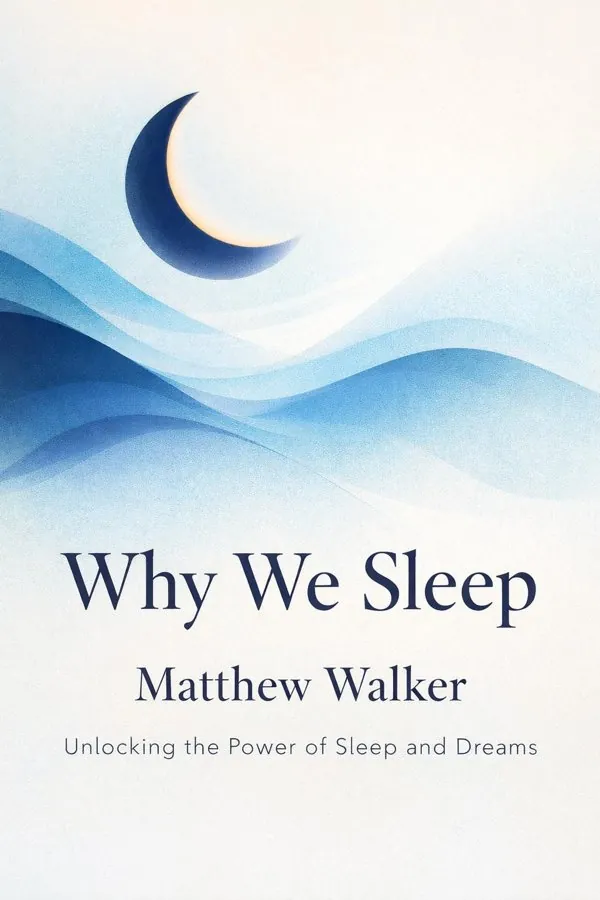
Why We Sleep: Summary & Key Insights
 10 min6 chaptersAudio available
Key Takeaways from Why We Sleep
Sleep is not a strange quirk of biology—it is one of its oldest and most carefully protected features.
Walker shows that sleep is not one uniform state but a precisely organized process made up of repeating cycles.
One of Walker’s strongest arguments is that sleep is essential for a healthy, high-performing brain.
Walker makes it clear that sleep is not only about the brain.
Few parts of *Why We Sleep* are more urgent than Walker’s warning about chronic sleep deprivation.
What Is Why We Sleep About?
Why We Sleep by Matthew Walker is a health book published in 2017 spanning 6 pages. What if the most powerful performance enhancer, mood stabilizer, memory booster, and long-term health intervention isn’t a supplement, a productivity hack, or a complicated wellness routine—but sleep? In *Why We Sleep*, neuroscientist Matthew Walker makes a compelling case that sleep is not a passive state of rest. It is one of the most active, essential, and life-preserving processes in the human body. Far from being wasted time, sleep is when the brain organizes memories, the body repairs itself, emotions are regulated, and countless biological systems reset for the next day. Walker brings both scientific authority and urgency to the topic. As a professor of neuroscience and psychology at the University of California, Berkeley, and founder and director of the Center for Human Sleep Science, he has spent years studying how sleep shapes human health and performance. His central message is both simple and profound: the modern tendency to cut sleep short comes at a steep cost. This book matters because it connects sleep to nearly everything readers care about—focus, energy, mental health, disease prevention, learning, relationships, and longevity—and offers a persuasive reminder that better sleep can change your life.
This FizzRead summary covers all 6 key chapters of Why We Sleep in approximately 10 minutes, distilling the most important ideas, arguments, and takeaways from Matthew Walker's work. Also available as an audio summary and Key Quotes Podcast.
Why We Sleep: Unlocking the Power of Sleep and Dreams
What if the most powerful performance enhancer, mood stabilizer, memory booster, and long-term health intervention isn’t a supplement, a productivity hack, or a complicated wellness routine—but sleep? In *Why We Sleep*, neuroscientist Matthew Walker makes a compelling case that sleep is not a passive state of rest. It is one of the most active, essential, and life-preserving processes in the human body. Far from being wasted time, sleep is when the brain organizes memories, the body repairs itself, emotions are regulated, and countless biological systems reset for the next day.
Walker brings both scientific authority and urgency to the topic. As a professor of neuroscience and psychology at the University of California, Berkeley, and founder and director of the Center for Human Sleep Science, he has spent years studying how sleep shapes human health and performance. His central message is both simple and profound: the modern tendency to cut sleep short comes at a steep cost. This book matters because it connects sleep to nearly everything readers care about—focus, energy, mental health, disease prevention, learning, relationships, and longevity—and offers a persuasive reminder that better sleep can change your life.
Who Should Read Why We Sleep?
This book is perfect for anyone interested in health and looking to gain actionable insights in a short read. Whether you're a student, professional, or lifelong learner, the key ideas from Why We Sleep by Matthew Walker will help you think differently.
- ✓Readers who enjoy health and want practical takeaways
- ✓Professionals looking to apply new ideas to their work and life
- ✓Anyone who wants the core insights of Why We Sleep in just 10 minutes
Want the full summary?
Get instant access to this book summary and 100K+ more with Fizz Moment.
Get Free SummaryAvailable on App Store • Free to download
Key Chapters
Sleep is not a strange quirk of biology—it is one of its oldest and most carefully protected features. Walker emphasizes that virtually every species studied shows some form of sleep or sleep-like rest. That consistency across evolution suggests that sleep must deliver enormous survival benefits. If sleep were useless, natural selection would have eliminated it long ago, especially because sleeping makes animals less responsive and more vulnerable to predators. The fact that evolution kept it tells us that the benefits outweigh the risks.
The book explains that sleep serves many purposes at once. It supports learning by helping the brain absorb new information and then stabilize it overnight. It restores the body through cellular repair, hormone regulation, and immune strengthening. It also helps clear metabolic waste from the brain, a kind of overnight housekeeping that keeps neural systems functioning smoothly. This multi-layered usefulness is why there is no single answer to the question, “Why do we sleep?” We sleep because nearly every major system in the body depends on it.
A practical takeaway is to stop treating sleep as negotiable. If nature has preserved sleep across millions of years, then consistently shortening it is not a harmless lifestyle choice. It is a direct challenge to biology. Walker’s memorable idea is that sleep is “nature’s medicine cabinet”—a nightly recovery process that supports both immediate functioning and long-term health.
Walker shows that sleep is not one uniform state but a precisely organized process made up of repeating cycles. Over the course of a typical night, the brain moves through roughly 90-minute cycles containing non-REM and REM sleep. Non-REM includes lighter stages and deep slow-wave sleep, while REM sleep is associated with vivid dreaming and heightened brain activity. Each stage contributes something different, which means the quality of sleep matters just as much as the quantity.
Deep non-REM sleep is especially important for physical restoration and memory stabilization. During this phase, brain waves become slower and more synchronized, creating the conditions for recovery, immune support, and the strengthening of newly learned information. REM sleep plays a different but equally valuable role. It helps the brain process emotions, integrate experiences, and make unusual connections that fuel creativity and insight. That is one reason people sometimes “sleep on” a problem and wake up with a better solution.
An actionable lesson is to protect your full night of sleep rather than only aiming for a minimum number of hours. Cutting sleep short late at night or waking too early may rob you of REM-rich periods, while falling asleep too late can reduce deep sleep. Regular bedtimes, enough total sleep opportunity, and a stable schedule help preserve this architecture. Walker’s larger point is that healthy sleep is a carefully timed symphony, and every stage has a role in helping you think, feel, and function better.
One of Walker’s strongest arguments is that sleep is essential for a healthy, high-performing brain. During the day, the brain takes in enormous amounts of information, but without sleep, much of that input remains fragile and disorganized. Sleep helps convert short-term experiences into more stable memories, almost like moving files from temporary storage into a reliable long-term archive. This is why students who sleep well often learn more efficiently than those who stay up late cramming.
Walker also explains that sleep prepares the brain for future learning. If you are sleep-deprived, your ability to absorb and encode new information drops significantly. It is not just that you remember less later—you may fail to properly take in the information in the first place. Sleep also supports concentration, decision-making, emotional balance, and creative thinking. REM sleep in particular appears to help the brain connect distant ideas, which can lead to fresh insights and problem-solving breakthroughs.
For everyday life, this means sleep should be viewed as part of your study strategy, work strategy, and mental health strategy. If you want sharper attention, better recall, and more balanced reactions under stress, prioritize sleep before a big meeting, exam, or presentation—not just after. Walker’s message is clear: a well-rested brain is not a luxury. It is the foundation for learning, performance, and psychological resilience.
Walker makes it clear that sleep is not only about the brain. The entire body depends on sufficient sleep to maintain health and stability. During sleep, the immune system is strengthened, tissues are repaired, and key hormones are regulated. This helps explain why people often feel run down, get sick more easily, or recover more slowly when they do not sleep enough. Sleep is a full-body maintenance window, and skipping it has consequences that build over time.
The book also links sleep to metabolic health. Poor sleep can disrupt appetite-regulating hormones, which may increase hunger and cravings, especially for calorie-dense foods. That means sleep loss can make healthy eating harder even when your intentions are good. Walker further connects sleep to cardiovascular health, showing that sleep supports blood pressure regulation and broader bodily recovery. In other words, sleep is deeply connected to energy, weight, immunity, and long-term disease risk.
A useful takeaway is to think of sleep as one of the pillars of physical health alongside food and movement. People often focus intensely on diet and exercise while ignoring sleep, but Walker argues that these habits are less effective when sleep is chronically poor. If you are trying to feel better physically, improve your energy, or support long-term wellness, protecting sleep is one of the highest-return changes you can make.
Few parts of *Why We Sleep* are more urgent than Walker’s warning about chronic sleep deprivation. Losing sleep does not just make you tired—it impairs thinking, mood, reaction time, judgment, and physical health. One of the most dangerous features of sleep loss is that people often underestimate how impaired they are. You may feel “fine enough” while your performance, focus, and decision-making are already significantly reduced.
Walker describes how insufficient sleep harms memory, weakens the immune system, and disrupts emotional regulation. Sleep-deprived people are often more irritable, more anxious, and less able to handle stress. The risks extend beyond personal well-being to public safety. Fatigue contributes to mistakes at work, poor driving decisions, and accidents that can affect many lives. In a culture that sometimes celebrates burning the candle at both ends, Walker argues that sleep deprivation should be treated as a serious health and safety issue, not a badge of honor.
The practical lesson is to notice where sleep loss has become normalized in your life. Are you relying on caffeine to function, making more mistakes, or feeling emotionally reactive? Those may be signs that your sleep debt is already affecting you. Walker’s bigger point is simple but powerful: every hour of lost sleep has a cost, and that cost shows up in both daily performance and long-term health.
Walker does not stop at explaining why sleep matters—he also offers guidance for sleeping better. A core principle is consistency. Going to bed and waking up at roughly the same time each day helps regulate your internal body clock, making it easier to fall asleep naturally and wake feeling more refreshed. This matters even on weekends, when dramatic schedule shifts can leave you feeling as though you are recovering from jet lag.
He also points to environmental and behavioral changes that support better sleep. A cool, dark, quiet room can improve sleep quality, while late-evening exposure to bright light may interfere with the body’s readiness for rest. Caffeine and alcohol can also disrupt sleep more than many people realize. Caffeine may linger in the system for hours, and alcohol, despite making some people feel sleepy, can fragment sleep architecture and reduce its restorative value.
Actionably, build a wind-down routine: dim lights, reduce stimulating screen use, avoid heavy late-night meals, and give yourself enough time in bed to get adequate sleep. If you cannot sleep, the goal is not to force it with anxiety, but to create conditions that allow sleep to arrive. Walker’s broader advice is to treat sleep with respect and intentionality. Small habits, repeated consistently, can produce meaningful improvements in mood, energy, focus, and overall well-being.
All Chapters in Why We Sleep
About the Author
Matthew Walker is a British neuroscientist and professor of neuroscience and psychology at the University of California, Berkeley. He is the founder and director of the Center for Human Sleep Science and is widely recognized as a leading researcher on sleep and its effects on human health, learning, memory, and aging. In *Why We Sleep*, Walker draws on his academic and scientific background to translate complex sleep research into practical insights for a general audience. His work has helped bring sleep science into mainstream health conversations, highlighting sleep as a critical pillar of physical and mental well-being.
Get This Summary in Your Preferred Format
Read or listen to the Why We Sleep summary by Matthew Walker anytime, anywhere. FizzRead offers multiple formats so you can learn on your terms — all free.
Available formats: App · Audio · PDF · EPUB — All included free with FizzRead
Download Why We Sleep PDF and EPUB Summary
Key Quotes from Why We Sleep
“Sleep is not a strange quirk of biology—it is one of its oldest and most carefully protected features.”
“Walker shows that sleep is not one uniform state but a precisely organized process made up of repeating cycles.”
“One of Walker’s strongest arguments is that sleep is essential for a healthy, high-performing brain.”
“Walker makes it clear that sleep is not only about the brain.”
“Few parts of *Why We Sleep* are more urgent than Walker’s warning about chronic sleep deprivation.”
Frequently Asked Questions about Why We Sleep
Why We Sleep by Matthew Walker is a health book that explores key ideas across 6 chapters. What if the most powerful performance enhancer, mood stabilizer, memory booster, and long-term health intervention isn’t a supplement, a productivity hack, or a complicated wellness routine—but sleep? In *Why We Sleep*, neuroscientist Matthew Walker makes a compelling case that sleep is not a passive state of rest. It is one of the most active, essential, and life-preserving processes in the human body. Far from being wasted time, sleep is when the brain organizes memories, the body repairs itself, emotions are regulated, and countless biological systems reset for the next day. Walker brings both scientific authority and urgency to the topic. As a professor of neuroscience and psychology at the University of California, Berkeley, and founder and director of the Center for Human Sleep Science, he has spent years studying how sleep shapes human health and performance. His central message is both simple and profound: the modern tendency to cut sleep short comes at a steep cost. This book matters because it connects sleep to nearly everything readers care about—focus, energy, mental health, disease prevention, learning, relationships, and longevity—and offers a persuasive reminder that better sleep can change your life.
Compare Why We Sleep



You Might Also Like


Featured In
Browse by Category
Ready to read Why We Sleep?
Get the full summary and 100K+ more books with Fizz Moment.