
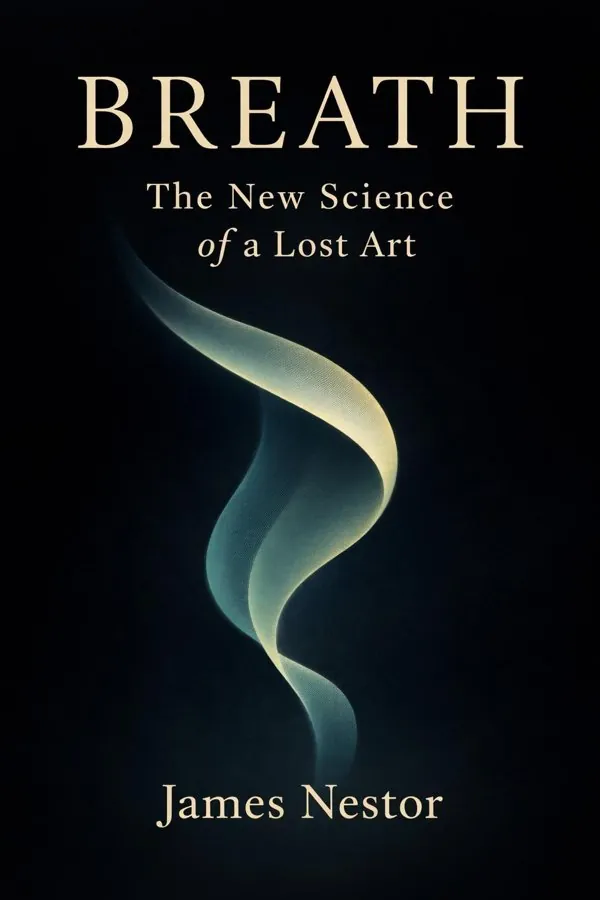
Breath: Summary & Key Insights
by James Nestor
 10 min9 chaptersAudio available
Key Takeaways from Breath
One of the book’s most unsettling insights is that something as ordinary as breathing can quietly undermine health when done poorly.
Long before modern laboratories measured oxygen saturation or heart rate variability, ancient traditions treated breath as a bridge between body and mind.
A surprising argument in Breath is that breathing problems are not just behavioral; they are partly anatomical consequences of modern living.
If the book has a single practical rule, it is this: breathe through your nose whenever possible.
Many people assume breathing more is always better, but Nestor highlights a counterintuitive truth: overbreathing can reduce efficiency.
What Is Breath About?
Breath by James Nestor is a health book published in 2020 spanning 12 pages. What if one of the most powerful tools for better health, sharper focus, deeper sleep, and longer life were something you already do every moment of the day? In Breath, journalist James Nestor argues that breathing is not just automatic background biology but a skill that modern people have largely forgotten how to use well. Drawing on scientific studies, ancient traditions, medical history, and his own immersive experiments, Nestor explores how the way we inhale and exhale shapes everything from anxiety and posture to athletic performance, immunity, and sleep quality. The book’s central claim is strikingly simple: many modern illnesses are worsened not by how much air we take in, but by how poorly we breathe. Nestor is a compelling guide because he combines rigorous reporting with curiosity and personal testing. He interviews pulmonologists, orthodontists, researchers, and breathing teachers, then translates complex physiology into clear, memorable lessons. Breath matters because it reframes health through a basic daily act most people ignore. It invites readers to see breathing not as passive survival, but as an active, trainable pathway to resilience and well-being.
This FizzRead summary covers all 9 key chapters of Breath in approximately 10 minutes, distilling the most important ideas, arguments, and takeaways from James Nestor's work. Also available as an audio summary and Key Quotes Podcast.
Breath
What if one of the most powerful tools for better health, sharper focus, deeper sleep, and longer life were something you already do every moment of the day? In Breath, journalist James Nestor argues that breathing is not just automatic background biology but a skill that modern people have largely forgotten how to use well. Drawing on scientific studies, ancient traditions, medical history, and his own immersive experiments, Nestor explores how the way we inhale and exhale shapes everything from anxiety and posture to athletic performance, immunity, and sleep quality. The book’s central claim is strikingly simple: many modern illnesses are worsened not by how much air we take in, but by how poorly we breathe. Nestor is a compelling guide because he combines rigorous reporting with curiosity and personal testing. He interviews pulmonologists, orthodontists, researchers, and breathing teachers, then translates complex physiology into clear, memorable lessons. Breath matters because it reframes health through a basic daily act most people ignore. It invites readers to see breathing not as passive survival, but as an active, trainable pathway to resilience and well-being.
Who Should Read Breath?
This book is perfect for anyone interested in health and looking to gain actionable insights in a short read. Whether you're a student, professional, or lifelong learner, the key ideas from Breath by James Nestor will help you think differently.
- ✓Readers who enjoy health and want practical takeaways
- ✓Professionals looking to apply new ideas to their work and life
- ✓Anyone who wants the core insights of Breath in just 10 minutes
Want the full summary?
Get instant access to this book summary and 100K+ more with Fizz Moment.
Get Free SummaryAvailable on App Store • Free to download
Key Chapters
One of the book’s most unsettling insights is that something as ordinary as breathing can quietly undermine health when done poorly. Nestor begins with a provocative premise: people breathe around 25,000 times a day, yet few have ever been taught how to do it well. To test whether breathing method really matters, he participates in a controlled experiment with researchers and pulmonology experts, comparing the effects of exclusive mouth breathing with later nasal breathing. The results are dramatic. Within days of breathing through the mouth, markers of stress rise, sleep worsens, snoring intensifies, blood pressure changes, and overall well-being declines. The experience transforms breathing from a vague wellness topic into a measurable biological force.
This opening experiment matters because it strips away abstract claims and shows that respiration influences the body immediately. Breathing affects gas exchange, circulation, nervous system balance, and even facial structure over time. What seems automatic is actually trainable, and bad breathing habits can accumulate into chronic problems. Nestor uses this experiment to frame the whole book: modern life has altered how we eat, sleep, sit, and also how we breathe. Soft diets, poor posture, stress, and indoor living have pushed many people toward dysfunctional patterns that feel normal only because they are common.
In practical terms, this means issues such as fatigue, anxiety, poor sleep, and reduced endurance may sometimes be improved by changing breathing mechanics. Paying attention to whether you breathe through the nose or mouth, whether your breaths are shallow or slow, and whether your breathing is calm or chaotic can reveal patterns with real health consequences.
Actionable takeaway: Spend one day noticing how you breathe in different situations, especially during sleep, exercise, and stress, and treat breathing quality as a health metric worth improving.
Long before modern laboratories measured oxygen saturation or heart rate variability, ancient traditions treated breath as a bridge between body and mind. Nestor traces how cultures across India, China, Tibet, Greece, and other civilizations developed sophisticated breathing practices because they believed breath was more than air. It was vitality, control, spirit, and medicine. Sanskrit traditions described prana, the life force carried through breath. Chinese systems linked breath to energy flow and longevity. Religious and contemplative traditions used breathing rhythms to calm thought, endure pain, sharpen attention, and access altered states.
Nestor’s point is not that ancient systems were mystical guesses while modern science finally discovered truth. Instead, he shows that many old traditions observed practical effects that science is only now validating. Slow breathing can regulate the nervous system. Breath retention changes blood chemistry and stress response. Nasal breathing improves filtration, humidification, and nitric oxide uptake. Chanting, prayer, and measured exhalation can shift heart rhythms and mental state. Ancient practices encoded these benefits in rituals, exercises, and spiritual language long before medicine understood the mechanisms.
This historical perspective also exposes a blind spot in modern culture. Industrial societies often assume progress means abandoning older bodily wisdom, yet in breathing we may have discarded useful knowledge. The lesson is not to romanticize the past, but to recognize that breathing techniques endured for centuries because they worked.
In everyday life, this can mean rethinking practices like yoga breathing, humming, chanting, or meditative counting not as fringe habits but as tools with physiological value. Even a simple five-minute session of slow, controlled breathing before a stressful meeting echoes methods humans have used for generations.
Actionable takeaway: Experiment with one traditional breath practice, such as slow counted breathing or alternate-nostril breathing, for a week and observe its effect on stress and focus.
A surprising argument in Breath is that breathing problems are not just behavioral; they are partly anatomical consequences of modern living. Nestor explores how softer processed foods, less chewing, chronic allergies, poor posture, pollution, and sedentary habits have changed human faces and airways. Compared with many ancestors, modern people often develop narrower mouths, smaller jaws, crooked teeth, and more obstructed nasal passages. These structural shifts can make healthy breathing harder, especially during sleep.
This matters because poor breathing is not always a matter of laziness or ignorance. If the jaw is underdeveloped or the nose is chronically blocked, the body compensates by opening the mouth. That leads to a cycle: mouth breathing dries the airway, worsens snoring, reduces sleep quality, and reinforces dysfunction. Nestor draws on the work of orthodontists, anthropologists, and airway specialists to show that how we grow, eat, and live affects how we breathe.
The practical implication is broad. Parents, dentists, and doctors may need to pay more attention to signs like chronic mouth breathing in children, frequent snoring, poor sleep, teeth crowding, and forward-head posture. Adults can also benefit from examining environmental and mechanical factors that limit nasal breathing, including congestion, slumped sitting, and overuse of climate-controlled indoor spaces.
Nestor does not claim every breathing issue can be solved with a simple trick. Some cases require medical evaluation, allergy treatment, or dental and sleep interventions. But he argues that many people normalize warning signs that should be taken seriously because they reflect a deeper mismatch between human biology and modern habits.
Actionable takeaway: If you regularly wake with a dry mouth, snore, or struggle to breathe comfortably through your nose, treat these as important clues and consider both habit changes and professional evaluation.
If the book has a single practical rule, it is this: breathe through your nose whenever possible. Nestor shows that the nose is not a decorative feature but a highly specialized organ designed to process air before it reaches the lungs. Nasal passages filter particles, warm cold air, humidify dry air, and help regulate airflow. They also produce nitric oxide, a molecule that improves oxygen uptake and helps blood vessels function more effectively. Mouth breathing bypasses these advantages and often leads to faster, harsher, less efficient respiration.
Through his own experiment and a wide range of medical evidence, Nestor demonstrates how mouth breathing can contribute to snoring, sleep apnea, bad breath, dehydration, gum disease, and poor sleep. In children, chronic mouth breathing may even influence facial growth. By contrast, nasal breathing supports calmer, slower, more efficient gas exchange and can improve endurance, especially when practiced during light exercise or walking.
The book does not suggest that mouth breathing is always wrong. During intense exertion, illness, or nasal obstruction, it may be necessary. But as a default habit, it is usually inferior. One of Nestor’s strengths is showing how a basic shift in breathing route can create ripple effects across sleep, mood, and physical performance.
A practical example is exercise. Someone who habitually pants through workouts may find that intentionally keeping the mouth closed during warm-ups or easy aerobic sessions increases tolerance to carbon dioxide and gradually improves efficiency. At night, addressing congestion and encouraging nasal breathing may reduce snoring and improve rest.
Actionable takeaway: Make nasal breathing your default during rest, walking, and light activity, and work on clearing and strengthening that pathway rather than relying on habitual mouth breathing.
Many people assume breathing more is always better, but Nestor highlights a counterintuitive truth: overbreathing can reduce efficiency. The body’s relationship with oxygen depends partly on carbon dioxide, a gas often misunderstood as mere waste. Carbon dioxide helps regulate blood pH and plays a key role in releasing oxygen from hemoglobin into tissues. If you breathe too fast, too hard, or too often, you can blow off too much carbon dioxide and impair oxygen delivery where it is needed most.
This insight helps explain why anxious or chronically stressed people may feel breathless even while taking many breaths. Rapid breathing can create a self-reinforcing sense of panic, dizziness, tightness, and air hunger. It also clarifies why some controlled breath-hold exercises, when practiced safely, can improve tolerance to carbon dioxide and make breathing feel more stable and efficient.
Nestor uses this idea to challenge the cultural image of “big deep breaths” as the universal fix. In many situations, gentler, slower, lighter breathing is more beneficial. The goal is not maximal air intake but balanced respiration. This principle appears in practices ranging from clinical breathing retraining to athletic conditioning and meditation.
For daily life, this means noticing whether you tend to sigh, yawn, gasp, or breathe noisily under stress. It may also mean approaching exercise differently, emphasizing breath control instead of constant heavy panting. Athletes can benefit from improved carbon dioxide tolerance because it can support endurance and composure under load.
Actionable takeaway: When stressed, avoid taking repeated huge breaths; instead, practice quieter, slower nasal breathing and allow your body to build comfort with slightly higher carbon dioxide levels.
A remarkable lesson in Breath is that breathing rhythm can serve as a remote control for the autonomic nervous system. Nestor explores research showing that breathing at a slower pace, often around five to six breaths per minute, can improve heart rate variability, calm the body, and increase resilience to stress. Heart rate variability, the subtle variation in time between heartbeats, is associated with adaptability and nervous system balance. When breathing becomes slower and more coherent, heart rhythms often synchronize in beneficial ways.
This matters because many people live in a state of low-grade hyperarousal. They are not in obvious panic, yet their bodies remain keyed up by deadlines, screens, poor sleep, and chronic stress. Slow breathing offers a low-cost, immediate intervention. It can reduce feelings of anxiety, improve concentration, and even support blood pressure regulation. Nestor ties together modern physiology and traditional breathing disciplines to show that this is one of the simplest methods for shifting from fight-or-flight toward rest-and-digest.
Practical applications are everywhere. Before public speaking, a few minutes of slow inhaling and longer exhaling can steady nerves. During bedtime routines, coherent breathing may help quiet racing thoughts. In workplaces, it can become a reset tool between demanding tasks. Even people skeptical of meditation may find breathing cadence easier to adopt because it is concrete and measurable.
The broader lesson is empowering: while many stressors are outside our control, breathing rhythm is usually available in the moment. It is one of the few body processes that is both automatic and voluntary, making it an unusually effective lever for self-regulation.
Actionable takeaway: Practice five minutes of slow nasal breathing each day, aiming for roughly five to six breaths per minute, especially when you feel scattered, tense, or overstimulated.
Not all breathing exercises do the same thing, and Nestor is careful to show the range of effects different techniques can produce. Some methods calm the system, others energize it, and some push the body into unusual physiological states. He examines practices from pranayama, Tummo, Buteyko-style retraining, chanting, humming, and modern therapeutic protocols. The larger point is that breathing is a toolkit, not a single trick.
For example, extended exhales and slow rhythmic breathing often reduce arousal and improve emotional steadiness. Breath retention can increase tolerance to carbon dioxide and alter stress response. Humming may boost nitric oxide production in the nasal passages. More forceful techniques can heighten alertness or produce temporary surges in energy and sensation. Nestor neither dismisses these methods nor treats them as magic. He presents them as interventions with specific uses and cautions.
This is especially useful because people often try one breathing exercise, feel little benefit, and conclude that breathwork is overhyped. Nestor suggests a more precise approach: match the method to the goal. Want to sleep? Use slower, quieter breathing. Want to focus before performance? Try controlled rhythmic breathing. Want to improve tolerance to air hunger? Explore mild, supervised breath-hold work. The effectiveness lies in selecting the right pattern for the right need.
At the same time, the book warns against reckless experimentation, especially with intense techniques, underwater breath holds, or practices done without guidance. Breath can heal, but it can also be destabilizing when used carelessly.
Actionable takeaway: Build a small personal breathing toolkit by learning one calming method, one focusing method, and one recovery method, then use each deliberately instead of breathing reactively.
Breathing quality becomes especially important when the body is under demand, whether during sleep, exercise, or illness. Nestor shows that nighttime breathing problems are often hidden drivers of poor health. Snoring, sleep apnea, dry mouth, restless sleep, and frequent waking are not minor annoyances; they may signal impaired oxygenation, stress activation, and poor recovery. Because sleep is when the body repairs itself, dysfunctional breathing at night can ripple into mood, cognition, appetite, and cardiovascular risk.
The same principle applies to physical performance. Efficient breathers are not necessarily those who move the most air, but those who regulate it best. Nasal breathing, cadence control, better posture, and increased tolerance to carbon dioxide can improve endurance and pacing. Instead of collapsing into frantic panting, trained breathers can stay calmer and more efficient under effort. Nestor also discusses respiratory health and immunity, noting that proper airway function, nasal filtration, and balanced breathing may help the body defend itself more effectively.
What makes this idea powerful is its breadth. Better breathing is not just about relaxation. It influences recovery between workouts, resilience during sickness, and mental clarity after sleep. Someone trying to improve athletic output, reduce nighttime waking, or strengthen day-to-day energy may all benefit from the same foundational habit: more functional breathing.
Simple applications include monitoring whether you wake with a dry mouth, using nasal breathing during easy runs or walks, improving sleep posture, and addressing chronic congestion rather than accepting it as normal. These changes may look small, but the cumulative payoff can be large because breathing is continuous.
Actionable takeaway: Treat sleep breathing and exercise breathing as trainable skills, and start by improving nasal airflow, posture, and awareness of nighttime symptoms like snoring or dry mouth.
Perhaps the most lasting contribution of Breath is its insistence that breathing is not a one-time trick but a lifelong practice. Nestor’s personal transformation throughout the book comes not from a miraculous method but from sustained attention to a neglected function. He becomes more aware of posture, jaw position, breath rate, sleep quality, and stress response. The lesson is not perfection. It is that small respiratory improvements, repeated daily, can create meaningful change over time.
This idea also reflects the book’s balanced integration of science and lived experience. Nestor does not ask readers to choose between ancient breathing traditions and modern medicine. Instead, he argues for synthesis. Scientific tools can measure mechanisms and outcomes; older practices can offer techniques refined through generations. Together, they create a practical framework for healthier living. Breath becomes a gateway habit, one that influences how we eat, move, recover, and respond emotionally.
For readers, this means avoiding the common trap of consuming inspiring health information without changing routine. The real value of the book lies in applying simple principles consistently: favor the nose, slow the breath, reduce overbreathing, improve airway health, and use breathing deliberately in moments of stress or recovery. No single technique will solve every problem, but a more skillful relationship with breath can support many systems at once.
Breathing is especially powerful because it is always available. It costs nothing, travels anywhere, and can be adjusted in real time. That makes it one of the most democratic health tools a person has.
Actionable takeaway: Choose one sustainable breathing habit, such as five minutes of slow nasal breathing or keeping your mouth closed during walks, and practice it daily for a month.
All Chapters in Breath
About the Author
James Nestor is an American journalist and nonfiction author known for exploring science, health, and human potential through immersive reporting. His writing has appeared in publications including The New York Times, Scientific American, Outside, and The Atlantic. Nestor has built a reputation for taking complex subjects and turning them into vivid, accessible narratives grounded in interviews, firsthand experiments, and careful research. Before writing Breath, he gained recognition for Deep, a book about freediving and the ocean that reflected his broader interest in the limits and possibilities of the human body. In Breath, he brings that same curiosity to respiration, combining medical science, history, and personal testing to examine how breathing affects sleep, stress, endurance, and long-term health. His work is widely praised for being both informative and highly readable.
Get This Summary in Your Preferred Format
Read or listen to the Breath summary by James Nestor anytime, anywhere. FizzRead offers multiple formats so you can learn on your terms — all free.
Available formats: App · Audio · PDF · EPUB — All included free with FizzRead
Download Breath PDF and EPUB Summary
Key Quotes from Breath
“One of the book’s most unsettling insights is that something as ordinary as breathing can quietly undermine health when done poorly.”
“Long before modern laboratories measured oxygen saturation or heart rate variability, ancient traditions treated breath as a bridge between body and mind.”
“A surprising argument in Breath is that breathing problems are not just behavioral; they are partly anatomical consequences of modern living.”
“If the book has a single practical rule, it is this: breathe through your nose whenever possible.”
“Many people assume breathing more is always better, but Nestor highlights a counterintuitive truth: overbreathing can reduce efficiency.”
Frequently Asked Questions about Breath
Breath by James Nestor is a health book that explores key ideas across 9 chapters. What if one of the most powerful tools for better health, sharper focus, deeper sleep, and longer life were something you already do every moment of the day? In Breath, journalist James Nestor argues that breathing is not just automatic background biology but a skill that modern people have largely forgotten how to use well. Drawing on scientific studies, ancient traditions, medical history, and his own immersive experiments, Nestor explores how the way we inhale and exhale shapes everything from anxiety and posture to athletic performance, immunity, and sleep quality. The book’s central claim is strikingly simple: many modern illnesses are worsened not by how much air we take in, but by how poorly we breathe. Nestor is a compelling guide because he combines rigorous reporting with curiosity and personal testing. He interviews pulmonologists, orthodontists, researchers, and breathing teachers, then translates complex physiology into clear, memorable lessons. Breath matters because it reframes health through a basic daily act most people ignore. It invites readers to see breathing not as passive survival, but as an active, trainable pathway to resilience and well-being.
Compare Breath

You Might Also Like

Featured In
Browse by Category
Ready to read Breath?
Get the full summary and 100K+ more books with Fizz Moment.