
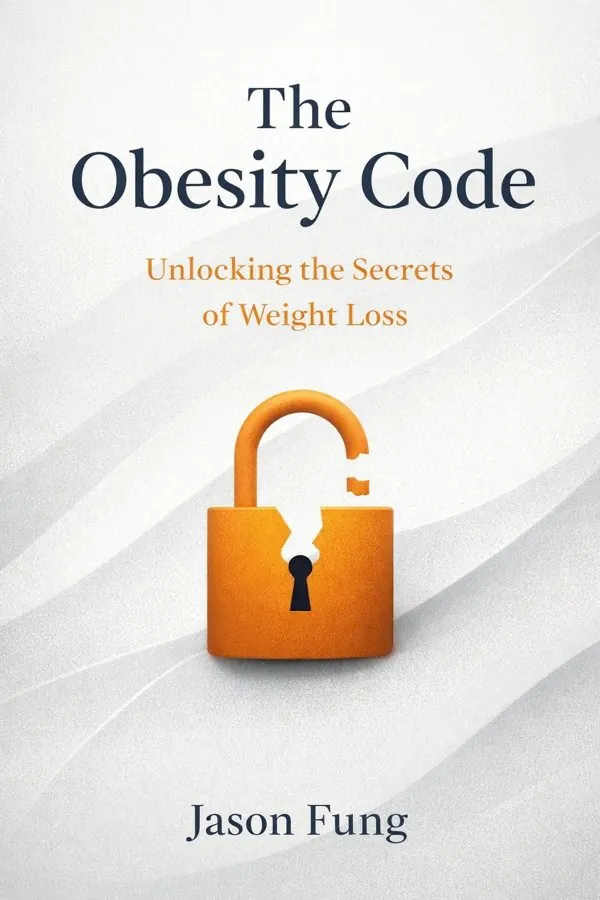
The Obesity Code: Summary & Key Insights
by Jason Fung
 10 min9 chaptersAudio available
Key Takeaways from The Obesity Code
One of the book’s most provocative claims is that obesity cannot be fully explained by the familiar formula of “calories in, calories out.
A central insight of The Obesity Code is that insulin functions as a major fat-storage hormone.
Fung compares this process to the body gradually becoming numb to a signal that is constantly turned on.
Perhaps the most liberating message in The Obesity Code is that obesity should not be viewed as a moral failure.
A striking argument in the book is that many traditional diets fail because they rely on chronic calorie restriction without addressing hunger hormones or metabolic adaptation.
What Is The Obesity Code About?
The Obesity Code by Jason Fung is a health book published in 2016 spanning 11 pages. In The Obesity Code, physician Jason Fung argues that obesity is not simply the result of eating too much and moving too little. Instead, he presents a hormonal model of weight gain, placing insulin at the center of the story. According to Fung, the body is not a simple calorie calculator. It is a complex biological system that responds to hormones, meal timing, food quality, stress, and long-term eating patterns. This shift in perspective matters because it challenges decades of conventional dieting advice that has often left people hungry, discouraged, and trapped in cycles of weight loss and regain. Drawing on medical research, historical analysis, and his clinical work with patients suffering from obesity and type 2 diabetes, Fung explains why calorie restriction alone frequently fails and why approaches such as reducing refined carbohydrates and practicing intermittent fasting may be more effective. Whether or not readers agree with every claim, the book is a provocative and influential rethink of modern nutrition advice. It offers a framework that many readers find both empowering and practical, especially after repeated dieting disappointments.
This FizzRead summary covers all 9 key chapters of The Obesity Code in approximately 10 minutes, distilling the most important ideas, arguments, and takeaways from Jason Fung's work. Also available as an audio summary and Key Quotes Podcast.
The Obesity Code
In The Obesity Code, physician Jason Fung argues that obesity is not simply the result of eating too much and moving too little. Instead, he presents a hormonal model of weight gain, placing insulin at the center of the story. According to Fung, the body is not a simple calorie calculator. It is a complex biological system that responds to hormones, meal timing, food quality, stress, and long-term eating patterns. This shift in perspective matters because it challenges decades of conventional dieting advice that has often left people hungry, discouraged, and trapped in cycles of weight loss and regain. Drawing on medical research, historical analysis, and his clinical work with patients suffering from obesity and type 2 diabetes, Fung explains why calorie restriction alone frequently fails and why approaches such as reducing refined carbohydrates and practicing intermittent fasting may be more effective. Whether or not readers agree with every claim, the book is a provocative and influential rethink of modern nutrition advice. It offers a framework that many readers find both empowering and practical, especially after repeated dieting disappointments.
Who Should Read The Obesity Code?
This book is perfect for anyone interested in health and looking to gain actionable insights in a short read. Whether you're a student, professional, or lifelong learner, the key ideas from The Obesity Code by Jason Fung will help you think differently.
- ✓Readers who enjoy health and want practical takeaways
- ✓Professionals looking to apply new ideas to their work and life
- ✓Anyone who wants the core insights of The Obesity Code in just 10 minutes
Want the full summary?
Get instant access to this book summary and 100K+ more with Fizz Moment.
Get Free SummaryAvailable on App Store • Free to download
Key Chapters
One of the book’s most provocative claims is that obesity cannot be fully explained by the familiar formula of “calories in, calories out.” Fung does not deny that calories matter in a physical sense, but he argues that this model is too simplistic to explain why people gain weight, struggle to lose it, and often regain it after dieting. Human bodies are not passive machines. When calorie intake falls, the body can respond by lowering energy expenditure, increasing hunger, and pushing people to seek food more aggressively. In other words, the body adapts.
Fung traces the calorie-focused view back to early nutrition science, when researchers began measuring the energy content of food. Over time, this idea hardened into the belief that all weight problems are just math problems. But in practice, people on low-calorie diets often experience fatigue, cravings, and plateaus. If two people eat the same number of calories but one consumes highly processed sugary foods and the other eats whole foods with different hormonal effects, their bodies may respond very differently.
This is why many standard diets fail. They ask people to eat less while ignoring the biological systems that regulate hunger, fat storage, and metabolic rate. Fung’s broader point is that the body’s hormonal environment influences how calories are used, stored, or burned. Looking at obesity only through the calorie lens misses the deeper drivers.
A practical application is to stop asking only, “How much am I eating?” and begin asking, “What is this food doing to my hormones and appetite?” Track not just portion size, but also how meals affect hunger, energy, and cravings. The actionable takeaway: focus on the quality and metabolic effect of food, not just the raw calorie number.
A central insight of The Obesity Code is that insulin functions as a major fat-storage hormone. Every time we eat, especially foods rich in refined carbohydrates and sugar, insulin rises. This hormone helps move glucose out of the bloodstream and into cells, but it also signals the body to store excess energy. When insulin remains elevated too often for too long, the body becomes increasingly oriented toward storing fat rather than burning it.
Fung argues that this matters far more than many people realize. In the conventional view, all calories are treated similarly. In the hormonal view, however, foods that provoke large insulin responses have different consequences than foods that produce a smaller, steadier response. A breakfast of sugary cereal, toast, and juice may lead to a sharp insulin spike, followed by a blood sugar drop and renewed hunger. By contrast, a meal built around eggs, vegetables, and healthy fats may keep insulin lower and appetite steadier.
This framework also helps explain why frequent snacking can backfire. If insulin rises every few hours, the body gets fewer opportunities to access stored fat. Instead of alternating between feeding and fasting states, many people remain in a constant fed state, which encourages weight gain over time.
In practical terms, Fung recommends paying attention to foods that strongly stimulate insulin, especially sugar, refined grains, and many processed snacks. He also emphasizes that eating less often can matter, not just eating differently. A useful experiment is to compare how two breakfasts affect hunger for the rest of the day. The actionable takeaway: choose meals and eating patterns that reduce repeated insulin spikes, giving your body a better chance to use stored energy.
An especially important idea in the book is that high insulin does not just cause fat storage; over time, it may also contribute to insulin resistance, creating a self-reinforcing cycle. Fung compares this process to the body gradually becoming numb to a signal that is constantly turned on. If insulin levels stay elevated day after day, cells may respond less effectively. In response, the body produces even more insulin to achieve the same effect. That extra insulin then promotes even more fat storage.
This model helps explain why obesity and type 2 diabetes often appear together. The body is trying to manage blood sugar, but it is doing so in an increasingly dysfunctional hormonal environment. More insulin leads to more resistance, and more resistance leads to even more insulin. Many people interpret weight gain as a failure of willpower, but Fung reframes it as part of a deeper metabolic loop.
You can see this pattern in everyday eating habits. A person who relies on sugary coffee drinks, refined snacks, and constant grazing may feel hungry often, tired after meals, and increasingly dependent on quick carbohydrates. The problem is not just too much food. It is a system that has become hormonally dysregulated.
Fung’s solution is to lower the body’s insulin burden through diet and periods of fasting, allowing insulin levels to fall rather than constantly stimulating them. While readers should consult a healthcare professional before major changes, the principle is straightforward: reduce the frequency and intensity of insulin spikes. The actionable takeaway: if you feel trapped in recurring hunger, cravings, and weight gain, address the hormonal cycle, not only the calorie count.
Perhaps the most liberating message in The Obesity Code is that obesity should not be viewed as a moral failure. Fung argues that excess weight is largely driven by hormonal signals and environmental conditions, not laziness, gluttony, or lack of character. This is a powerful shift because shame rarely helps people improve their health. In fact, self-blame often fuels stress, emotional eating, and hopelessness.
By describing obesity as a hormonal imbalance, Fung changes the question from “Why can’t people control themselves?” to “What biological forces are shaping appetite, storage, and energy use?” Hormones such as insulin influence whether the body burns stored fat or protects it. If a person is constantly hungry because of unstable blood sugar and repeated insulin spikes, asking them to simply “eat less” misses the point. The body is resisting.
This perspective also explains why two people can follow similar diets and see very different results. Genetics, prior dieting, medication use, sleep patterns, stress, and metabolic health can all influence hormonal responses. Fung’s broader lesson is that effective weight management should work with the body’s regulatory systems rather than against them.
Practically, this means replacing guilt with observation. Instead of judging yourself for being hungry, look for the triggers: ultra-processed food, constant snacking, poor sleep, or meals that leave you unsatisfied. It also means designing habits that support hormonal balance, such as eating more whole foods, limiting sugar, and allowing longer breaks between meals when appropriate. The actionable takeaway: stop treating obesity as a character flaw and start treating it as a biological problem that can be understood and addressed.
A striking argument in the book is that many traditional diets fail because they rely on chronic calorie restriction without addressing hunger hormones or metabolic adaptation. Fung argues that when people cut calories while continuing to eat foods that stimulate insulin, they often end up fighting both biology and psychology. They are hungry, their energy drops, and their bodies may slow down metabolism to conserve fuel. The result is familiar: initial weight loss, then plateau, then regain.
This helps explain the discouraging pattern seen in countless dieters. Someone cuts portions, switches to low-fat packaged foods, and uses willpower to endure hunger. At first, the scale moves. But over time, the body adapts. Resting energy expenditure can decline, cravings intensify, and the diet becomes harder to sustain. When normal eating resumes, the lowered metabolic rate and increased appetite make regain likely.
Fung is especially critical of low-fat, high-carbohydrate diet advice that encourages frequent eating. If every meal and snack keeps insulin elevated, the body remains geared toward storage. In that context, “eat less and move more” becomes a frustrating command rather than a true solution.
A practical lesson here is to judge a diet not by how strict it is for two weeks, but by whether it reduces hunger and can be maintained for months or years. For many readers, this means prioritizing satiety: protein, natural fats, fiber-rich vegetables, and fewer refined foods. It may also mean cutting out snacks instead of merely shrinking meals. The actionable takeaway: choose an approach that lowers hunger and improves metabolic stability, not one that depends on endless willpower.
Fung emphasizes that health is shaped not only by what we eat but also by when we eat. This idea challenges modern habits of constant grazing, late-night snacking, and eating from early morning until bedtime. According to the book, each eating occasion triggers hormonal responses, especially insulin. If we eat frequently throughout the day, insulin may remain elevated for long stretches, leaving little time for the body to access stored fat.
This does not mean everyone must follow the same schedule. Rather, Fung’s point is that meal timing itself influences metabolism. Two people may eat similar foods, but if one consumes them within a shorter eating window and avoids constant snacking, that person may spend more time in a lower-insulin state. This can improve fat burning, appetite regulation, and sometimes blood sugar control.
Modern food culture often encourages the opposite. Many people are told to eat every two to three hours to “keep metabolism up,” yet Fung argues that this advice may actually trap people in a perpetual fed state. A muffin at breakfast, a granola bar midmorning, lunch, an afternoon snack, dinner, and dessert create repeated hormonal stimulation, even if portions seem reasonable.
A practical way to test this idea is to begin by removing unnecessary snacks and eating satisfying meals instead. Some readers may later experiment with a 12-hour or 8-hour eating window, depending on their health status and medical guidance. Meal timing should support life, not dominate it. The actionable takeaway: create longer breaks between eating occasions so your body has regular opportunities to lower insulin and use stored energy.
One of the most discussed ideas in The Obesity Code is Fung’s defense of intermittent fasting. He presents fasting not as punishment, but as a natural and historically normal practice that gives the body a break from constant insulin stimulation. If eating raises insulin, then not eating for a defined period allows insulin to fall. In Fung’s framework, this makes fasting a direct way to address the hormonal drivers of weight gain.
He also argues that fasting is flexible. It can take many forms, from extending the overnight fast to skipping one meal, to occasional 24-hour fasts in appropriate contexts. Unlike many diets, fasting does not necessarily require buying special foods or following complicated recipes. It changes timing rather than just menu choices.
Fung also tries to correct misconceptions. He argues that short-term fasting is not the same as starvation, because it is voluntary, time-limited, and often followed by normal eating. During fasting periods, the body can draw on stored glycogen and fat for fuel. Many people report that hunger comes in waves and may lessen once they stop eating constantly.
That said, fasting is not appropriate for everyone. People with diabetes, those taking glucose-lowering medications, pregnant women, individuals with a history of eating disorders, and others with medical conditions should seek professional advice first. A sensible beginner approach might be simply avoiding late-night eating and pushing breakfast later once or twice a week. The actionable takeaway: think of fasting as a structured metabolic tool, and start conservatively rather than dramatically.
A key strength of Fung’s approach is that he treats fasting as practical rather than extreme. Instead of insisting on one perfect protocol, he describes fasting as a skill that can be tailored to goals, lifestyle, and experience. For some people, a simple 16-hour fast a few times per week may be enough to improve appetite control. Others may benefit from occasional longer fasts under proper supervision. The larger point is that flexibility improves sustainability.
Fung also offers strategies for making fasting easier. Staying hydrated, keeping busy, drinking water, tea, or black coffee, and understanding that hunger tends to rise and fall can help people stay consistent. He encourages people to distinguish true hunger from habit, boredom, or emotional triggers. This awareness can itself be transformative. Many discover they have been eating by schedule or stress rather than actual need.
Equally important is what happens when the fast ends. Fung does not recommend bingeing after fasting. The goal is to return to normal, nourishing meals rather than turning fasting into a compensation cycle. Meals built around whole foods, protein, vegetables, and unprocessed fats can help maintain the hormonal benefits.
In real life, sustainability may mean using fasting strategically. You might skip breakfast after a big dinner the night before, avoid snacks during workdays, or shorten your eating window on weekdays while being more relaxed on weekends. The best protocol is one you can maintain without obsession. The actionable takeaway: begin with the smallest fasting routine you can do consistently, then adjust based on your energy, hunger, and results.
Although fasting receives much attention, Fung also makes it clear that food quality still matters. He recommends minimizing sugar and refined carbohydrates, which tend to provoke strong insulin responses and encourage overeating. In place of highly processed foods, he favors whole, minimally processed meals that provide satiety and metabolic stability. This often includes vegetables, natural fats, moderate protein, and fewer industrial snack foods.
A notable part of his argument is the critique of low-fat dieting. Fung suggests that when fat was removed from many foods, sugar and starch often took its place, making products more insulin-stimulating and less satisfying. People were encouraged to fear fat while eating more refined carbohydrates, a pattern he believes contributed to rising obesity. Whether readers accept this view completely or not, the book strongly challenges the assumption that all “diet foods” are helpful.
Food quality also influences behavior. Ultra-processed foods are engineered to be easy to overeat, quickly digested, and often less filling than whole foods. A bowl of sweetened cereal may disappear in minutes and leave you hungry again soon. A meal of salmon, olive oil, vegetables, and avocado may provide more lasting fullness even if the calorie count is similar or higher.
For practical use, readers can begin by changing one meal per day. Replace a processed breakfast with eggs and vegetables, or swap sweet snacks for whole-food alternatives. Don’t focus only on eating less; focus on eating in a way that reduces the need to keep eating. The actionable takeaway: build meals around foods that lower cravings and support satiety, rather than relying on packaged low-calorie options.
All Chapters in The Obesity Code
About the Author
Dr. Jason Fung is a Canadian nephrologist, educator, and author best known for his work on obesity, insulin resistance, and intermittent fasting. Trained as a kidney specialist, he became interested in the metabolic roots of obesity and type 2 diabetes after seeing how often conventional dietary advice failed his patients. Fung later developed a public profile through his books, lectures, articles, and clinical programs focused on nutrition-based approaches to metabolic disease. He is widely credited with helping bring intermittent fasting into mainstream health discussions. In addition to The Obesity Code, he has written other influential books on fasting and diabetes. His work is both popular and controversial, but it has had a major impact on how many readers and practitioners think about weight loss and metabolic health.
Get This Summary in Your Preferred Format
Read or listen to the The Obesity Code summary by Jason Fung anytime, anywhere. FizzRead offers multiple formats so you can learn on your terms — all free.
Available formats: App · Audio · PDF · EPUB — All included free with FizzRead
Download The Obesity Code PDF and EPUB Summary
Key Quotes from The Obesity Code
“One of the book’s most provocative claims is that obesity cannot be fully explained by the familiar formula of “calories in, calories out.”
“A central insight of The Obesity Code is that insulin functions as a major fat-storage hormone.”
“An especially important idea in the book is that high insulin does not just cause fat storage; over time, it may also contribute to insulin resistance, creating a self-reinforcing cycle.”
“Perhaps the most liberating message in The Obesity Code is that obesity should not be viewed as a moral failure.”
“A striking argument in the book is that many traditional diets fail because they rely on chronic calorie restriction without addressing hunger hormones or metabolic adaptation.”
Frequently Asked Questions about The Obesity Code
The Obesity Code by Jason Fung is a health book that explores key ideas across 9 chapters. In The Obesity Code, physician Jason Fung argues that obesity is not simply the result of eating too much and moving too little. Instead, he presents a hormonal model of weight gain, placing insulin at the center of the story. According to Fung, the body is not a simple calorie calculator. It is a complex biological system that responds to hormones, meal timing, food quality, stress, and long-term eating patterns. This shift in perspective matters because it challenges decades of conventional dieting advice that has often left people hungry, discouraged, and trapped in cycles of weight loss and regain. Drawing on medical research, historical analysis, and his clinical work with patients suffering from obesity and type 2 diabetes, Fung explains why calorie restriction alone frequently fails and why approaches such as reducing refined carbohydrates and practicing intermittent fasting may be more effective. Whether or not readers agree with every claim, the book is a provocative and influential rethink of modern nutrition advice. It offers a framework that many readers find both empowering and practical, especially after repeated dieting disappointments.
Compare The Obesity Code

You Might Also Like
Featured In
Browse by Category
Ready to read The Obesity Code?
Get the full summary and 100K+ more books with Fizz Moment.