
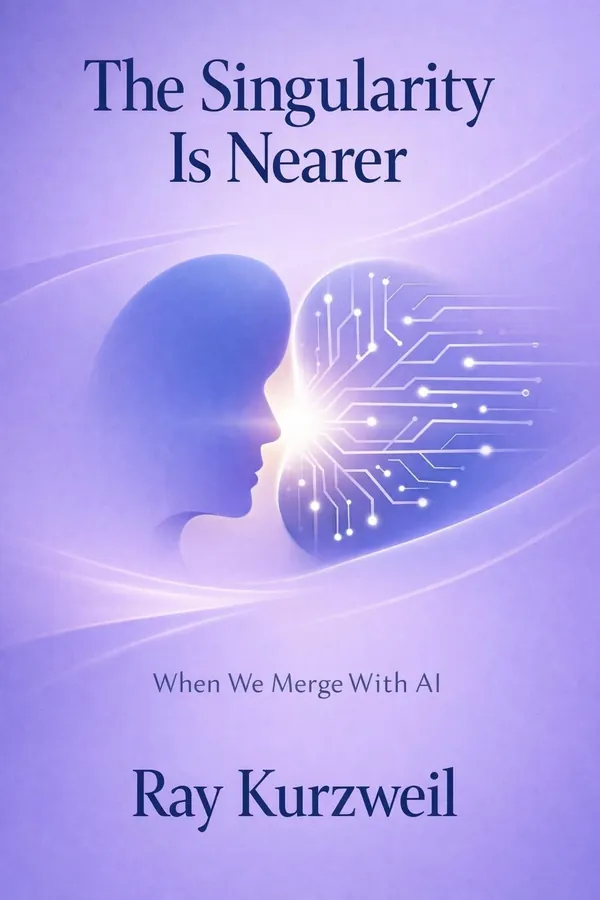
The Singularity Is Nearer: When We Merge With Ai: Summary & Key Insights
by Ray Kurzweil
 10 min9 chaptersAudio available
What Is The Singularity Is Nearer: When We Merge With Ai About?
The Singularity Is Nearer: When We Merge With Ai by Ray Kurzweil is a future_trends book spanning 9 pages. The Singularity Is Nearer explores the exponential progress of information technology, artificial intelligence, biotechnology, and nanotechnology, and how these advances are converging to transform human life. Ray Kurzweil assesses the trajectory toward the technological Singularity—a point when humans will merge with AI, vastly expanding intelligence and consciousness. The book discusses the evolution of intelligence, the rise of deep learning, the future of jobs, radical life extension, and the profound risks and opportunities posed by superintelligent AI and other emerging technologies.
This FizzRead summary covers all 9 key chapters of The Singularity Is Nearer: When We Merge With Ai in approximately 10 minutes, distilling the most important ideas, arguments, and takeaways from Ray Kurzweil's work. Also available as an audio summary and Key Quotes Podcast.
The Singularity Is Nearer: When We Merge With Ai
The Singularity Is Nearer explores the exponential progress of information technology, artificial intelligence, biotechnology, and nanotechnology, and how these advances are converging to transform human life. Ray Kurzweil assesses the trajectory toward the technological Singularity—a point when humans will merge with AI, vastly expanding intelligence and consciousness. The book discusses the evolution of intelligence, the rise of deep learning, the future of jobs, radical life extension, and the profound risks and opportunities posed by superintelligent AI and other emerging technologies.
Who Should Read The Singularity Is Nearer: When We Merge With Ai?
This book is perfect for anyone interested in future_trends and looking to gain actionable insights in a short read. Whether you're a student, professional, or lifelong learner, the key ideas from The Singularity Is Nearer: When We Merge With Ai by Ray Kurzweil will help you think differently.
- ✓Readers who enjoy future_trends and want practical takeaways
- ✓Professionals looking to apply new ideas to their work and life
- ✓Anyone who wants the core insights of The Singularity Is Nearer: When We Merge With Ai in just 10 minutes
Want the full summary?
Get instant access to this book summary and 100K+ more with Fizz Moment.
Get Free SummaryAvailable on App Store • Free to download
Key Chapters
In the opening of this book, I revisit the core thesis I first set forth in The Singularity Is Near: that convergent, exponential technological trends are leading humanity toward a transition of unprecedented magnitude. The Singularity, as I define it, is the point at which we will merge with artificial intelligence, expanding our cognitive capacities by millions of times and transforming our consciousness in ways that are difficult to imagine from our current perspective.
The metaphor of the Singularity is drawn from mathematics and physics, where it denotes a point beyond which the usual rules break down. In the technological context, it captures the idea that the rate and impact of change will soon exceed our ability to predict or fully comprehend. Yet, as I emphasize, this does not mean that change becomes infinite or that we lose agency. Rather, as the transition unfolds, our own intelligence will be enhanced rapidly enough to keep pace with the accelerating world.
Since I first predicted the Singularity would occur around 2045, the pace of progress has only accelerated. Technologies that were once theoretical are now part of daily life: AI systems can master complex games, drive cars, write essays, and diagnose diseases. The cost of sequencing a human genome has plummeted, and we are beginning to connect computers directly to the brain. Underlying all these developments is the law of accelerating returns, which states that information technologies become exponentially cheaper and more powerful because each advance makes the next easier to achieve.
We are now in the final approach to the Singularity. The exponential curve has steepened, and the effects of technological change are being felt by billions. The timeline I set out in 2005 has held: we are closer to the creation of superhuman AI than to the publication of my previous books. Babies born today will come of age in a world transformed by these forces.
This book is written now because the transition is no longer a distant horizon—it is the last generation of the world as we knew it. The key precursors to the Singularity are moving from theory to practice. In the coming decade, AI will become convincingly humanlike, brain–computer interfaces will become commonplace, and biotechnology will extend healthy lifespans. Yet these advances also bring risks: economic disruption, misuse of technology, and existential threats. The choices we make in this final approach will determine whether we achieve a future of abundance and flourishing, or face catastrophic setbacks.
The journey ahead requires us to understand not only the technological trends, but also the philosophical, ethical, and social challenges they pose. By anticipating these transitions, we can help ensure that the Singularity is a leap forward for humanity.
To understand where we are headed, I frame the evolution of intelligence as a series of six epochs, each building on the information processing of the previous stage. The First Epoch began with the birth of the laws of physics and chemistry, setting the stage for the emergence of atoms and molecules. The universe is finely tuned to allow for complex chemistry, and even slight changes in physical constants would have made life impossible.
The Second Epoch saw the emergence of life, as molecules became complex enough to encode entire organisms in DNA. This allowed for evolution and the spread of living creatures. The Third Epoch brought the development of brains, which provided evolutionary advantages and enabled more complex behaviors.
In the Fourth Epoch, humans used their brains and opposable thumbs to create technology that could store and manipulate information, from writing to digital computers. This technological evolution far outpaced biological evolution, with digital computation doubling in price-performance every sixteen months.
The Fifth Epoch, which we are now approaching, will see the direct merger of biological and nonbiological intelligence through brain–computer interfaces. By connecting our neocortex to the cloud, we will augment our cognitive capacities with digital computation that is thousands or millions of times faster and more powerful than our biological brains alone.
The Sixth Epoch envisions intelligence spreading throughout the universe, transforming matter into computronium—matter organized at the ultimate density of computation.
We are currently in the Fourth Epoch, but the rapid progress of AI and brain–computer interfaces is bringing us to the threshold of the Fifth. The passing of the Turing test by AI, which I have long predicted for 2029, will mark a key milestone. As we connect our brains to the cloud, the nonbiological portions of our minds will vastly outstrip the biological, enabling transformations that justify the Singularity metaphor.
+ 7 more chapters — available in the FizzRead app
All Chapters in The Singularity Is Nearer: When We Merge With Ai
About the Author
Ray Kurzweil is an inventor, thinker, and futurist with a long track record of accurate predictions. He has been a leading developer in artificial intelligence for over sixty years and is the principal inventor of several landmark technologies, including the first CCD flat-bed scanner, omni-font optical character recognition, and large-vocabulary speech recognition software. Kurzweil is a recipient of the National Medal of Technology, a GRAMMY® Award for music technology, and is a Principal Researcher and AI Visionary at Google. He is also the author of several best-selling books.
Get This Summary in Your Preferred Format
Read or listen to the The Singularity Is Nearer: When We Merge With Ai summary by Ray Kurzweil anytime, anywhere. FizzRead offers multiple formats so you can learn on your terms — all free.
Available formats: App · Audio · PDF · EPUB — All included free with FizzRead
Download The Singularity Is Nearer: When We Merge With Ai PDF and EPUB Summary
Key Quotes from The Singularity Is Nearer: When We Merge With Ai
“To understand where we are headed, I frame the evolution of intelligence as a series of six epochs, each building on the information processing of the previous stage.”
Frequently Asked Questions about The Singularity Is Nearer: When We Merge With Ai
The Singularity Is Nearer: When We Merge With Ai by Ray Kurzweil is a future_trends book that explores key ideas across 9 chapters. The Singularity Is Nearer explores the exponential progress of information technology, artificial intelligence, biotechnology, and nanotechnology, and how these advances are converging to transform human life. Ray Kurzweil assesses the trajectory toward the technological Singularity—a point when humans will merge with AI, vastly expanding intelligence and consciousness. The book discusses the evolution of intelligence, the rise of deep learning, the future of jobs, radical life extension, and the profound risks and opportunities posed by superintelligent AI and other emerging technologies.
More by Ray Kurzweil
How to Create a Mind: The Secret of Human Thought Revealed
Ray Kurzweil
10 min
The Singularity Is Near: When Humans Transcend Biology
Ray Kurzweil
10 min
The Age of Spiritual Machines: When Computers Exceed Human Intelligence
Ray Kurzweil
10 min
Transcendence
Ray Kurzweil
10 minYou Might Also Like
Futureproof: 9 Rules for Humans in the Age of Automation
Kevin Roose
10 min
The Third Wave
Alvin Toffler
10 min
2030: How Today's Biggest Trends Will Collide and Reshape the Future of Everything
Mauro F. Guillén
10 min
A Very Human Future: Enriching Humanity in a Digitized World
Rohit Talwar, Steve Wells, Alexandra Whittington
10 min
AI 2041: Ten Visions for Our Future
Kai-Fu Lee, Chen Qiufan
10 min
Abundance: The Future Is Better Than You Think
Peter H. Diamandis, Steven Kotler
10 minBrowse by Category
Ready to read The Singularity Is Nearer: When We Merge With Ai?
Get the full summary and 100K+ more books with Fizz Moment.