
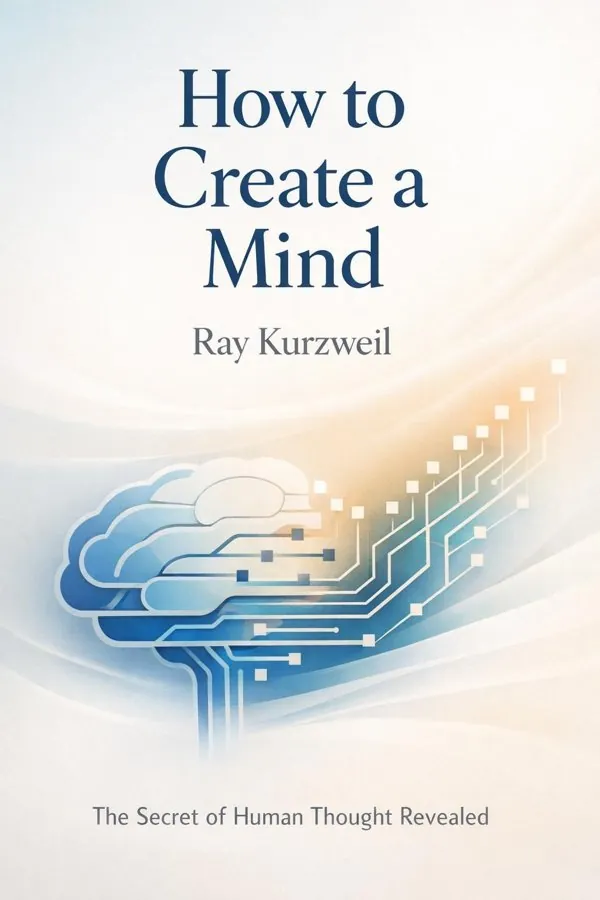
How to Create a Mind: The Secret of Human Thought Revealed: Summary & Key Insights
by Ray Kurzweil
 10 min9 chaptersAudio available
What Is How to Create a Mind: The Secret of Human Thought Revealed About?
How to Create a Mind: The Secret of Human Thought Revealed by Ray Kurzweil is a ai_ml book spanning 9 pages. In this groundbreaking work, inventor and futurist Ray Kurzweil explores the workings of the human brain and proposes how we can replicate its processes to build intelligent machines. He examines the neocortex’s hierarchical pattern recognition and argues that understanding these mechanisms will enable the creation of artificial intelligence that mirrors human cognition. The book blends neuroscience, computer science, and philosophy to outline a vision of the future where human and machine intelligence converge.
This FizzRead summary covers all 9 key chapters of How to Create a Mind: The Secret of Human Thought Revealed in approximately 10 minutes, distilling the most important ideas, arguments, and takeaways from Ray Kurzweil's work. Also available as an audio summary and Key Quotes Podcast.
How to Create a Mind: The Secret of Human Thought Revealed
In this groundbreaking work, inventor and futurist Ray Kurzweil explores the workings of the human brain and proposes how we can replicate its processes to build intelligent machines. He examines the neocortex’s hierarchical pattern recognition and argues that understanding these mechanisms will enable the creation of artificial intelligence that mirrors human cognition. The book blends neuroscience, computer science, and philosophy to outline a vision of the future where human and machine intelligence converge.
Who Should Read How to Create a Mind: The Secret of Human Thought Revealed?
This book is perfect for anyone interested in ai_ml and looking to gain actionable insights in a short read. Whether you're a student, professional, or lifelong learner, the key ideas from How to Create a Mind: The Secret of Human Thought Revealed by Ray Kurzweil will help you think differently.
- ✓Readers who enjoy ai_ml and want practical takeaways
- ✓Professionals looking to apply new ideas to their work and life
- ✓Anyone who wants the core insights of How to Create a Mind: The Secret of Human Thought Revealed in just 10 minutes
Want the full summary?
Get instant access to this book summary and 100K+ more with Fizz Moment.
Get Free SummaryAvailable on App Store • Free to download
Key Chapters
At the heart of my theory is a simple but powerful insight: the human brain operates as a hierarchy of pattern recognizers. Each layer of the neocortex receives inputs, detects regularities, and forms representations. These representations, in turn, become inputs for higher layers that recognize more complex patterns—words from phonemes, concepts from words, ideas from sensory impressions. The mind, therefore, is a network of pattern-processing modules wired for continuous learning.
This model draws deeply from neuroscience. We know that the neocortex has a remarkably uniform structure across all regions. Whether processing vision, sound, or language, the fundamental wiring is the same; only the input data differ. This suggests a single computational principle operating everywhere—a principle of pattern storage, recognition, and abstraction. The neocortex learns by storing sequences of patterns and predicting what comes next. That predictive capability is what we experience as understanding.
In daily life, you take this for granted. When you read these words, your brain recognizes letters, then words, then meaning. You don’t perceive a series of symbols; you experience comprehension. That awareness emerges from hierarchical pattern recognition at work. The same principle governs how you recognize a friend’s voice, solve a problem, or compose a symphony.
When we attempt to create intelligent machines, this hierarchy must be at the core. Deep learning networks—artificial models inspired by the brain—have already validated aspects of this idea. But the Pattern Recognition Theory of Mind goes further, offering a unified framework not only for perception but for creativity, decision-making, and consciousness itself.
The neocortex is a thin sheet of tissue, folded multiple times to fit within the skull, but its apparent simplicity hides an extraordinary uniformity of design. Each cubic millimeter contains about a hundred thousand neurons arranged in similar vertical structures, known as cortical columns. Every column processes a small fragment of data, and together they compose a dynamic encyclopedia of experience.
What’s fascinating is that this architecture allows for flexibility and universality. The same mechanisms that enable you to understand a sentence also allow you to drive a car or solve an equation. Intelligence, in this model, is not the product of domain-specific processing but of generalized pattern recognition. The brain doesn’t need separate hardware for vision and reasoning—it merely reuses the same cortical column algorithm across contexts.
Cortical columns function as miniature prediction engines. They receive data, compare it to stored templates, and adjust their internal models when patterns shift. Over time, this process of continual refinement builds a dense web of predictions across the brain. When a prediction fails, the brain learns. When it succeeds, understanding deepens.
This discovery carries profound implications for AI. If we can replicate this uniform cortical algorithm in silicon, we can construct synthetic neocortices. The key lies not in raw computational speed but in effective pattern organization and predictive learning. Modern neural networks, which operate by adjusting weights across layers, echo the structure of the cortex, but they are still primitive compared to the adaptability of biological networks.
What I propose is not imitation but translation: understanding how the brain’s architecture functions so we can design its computational counterpart, capable of similar generalization and creativity.
+ 7 more chapters — available in the FizzRead app
All Chapters in How to Create a Mind: The Secret of Human Thought Revealed
About the Author
Ray Kurzweil is an American inventor, author, and futurist known for his pioneering work in optical character recognition, text-to-speech synthesis, and artificial intelligence. He has written several influential books on technology and the future of humanity, and currently serves as a Director of Engineering at Google, focusing on machine learning and language processing.
Get This Summary in Your Preferred Format
Read or listen to the How to Create a Mind: The Secret of Human Thought Revealed summary by Ray Kurzweil anytime, anywhere. FizzRead offers multiple formats so you can learn on your terms — all free.
Available formats: App · Audio · PDF · EPUB — All included free with FizzRead
Download How to Create a Mind: The Secret of Human Thought Revealed PDF and EPUB Summary
Key Quotes from How to Create a Mind: The Secret of Human Thought Revealed
“At the heart of my theory is a simple but powerful insight: the human brain operates as a hierarchy of pattern recognizers.”
“The neocortex is a thin sheet of tissue, folded multiple times to fit within the skull, but its apparent simplicity hides an extraordinary uniformity of design.”
Frequently Asked Questions about How to Create a Mind: The Secret of Human Thought Revealed
How to Create a Mind: The Secret of Human Thought Revealed by Ray Kurzweil is a ai_ml book that explores key ideas across 9 chapters. In this groundbreaking work, inventor and futurist Ray Kurzweil explores the workings of the human brain and proposes how we can replicate its processes to build intelligent machines. He examines the neocortex’s hierarchical pattern recognition and argues that understanding these mechanisms will enable the creation of artificial intelligence that mirrors human cognition. The book blends neuroscience, computer science, and philosophy to outline a vision of the future where human and machine intelligence converge.
More by Ray Kurzweil
The Singularity Is Near: When Humans Transcend Biology
Ray Kurzweil
10 min
The Age of Spiritual Machines: When Computers Exceed Human Intelligence
Ray Kurzweil
10 min
The Singularity Is Nearer: When We Merge With Ai
Ray Kurzweil
10 min
Transcendence
Ray Kurzweil
10 minYou Might Also Like
Life 3.0
Max Tegmark
10 min
Superintelligence
Nick Bostrom
10 min
TensorFlow in Action
Thushan Ganegedara
10 min
AI Made Simple: A Beginner’s Guide to Generative AI, ChatGPT, and the Future of Work
Rajeev Kapur
10 min
AI Snake Oil
Arvind Narayanan, Sayash Kapoor
10 min
AI Superpowers: China, Silicon Valley, and the New World Order
Kai-Fu Lee
10 minBrowse by Category
Ready to read How to Create a Mind: The Secret of Human Thought Revealed?
Get the full summary and 100K+ more books with Fizz Moment.