
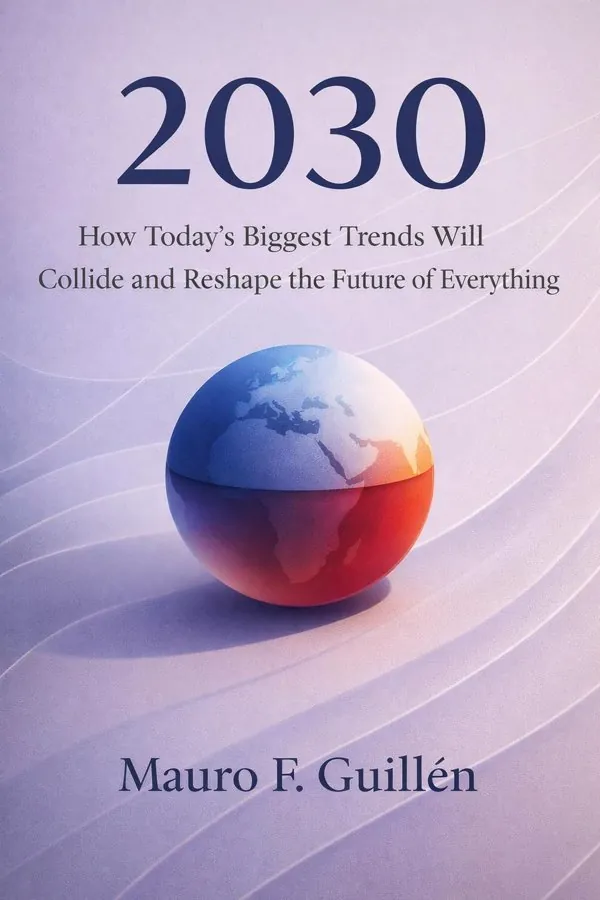
2030: How Today's Biggest Trends Will Collide and Reshape the Future of Everything: Summary & Key Insights
 10 min7 chaptersAudio available
What Is 2030: How Today's Biggest Trends Will Collide and Reshape the Future of Everything About?
2030: How Today's Biggest Trends Will Collide and Reshape the Future of Everything by Mauro F. Guillén is a future_trends book spanning 7 pages. En este libro, Mauro F. Guillén analiza cómo las tendencias demográficas, económicas y tecnológicas más importantes del mundo convergerán para transformar radicalmente la sociedad global hacia el año 2030. A través de un enfoque interdisciplinario, el autor explora cómo el envejecimiento de la población, el auge de las economías emergentes, la innovación tecnológica y los cambios en los valores culturales remodelarán la economía, los negocios y la vida cotidiana.
This FizzRead summary covers all 7 key chapters of 2030: How Today's Biggest Trends Will Collide and Reshape the Future of Everything in approximately 10 minutes, distilling the most important ideas, arguments, and takeaways from Mauro F. Guillén's work. Also available as an audio summary and Key Quotes Podcast.
2030: How Today's Biggest Trends Will Collide and Reshape the Future of Everything
En este libro, Mauro F. Guillén analiza cómo las tendencias demográficas, económicas y tecnológicas más importantes del mundo convergerán para transformar radicalmente la sociedad global hacia el año 2030. A través de un enfoque interdisciplinario, el autor explora cómo el envejecimiento de la población, el auge de las economías emergentes, la innovación tecnológica y los cambios en los valores culturales remodelarán la economía, los negocios y la vida cotidiana.
Who Should Read 2030: How Today's Biggest Trends Will Collide and Reshape the Future of Everything?
This book is perfect for anyone interested in future_trends and looking to gain actionable insights in a short read. Whether you're a student, professional, or lifelong learner, the key ideas from 2030: How Today's Biggest Trends Will Collide and Reshape the Future of Everything by Mauro F. Guillén will help you think differently.
- ✓Readers who enjoy future_trends and want practical takeaways
- ✓Professionals looking to apply new ideas to their work and life
- ✓Anyone who wants the core insights of 2030: How Today's Biggest Trends Will Collide and Reshape the Future of Everything in just 10 minutes
Want the full summary?
Get instant access to this book summary and 100K+ more with Fizz Moment.
Get Free SummaryAvailable on App Store • Free to download
Key Chapters
By 2030, the composition of humanity will look remarkably different. In developed nations such as Japan, Germany, and Italy, the median age will surpass fifty, while in much of sub-Saharan Africa and parts of South Asia, more than half the population will still be under twenty-five. This demographic bifurcation has profound consequences—not just for economies, but for values, consumption, and innovation.
An aging population alters the rhythm of growth. It changes what societies demand: fewer toys and more healthcare, fewer new homes and more assisted-living facilities. The elderly will form a significant consumer segment, but they will also reshape labor markets by creating shortages of working-age people. Automation and migration will partially fill these gaps, yet the cultural adaptation required will be immense. Retirement as we know it will disappear. People will work longer, not out of necessity alone, but because their lifespan and health make economic participation viable well into their seventies.
At the same time, younger populations in emerging economies will become the world’s principal source of dynamism. They will provide not just labor but creativity. The imbalance between aging and youthful societies will drive global interdependence—capital and technology will flow toward the young, while manufacturing and service industries evolve to serve the old. This is not a tragedy of aging nor a triumph of youth—it is a complex interlocking pattern. Understanding that pattern is the first step toward policy, investment, and opportunity alignment in the 2030 world.
The center of gravity of global consumption is moving swiftly toward emerging markets. By 2030, China, India, Indonesia, Nigeria, and other developing nations will collectively produce and consume the majority of the world’s goods and services. This shift marks the most radical decentralization of economic power since the Industrial Revolution.
When I speak of emergence, I mean more than GDP growth. I mean the cultural, technological, and institutional maturation that transforms these nations into standard-setters rather than followers. The global middle class—the driving engine of consumption—will increasingly speak Mandarin, Hindi, Portuguese, and Swahili. Multinationals that fail to understand these consumers’ priorities—affordability, connectivity, community, and sustainability—will quickly lose relevance.
Emerging markets will not merely imitate Western models. They will innovate uniquely within their constraints. Mobile banking in Kenya, digital health in India, and social commerce in China are examples of leapfrogging—where necessity and technology combine to bypass the old paradigm. This rise is not about catching up; it is about redefining what progress means. The global economic landscape by 2030 will be polycentric, with influence distributed across multiple nodes of innovation.
+ 5 more chapters — available in the FizzRead app
All Chapters in 2030: How Today's Biggest Trends Will Collide and Reshape the Future of Everything
About the Author
Mauro F. Guillén es profesor de gestión internacional y decano de la Judge Business School de la Universidad de Cambridge. Anteriormente fue profesor en la Wharton School de la Universidad de Pensilvania. Es reconocido por su trabajo sobre globalización, innovación y tendencias económicas mundiales.
Get This Summary in Your Preferred Format
Read or listen to the 2030: How Today's Biggest Trends Will Collide and Reshape the Future of Everything summary by Mauro F. Guillén anytime, anywhere. FizzRead offers multiple formats so you can learn on your terms — all free.
Available formats: App · Audio · PDF · EPUB — All included free with FizzRead
Download 2030: How Today's Biggest Trends Will Collide and Reshape the Future of Everything PDF and EPUB Summary
Key Quotes from 2030: How Today's Biggest Trends Will Collide and Reshape the Future of Everything
“By 2030, the composition of humanity will look remarkably different.”
“The center of gravity of global consumption is moving swiftly toward emerging markets.”
Frequently Asked Questions about 2030: How Today's Biggest Trends Will Collide and Reshape the Future of Everything
2030: How Today's Biggest Trends Will Collide and Reshape the Future of Everything by Mauro F. Guillén is a future_trends book that explores key ideas across 7 chapters. En este libro, Mauro F. Guillén analiza cómo las tendencias demográficas, económicas y tecnológicas más importantes del mundo convergerán para transformar radicalmente la sociedad global hacia el año 2030. A través de un enfoque interdisciplinario, el autor explora cómo el envejecimiento de la población, el auge de las economías emergentes, la innovación tecnológica y los cambios en los valores culturales remodelarán la economía, los negocios y la vida cotidiana.
You Might Also Like
Futureproof: 9 Rules for Humans in the Age of Automation
Kevin Roose
10 min
The Third Wave
Alvin Toffler
10 min
A Very Human Future: Enriching Humanity in a Digitized World
Rohit Talwar, Steve Wells, Alexandra Whittington
10 min
AI 2041: Ten Visions for Our Future
Kai-Fu Lee, Chen Qiufan
10 min
Abundance: The Future Is Better Than You Think
Peter H. Diamandis, Steven Kotler
10 min
After Shock: The World's Foremost Futurists Reflect on 50 Years of Future Shock—and Look Ahead to the Next 50
John Schroeter (Editor)
10 minFeatured In
Browse by Category
Ready to read 2030: How Today's Biggest Trends Will Collide and Reshape the Future of Everything?
Get the full summary and 100K+ more books with Fizz Moment.