
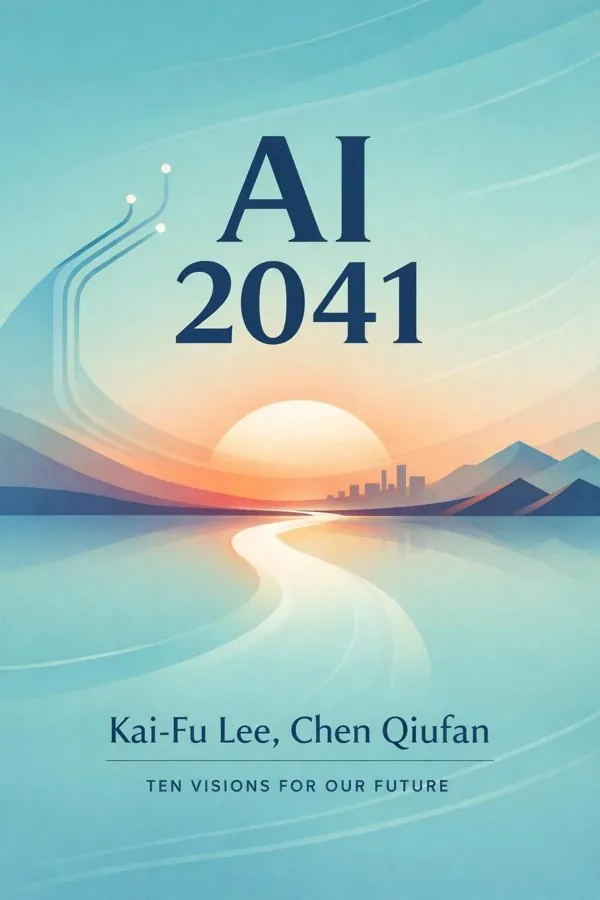
AI 2041: Ten Visions for Our Future: Summary & Key Insights
 10 min9 chaptersAudio available
Key Takeaways from AI 2041: Ten Visions for Our Future
The most transformative teacher of the future may not stand at the front of a classroom.
The future of work will not be decided by whether automation arrives, but by how humans respond when it does.
For billions of people, the biggest economic barrier is not lack of talent but lack of access.
Technology can simulate attention, but that does not mean it can satisfy the human need for love.
A self-driving future is not only about convenience; it is about what happens to the people whose identities are tied to driving.
What Is AI 2041: Ten Visions for Our Future About?
AI 2041: Ten Visions for Our Future by Kai-Fu Lee, Chen Qiufan is a future_trends book spanning 9 pages. What will artificial intelligence actually feel like in everyday life—not in abstract theory, but in schools, hospitals, workplaces, relationships, and cities? In AI 2041: Ten Visions for Our Future, Kai-Fu Lee and Chen Qiufan answer that question through a powerful blend of analysis and fiction. Each chapter begins with a story set in 2041, then unpacks the real technologies behind it, showing how today’s advances in machine learning, automation, biotechnology, robotics, and data systems could reshape human life within two decades. What makes this book especially valuable is the pairing of two rare perspectives. Kai-Fu Lee brings deep technical and business authority as one of the world’s best-known AI investors and researchers, while Chen Qiufan contributes the emotional and imaginative force of speculative fiction. Together, they make complex ideas accessible without oversimplifying their risks. The result is neither utopian fantasy nor dystopian warning, but a grounded exploration of possibility. For anyone trying to understand where AI is heading—and how society can shape that future—AI 2041 offers an intelligent, vivid, and urgently relevant guide.
This FizzRead summary covers all 9 key chapters of AI 2041: Ten Visions for Our Future in approximately 10 minutes, distilling the most important ideas, arguments, and takeaways from Kai-Fu Lee, Chen Qiufan's work. Also available as an audio summary and Key Quotes Podcast.
AI 2041: Ten Visions for Our Future
What will artificial intelligence actually feel like in everyday life—not in abstract theory, but in schools, hospitals, workplaces, relationships, and cities? In AI 2041: Ten Visions for Our Future, Kai-Fu Lee and Chen Qiufan answer that question through a powerful blend of analysis and fiction. Each chapter begins with a story set in 2041, then unpacks the real technologies behind it, showing how today’s advances in machine learning, automation, biotechnology, robotics, and data systems could reshape human life within two decades.
What makes this book especially valuable is the pairing of two rare perspectives. Kai-Fu Lee brings deep technical and business authority as one of the world’s best-known AI investors and researchers, while Chen Qiufan contributes the emotional and imaginative force of speculative fiction. Together, they make complex ideas accessible without oversimplifying their risks. The result is neither utopian fantasy nor dystopian warning, but a grounded exploration of possibility. For anyone trying to understand where AI is heading—and how society can shape that future—AI 2041 offers an intelligent, vivid, and urgently relevant guide.
Who Should Read AI 2041: Ten Visions for Our Future?
This book is perfect for anyone interested in future_trends and looking to gain actionable insights in a short read. Whether you're a student, professional, or lifelong learner, the key ideas from AI 2041: Ten Visions for Our Future by Kai-Fu Lee, Chen Qiufan will help you think differently.
- ✓Readers who enjoy future_trends and want practical takeaways
- ✓Professionals looking to apply new ideas to their work and life
- ✓Anyone who wants the core insights of AI 2041: Ten Visions for Our Future in just 10 minutes
Want the full summary?
Get instant access to this book summary and 100K+ more with Fizz Moment.
Get Free SummaryAvailable on App Store • Free to download
Key Chapters
The most transformative teacher of the future may not stand at the front of a classroom. In “The Golden Elephant,” the book imagines an AI tutor in rural India that adapts to a child’s learning style, emotional state, pace, and ambitions. This vision captures one of AI’s most promising applications: individualized education at scale. Instead of forcing millions of students through a one-size-fits-all system, intelligent tutors could identify knowledge gaps instantly, adjust explanations in real time, and motivate learners in ways that suit their personalities.
The authors argue that this matters most where educational inequality is deepest. In regions with overcrowded schools, limited teacher training, or inconsistent access to materials, AI can act as a force multiplier. A child struggling with math could receive extra visual explanations; a fast learner could move ahead without waiting for the class. Language translation, speech recognition, and adaptive testing would make education more accessible across social and geographic divides.
But the book is careful not to romanticize the technology. Education is not only about content delivery; it is also about values, trust, social development, and mentorship. AI can personalize instruction, but it cannot fully replace human guidance. The best model is partnership: machines handle repetition, diagnosis, and customization, while teachers focus on inspiration, judgment, and care.
In practice, we already see early versions of this future in adaptive learning apps, AI writing assistants, and real-time language tools. The broader lesson is that AI’s value grows when it expands access rather than merely increasing efficiency.
Actionable takeaway: Use AI as a supplement for learning—whether in school or self-study—but pair it with human feedback, reflection, and real-world practice.
The future of work will not be decided by whether automation arrives, but by how humans respond when it does. In “Twin Sparrows,” two factory workers in China confront the same technological disruption and make opposite choices. One clings to the identity and routines of a fading industrial world. The other experiments, retrains, and gradually finds new forms of value in an automated economy. Their contrast reveals a central argument of the book: the greatest risk is not automation itself, but social paralysis in the face of change.
AI excels at pattern recognition, repetitive optimization, prediction, and task execution. That makes manufacturing, logistics, quality control, scheduling, and administrative work especially vulnerable. Yet the authors reject simplistic claims that “robots will take all jobs.” More often, AI breaks jobs into tasks, automating some while increasing the importance of others. Human workers may shift from doing the labor directly to supervising systems, handling exceptions, supporting customers, or integrating complex workflows.
The challenge is transition. Workers cannot simply be told to “learn to code.” Effective reskilling requires public policy, employer investment, accessible training, and social respect for mid-career reinvention. A warehouse employee might move into robot maintenance. A line operator might become a data-literate process coordinator. A driver might become part of a mobility service team. The future belongs not just to technical elites, but to societies that help ordinary people adapt with dignity.
This idea already matters today as AI reshapes white-collar work as much as manual labor. The lesson is emotional as well as economic: fear narrows options, while curiosity creates them.
Actionable takeaway: Identify which parts of your work are repetitive and predictable, then begin building adjacent skills—communication, digital fluency, problem-solving, and system oversight—that complement AI rather than compete with it.
For billions of people, the biggest economic barrier is not lack of talent but lack of access. In “Job Savior,” set in Nigeria, the book explores how AI-driven financial systems can open opportunities for people excluded from traditional banking. When individuals have no formal credit history, no collateral, and irregular income, banks often treat them as invisible. AI changes that by analyzing alternative signals—transaction patterns, mobile behavior, work history, social trust indicators, and business activity—to make more nuanced judgments about risk and opportunity.
This is one of the book’s most practical futures. Intelligent lending systems could help street vendors, small farmers, freelancers, and micro-entrepreneurs obtain credit, insurance, savings tools, and business advice. AI could also detect fraud faster, personalize financial products, and lower the cost of serving communities that were previously unprofitable for human-heavy institutions. In developing economies especially, mobile-first AI finance could become a major engine of inclusion.
Yet the authors also warn that data-based fairness can become a new form of exclusion if poorly designed. If a model learns from biased data, it can deny loans at scale with a false aura of objectivity. If people do not understand why they were rejected, trust collapses. And if a handful of platforms own financial identities, they gain enormous power over livelihoods.
The promise of AI finance is therefore inseparable from transparency, regulation, digital rights, and competition. Access must not come at the price of surveillance or algorithmic discrimination. Used well, AI can create economic participation; used badly, it can harden inequality.
Actionable takeaway: When evaluating AI-powered financial tools, prioritize providers that explain decisions clearly, protect your data, and give users meaningful ways to appeal or correct errors.
Technology can simulate attention, but that does not mean it can satisfy the human need for love. In “Contactless Love,” set in Japan, the authors imagine a world in which emotionally responsive AI companions become deeply woven into everyday life. These systems listen, adapt, flatter, remember preferences, and offer comfort without the friction, unpredictability, or vulnerability of human relationships. For lonely individuals, the appeal is obvious: AI companions are always available, endlessly patient, and designed to respond in emotionally rewarding ways.
The chapter explores a future that feels increasingly plausible as voice assistants, social robots, and generative AI become more conversational. For elderly people living alone, AI companions might reduce isolation. For overworked professionals, they might offer stress relief. For people with social anxiety, they could even serve as a bridge to greater confidence. In this sense, emotional AI may provide genuine support.
But the authors draw a crucial distinction between responsiveness and reciprocity. A machine can mirror emotion without experiencing it. It can generate empathy-like language without moral agency, commitment, or mutual growth. Human intimacy is valuable partly because it requires negotiation, patience, and the recognition of another consciousness. If AI relationships become easier than human ones, society may drift toward emotionally convenient but psychologically thinner forms of connection.
The chapter ultimately asks not whether AI can imitate affection, but what happens if people begin to prefer controllable companionship to real relationships. This is less a technical problem than a cultural one.
Actionable takeaway: Use AI tools for support or companionship carefully, but protect time for messy, demanding, irreplaceable human relationships that build true emotional resilience.
A self-driving future is not only about convenience; it is about what happens to the people whose identities are tied to driving. In “The Holy Driver,” set in Indonesia, the rise of autonomous vehicles threatens the livelihood of a proud professional driver. The story highlights a theme that appears across the book: technological progress can be efficient and still feel cruel if it strips people of status, meaning, and belonging.
Autonomous mobility promises enormous benefits. AI-powered vehicles can reduce accidents caused by human error, optimize traffic flow, cut delivery costs, and provide transportation to elderly or disabled people. Entire logistics networks may become more reliable and less wasteful. Urban design could shift as parking needs decline and transportation becomes more flexible.
Yet the social cost is not trivial. Millions of drivers worldwide—truckers, taxi operators, couriers, delivery workers—could face displacement. The authors argue that society often underestimates how much work provides beyond income. Jobs structure identity, create social networks, and signal respect. A driver who loses his role does not only lose wages; he may lose a place in the moral fabric of his community.
That is why the transition matters as much as the destination. New jobs will emerge in fleet management, customer experience, remote intervention, maintenance, and transportation design, but only if institutions help workers move into them. A humane automation strategy must include retraining, transition support, and narratives that honor the workers who built the previous system.
Actionable takeaway: When thinking about automation in any sector, ask not only “What becomes cheaper?” but also “Whose dignity is at stake, and how can the transition create new roles with real meaning?”
The future of medicine may depend as much on algorithms as on doctors. In “Quantum Genomics,” set in the United States, the book explores how AI, genomic sequencing, and advanced computing could radically improve diagnosis, prevention, and treatment. By analyzing vast biological datasets, AI may detect subtle disease patterns long before symptoms appear, identify drug combinations tailored to an individual’s genetic profile, and accelerate discovery at a speed no human research team could match alone.
This vision is especially compelling because health care generates exactly the kind of complex, high-dimensional information AI handles well: medical images, lab values, genetic data, treatment histories, lifestyle signals, and population outcomes. An AI system might notice cancer in imaging earlier than radiologists, predict heart disease risk more accurately from multi-source data, or help design personalized therapies for rare conditions. In global health, these tools could make expert-level screening available where specialists are scarce.
But the deeper message of the chapter is ethical. When prediction becomes powerful, who controls the knowledge? If an insurer knows your genomic risk, should it adjust your coverage? If parents can select embryos using AI-guided probabilities, what happens to ideas of fairness, disability, and human acceptance? As biological insight becomes more precise, the line between treatment and enhancement may blur.
The authors neither reject nor celebrate these advances blindly. They insist that life-saving innovation must be matched with careful governance, privacy protection, and moral humility. Medicine improved by AI can become more preventive and personalized, but it can also become more unequal if available only to the privileged.
Actionable takeaway: Support AI-driven health innovation, but demand strong standards for privacy, informed consent, and equitable access before trusting systems with deeply personal biological data.
The rise of creative machines forces a difficult question: if AI can generate impressive work, what remains uniquely human? In “The AI Olympiad,” the authors examine a future in which young people compete not only through raw knowledge but through their ability to collaborate with intelligent systems. The chapter suggests that creativity in the AI era will be less about producing everything alone and more about framing problems, asking better questions, curating outputs, and injecting human taste, context, and purpose.
This is a major shift from old educational ideals. Memorization matters less when information is instantly accessible. Standardized performance matters less when machines can optimize predictable tasks. What grows in value is originality, interdisciplinary thinking, ethical judgment, and the ability to turn machine-generated possibilities into meaningful human outcomes.
In practical terms, this future is already emerging. Designers use generative tools to explore concepts faster. Programmers work with AI coding assistants. Marketers test dozens of campaign angles in minutes. Researchers summarize literature with machine help before deciding where genuine insight lies. In each case, AI expands the creative search space, but humans still shape the direction, select what matters, and decide what is beautiful, useful, or true.
The danger is educational complacency. If schools continue rewarding only conformity and test performance, they may prepare students for the very tasks AI can do best. The authors argue for an education system that treats AI as a collaborator and trains people to develop imagination, resilience, and values.
Actionable takeaway: Strengthen the parts of creativity AI cannot own by practicing idea generation, synthesis, taste, storytelling, and ethical reasoning—not just technical execution.
As machines master more cognitive tasks, the ultimate human advantage may be our capacity to care. In “The Last Human Job,” the book imagines a world where efficiency has spread so far that many traditional forms of labor have been automated. In this environment, empathy becomes not a soft luxury but a core economic and social resource. Roles involving trust, moral judgment, emotional support, caregiving, coaching, and human presence remain difficult to automate because their value lies in genuine relationship rather than optimized output.
This idea challenges the old assumption that technical ability alone guarantees future relevance. AI can draft reports, identify patterns, optimize routes, and even simulate emotionally intelligent responses. But there is still a difference between a nurse who notices fear behind a patient’s words and a system that labels that fear probabilistically. There is a difference between a mentor who believes in someone and a chatbot that mimics encouragement. Human-centered work may become more important precisely because machine competence grows elsewhere.
The authors do not claim empathy is immune to technological assistance. AI can support therapists, help teachers track student well-being, and enable caregivers with better information. But support is not substitution. Societies that undervalue caregiving, social work, teaching, and emotional labor may discover that these are among the most important professions in the AI age.
For individuals, this means the future of work is not just about learning tools but also about deepening humanity. Listening well, earning trust, resolving conflict, and exercising judgment under uncertainty may become defining career advantages.
Actionable takeaway: Invest deliberately in human skills—empathy, communication, mentoring, and ethical decision-making—because the more powerful AI becomes, the more valuable authentic human connection is likely to be.
All Chapters in AI 2041: Ten Visions for Our Future
About the Authors
Kai-Fu Lee is a Taiwanese-born computer scientist, AI pioneer, investor, and entrepreneur. Over the course of his career, he has held senior roles at Apple, SGI, Microsoft, and Google, and later founded Sinovation Ventures, a major technology investment firm focused on artificial intelligence and innovation. He is widely recognized for translating complex AI trends into practical insights for global audiences. Chen Qiufan, also known as Stanley Chan, is an award-winning Chinese science fiction writer whose work often explores the intersection of technology, society, and human identity. His fiction is known for combining sharp speculative imagination with emotional and cultural depth. Together, Lee and Chen form a rare partnership: one grounded in technical expertise, the other in visionary storytelling.
Get This Summary in Your Preferred Format
Read or listen to the AI 2041: Ten Visions for Our Future summary by Kai-Fu Lee, Chen Qiufan anytime, anywhere. FizzRead offers multiple formats so you can learn on your terms — all free.
Available formats: App · Audio · PDF · EPUB — All included free with FizzRead
Download AI 2041: Ten Visions for Our Future PDF and EPUB Summary
Key Quotes from AI 2041: Ten Visions for Our Future
“The most transformative teacher of the future may not stand at the front of a classroom.”
“The future of work will not be decided by whether automation arrives, but by how humans respond when it does.”
“For billions of people, the biggest economic barrier is not lack of talent but lack of access.”
“Technology can simulate attention, but that does not mean it can satisfy the human need for love.”
“A self-driving future is not only about convenience; it is about what happens to the people whose identities are tied to driving.”
Frequently Asked Questions about AI 2041: Ten Visions for Our Future
AI 2041: Ten Visions for Our Future by Kai-Fu Lee, Chen Qiufan is a future_trends book that explores key ideas across 9 chapters. What will artificial intelligence actually feel like in everyday life—not in abstract theory, but in schools, hospitals, workplaces, relationships, and cities? In AI 2041: Ten Visions for Our Future, Kai-Fu Lee and Chen Qiufan answer that question through a powerful blend of analysis and fiction. Each chapter begins with a story set in 2041, then unpacks the real technologies behind it, showing how today’s advances in machine learning, automation, biotechnology, robotics, and data systems could reshape human life within two decades. What makes this book especially valuable is the pairing of two rare perspectives. Kai-Fu Lee brings deep technical and business authority as one of the world’s best-known AI investors and researchers, while Chen Qiufan contributes the emotional and imaginative force of speculative fiction. Together, they make complex ideas accessible without oversimplifying their risks. The result is neither utopian fantasy nor dystopian warning, but a grounded exploration of possibility. For anyone trying to understand where AI is heading—and how society can shape that future—AI 2041 offers an intelligent, vivid, and urgently relevant guide.
You Might Also Like
Futureproof: 9 Rules for Humans in the Age of Automation
Kevin Roose
10 min
The Third Wave
Alvin Toffler
10 min
2030: How Today's Biggest Trends Will Collide and Reshape the Future of Everything
Mauro F. Guillén
10 min
A Very Human Future: Enriching Humanity in a Digitized World
Rohit Talwar, Steve Wells, Alexandra Whittington
10 min
Abundance: The Future Is Better Than You Think
Peter H. Diamandis, Steven Kotler
10 min
After Shock: The World's Foremost Futurists Reflect on 50 Years of Future Shock—and Look Ahead to the Next 50
John Schroeter (Editor)
10 minFeatured In
Browse by Category
Ready to read AI 2041: Ten Visions for Our Future?
Get the full summary and 100K+ more books with Fizz Moment.