

The Third Wave: Summary & Key Insights
 10 min9 chaptersAudio available
Key Takeaways from The Third Wave
Most people experience change as a series of disconnected events, but Toffler invites us to see something larger: entire civilizations rise and fall in waves.
One of Toffler’s sharpest observations is that industrial civilization did not just change how goods were produced; it changed how humans were organized.
A defining feature of the emerging civilization, according to Toffler, is the weakening of centralized control.
Industrial society treated land, labor, and capital as the main sources of power.
The industrial age created mass markets, mass education, mass media, and mass culture.
What Is The Third Wave About?
The Third Wave by Alvin Toffler is a future_trends book. The Third Wave is Alvin Toffler’s bold attempt to explain one of history’s biggest turning points: the shift from industrial society to a new civilization shaped by information, technology, decentralization, and rapid change. First published in 1980, the book argues that human history has moved through three great waves. The First Wave was the agricultural revolution, which settled humans into farming communities. The Second Wave was the industrial age, which standardized work, education, production, and daily life. The Third Wave, Toffler says, is now transforming everything again—from family structures and business models to politics, media, and identity. What makes the book enduring is not just its sweeping vision, but how many of its insights anticipated the modern world: remote work, personalized media, flexible careers, knowledge-based economies, and the breakdown of mass institutions. Toffler was one of the most influential futurists of the twentieth century, known for translating complex social changes into vivid, accessible ideas. The Third Wave matters because it helps readers see today’s disruptions not as isolated trends, but as part of a larger civilizational shift that is still unfolding.
This FizzRead summary covers all 9 key chapters of The Third Wave in approximately 10 minutes, distilling the most important ideas, arguments, and takeaways from Alvin Toffler's work. Also available as an audio summary and Key Quotes Podcast.
The Third Wave
The Third Wave is Alvin Toffler’s bold attempt to explain one of history’s biggest turning points: the shift from industrial society to a new civilization shaped by information, technology, decentralization, and rapid change. First published in 1980, the book argues that human history has moved through three great waves. The First Wave was the agricultural revolution, which settled humans into farming communities. The Second Wave was the industrial age, which standardized work, education, production, and daily life. The Third Wave, Toffler says, is now transforming everything again—from family structures and business models to politics, media, and identity.
What makes the book enduring is not just its sweeping vision, but how many of its insights anticipated the modern world: remote work, personalized media, flexible careers, knowledge-based economies, and the breakdown of mass institutions. Toffler was one of the most influential futurists of the twentieth century, known for translating complex social changes into vivid, accessible ideas. The Third Wave matters because it helps readers see today’s disruptions not as isolated trends, but as part of a larger civilizational shift that is still unfolding.
Who Should Read The Third Wave?
This book is perfect for anyone interested in future_trends and looking to gain actionable insights in a short read. Whether you're a student, professional, or lifelong learner, the key ideas from The Third Wave by Alvin Toffler will help you think differently.
- ✓Readers who enjoy future_trends and want practical takeaways
- ✓Professionals looking to apply new ideas to their work and life
- ✓Anyone who wants the core insights of The Third Wave in just 10 minutes
Want the full summary?
Get instant access to this book summary and 100K+ more with Fizz Moment.
Get Free SummaryAvailable on App Store • Free to download
Key Chapters
Most people experience change as a series of disconnected events, but Toffler invites us to see something larger: entire civilizations rise and fall in waves. His central framework is simple yet powerful. The First Wave was the agricultural revolution, when humans shifted from hunting and gathering to settled farming. The Second Wave was the industrial revolution, which reorganized society around factories, mass production, centralized authority, and standardization. The Third Wave, now emerging, is driven by knowledge, information, digital technology, and more flexible forms of living and working.
This model matters because it explains why so many institutions feel unstable at the same time. Schools, corporations, governments, media systems, and families are not all failing independently. They were largely designed for a Second Wave world and are now struggling under Third Wave conditions. Industrial-era systems assume uniformity, hierarchy, fixed schedules, and mass audiences. But the new era rewards adaptability, customization, speed, and distributed networks.
You can see this in everyday life. Traditional media gives way to streaming platforms and creator economies. Career ladders turn into portfolio careers. One-size-fits-all education faces pressure from online learning and personalized instruction. Even politics becomes less dominated by a few central gatekeepers and more shaped by fragmented communities and digital influence.
Toffler’s insight helps readers reduce confusion. When old systems collide with new realities, conflict is inevitable. People who think in terms of waves can better understand why change feels so disruptive—and why resistance is often strongest from those invested in the previous order.
Actionable takeaway: When evaluating a trend in your work or life, ask whether it reflects an industrial-era assumption or a Third Wave shift. That question can clarify what is changing and where to adapt.
One of Toffler’s sharpest observations is that industrial civilization did not just change how goods were produced; it changed how humans were organized. The Second Wave depended on standardization. Factories needed interchangeable parts, synchronized labor, fixed schedules, and predictable consumers. Over time, this logic spread far beyond manufacturing into schools, offices, governments, and even family life.
Think about the typical industrial model: children of the same age move through standardized classrooms; workers commute at similar hours; mass media delivers the same messages to millions; corporations rely on rigid hierarchies; and national politics speaks in broad categories designed for large, uniform populations. This system was efficient for scaling production, but it also encouraged conformity. It trained people to fit systems rather than shape them.
Toffler shows that many modern frustrations come from continuing to live inside structures optimized for a previous age. Employees want flexibility, but organizations still reward attendance over outcomes. Students learn differently, but educational systems still emphasize batch processing. Consumers seek personalization, but institutions often provide generic experiences. The industrial mindset lingers because it once worked brilliantly. Its weakness is that it handles variation poorly.
Today, the breakdown of standardization appears everywhere. Customized products, niche communities, flexible work arrangements, and specialized media all reflect a move away from mass sameness. Businesses that understand this can create better services. Leaders can redesign processes around user needs rather than inherited routines. Individuals can also stop assuming that the “normal” path is the only valid one.
Actionable takeaway: Identify one area of your life or organization still run by unnecessary standardization, and experiment with a more flexible, personalized alternative.
A defining feature of the emerging civilization, according to Toffler, is the weakening of centralized control. Industrial society concentrated power because factories, mass media, and bureaucracies functioned best when decisions were made from the top and distributed downward. The Third Wave changes that logic. Information technologies, smaller production systems, and faster communication make it possible to distribute power more widely.
This does not mean hierarchy disappears. Instead, it becomes less absolute. In a Third Wave environment, value can be created by small teams, independent experts, startups, local communities, and networked individuals. A single creator can build an audience without a television network. A distributed company can coordinate globally without a large headquarters. Local energy systems, modular manufacturing, and digital collaboration all reduce dependence on giant centralized institutions.
Toffler’s point is especially relevant in leadership and strategy. Centralized organizations often move too slowly in volatile environments. They gather information at the edges but force decisions through the center, creating bottlenecks. More adaptive systems push authority closer to where knowledge exists. This shift shows up in agile teams, open-source communities, platform businesses, and decentralized media ecosystems.
However, decentralization also creates new problems: fragmented attention, inconsistent quality, coordination challenges, and the spread of misinformation. Toffler does not argue that all central institutions should vanish. Rather, he suggests that societies must redesign power structures to fit a world where information is abundant and control is harder to monopolize.
For readers today, the lesson is practical. Whether you manage a team, run a business, or build a personal brand, influence increasingly depends on networks rather than position alone.
Actionable takeaway: Move one important decision closer to the people with the best real-time knowledge instead of routing it through unnecessary layers of approval.
Industrial society treated land, labor, and capital as the main sources of power. Toffler argues that in the Third Wave, information joins and often surpasses them. Knowledge becomes a primary resource because it can improve every other resource. Better data refines production, smarter communication improves coordination, and specialized expertise creates new markets entirely.
This was a remarkable insight when the book appeared, and it feels even more obvious now. Some of the world’s most valuable companies generate enormous wealth not mainly by owning factories, but by organizing information, software, networks, and intellectual property. Workers increasingly compete through creativity, interpretation, analysis, and learning speed rather than purely physical effort. Entire industries—from finance to healthcare to entertainment—depend on collecting, processing, and applying knowledge effectively.
Toffler also saw that information behaves differently from industrial goods. It can be shared rapidly, copied cheaply, and updated continuously. That makes the economy more dynamic but also more unstable. Skills go out of date faster. Competitive advantage becomes temporary. Reputation, insight, and timing matter more. Individuals who can learn, filter noise, and make sense of complexity become more valuable than those who merely repeat routine tasks.
In practical terms, this changes how people should think about career development. Degrees still matter, but continuous learning matters more. Organizations need systems for knowledge-sharing, not just command-and-control management. Professionals must cultivate judgment, not just information access, because raw data alone is overwhelming.
Toffler’s deeper point is that the societies best prepared for the future will not simply own more things. They will know how to generate, interpret, and apply knowledge better.
Actionable takeaway: Invest weekly in building a knowledge advantage—through reading, skill development, or better information systems—rather than relying only on past experience.
The industrial age created mass markets, mass education, mass media, and mass culture. Toffler argues that the Third Wave breaks this apart. As technology expands choice and lowers the cost of producing specialized goods and messages, society becomes more diverse, segmented, and individualized. Instead of one dominant mainstream, many smaller worlds emerge.
This fragmentation is visible everywhere. Consumers expect products tailored to their preferences. Audiences split across thousands of channels and platforms. Communities organize around interests, identities, and values rather than geography alone. Careers become less linear. Family structures become more varied. Even political discourse splinters into competing narratives shaped by different information ecosystems.
Toffler does not present diversity simply as cultural decoration. He sees it as structurally connected to the decline of industrial standardization. Once technology no longer requires giant uniform systems, variation becomes more economically and socially viable. This creates freedom, but it also creates complexity. Shared norms weaken. Coordination becomes harder. Institutions designed for homogeneous populations struggle to serve heterogeneous ones.
For businesses, this means segmentation is not optional. Products, messaging, and customer experience must acknowledge real differences. For educators, it means supporting multiple learning styles and pathways. For citizens, it means learning to live in a society where fewer assumptions are universally shared.
There is a warning here too. Fragmentation can enrich life, but it can also isolate people into narrow bubbles. The challenge is to combine personalization with enough shared understanding to maintain cooperation.
Actionable takeaway: Stop designing for an average person who may not exist. Whether you create products, teach, lead, or communicate, identify the specific audiences you serve and adapt accordingly.
Toffler recognized early that technological change would not remain confined to economics. It would reach into the most intimate structures of daily life, especially work and family. Industrial society separated home from workplace, assigned fixed gender roles, and organized life around the rhythms of factories and offices. The Third Wave begins to dissolve these arrangements.
As information technology expands, more work can be performed outside centralized workplaces. Toffler famously anticipated forms of telecommuting and home-based work long before the internet made them common. He also foresaw that rigid employment models would give way to more fluid patterns: project-based work, flexible schedules, mixed income streams, and careers that require repeated reinvention.
These shifts inevitably reshape family life. If work is no longer tied to a factory clock, household responsibilities, parenting patterns, and relationship expectations also change. The industrial-era nuclear family, while highly influential, is not the only structure capable of supporting social life. Toffler points to a future of more diverse living arrangements and family forms, driven by economic and cultural transformation.
Today, this insight feels strikingly current. Remote work, freelancing, dual-career households, digital entrepreneurship, and changing caregiving expectations all reflect the same trend. But the transition is messy. Boundaries between work and life blur. Social protections built around stable employment weaken. Many people gain freedom while losing predictability.
Toffler encourages readers to see these changes not as personal failures or isolated lifestyle experiments, but as signs of a broader civilizational redesign. That perspective can reduce anxiety and inspire more intentional choices.
Actionable takeaway: Reevaluate your assumptions about where work must happen and how family life must be structured, then design routines that match your actual needs instead of inherited industrial patterns.
One of Toffler’s enduring contributions across his work is the idea that people can be overwhelmed by too much change in too little time. In The Third Wave, this insight remains central. The transition between civilizations is not smooth. It creates disorientation because institutions, habits, and identities formed in one era no longer fit the next. People feel pressure not just from specific innovations, but from the speed and density of transformation itself.
This helps explain why technological progress often produces social anxiety rather than simple optimism. New tools arrive before norms are established. Jobs change faster than training systems. Generations disagree about what is normal. Communities split between those embracing change and those defending older structures. People may feel informed yet disoriented, connected yet unstable.
Toffler’s concept is useful because it makes adaptation a skill, not an accident. The issue is not whether change will stop. It is whether individuals and institutions can develop resilience, learning habits, and psychological flexibility. In organizations, this might mean shorter planning cycles, continuous retraining, and experimentation. In personal life, it means building routines that help process complexity rather than react impulsively to every disruption.
Examples are easy to find today: AI tools transform workflows faster than companies can write policies; young people navigate identity and career choices in a landscape their parents never experienced; and entire industries are reshaped by digital platforms within a few years. Future shock is no longer a theory—it is a common condition.
Actionable takeaway: Build a personal adaptation system: regularly review what is changing, decide what truly matters, and update your skills and assumptions before disruption forces the issue.
Perhaps the most important message in The Third Wave is that the future is not something that simply happens to us. Toffler argues that once we recognize a civilizational transition is underway, we gain responsibility. We can either let outdated institutions crumble chaotically and allow new systems to emerge by accident, or we can consciously shape the transition.
This idea gives the book its moral force. Toffler is not merely describing trends; he is urging people to participate in the design of tomorrow’s society. Technology alone does not guarantee progress. A more information-rich world can produce liberation or surveillance, creativity or fragmentation, flexibility or insecurity. Outcomes depend on choices made by leaders, communities, entrepreneurs, educators, and citizens.
This is especially relevant today because forecasting has become common while long-term thinking remains rare. Many people can identify disruption, but fewer can translate that awareness into institution-building. Toffler pushes readers to think beyond reacting. What kind of education fits a knowledge society? What kind of work protections fit flexible labor? What kind of governance fits networked publics? These are design questions, not just policy questions.
On a personal level, the same principle applies. Rather than clinging to inherited scripts, individuals can design careers, learning systems, communities, and family arrangements suited to changing realities. Conscious design does not eliminate uncertainty, but it creates agency within it.
Toffler’s lasting challenge is clear: if we understand that a new wave is reshaping civilization, we cannot remain passive observers.
Actionable takeaway: Choose one future-facing domain—work, education, family, community, or technology—and deliberately design your next step instead of defaulting to legacy assumptions.
All Chapters in The Third Wave
About the Author
Alvin Toffler was an American futurist, writer, and social thinker whose work helped shape public understanding of technological and social change in the late twentieth century. Born in 1928, he became widely known for exploring how accelerating innovation affects everyday life, institutions, and human psychology. His breakthrough book, Future Shock, introduced the idea that people can become overwhelmed by too much change in too short a time. In The Third Wave, he expanded that analysis into a sweeping theory of historical transformation, arguing that industrial civilization was giving way to an information-based society. Toffler’s ideas influenced business leaders, policymakers, educators, and global audiences. He remains one of the most recognizable voices in modern futurism for his ability to connect large trends to lived experience.
Get This Summary in Your Preferred Format
Read or listen to the The Third Wave summary by Alvin Toffler anytime, anywhere. FizzRead offers multiple formats so you can learn on your terms — all free.
Available formats: App · Audio · PDF · EPUB — All included free with FizzRead
Download The Third Wave PDF and EPUB Summary
Key Quotes from The Third Wave
“Most people experience change as a series of disconnected events, but Toffler invites us to see something larger: entire civilizations rise and fall in waves.”
“One of Toffler’s sharpest observations is that industrial civilization did not just change how goods were produced; it changed how humans were organized.”
“A defining feature of the emerging civilization, according to Toffler, is the weakening of centralized control.”
“Industrial society treated land, labor, and capital as the main sources of power.”
“The industrial age created mass markets, mass education, mass media, and mass culture.”
Frequently Asked Questions about The Third Wave
The Third Wave by Alvin Toffler is a future_trends book that explores key ideas across 9 chapters. The Third Wave is Alvin Toffler’s bold attempt to explain one of history’s biggest turning points: the shift from industrial society to a new civilization shaped by information, technology, decentralization, and rapid change. First published in 1980, the book argues that human history has moved through three great waves. The First Wave was the agricultural revolution, which settled humans into farming communities. The Second Wave was the industrial age, which standardized work, education, production, and daily life. The Third Wave, Toffler says, is now transforming everything again—from family structures and business models to politics, media, and identity. What makes the book enduring is not just its sweeping vision, but how many of its insights anticipated the modern world: remote work, personalized media, flexible careers, knowledge-based economies, and the breakdown of mass institutions. Toffler was one of the most influential futurists of the twentieth century, known for translating complex social changes into vivid, accessible ideas. The Third Wave matters because it helps readers see today’s disruptions not as isolated trends, but as part of a larger civilizational shift that is still unfolding.
More by Alvin Toffler
You Might Also Like
Futureproof: 9 Rules for Humans in the Age of Automation
Kevin Roose
10 min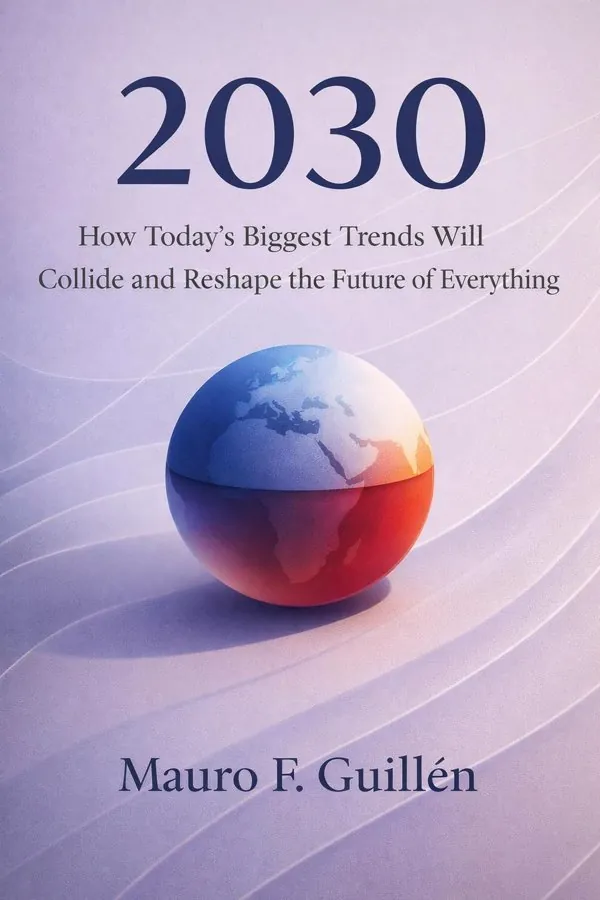
2030: How Today's Biggest Trends Will Collide and Reshape the Future of Everything
Mauro F. Guillén
10 min
A Very Human Future: Enriching Humanity in a Digitized World
Rohit Talwar, Steve Wells, Alexandra Whittington
10 min
AI 2041: Ten Visions for Our Future
Kai-Fu Lee, Chen Qiufan
10 min
Abundance: The Future Is Better Than You Think
Peter H. Diamandis, Steven Kotler
10 min
After Shock: The World's Foremost Futurists Reflect on 50 Years of Future Shock—and Look Ahead to the Next 50
John Schroeter (Editor)
10 minBrowse by Category
Ready to read The Third Wave?
Get the full summary and 100K+ more books with Fizz Moment.