
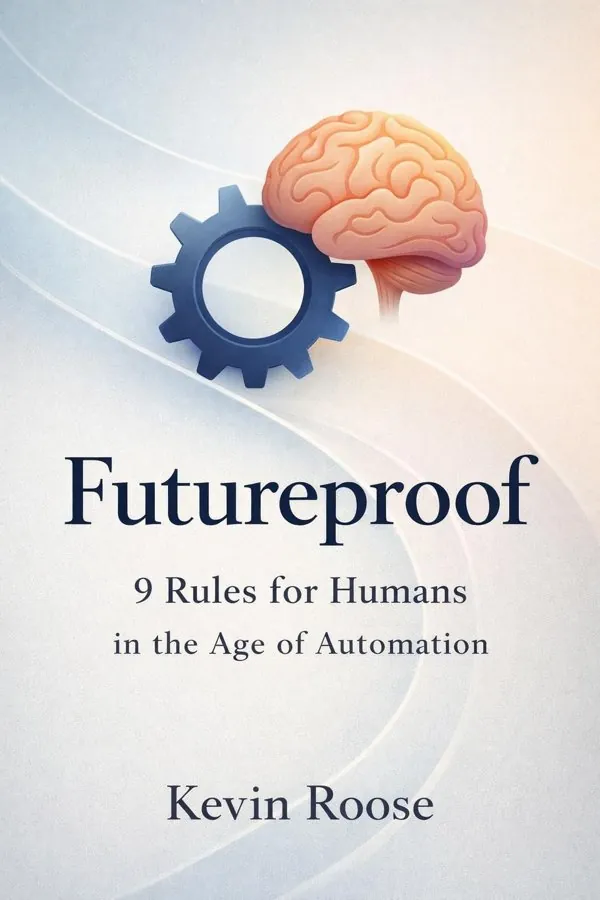
Futureproof: 9 Rules for Humans in the Age of Automation: Summary & Key Insights
by Kevin Roose
 10 min9 chaptersAudio available
Key Takeaways from Futureproof: 9 Rules for Humans in the Age of Automation
If your work can be broken into clear steps, measured efficiently, and repeated at scale, it becomes a candidate for software, AI, or outsourcing.
In an automated world, the qualities once dismissed as soft become strategically hard to replace.
A machine can often outperform a human at doing the ordinary faster and cheaper.
Technology can optimize transactions, but it struggles to replicate genuine human connection.
The future does not belong only to humans or only to machines; it belongs to teams where each does what it does best.
What Is Futureproof: 9 Rules for Humans in the Age of Automation About?
Futureproof: 9 Rules for Humans in the Age of Automation by Kevin Roose is a future_trends book. Automation is no longer a distant possibility reserved for factories and science fiction. It is already reshaping offices, hospitals, classrooms, logistics networks, and even the creative industries. In Futureproof, journalist Kevin Roose asks a pressing question: if machines are getting better at more and more tasks, what should humans focus on to remain valuable, adaptable, and fulfilled? Rather than offering fearmongering predictions about robots taking over, he delivers a practical guide for surviving and thriving in a world increasingly organized around algorithms, software, and artificial intelligence. Roose brings credibility to this subject through his work as a technology columnist and reporter who has spent years analyzing Silicon Valley, digital culture, and the real-world effects of technological change. His strength lies in translating big trends into human terms. This book matters because it shifts the conversation from panic to preparation. Instead of asking which jobs will disappear, Roose asks which distinctly human qualities will matter more. The result is a smart, encouraging framework for anyone who wants to build a career, mindset, and life that cannot easily be automated away.
This FizzRead summary covers all 9 key chapters of Futureproof: 9 Rules for Humans in the Age of Automation in approximately 10 minutes, distilling the most important ideas, arguments, and takeaways from Kevin Roose's work. Also available as an audio summary and Key Quotes Podcast.
Futureproof: 9 Rules for Humans in the Age of Automation
Automation is no longer a distant possibility reserved for factories and science fiction. It is already reshaping offices, hospitals, classrooms, logistics networks, and even the creative industries. In Futureproof, journalist Kevin Roose asks a pressing question: if machines are getting better at more and more tasks, what should humans focus on to remain valuable, adaptable, and fulfilled? Rather than offering fearmongering predictions about robots taking over, he delivers a practical guide for surviving and thriving in a world increasingly organized around algorithms, software, and artificial intelligence.
Roose brings credibility to this subject through his work as a technology columnist and reporter who has spent years analyzing Silicon Valley, digital culture, and the real-world effects of technological change. His strength lies in translating big trends into human terms. This book matters because it shifts the conversation from panic to preparation. Instead of asking which jobs will disappear, Roose asks which distinctly human qualities will matter more. The result is a smart, encouraging framework for anyone who wants to build a career, mindset, and life that cannot easily be automated away.
Who Should Read Futureproof: 9 Rules for Humans in the Age of Automation?
This book is perfect for anyone interested in future_trends and looking to gain actionable insights in a short read. Whether you're a student, professional, or lifelong learner, the key ideas from Futureproof: 9 Rules for Humans in the Age of Automation by Kevin Roose will help you think differently.
- ✓Readers who enjoy future_trends and want practical takeaways
- ✓Professionals looking to apply new ideas to their work and life
- ✓Anyone who wants the core insights of Futureproof: 9 Rules for Humans in the Age of Automation in just 10 minutes
Want the full summary?
Get instant access to this book summary and 100K+ more with Fizz Moment.
Get Free SummaryAvailable on App Store • Free to download
Key Chapters
The uncomfortable truth about automation is that machines do not simply replace low-paid manual work; they also threaten white-collar jobs built around repetition, predictability, and rules. If your work can be broken into clear steps, measured efficiently, and repeated at scale, it becomes a candidate for software, AI, or outsourcing. Roose argues that the real dividing line is not blue collar versus white collar, but routine versus nonroutine.
This matters because many people mistakenly assume that education or status alone protects them. In reality, bookkeeping, basic legal review, data entry, scheduling, and standard reporting are all vulnerable because they follow recognizable patterns. By contrast, jobs that involve ambiguity, interpersonal nuance, judgment, and adaptation are harder to automate. A therapist reading emotion, a teacher motivating different students, a product leader navigating uncertainty, or a nurse calming a frightened patient all do work that extends beyond formal instructions.
Roose encourages readers to examine their own roles honestly. Which parts of your job are repetitive? Which parts rely on human trust, interpretation, improvisation, or relationship-building? A marketer who only produces templated performance reports is exposed; a marketer who translates customer psychology into strategy is more secure. A manager who only tracks deadlines can be replaced by software; a manager who resolves conflict and inspires teams is harder to automate.
The practical application is to redesign your work around the tasks machines struggle with most. Volunteer for projects that require cross-functional collaboration. Take ownership of messy problems. Build expertise in contexts where data is incomplete and the answer is not obvious.
Actionable takeaway: audit your job this week and identify three routine tasks to automate, delegate, or reduce, then spend more time on work that requires judgment, trust, and creativity.
In an automated world, the qualities once dismissed as soft become strategically hard to replace. Roose makes the case that empathy, communication, creativity, ethical judgment, and emotional intelligence are not secondary skills; they are becoming core assets. The rise of machines actually increases the value of the traits machines lack.
This is a major mindset shift. For decades, many organizations rewarded efficiency, standardization, and technical specialization. But as software grows better at speed and precision, the uniquely human contribution changes. A doctor may use AI to interpret scans, but patients still need trust, reassurance, and nuanced explanation. A sales team may rely on predictive analytics, yet high-value deals still depend on relationships and credibility. Even in technical fields, professionals who can listen, frame problems, and unite people around decisions often outperform those who rely on expertise alone.
Roose does not suggest abandoning technical skill. Instead, he argues for pairing it with human depth. The engineer who can explain tradeoffs clearly will lead. The analyst who can present data in a compelling story will influence. The founder who can sense unspoken fears in a room will negotiate better. These abilities are practical, trainable, and increasingly valuable because they create differentiation where machines level the technical playing field.
To apply this idea, treat human skills as disciplines rather than personality traits. Practice active listening. Learn how to ask better questions. Study conflict resolution, persuasion, and storytelling. Notice where your work depends on trust and interpretation, then strengthen those muscles deliberately.
Actionable takeaway: choose one human skill to improve over the next month, such as listening, public speaking, or coaching, and practice it in real interactions until it becomes a professional advantage.
A machine can often outperform a human at doing the ordinary faster and cheaper. Roose therefore urges readers to stop competing on pure efficiency alone and start becoming more interesting. By interesting, he means cultivating a perspective, combination of skills, or style of contribution that is difficult to standardize. Futureproof people are not generic workers; they are memorable because they bring originality, taste, curiosity, and synthesis.
This idea is especially relevant in careers facing commoditization. If you write formulaic content, AI tools can generate alternatives. If you create average presentations, templates can do much of the work. But if you can connect ideas across disciplines, detect cultural shifts early, frame fresh questions, or produce work with a distinctive point of view, you create value beyond standardized output. The same principle applies to entrepreneurship. Businesses that merely optimize existing models are easier to copy, while those that create emotional resonance or unique customer experiences stand out.
Roose suggests that interestingness often comes from unexpected combinations. A programmer who understands design and psychology can build better products. A healthcare professional who understands data and bedside communication can improve patient outcomes. A finance expert who writes clearly for broad audiences can become indispensable. Distinctiveness often lies at the intersection of domains.
Practically, this means developing side interests, learning outside your profession, and resisting over-specialization that narrows your lens too much. Read broadly. Follow technology, culture, economics, and human behavior. The goal is not randomness but richer pattern recognition. Interesting people notice what others miss because they draw from wider reservoirs of knowledge and experience.
Actionable takeaway: map your current skill set, then choose one adjacent field or passion to explore deeply so you can build a rare combination that machines and competitors cannot easily replicate.
Technology can optimize transactions, but it struggles to replicate genuine human connection. Roose emphasizes that one of the strongest defenses against automation is becoming someone people want to work with, learn from, and trust. Networks, reputation, and community are not optional career accessories; they are resilience systems.
This matters because automated systems often remove the transactional parts of work while making relational value even more important. For example, travel platforms can book flights instantly, but an advisor who understands a client’s anxieties and preferences still matters for complex trips. HR software can screen applicants, but leaders who mentor talent and create belonging shape organizations in ways platforms cannot. In freelance and entrepreneurial settings, clients often choose based on reliability, chemistry, and confidence as much as raw competence.
Roose’s point is not to network superficially. The future favors people who invest in durable, mutual relationships rather than collecting contacts. A strong professional network provides information, opportunities, recommendations, and emotional support during disruption. It also helps you stay aware of changing market needs. If automation changes your role, relationships often create the bridge to your next one.
To put this into practice, prioritize generosity and consistency. Share useful insights. Introduce people who should know each other. Follow up after meetings. Build a reputation for thoughtful collaboration. Inside organizations, become known as someone who reduces friction and elevates group performance. Outside them, participate in communities where ideas and opportunities circulate.
Actionable takeaway: strengthen five important relationships this month by reaching out with something useful, thoughtful, or supportive rather than waiting until you need help.
The future does not belong only to humans or only to machines; it belongs to teams where each does what it does best. Roose argues that resisting technology entirely is a losing strategy. The more durable approach is learning how to collaborate with automation so you can extend your capabilities instead of being displaced by them.
Machines excel at speed, scale, data processing, pattern detection, and consistency. Humans excel at context, values, interpretation, adaptation, and relationship management. The most effective workers combine these strengths. A doctor using AI diagnostic tools can analyze more cases while still making nuanced treatment decisions. A recruiter can use software to identify candidates, then rely on human judgment to assess motivation and cultural fit. A writer may use AI for research support or brainstorming, while preserving voice, structure, and editorial judgment.
Roose’s framework encourages readers to ask not "How do I beat the machine?" but "How do I become better because the machine exists?" This means understanding what tools can do, where they fail, and how to supervise them intelligently. It also means becoming comfortable with experimentation. The people who benefit most from automation are often the ones willing to test tools early and redesign workflows around them.
A practical application is to identify bottlenecks in your work. Which tasks eat up time but add limited strategic value? Where could software handle the first pass, leaving you to refine, interpret, or personalize the result? Collaboration with machines is strongest when humans stay accountable for outcomes, ethics, and quality.
Actionable takeaway: choose one AI or automation tool relevant to your field and spend two weeks learning how it can remove low-value work while preserving your role in judgment, quality, and decision-making.
One of the biggest career risks in an age of rapid automation is assuming the future will unfold in a stable, predictable way. Roose warns against overly rigid plans built on static job descriptions or narrow identities. When industries transform quickly, adaptability becomes more valuable than certainty.
Traditional career advice often assumes a relatively linear path: choose a field, gain expertise, climb the ladder, and remain in that lane. But technological change disrupts this logic. Entire categories of work evolve, merge, or disappear. The people most likely to thrive are not those who guessed the future perfectly but those who can pivot when conditions change. Flexibility means staying curious, continuously learning, and being willing to revise your assumptions about what your career should look like.
This applies at every level. A customer support specialist may transition into user research after learning customer psychology. A teacher may move into instructional design as education technology expands. A journalist may blend reporting with data analysis, audience strategy, or multimedia storytelling. Adaptive careers are built through transferable capabilities rather than dependence on a single title.
Roose encourages readers to think in portfolios, not fixed boxes. Develop a mix of skills, experiences, and interests that can travel across roles. Keep scanning for weak signals in your industry. Notice what employers are starting to value. Build optionality so that change feels like movement rather than collapse.
Practically, this means updating skills before a crisis forces you to. It also means becoming less attached to prestige labels and more focused on durable usefulness. Flexibility is not aimlessness; it is structured responsiveness.
Actionable takeaway: identify one emerging trend affecting your field and commit to a learning plan that expands your options before disruption turns urgent.
As machines take over more tasks, the question is not only how humans stay employed, but how humans stay fulfilled. Roose highlights an often-overlooked issue: efficiency does not automatically lead to meaning. Even if automation makes life easier, people still need purpose, agency, and a sense that their efforts matter.
This is important because modern work is about more than income. Jobs provide identity, social connection, structure, and contribution. If automation strips out challenge or compresses people into monitoring systems they barely influence, workers may feel alienated even when productivity rises. A futureproof life therefore requires more than technical survival. It requires designing work and routines that preserve dignity and significance.
Roose’s insight pushes readers to ask deeper questions about their careers. What kind of contribution feels meaningful to you? Which parts of your work make you feel most alive or useful? How can you steer toward roles where human presence is genuinely needed? For some, meaning comes from service, such as healthcare, education, or coaching. For others, it comes from creativity, community-building, or solving complex problems. Automation may handle parts of these jobs, but the human mission remains.
A practical application is to separate output from purpose. You may not control every tool your organization adopts, but you can often shape how you create value within the system. Look for work that involves helping others, making decisions that matter, or creating experiences people remember. Meaning is often strongest where human impact is visible.
Actionable takeaway: write down the two moments in your recent work that felt most meaningful, then look for ways to increase the proportion of your time spent on similar activities.
The more decisions we hand to algorithms, the more important human judgment becomes. Roose stresses that automation is never just a technical story; it is also a moral one. Machines can optimize for speed and prediction, but they do not understand fairness, dignity, accountability, or the broader consequences of their outputs unless humans deliberately build and supervise those values.
This idea is crucial because automated systems increasingly affect hiring, credit, policing, medicine, education, and media. If these systems inherit biased data or poorly chosen incentives, they can scale harm efficiently. A hiring algorithm may favor the patterns of past employees and silently perpetuate discrimination. A recommendation system may maximize engagement while spreading outrage or misinformation. In these cases, the problem is not that machines are evil; it is that humans failed to govern them wisely.
Roose argues that being futureproof includes developing ethical literacy. Workers, managers, and citizens need to ask better questions about the systems they use. What is this tool optimizing for? Who might be disadvantaged by it? What happens when it gets things wrong? Who is accountable? This is not a niche concern limited to engineers. Anyone involved in selecting, deploying, or relying on automated systems should be able to challenge them.
In practice, ethical judgment means slowing down at key moments. It means testing technology in context, seeking diverse perspectives, and resisting the temptation to outsource difficult decisions to supposedly objective tools. Human oversight is not inefficiency; it is responsibility.
Actionable takeaway: the next time your team adopts a new automated tool, ask three ethical questions about bias, accountability, and unintended consequences before fully trusting its output.
What once looked like career instability may soon become the normal path of healthy adaptation. Roose’s broader message is that in the age of automation, stability no longer comes from standing still. It comes from continuous reinvention. The ability to learn, unlearn, and reconfigure yourself is becoming a foundational life skill.
This can sound exhausting, but Roose frames it as empowering. You do not need to predict every technological shift. You need a repeatable process for responding to change. That process includes curiosity, experimentation, self-awareness, and the willingness to let go of outdated versions of yourself. Reinvention is not a one-time dramatic event; it is a regular practice of adjusting how you work, what you learn, and where you create value.
Examples of reinvention are everywhere. A retail worker learns e-commerce operations. A lawyer develops expertise in technology policy. A designer shifts from static graphics to user experience strategy. A mid-career manager learns data fluency and becomes more effective in digital transformation. In each case, the person remains grounded in core strengths while evolving the form those strengths take.
The practical lesson is to create systems for growth instead of waiting for motivation. Schedule regular skill reviews. Track which parts of your work are becoming more automated. Seek feedback on where your uniquely human strengths show up most clearly. Reinvention is easier when it is proactive and incremental rather than reactive and forced.
Actionable takeaway: set a quarterly personal upgrade ritual where you review your skills, industry trends, and opportunities, then choose one capability to build and one outdated habit to retire.
All Chapters in Futureproof: 9 Rules for Humans in the Age of Automation
About the Author
Kevin Roose is a journalist, author, and technology columnist known for making complex digital trends understandable to broad audiences. He has written extensively about Silicon Valley, artificial intelligence, social media, automation, and the way technology reshapes work and daily life. Roose has been a prominent voice at The New York Times, where his reporting often blends sharp analysis with on-the-ground curiosity about how systems actually affect people. His earlier books and articles explored themes of work, productivity, and the hidden structures of modern institutions. In Futureproof, he brings together his strengths as a reporter and explainer, offering practical guidance for navigating the future of work. His writing is valued for being insightful, accessible, and grounded in real-world implications rather than abstract tech hype.
Get This Summary in Your Preferred Format
Read or listen to the Futureproof: 9 Rules for Humans in the Age of Automation summary by Kevin Roose anytime, anywhere. FizzRead offers multiple formats so you can learn on your terms — all free.
Available formats: App · Audio · PDF · EPUB — All included free with FizzRead
Download Futureproof: 9 Rules for Humans in the Age of Automation PDF and EPUB Summary
Key Quotes from Futureproof: 9 Rules for Humans in the Age of Automation
“The uncomfortable truth about automation is that machines do not simply replace low-paid manual work; they also threaten white-collar jobs built around repetition, predictability, and rules.”
“In an automated world, the qualities once dismissed as soft become strategically hard to replace.”
“A machine can often outperform a human at doing the ordinary faster and cheaper.”
“Technology can optimize transactions, but it struggles to replicate genuine human connection.”
“The future does not belong only to humans or only to machines; it belongs to teams where each does what it does best.”
Frequently Asked Questions about Futureproof: 9 Rules for Humans in the Age of Automation
Futureproof: 9 Rules for Humans in the Age of Automation by Kevin Roose is a future_trends book that explores key ideas across 9 chapters. Automation is no longer a distant possibility reserved for factories and science fiction. It is already reshaping offices, hospitals, classrooms, logistics networks, and even the creative industries. In Futureproof, journalist Kevin Roose asks a pressing question: if machines are getting better at more and more tasks, what should humans focus on to remain valuable, adaptable, and fulfilled? Rather than offering fearmongering predictions about robots taking over, he delivers a practical guide for surviving and thriving in a world increasingly organized around algorithms, software, and artificial intelligence. Roose brings credibility to this subject through his work as a technology columnist and reporter who has spent years analyzing Silicon Valley, digital culture, and the real-world effects of technological change. His strength lies in translating big trends into human terms. This book matters because it shifts the conversation from panic to preparation. Instead of asking which jobs will disappear, Roose asks which distinctly human qualities will matter more. The result is a smart, encouraging framework for anyone who wants to build a career, mindset, and life that cannot easily be automated away.
More by Kevin Roose
You Might Also Like

The Third Wave
Alvin Toffler
10 min
2030: How Today's Biggest Trends Will Collide and Reshape the Future of Everything
Mauro F. Guillén
10 min
A Very Human Future: Enriching Humanity in a Digitized World
Rohit Talwar, Steve Wells, Alexandra Whittington
10 min
AI 2041: Ten Visions for Our Future
Kai-Fu Lee, Chen Qiufan
10 min
Abundance: The Future Is Better Than You Think
Peter H. Diamandis, Steven Kotler
10 min
After Shock: The World's Foremost Futurists Reflect on 50 Years of Future Shock—and Look Ahead to the Next 50
John Schroeter (Editor)
10 minBrowse by Category
Ready to read Futureproof: 9 Rules for Humans in the Age of Automation?
Get the full summary and 100K+ more books with Fizz Moment.