
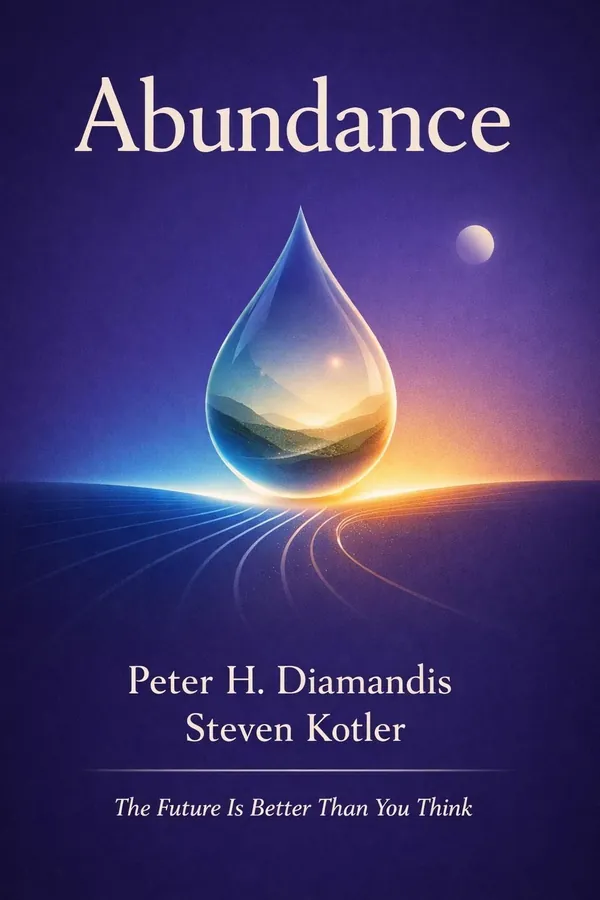
Abundance: The Future Is Better Than You Think: Summary & Key Insights
by Peter H. Diamandis, Steven Kotler
 10 min13 chaptersAudio available
What Is Abundance: The Future Is Better Than You Think About?
Abundance: The Future Is Better Than You Think by Peter H. Diamandis, Steven Kotler is a future_trends book spanning 13 pages. Abundance ofrece una visión optimista del futuro argumentando que la humanidad está avanzando hacia una era en la que la escasez será superada. Los autores muestran cómo los avances tecnológicos, desde la inteligencia artificial hasta la biotecnología y la robótica, pueden resolver los grandes desafíos globales de agua, comida, energía y educación. Presentan ejemplos concretos de innovadores y emprendedores que están mejorando la vida de millones de personas.
This FizzRead summary covers all 13 key chapters of Abundance: The Future Is Better Than You Think in approximately 10 minutes, distilling the most important ideas, arguments, and takeaways from Peter H. Diamandis, Steven Kotler's work. Also available as an audio summary and Key Quotes Podcast.
Abundance: The Future Is Better Than You Think
Abundance ofrece una visión optimista del futuro argumentando que la humanidad está avanzando hacia una era en la que la escasez será superada. Los autores muestran cómo los avances tecnológicos, desde la inteligencia artificial hasta la biotecnología y la robótica, pueden resolver los grandes desafíos globales de agua, comida, energía y educación. Presentan ejemplos concretos de innovadores y emprendedores que están mejorando la vida de millones de personas.
Who Should Read Abundance: The Future Is Better Than You Think?
This book is perfect for anyone interested in future_trends and looking to gain actionable insights in a short read. Whether you're a student, professional, or lifelong learner, the key ideas from Abundance: The Future Is Better Than You Think by Peter H. Diamandis, Steven Kotler will help you think differently.
- ✓Readers who enjoy future_trends and want practical takeaways
- ✓Professionals looking to apply new ideas to their work and life
- ✓Anyone who wants the core insights of Abundance: The Future Is Better Than You Think in just 10 minutes
Want the full summary?
Get instant access to this book summary and 100K+ more with Fizz Moment.
Get Free SummaryAvailable on App Store • Free to download
Key Chapters
Human progress can feel invisible because it often moves at a slow crawl compared to the speed of our fears. To appreciate abundance, we first need historical perspective. Throughout history, our species has battled scarcity—scarcity of resources, of knowledge, of safety. Yet time and again, innovation has transformed limits into launchpads.
In the pre-industrial world, life expectancy hovered around 30 years; hunger and disease were constants. But every major leap—agriculture, the printing press, the industrial revolution—expanded our capacity to provide for and protect more lives. The story of humanity, as we tell it here, is one of compounding improvement driven by curiosity and necessity. Even as population soared, productivity soared faster. The Green Revolution multiplied food output using science and fertilizer. Clean water systems and sanitation cut mortality rates. Communication technologies connected minds across continents, vastly accelerating innovation.
Today, the pace has become exponential. Moore’s Law and similar dynamics in information technology mean that breakthroughs build upon each other, self-amplifying year by year. Seen historically, abundance is the next logical chapter. The arc of progress bends toward the democratization of access—toward making what was once scarce available to everyone.
At the heart of abundance lies exponential growth—the phenomenon that explains how computing, robotics, biotechnology, and artificial intelligence are not merely improving but accelerating at an accelerating rate. Most people intuitively think in linear terms: one step forward, another step forward. But technology moves geometrically: doubling upon doubling, compounding power until systems that seemed toys a decade ago become world-changing today.
When we wrote this book, we focused on what Ray Kurzweil calls “exponential technologies,” each a driver of transformative progress. Computing power expands capacity across all fields: big data redefines healthcare, AI enhances precision agriculture, and robotic manufacturing democratizes production. Biotechnology, with genetic and synthetic tools, enables custom crops, clean biofuels, and personalized medicine faster than ever before.
What matters most is convergence. When robotics meets AI, when nanotechnology meets digital manufacturing, their combined impact transforms entire sectors. These are not isolated revolutions but interlocking gears of global change. The exponential engine enables abundance because once innovation becomes digital, it becomes democratized. 3D printing allows anyone to prototype; AI algorithms open expertise to the masses; the cloud makes computing global.
We no longer rely solely on governments or giant corporations to solve massive problems. Today, exponential tools empower small teams to achieve large-scale impact, reshaping the economy from centralized scarcity to distributed abundance.
+ 11 more chapters — available in the FizzRead app
All Chapters in Abundance: The Future Is Better Than You Think
About the Authors
Peter H. Diamandis es un ingeniero estadounidense conocido por fundar XPRIZE Foundation y Singularity University. Steven Kotler es periodista y autor especializado en ciencia y tecnología del rendimiento humano.
Get This Summary in Your Preferred Format
Read or listen to the Abundance: The Future Is Better Than You Think summary by Peter H. Diamandis, Steven Kotler anytime, anywhere. FizzRead offers multiple formats so you can learn on your terms — all free.
Available formats: App · Audio · PDF · EPUB — All included free with FizzRead
Download Abundance: The Future Is Better Than You Think PDF and EPUB Summary
Key Quotes from Abundance: The Future Is Better Than You Think
“Human progress can feel invisible because it often moves at a slow crawl compared to the speed of our fears.”
“Most people intuitively think in linear terms: one step forward, another step forward.”
Frequently Asked Questions about Abundance: The Future Is Better Than You Think
Abundance: The Future Is Better Than You Think by Peter H. Diamandis, Steven Kotler is a future_trends book that explores key ideas across 13 chapters. Abundance ofrece una visión optimista del futuro argumentando que la humanidad está avanzando hacia una era en la que la escasez será superada. Los autores muestran cómo los avances tecnológicos, desde la inteligencia artificial hasta la biotecnología y la robótica, pueden resolver los grandes desafíos globales de agua, comida, energía y educación. Presentan ejemplos concretos de innovadores y emprendedores que están mejorando la vida de millones de personas.
More by Peter H. Diamandis, Steven Kotler


You Might Also Like
Futureproof: 9 Rules for Humans in the Age of Automation
Kevin Roose
10 min
The Third Wave
Alvin Toffler
10 min
2030: How Today's Biggest Trends Will Collide and Reshape the Future of Everything
Mauro F. Guillén
10 min
A Very Human Future: Enriching Humanity in a Digitized World
Rohit Talwar, Steve Wells, Alexandra Whittington
10 min
AI 2041: Ten Visions for Our Future
Kai-Fu Lee, Chen Qiufan
10 min
After Shock: The World's Foremost Futurists Reflect on 50 Years of Future Shock—and Look Ahead to the Next 50
John Schroeter (Editor)
10 minFeatured In
Browse by Category
Ready to read Abundance: The Future Is Better Than You Think?
Get the full summary and 100K+ more books with Fizz Moment.