
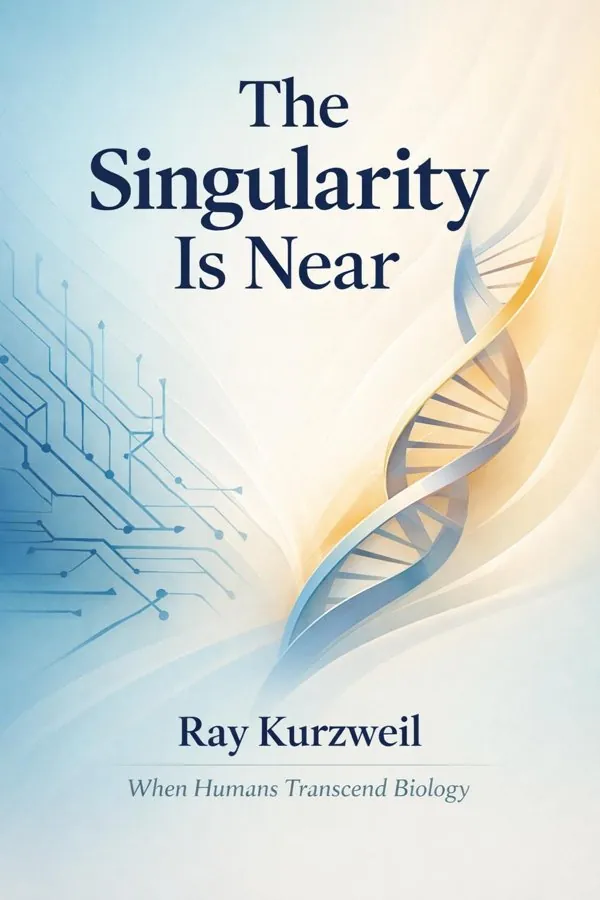
The Singularity Is Near: When Humans Transcend Biology: Summary & Key Insights
by Ray Kurzweil
 10 min12 chaptersAudio available
What Is The Singularity Is Near: When Humans Transcend Biology About?
The Singularity Is Near: When Humans Transcend Biology by Ray Kurzweil is a future_trends book spanning 12 pages. In this influential work, inventor and futurist Ray Kurzweil explores the accelerating pace of technological change and predicts a future where humans and machines merge. He argues that exponential growth in computing, genetics, nanotechnology, and robotics will lead to a 'singularity'—a point where artificial intelligence surpasses human intelligence, transforming civilization and redefining life itself.
This FizzRead summary covers all 12 key chapters of The Singularity Is Near: When Humans Transcend Biology in approximately 10 minutes, distilling the most important ideas, arguments, and takeaways from Ray Kurzweil's work. Also available as an audio summary and Key Quotes Podcast.
The Singularity Is Near: When Humans Transcend Biology
In this influential work, inventor and futurist Ray Kurzweil explores the accelerating pace of technological change and predicts a future where humans and machines merge. He argues that exponential growth in computing, genetics, nanotechnology, and robotics will lead to a 'singularity'—a point where artificial intelligence surpasses human intelligence, transforming civilization and redefining life itself.
Who Should Read The Singularity Is Near: When Humans Transcend Biology?
This book is perfect for anyone interested in future_trends and looking to gain actionable insights in a short read. Whether you're a student, professional, or lifelong learner, the key ideas from The Singularity Is Near: When Humans Transcend Biology by Ray Kurzweil will help you think differently.
- ✓Readers who enjoy future_trends and want practical takeaways
- ✓Professionals looking to apply new ideas to their work and life
- ✓Anyone who wants the core insights of The Singularity Is Near: When Humans Transcend Biology in just 10 minutes
Want the full summary?
Get instant access to this book summary and 100K+ more with Fizz Moment.
Get Free SummaryAvailable on App Store • Free to download
Key Chapters
For decades, economic models and scientific projections assumed that progress moved linearly—slow, steady, predictable. Yet the evidence tells a different story. I illustrate how every major advance in computation, from the vacuum tube to the integrated circuit, follows an exponential curve. Each generation of technology builds not just upon the previous one, but upon the rate of growth itself, creating a cascade of acceleration. This law is not confined to silicon; evolution itself is exponential. Biological evolution produced increasingly complex organisms in ever shorter timescales, culminating in the human brain—a computational miracle born from iterative acceleration.
The reason this matters is that most human intuitions are linear; we underestimate the speed of change. The rhythm of progress is doubling, not adding. I show that when this curve is extended, even modest extrapolations lead to extraordinary outcomes: computing power sufficient to emulate the human brain by the 2030s, nanobots able to sustain our cellular health, and artificial intelligences capable of rewriting their own code. Once acceleration becomes visible, you realize that the future is not distant—it’s unfolding right now.
The story of acceleration reaches back through history. I draw parallels between the evolution of life and the development of technology: DNA as the first information processor, neurons as a biological computer network, and civilization as a vast data transformation system. I examine data series from computation and communication technologies—from Moore’s Law to the shrinking of transistors—to reveal a universal pattern. Whether it’s the time taken for technology adoption or the falling cost of information storage, the curves are all exponential.
But beyond technology, I trace how knowledge itself compounds. When one discovery enables the next, acceleration becomes self-perpetuating. The print revolution preceded the scientific revolution; the computing revolution gives rise to the age of artificial cognition. These feedback loops ensure that progress feeds upon progress, and the pace of change becomes the defining condition of our era. Understanding these historical arcs is key to accepting that today’s transformations are not anomalies but continuations of a deep evolutionary rhythm.
+ 10 more chapters — available in the FizzRead app
All Chapters in The Singularity Is Near: When Humans Transcend Biology
About the Author
Ray Kurzweil is an American inventor, author, and futurist known for his pioneering work in optical character recognition, text-to-speech synthesis, and artificial intelligence. He has written several books on technology and the future, and serves as a director of engineering at Google.
Get This Summary in Your Preferred Format
Read or listen to the The Singularity Is Near: When Humans Transcend Biology summary by Ray Kurzweil anytime, anywhere. FizzRead offers multiple formats so you can learn on your terms — all free.
Available formats: App · Audio · PDF · EPUB — All included free with FizzRead
Download The Singularity Is Near: When Humans Transcend Biology PDF and EPUB Summary
Key Quotes from The Singularity Is Near: When Humans Transcend Biology
“For decades, economic models and scientific projections assumed that progress moved linearly—slow, steady, predictable.”
“The story of acceleration reaches back through history.”
Frequently Asked Questions about The Singularity Is Near: When Humans Transcend Biology
The Singularity Is Near: When Humans Transcend Biology by Ray Kurzweil is a future_trends book that explores key ideas across 12 chapters. In this influential work, inventor and futurist Ray Kurzweil explores the accelerating pace of technological change and predicts a future where humans and machines merge. He argues that exponential growth in computing, genetics, nanotechnology, and robotics will lead to a 'singularity'—a point where artificial intelligence surpasses human intelligence, transforming civilization and redefining life itself.
More by Ray Kurzweil
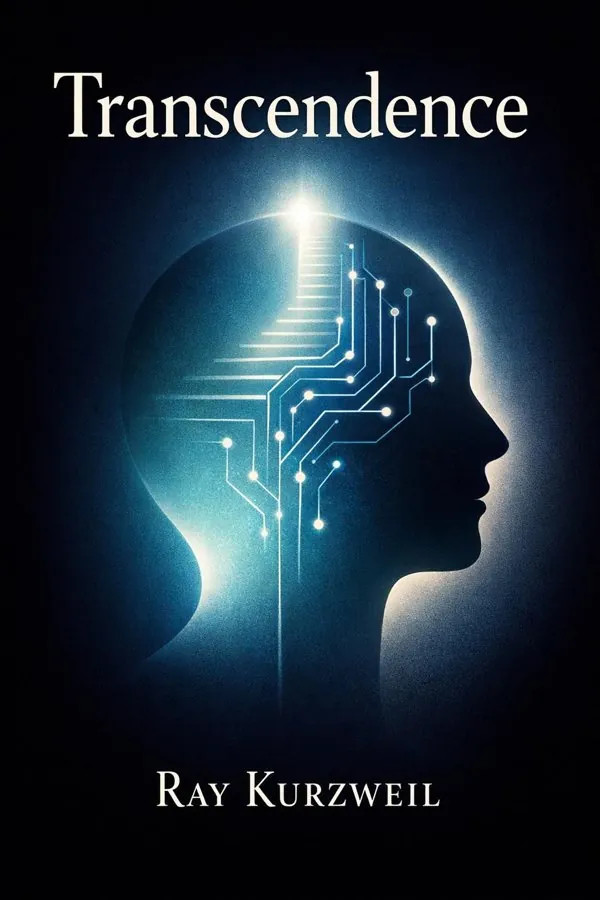
You Might Also Like
Futureproof: 9 Rules for Humans in the Age of Automation
Kevin Roose
10 min
The Third Wave
Alvin Toffler
10 min
2030: How Today's Biggest Trends Will Collide and Reshape the Future of Everything
Mauro F. Guillén
10 min
A Very Human Future: Enriching Humanity in a Digitized World
Rohit Talwar, Steve Wells, Alexandra Whittington
10 min
AI 2041: Ten Visions for Our Future
Kai-Fu Lee, Chen Qiufan
10 min
Abundance: The Future Is Better Than You Think
Peter H. Diamandis, Steven Kotler
10 minBrowse by Category
Ready to read The Singularity Is Near: When Humans Transcend Biology?
Get the full summary and 100K+ more books with Fizz Moment.