
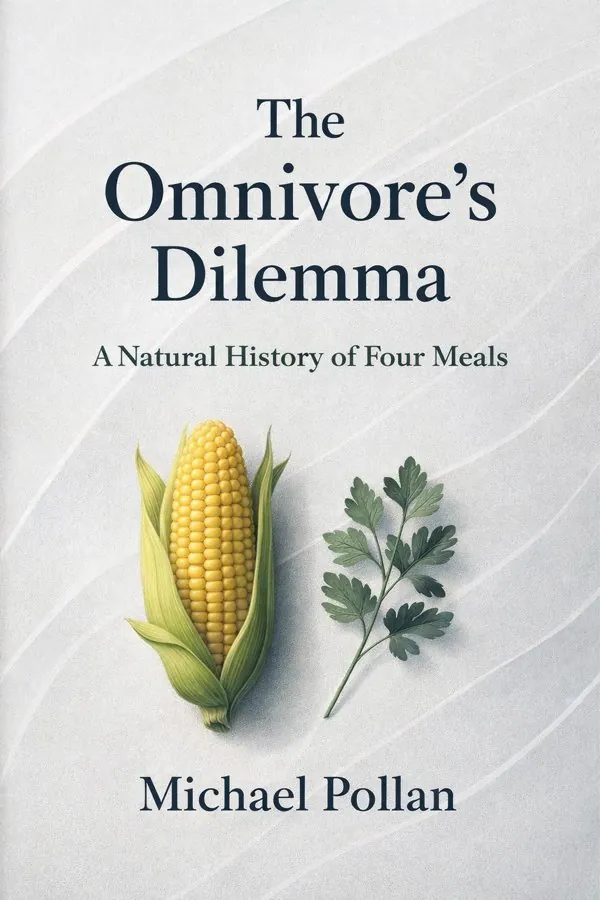
The Omnivore’s Dilemma: A Natural History of Four Meals: Summary & Key Insights
 10 min9 chaptersAudio available
What Is The Omnivore’s Dilemma: A Natural History of Four Meals About?
The Omnivore’s Dilemma: A Natural History of Four Meals by Michael Pollan is a environment book spanning 9 pages. In this influential work, Michael Pollan explores the origins and consequences of the modern food chain. He traces four meals—from industrial agriculture to organic farming and foraging—revealing how our food choices affect our health, the environment, and society. The book challenges readers to reconsider what it means to eat ethically and sustainably in a complex global food system.
This FizzRead summary covers all 9 key chapters of The Omnivore’s Dilemma: A Natural History of Four Meals in approximately 10 minutes, distilling the most important ideas, arguments, and takeaways from Michael Pollan's work. Also available as an audio summary and Key Quotes Podcast.
The Omnivore’s Dilemma: A Natural History of Four Meals
In this influential work, Michael Pollan explores the origins and consequences of the modern food chain. He traces four meals—from industrial agriculture to organic farming and foraging—revealing how our food choices affect our health, the environment, and society. The book challenges readers to reconsider what it means to eat ethically and sustainably in a complex global food system.
Who Should Read The Omnivore’s Dilemma: A Natural History of Four Meals?
This book is perfect for anyone interested in environment and looking to gain actionable insights in a short read. Whether you're a student, professional, or lifelong learner, the key ideas from The Omnivore’s Dilemma: A Natural History of Four Meals by Michael Pollan will help you think differently.
- ✓Readers who enjoy environment and want practical takeaways
- ✓Professionals looking to apply new ideas to their work and life
- ✓Anyone who wants the core insights of The Omnivore’s Dilemma: A Natural History of Four Meals in just 10 minutes
Want the full summary?
Get instant access to this book summary and 100K+ more with Fizz Moment.
Get Free SummaryAvailable on App Store • Free to download
Key Chapters
The story begins in a cornfield. Corn, I discovered, is the cornerstone of the modern food system—the grain that feeds our livestock, sweetens our sodas, and thickens our soups. In the vast monocultures of the Midwest, thousands of acres are planted with a single species, Zea mays, sustained by synthetic fertilizers derived from fossil fuels. This industrial model is astonishingly efficient but ecologically blind. The soil beneath these fields is treated as a mere substrate for chemical inputs; biodiversity is sacrificed for uniformity and yield.
Tracing corn’s journey from seed to supermarket, I found it in nearly every product that lines grocery shelves. Cows in feedlots eat it, chickens consume it, and even fish in aquaculture are fed corn-based diets—despite the fact that none of these animals evolved to eat grain. The result is a biologically distorted food chain that transforms cheap calories into expensive consequences: obesity, heart disease, and environmental degradation.
The omnipresence of corn reflects deeper economic and political forces. Federal subsidies encourage its overproduction, making it cheaper to process corn into hundreds of derivatives like high-fructose corn syrup, maltodextrin, and modified starch. These compounds have replaced natural ingredients in thousands of foods. I see corn not merely as a crop but as a metaphor for industrialization itself—our attempt to simplify nature’s complexity for the sake of profit and predictability. In eating industrial corn, we have disengaged from the ecological logic that once guided our ancestors: eating from the land’s diversity, not from a single factory crop.
As I followed corn deeper into the American diet, its ubiquity became almost surreal. Through industrial alchemy, corn becomes not just food but commodity—a raw material for nearly every substance that passes through our mouths or machines. This omnipresence reveals the invisible web connecting farmers, chemical manufacturers, animal feed producers, and ultimately consumers.
High-fructose corn syrup exemplifies this transformation. Invented in the 1970s, it reshaped the food industry by making sweetness cheap and abundant. Corn’s conversion into energy-dense processed foods also transformed public health: the average calorie intake soared, while our connection to real ingredients eroded. Eating became less about nourishment and more about consumption—the endless expansion of choice without awareness.
From my perspective, corn’s domination reflects a cultural problem as much as an agricultural one. We have come to expect food that is fast, uniform, and disconnected from its origins. By tracing corn’s path through the system, I wanted to expose how invisible this dependence has become. Understanding corn is understanding modern commerce and the way we’ve allowed a single plant to stand in for the diversity of nature itself.
+ 7 more chapters — available in the FizzRead app
All Chapters in The Omnivore’s Dilemma: A Natural History of Four Meals
About the Author
Michael Pollan is an American author, journalist, and professor known for his writings on food, agriculture, and the environment. His works, including 'The Botany of Desire' and 'In Defense of Food,' have shaped public discourse on sustainable eating and the cultural meaning of food.
Get This Summary in Your Preferred Format
Read or listen to the The Omnivore’s Dilemma: A Natural History of Four Meals summary by Michael Pollan anytime, anywhere. FizzRead offers multiple formats so you can learn on your terms — all free.
Available formats: App · Audio · PDF · EPUB — All included free with FizzRead
Download The Omnivore’s Dilemma: A Natural History of Four Meals PDF and EPUB Summary
Key Quotes from The Omnivore’s Dilemma: A Natural History of Four Meals
“Corn, I discovered, is the cornerstone of the modern food system—the grain that feeds our livestock, sweetens our sodas, and thickens our soups.”
“As I followed corn deeper into the American diet, its ubiquity became almost surreal.”
Frequently Asked Questions about The Omnivore’s Dilemma: A Natural History of Four Meals
The Omnivore’s Dilemma: A Natural History of Four Meals by Michael Pollan is a environment book that explores key ideas across 9 chapters. In this influential work, Michael Pollan explores the origins and consequences of the modern food chain. He traces four meals—from industrial agriculture to organic farming and foraging—revealing how our food choices affect our health, the environment, and society. The book challenges readers to reconsider what it means to eat ethically and sustainably in a complex global food system.
More by Michael Pollan
You Might Also Like
A Life on Our Planet: My Witness Statement and a Vision for the Future
David Attenborough
10 min
A Sky Full Of Birds
Matt Merritt
10 min
Carbon Zero: Imagining Cities That Can Save the Planet
Alex Steffen
10 min
Eaarth: Making a Life on a Tough New Planet
Bill McKibben
10 min
The Social Contract and Environmental Governance
Various Editors
10 min
The Wild Places
Robert Macfarlane
10 minBrowse by Category
Ready to read The Omnivore’s Dilemma: A Natural History of Four Meals?
Get the full summary and 100K+ more books with Fizz Moment.