
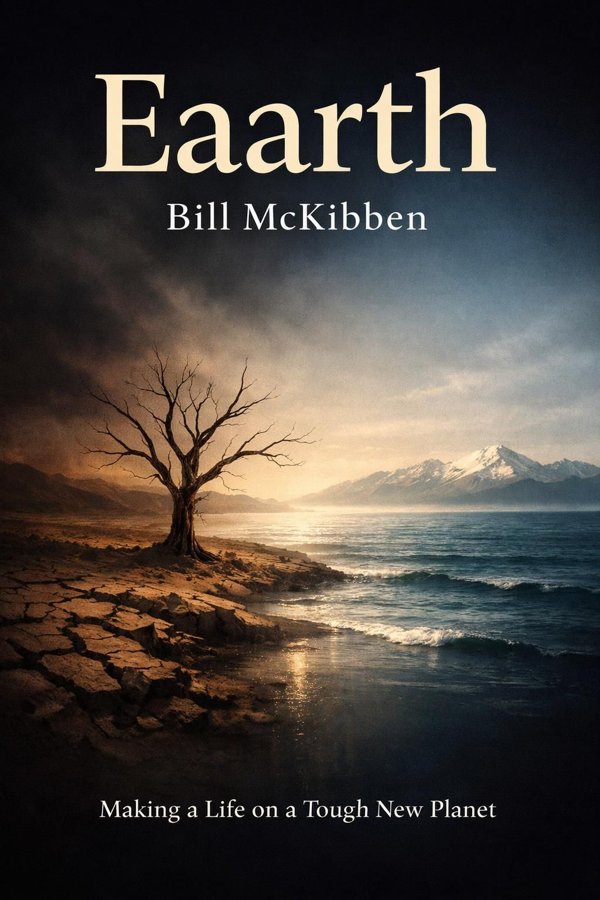
Eaarth: Making a Life on a Tough New Planet: Summary & Key Insights
 10 min8 chaptersAudio available
Key Takeaways from Eaarth: Making a Life on a Tough New Planet
The most unsettling idea in the book is also its central one: climate change is not something waiting in the future; it has already remade the conditions of life.
One of McKibben’s sharpest critiques is aimed at the modern obsession with endless growth.
A powerful insight running through Eaarth is that large-scale systems, once praised for efficiency, are often brittle in the face of disruption.
Climate change is often discussed as an environmental issue, but McKibben insists it is equally a question of everyday life.
Many people prefer to believe that technological innovation will solve climate change without requiring major cultural or economic shifts.
What Is Eaarth: Making a Life on a Tough New Planet About?
Eaarth: Making a Life on a Tough New Planet by Bill McKibben is a environment book. Bill McKibben’s Eaarth argues that climate change is no longer a distant warning but a lived reality that has already altered the planet so profoundly that we are effectively living on a different Earth—hence the altered spelling, “Eaarth.” Rather than asking how we can preserve the stable world in which human civilization developed, McKibben asks a harder question: how do we build meaningful, resilient lives on a harsher, less predictable planet? Drawing on climate science, economics, agriculture, and politics, he shows how rising temperatures, extreme weather, damaged ecosystems, and fragile global systems are reshaping daily life. What makes this book especially powerful is McKibben’s authority. He is one of the world’s most influential environmental writers and activists, known for translating complex climate science into moral, practical, and political terms. In Eaarth, he combines urgency with realism. He does not promise an easy return to normal. Instead, he urges communities to rethink scale, growth, energy use, food systems, and local resilience. The book matters because it shifts the climate conversation from prevention alone to adaptation, responsibility, and survival with dignity in a changed world.
This FizzRead summary covers all 8 key chapters of Eaarth: Making a Life on a Tough New Planet in approximately 10 minutes, distilling the most important ideas, arguments, and takeaways from Bill McKibben's work. Also available as an audio summary and Key Quotes Podcast.
Eaarth: Making a Life on a Tough New Planet
Bill McKibben’s Eaarth argues that climate change is no longer a distant warning but a lived reality that has already altered the planet so profoundly that we are effectively living on a different Earth—hence the altered spelling, “Eaarth.” Rather than asking how we can preserve the stable world in which human civilization developed, McKibben asks a harder question: how do we build meaningful, resilient lives on a harsher, less predictable planet? Drawing on climate science, economics, agriculture, and politics, he shows how rising temperatures, extreme weather, damaged ecosystems, and fragile global systems are reshaping daily life.
What makes this book especially powerful is McKibben’s authority. He is one of the world’s most influential environmental writers and activists, known for translating complex climate science into moral, practical, and political terms. In Eaarth, he combines urgency with realism. He does not promise an easy return to normal. Instead, he urges communities to rethink scale, growth, energy use, food systems, and local resilience. The book matters because it shifts the climate conversation from prevention alone to adaptation, responsibility, and survival with dignity in a changed world.
Who Should Read Eaarth: Making a Life on a Tough New Planet?
This book is perfect for anyone interested in environment and looking to gain actionable insights in a short read. Whether you're a student, professional, or lifelong learner, the key ideas from Eaarth: Making a Life on a Tough New Planet by Bill McKibben will help you think differently.
- ✓Readers who enjoy environment and want practical takeaways
- ✓Professionals looking to apply new ideas to their work and life
- ✓Anyone who wants the core insights of Eaarth: Making a Life on a Tough New Planet in just 10 minutes
Want the full summary?
Get instant access to this book summary and 100K+ more with Fizz Moment.
Get Free SummaryAvailable on App Store • Free to download
Key Chapters
The most unsettling idea in the book is also its central one: climate change is not something waiting in the future; it has already remade the conditions of life. McKibben uses the term “Eaarth” to signal that the old planet—the relatively stable world that supported agriculture, cities, and predictable seasons—has been altered by human activity. Rising temperatures, stronger storms, melting ice, drought, and shifting rainfall patterns are not isolated events. Together, they indicate that the operating system of the planet has changed.
This reframing matters because it challenges the comforting belief that we still have time to avoid disruption entirely. McKibben is not saying that all hope is lost. He is saying that the goal must change. Instead of assuming we can simply restore the old normal, we must learn to live responsibly within a new reality. That means redesigning systems that were built for cheap fossil fuels, predictable weather, and endless economic expansion.
A practical way to understand this is through local experience. Farmers who once relied on stable planting seasons now face erratic rainfall and heat waves. Coastal communities must cope with flooding that used to be rare. Even infrastructure—from roads to drainage systems—was designed for climate patterns that no longer hold. The challenge is no longer abstract science; it is physical planning, food security, public health, and economic stability.
The actionable takeaway is this: stop treating climate disruption as a future scenario and start making personal, civic, and economic decisions as if the new reality is already here—because it is.
One of McKibben’s sharpest critiques is aimed at the modern obsession with endless growth. For decades, wealthy societies have treated expansion—more production, more consumption, more extraction, more development—as the definition of success. But on a finite and damaged planet, this logic becomes self-destructive. Economic systems that require perpetual growth ignore ecological limits and amplify the very pressures destabilizing the climate.
McKibben does not argue against prosperity in any simplistic sense. Instead, he questions the assumption that bigger is always better. A larger economy powered by fossil fuels may increase short-term output while eroding long-term habitability. More highways can mean more emissions. More industrial agriculture can mean depleted soil, water stress, and carbon-intensive supply chains. Growth, when detached from ecological reality, becomes a dangerous illusion because it looks like progress while undermining the foundations of life.
This idea applies far beyond national policy. A town that keeps expanding suburbs may create dependence on cars, expensive infrastructure, and vulnerable supply systems. A household that defines success mainly through consumption may become financially and materially dependent on high-energy lifestyles that are increasingly unstable. By contrast, resilience often comes from sufficiency: efficient homes, durable goods, local networks, and energy systems that reduce dependence on fragile global inputs.
McKibben invites readers to imagine success differently—not as accumulation without limit, but as stability, community, and durability within natural boundaries. The actionable takeaway is to evaluate institutions, businesses, and personal choices not by how much they expand, but by whether they can endure responsibly on a constrained planet.
A powerful insight running through Eaarth is that large-scale systems, once praised for efficiency, are often brittle in the face of disruption. Global supply chains, centralized energy grids, industrial food networks, and highly leveraged financial systems may seem productive when conditions are stable. But climate shocks expose their fragility. McKibben argues that in a tougher world, resilience often comes from the local rather than the massive.
This does not mean every community should isolate itself. It means communities should reduce dangerous dependence on distant, complex systems they cannot control. If food travels thousands of miles, a fuel disruption, drought, or transport failure can ripple quickly. If electricity comes only from centralized sources, storms can leave entire regions vulnerable. Local farms, community energy projects, water conservation systems, and neighborhood institutions can provide buffers when larger systems fail.
Examples are everywhere. Farmers’ markets shorten food chains and keep money circulating locally. Rooftop solar and microgrids can improve energy reliability. Repair shops, community health networks, and local credit institutions help communities absorb shocks. Local decision-making can also be faster and more accountable than distant bureaucratic structures.
McKibben’s point is not romantic nostalgia. Small-scale systems can also be imperfect. But diversity, redundancy, and local knowledge are strengths in unstable times. The modern economy often rewards maximum efficiency, yet resilience requires extra capacity, flexibility, and relationships.
The actionable takeaway is to invest time and resources in local systems—food, energy, finance, and mutual aid—that increase your community’s ability to function when larger networks become stressed.
Climate change is often discussed as an environmental issue, but McKibben insists it is equally a question of everyday life. It shapes what we eat, how we travel, where we live, how much we pay for insurance, whether crops survive, and whether communities can recover from disasters. Framing it only as polar ice or endangered species can make it feel distant. Framing it as housing, health, infrastructure, and local economies reveals its true scale.
This broader view helps explain why climate disruption can no longer be treated as a niche concern. Heat waves affect labor productivity and public health. Flooding changes property values and strains municipal budgets. Drought raises food prices and destabilizes rural livelihoods. Stronger storms damage schools, hospitals, and transport systems. These are not side effects on the edge of society; they reach into the core of social and economic life.
McKibben’s argument has practical consequences for citizens and leaders. Urban planning must account for heat and water stress. Public health systems must prepare for climate-linked disease patterns and emergencies. Businesses must rethink supply vulnerabilities. Families may need to consider climate risk when choosing where to live or how to invest. Schools should teach ecological literacy not as a specialty subject but as civic knowledge.
When people understand climate change as a daily-life issue, they are more likely to support realistic adaptation and prevention measures. The issue stops being abstract and becomes concrete.
The actionable takeaway is to review one major area of your life—home, work, food, finances, or health—and identify how climate disruption already affects it, then make one practical change to reduce vulnerability.
Many people prefer to believe that technological innovation will solve climate change without requiring major cultural or economic shifts. McKibben does not dismiss technology; cleaner energy, better efficiency, and smarter design are all essential. But he warns that faith in technology becomes dangerous when it turns into avoidance. New tools cannot fully compensate for a worldview built on overconsumption, ecological denial, and limitless expansion.
This is one of the book’s most disciplined arguments. If a society keeps demanding ever more energy, materials, transport, and disposable goods, even improved technology may not reduce the overall burden fast enough. Efficiency can be undermined by scale. Cleaner systems can still be embedded in wasteful lifestyles. In that sense, technology is necessary but insufficient.
Consider housing. Better insulation and efficient appliances matter. But if efficiency gains are matched by larger homes farther from work, total energy use may remain high. The same is true for transportation. Electric vehicles help, but a car-dependent landscape still requires enormous material, land, and infrastructure commitments. McKibben pushes readers toward a harder but more honest conclusion: solving ecological crisis requires both better tools and smaller demands.
His emphasis falls on humility. Humans cannot engineer their way out of every consequence while preserving the exact habits that caused the damage. We must pair innovation with restraint, localization, conservation, and moral seriousness.
The actionable takeaway is to support technological solutions, but always ask the deeper question: does this change actually reduce our total ecological burden, or does it simply make an unsustainable system slightly more efficient?
A striking theme in Eaarth is that many modern societies have outsourced too much of their survival capacity. Food comes from far away, energy from centralized systems, repair skills have faded, and daily needs are met through long, fragile chains few people understand. McKibben argues that climate disruption makes this dependency risky. Communities need to relearn forms of self-reliance—not as isolationism, but as practical competence.
Self-reliance in this sense is communal, not individualistic. It includes knowing how to grow some food, conserve water, maintain buildings, generate part of local energy, and organize mutual support during crisis. A resilient town is not one in which every person fends for themselves. It is one in which people possess enough local skill, trust, and infrastructure to respond when outside systems falter.
This can take many forms. Schools can include gardening and ecological literacy. Cities can support community gardens and rainwater systems. Neighborhoods can organize emergency response groups. Local businesses can prioritize repair over replacement. Municipalities can encourage building retrofits, local energy cooperatives, and walkable design. None of these measures eliminates climate risk, but together they create adaptive capacity.
McKibben’s larger point is cultural. Consumer societies often celebrate convenience over competence. Yet a tougher planet rewards the opposite. Knowing how to fix, share, store, grow, and cooperate becomes a civic strength.
The actionable takeaway is to build one concrete resilience skill this year—such as food growing, home weatherization, emergency preparedness, or participation in a local mutual-aid network—and treat it as part of responsible citizenship.
Behind the instability McKibben describes lies a deeper historical truth: modern civilization has been organized around cheap fossil fuels. Coal, oil, and gas did not just power machines; they shaped settlement patterns, food systems, trade, work, and expectations of speed and abundance. Eaarth asks readers to see climate change not as a small policy problem but as the consequence of an entire civilization built on concentrated carbon.
This perspective helps explain why the challenge is so difficult. Fossil fuels are woven into everything from global shipping to fertilizer production to suburban commuting. As a result, climate action cannot be limited to symbolic gestures or isolated reforms. It requires redesigning systems at multiple levels. Energy, transport, agriculture, finance, and housing are all implicated.
McKibben is especially good at showing the hidden costs of fossil-fuel convenience. Industrial food may seem cheap, but it often depends on fuel-intensive transport, chemicals, and refrigeration. Long commutes may feel normal, but they lock households into volatile energy costs and emissions. Large distant supply systems may seem efficient, yet they are vulnerable to both climate shocks and fuel disruptions.
The implication is not that modern life must collapse into deprivation. It is that future well-being depends on reducing structural dependence on carbon-heavy systems. Communities that can function with less fossil fuel will be safer, more adaptable, and often more connected.
The actionable takeaway is to identify the areas where your household or organization is most dependent on fossil fuels—transport, heating, food, or purchasing—and make a plan to reduce that dependence step by step.
McKibben’s vision is not merely technical. At its heart, Eaarth argues that climate disruption is a moral and political challenge. A changed planet forces us to ask what we owe one another, how we distribute risk, and whether public systems are designed for profit or for survival. Adaptation is not just about seawalls, solar panels, or drought-resistant crops. It is also about justice, priorities, and democratic choice.
This matters because climate impacts are uneven. Wealthier people and nations can often shield themselves longer, while poorer communities face disproportionate harm. If adaptation is left entirely to markets, resources may flow toward those already protected rather than those most vulnerable. McKibben pushes readers to think in terms of solidarity: how should towns prepare for disasters? How should food and water be governed? Who pays for resilience infrastructure? Which communities are heard in planning decisions?
He also challenges the politics of denial and delay. Pretending the old world can continue unchanged prevents necessary preparation. A healthy politics on Eaarth would reward long-term thinking, local accountability, ecological realism, and shared sacrifice where needed. It would value durable public goods over short-term profit.
In practical terms, this can mean supporting public transit, resilient infrastructure, local agriculture, equitable disaster planning, and policies that reduce emissions while protecting vulnerable populations. It can also mean resisting the idea that private wealth alone should determine who stays safe.
The actionable takeaway is to treat climate resilience as a civic issue: support one local policy, organization, or public investment that strengthens shared protection rather than merely private advantage.
All Chapters in Eaarth: Making a Life on a Tough New Planet
About the Author
Bill McKibben is an American author, environmentalist, and educator best known for his pioneering work on climate change and ecological limits. He gained international attention with The End of Nature, one of the first major books written for a general audience about global warming. Over the years, he has written extensively on sustainability, economics, community, and the human relationship with the natural world. McKibben is also a leading climate activist and helped found 350.org, a global movement focused on reducing carbon emissions and accelerating action on the climate crisis. Known for combining scientific understanding with moral urgency and clear prose, he has become one of the most influential public voices in environmental thought. His work consistently challenges readers to rethink progress, consumption, and responsibility.
Get This Summary in Your Preferred Format
Read or listen to the Eaarth: Making a Life on a Tough New Planet summary by Bill McKibben anytime, anywhere. FizzRead offers multiple formats so you can learn on your terms — all free.
Available formats: App · Audio · PDF · EPUB — All included free with FizzRead
Download Eaarth: Making a Life on a Tough New Planet PDF and EPUB Summary
Key Quotes from Eaarth: Making a Life on a Tough New Planet
“The most unsettling idea in the book is also its central one: climate change is not something waiting in the future; it has already remade the conditions of life.”
“One of McKibben’s sharpest critiques is aimed at the modern obsession with endless growth.”
“A powerful insight running through Eaarth is that large-scale systems, once praised for efficiency, are often brittle in the face of disruption.”
“Climate change is often discussed as an environmental issue, but McKibben insists it is equally a question of everyday life.”
“Many people prefer to believe that technological innovation will solve climate change without requiring major cultural or economic shifts.”
Frequently Asked Questions about Eaarth: Making a Life on a Tough New Planet
Eaarth: Making a Life on a Tough New Planet by Bill McKibben is a environment book that explores key ideas across 8 chapters. Bill McKibben’s Eaarth argues that climate change is no longer a distant warning but a lived reality that has already altered the planet so profoundly that we are effectively living on a different Earth—hence the altered spelling, “Eaarth.” Rather than asking how we can preserve the stable world in which human civilization developed, McKibben asks a harder question: how do we build meaningful, resilient lives on a harsher, less predictable planet? Drawing on climate science, economics, agriculture, and politics, he shows how rising temperatures, extreme weather, damaged ecosystems, and fragile global systems are reshaping daily life. What makes this book especially powerful is McKibben’s authority. He is one of the world’s most influential environmental writers and activists, known for translating complex climate science into moral, practical, and political terms. In Eaarth, he combines urgency with realism. He does not promise an easy return to normal. Instead, he urges communities to rethink scale, growth, energy use, food systems, and local resilience. The book matters because it shifts the climate conversation from prevention alone to adaptation, responsibility, and survival with dignity in a changed world.
More by Bill McKibben
You Might Also Like
A Life on Our Planet: My Witness Statement and a Vision for the Future
David Attenborough
10 min
A Sky Full Of Birds
Matt Merritt
10 min
Carbon Zero: Imagining Cities That Can Save the Planet
Alex Steffen
10 min
The Social Contract and Environmental Governance
Various Editors
10 min
The Wild Places
Robert Macfarlane
10 min
A World Without Ice
Henry Pollack
10 minBrowse by Category
Ready to read Eaarth: Making a Life on a Tough New Planet?
Get the full summary and 100K+ more books with Fizz Moment.