
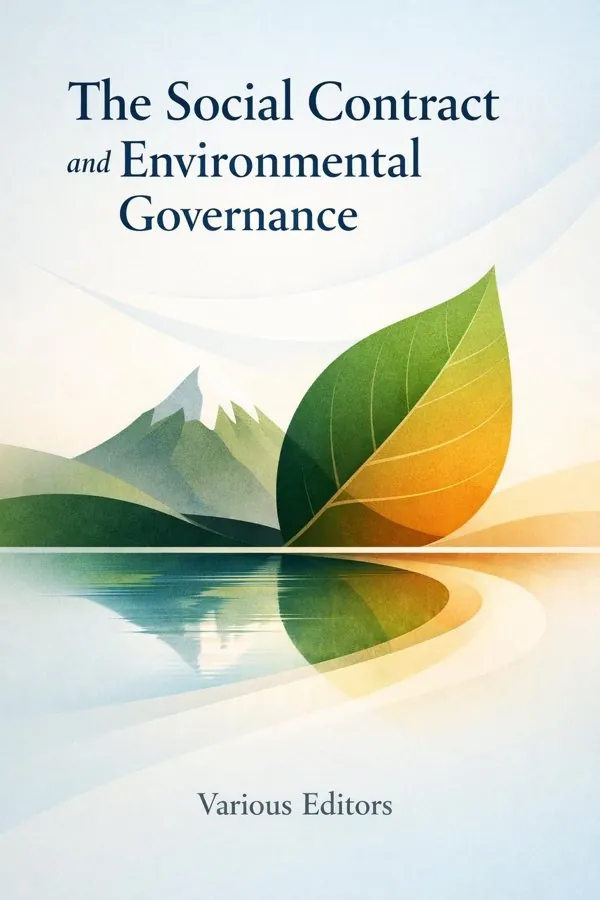
The Social Contract and Environmental Governance: Summary & Key Insights
 10 min8 chaptersAudio available
Key Takeaways from The Social Contract and Environmental Governance
Every environmental breakdown is also a breakdown in shared obligation.
People comply with environmental rules more consistently when they believe those rules are legitimate.
Sustainability without justice is rarely sustainable for long.
People protect what they help govern.
Markets can allocate resources, but they cannot by themselves define what should be protected.
What Is The Social Contract and Environmental Governance About?
The Social Contract and Environmental Governance by Various Editors is a environment book. The Social Contract and Environmental Governance explores one of the most urgent questions of our time: what do citizens, states, markets, and communities owe one another when the natural systems that support life are under pressure? Rather than treating environmental policy as a purely technical issue, this edited volume argues that ecological governance is fundamentally political and moral. It asks how legitimacy, trust, participation, fairness, and responsibility shape the way societies respond to climate change, biodiversity loss, pollution, and resource scarcity. The book matters because environmental crises do not emerge only from weak laws or poor science; they also reflect broken relationships between governments and the governed, between present and future generations, and between human development and ecological limits. Brought together by various editors and contributors, the volume draws on political theory, law, public policy, and environmental studies to examine how the idea of a social contract can be reinterpreted for the Anthropocene. The result is a rich, interdisciplinary framework for readers who want to understand not just how environmental governance works, but why it succeeds or fails in the first place.
This FizzRead summary covers all 8 key chapters of The Social Contract and Environmental Governance in approximately 10 minutes, distilling the most important ideas, arguments, and takeaways from Various Editors's work. Also available as an audio summary and Key Quotes Podcast.
The Social Contract and Environmental Governance
The Social Contract and Environmental Governance explores one of the most urgent questions of our time: what do citizens, states, markets, and communities owe one another when the natural systems that support life are under pressure? Rather than treating environmental policy as a purely technical issue, this edited volume argues that ecological governance is fundamentally political and moral. It asks how legitimacy, trust, participation, fairness, and responsibility shape the way societies respond to climate change, biodiversity loss, pollution, and resource scarcity. The book matters because environmental crises do not emerge only from weak laws or poor science; they also reflect broken relationships between governments and the governed, between present and future generations, and between human development and ecological limits. Brought together by various editors and contributors, the volume draws on political theory, law, public policy, and environmental studies to examine how the idea of a social contract can be reinterpreted for the Anthropocene. The result is a rich, interdisciplinary framework for readers who want to understand not just how environmental governance works, but why it succeeds or fails in the first place.
Who Should Read The Social Contract and Environmental Governance?
This book is perfect for anyone interested in environment and looking to gain actionable insights in a short read. Whether you're a student, professional, or lifelong learner, the key ideas from The Social Contract and Environmental Governance by Various Editors will help you think differently.
- ✓Readers who enjoy environment and want practical takeaways
- ✓Professionals looking to apply new ideas to their work and life
- ✓Anyone who wants the core insights of The Social Contract and Environmental Governance in just 10 minutes
Want the full summary?
Get instant access to this book summary and 100K+ more with Fizz Moment.
Get Free SummaryAvailable on App Store • Free to download
Key Chapters
Every environmental breakdown is also a breakdown in shared obligation. One of the book’s most powerful ideas is that pollution, climate instability, and ecological degradation are not just scientific or administrative problems; they signal a failure in the social contract itself. A social contract, broadly understood, is the set of expectations that binds citizens and institutions together around rights, duties, and legitimacy. When environmental harms fall disproportionately on vulnerable communities, when governments protect short-term interests over long-term survival, or when corporations profit while externalizing ecological costs, that contract starts to look incomplete or broken.
The book shows that environmental governance cannot rely only on top-down regulation or market efficiency. It must also answer deeper questions: who gets protected, who bears the burden, and who gets a voice in decisions about land, water, air, and energy? In this sense, environmental governance becomes a test of whether a society takes mutual responsibility seriously. A floodplain rezoned for luxury development, for example, may generate economic activity, but if nearby low-income residents face greater flood risk and have no meaningful role in planning, governance has failed morally as well as practically.
This idea has broad applications. Policymakers can use social contract thinking to assess whether climate adaptation plans are fair, whether carbon policies include compensation for affected workers, and whether environmental regulation reflects public consent rather than elite bargaining. Organizations can also ask whether their sustainability commitments merely reduce reputational risk or genuinely redistribute responsibility.
Actionable takeaway: evaluate every environmental policy through a social contract lens by asking three questions: who benefits, who pays, and who decides.
People comply with environmental rules more consistently when they believe those rules are legitimate. A central contribution of the book is its emphasis on legitimacy as the foundation of effective governance. Governments can impose emissions standards, conservation zones, or water restrictions, but coercion alone rarely produces lasting environmental cooperation. Policies work best when citizens see them as fair, transparent, and grounded in shared purpose.
The book connects legitimacy to several factors: procedural fairness, accountability, trust in institutions, and the visible consistency between public commitments and political action. Consider a government that announces strict water conservation measures during drought while allowing powerful industries to continue overusing local supplies. Even if the policy is technically sound, public trust may collapse because the burden appears unevenly distributed. By contrast, when authorities explain the evidence, invite participation, enforce rules consistently, and show willingness to share sacrifice, compliance improves.
This insight applies not only to national governments but also to municipalities, international bodies, NGOs, and private firms. Community-based forest management, for instance, often succeeds when local residents help shape rules and monitor use. Carbon pricing programs gain more support when revenues are transparently recycled into public services or household rebates. Legitimacy also matters globally: developing countries are less likely to support climate agreements they see as historically unfair or structurally biased.
The broader point is that environmental governance is not just about designing the perfect rule. It is about creating institutions people are willing to follow because they recognize them as morally and politically justified.
Actionable takeaway: build legitimacy into environmental decisions by making the process transparent, participatory, and visibly fair before focusing on enforcement.
Sustainability without justice is rarely sustainable for long. The book repeatedly argues that environmental governance cannot be separated from questions of equity. Ecological harms are distributed unevenly, and so are the costs of transition. Poorer communities often live closer to waste sites, breathe more polluted air, face greater climate vulnerability, and have fewer resources to adapt. At the same time, policies designed to improve environmental outcomes can impose heavy burdens if they ignore livelihoods, affordability, and historical exclusion.
By framing these issues through the social contract, the book expands justice beyond simple compensation. It includes recognition, participation, access, and intergenerational responsibility. For example, closing a high-emission industry may reduce pollution, but if affected workers are offered no retraining, social protection, or voice in the transition, the policy risks undermining public support and deepening inequality. Similarly, conservation efforts that displace Indigenous communities in the name of biodiversity can reproduce colonial patterns rather than deliver just governance.
The volume encourages readers to think in terms of environmental justice, just transition, and distributive fairness. In practice, this means designing climate and ecological policies that do not treat social pain as collateral damage. Urban planners can prioritize heat protection in low-income neighborhoods. Energy reforms can include subsidies for vulnerable households. National adaptation plans can direct funding toward those with the least resilience rather than those with the strongest political influence.
The key insight is simple but demanding: environmental governance must ask not only whether a policy reduces harm, but whether it does so in a way that respects dignity and shares burdens fairly.
Actionable takeaway: whenever evaluating a green policy, map its social winners and losers and redesign it until fairness is part of the outcome, not an afterthought.
People protect what they help govern. One of the most practical ideas in the book is that meaningful participation is not merely a democratic ideal; it is a functional requirement for durable environmental governance. When citizens, local communities, civil society groups, and affected stakeholders are excluded from decision-making, policies often become brittle, contested, and poorly informed. Participation improves legitimacy, but it also improves knowledge, implementation, and accountability.
The book distinguishes between symbolic consultation and genuine inclusion. A public hearing held after a project has effectively been approved is not real participation. By contrast, governance becomes stronger when local knowledge helps shape decisions from the beginning. Fishers can identify shifts in marine ecosystems long before national data sets are updated. Farmers understand how water rules interact with crop cycles. Indigenous communities often hold deep place-based ecological knowledge that can strengthen conservation and restoration strategies.
Participation also helps reveal hidden trade-offs. A renewable energy project may be climate-positive overall, but local residents may raise concerns about land use, biodiversity, or cultural heritage. These concerns do not automatically invalidate the project; instead, they create an opportunity to design better solutions, whether through altered siting, benefit-sharing, or co-management arrangements. Participatory budgeting, citizen assemblies on climate policy, watershed councils, and collaborative land-use planning all illustrate how governance can be both more democratic and more adaptive.
The book does not romanticize participation. Poorly designed processes can be captured by elites or slowed by conflict. But the answer is better participation, not less of it.
Actionable takeaway: involve affected communities early, give them access to information, and create real influence over environmental decisions rather than performative consultation.
Markets can allocate resources, but they cannot by themselves define what should be protected. The book offers a nuanced critique of market-centered environmental governance, arguing that instruments like carbon trading, pricing mechanisms, offsets, and ecosystem service valuation may be useful tools, but they are not substitutes for public judgment. A social contract perspective asks whether market solutions align with democratic accountability, fairness, and ecological integrity.
This matters because environmental policy is often framed as an optimization problem: put the right price on carbon, structure incentives correctly, and behavior will adjust. Yet the book reminds readers that many ecological issues involve non-market values, irreversible harms, and unequal power. For example, a company may purchase offsets while continuing pollution near frontline communities. A water market may improve efficiency while weakening access for small users. Carbon pricing may reduce emissions overall but provoke backlash if lower-income households bear higher costs without relief.
The editors and contributors do not reject economic tools outright. Instead, they argue for embedding them in broader governance structures. Markets can support transitions when paired with regulation, redistribution, public oversight, and participation. Renewable subsidies, for instance, work better when they also address grid access, community ownership, and regional inequality. Payment for ecosystem services can help conserve landscapes, but only if local communities retain rights and bargaining power.
The central lesson is that environmental goods are never only commodities. Air, forests, water, and climate stability are also public and relational goods tied to rights, identity, and collective survival.
Actionable takeaway: use market tools as limited instruments within democratically accountable policy frameworks, not as stand-alone answers to environmental problems.
A society that governs only for the present quietly abandons its future members. One of the book’s most compelling themes is the need to expand the social contract across time. Traditional contract thinking often focuses on existing citizens and current institutions, but environmental governance forces a harder question: what do we owe people who do not yet exist but will inherit the consequences of today’s choices?
Climate change, species loss, soil depletion, and long-lived pollution make this issue impossible to ignore. The benefits of destructive activity are often immediate, while the costs are delayed and dispersed. That creates a structural bias toward short-termism in politics, budgeting, and electoral cycles. The book argues that a renewed environmental social contract must include intergenerational justice, meaning institutions should not simply aggregate current preferences but actively safeguard future conditions for life, health, and dignity.
In practical terms, this can mean constitutional environmental rights, independent climate advisory bodies, long-term carbon budgets, legal duties of care, and planning systems that account for cumulative ecological risk. Some countries have introduced future generations commissioners or strengthened judicial review of environmental harms affecting youth. At the local level, cities can adopt resilience plans that prioritize long-lived infrastructure, ecosystem restoration, and heat adaptation rather than politically attractive but short-lived projects.
This perspective changes the ethics of governance. It reframes environmental stewardship from optional virtue to institutional responsibility. It also encourages humility: present generations are not owners of the planet’s life-support systems but temporary trustees.
Actionable takeaway: support policies and institutions that explicitly protect long-term ecological health, even when short-term political incentives point in the opposite direction.
Environmental governance becomes most difficult when the problem is shared but responsibility is unequal. The book uses the social contract idea to illuminate the tension at the heart of global environmental politics: climate change, biodiversity decline, ocean degradation, and transboundary pollution require collective action, yet nations differ dramatically in wealth, emissions histories, vulnerability, and institutional capacity. A single global rule may sound fair in abstraction while functioning unfairly in practice.
The volume highlights how legitimacy at the international level depends on recognizing historical responsibility and differentiated capability. Countries that industrialized early often built prosperity through intensive resource use and carbon emissions, while many poorer countries now face the harshest impacts with fewer means to adapt. From a social contract perspective, this means cooperation must involve more than universal targets. It should include climate finance, technology transfer, capacity building, loss-and-damage support, and room for development pathways that are both fair and sustainable.
This insight also applies below the level of nation-states. Within global supply chains, environmental burdens are frequently outsourced. Consumers in wealthy countries may enjoy cheap goods while production regions absorb pollution, deforestation, or water depletion. Businesses and policymakers can use this lens to rethink procurement standards, due diligence rules, and trade policies.
The book’s broader contribution is to show that global governance cannot rely solely on treaties and aggregate metrics. It must cultivate a sense of reciprocal but differentiated obligation. Only then can cooperation feel morally credible and politically durable.
Actionable takeaway: when assessing global environmental policies, look beyond common goals and ask whether responsibilities, resources, and risks are being shared in proportion to capacity and past contribution.
Environmental governance fails when institutions are either rigid or unanswerable. The book stresses that ecological systems are dynamic, uncertain, and interconnected, which means governance institutions must be capable of learning and adjustment. At the same time, adaptability cannot become an excuse for opacity or discretion without oversight. The challenge is to build institutions that can respond to new evidence while remaining publicly accountable.
This balance matters because many environmental problems evolve faster than legal and administrative structures. Wildfire regimes shift, fisheries migrate, groundwater declines gradually, and climate risks can intensify nonlinearly. Fixed rules may become outdated, but purely technocratic flexibility can sideline democratic consent. The book therefore supports forms of adaptive governance that combine monitoring, revision, local knowledge, multi-level coordination, and clear mechanisms for review.
Examples include watershed management systems that update allocation rules as hydrological conditions change, urban climate plans that revise heat adaptation measures using real-time health and infrastructure data, and protected area governance that integrates scientific monitoring with community stewardship. Accountability remains crucial: public reporting, judicial review, legislative scrutiny, and independent evaluation help ensure adaptation does not become arbitrary rule shifting.
The editors also point out that fragmentation is a recurring problem. Environmental authority is often spread across agencies, jurisdictions, and sectors that do not coordinate well. A social contract framework helps by reminding institutions that their legitimacy depends not only on expertise, but on coherence and responsibility to the public.
Actionable takeaway: design environmental institutions to learn continuously, publish results transparently, and revise policies through accountable processes rather than ad hoc improvisation.
All Chapters in The Social Contract and Environmental Governance
About the Author
Various Editors refers to a collaborative editorial team responsible for assembling and shaping this volume rather than a single named author. In edited academic books, the editors define the central theme, curate contributions from subject specialists, and ensure that individual chapters speak to a shared intellectual question. For a topic as broad as environmental governance and social contract theory, this format is especially effective because it brings together expertise from political theory, environmental law, public policy, ethics, and governance studies. The editors behind this volume act as conveners of a wider scholarly conversation, helping readers see how different disciplines approach legitimacy, justice, participation, and responsibility in the face of ecological crisis.
Get This Summary in Your Preferred Format
Read or listen to the The Social Contract and Environmental Governance summary by Various Editors anytime, anywhere. FizzRead offers multiple formats so you can learn on your terms — all free.
Available formats: App · Audio · PDF · EPUB — All included free with FizzRead
Download The Social Contract and Environmental Governance PDF and EPUB Summary
Key Quotes from The Social Contract and Environmental Governance
“Every environmental breakdown is also a breakdown in shared obligation.”
“People comply with environmental rules more consistently when they believe those rules are legitimate.”
“Sustainability without justice is rarely sustainable for long.”
“One of the most practical ideas in the book is that meaningful participation is not merely a democratic ideal; it is a functional requirement for durable environmental governance.”
“Markets can allocate resources, but they cannot by themselves define what should be protected.”
Frequently Asked Questions about The Social Contract and Environmental Governance
The Social Contract and Environmental Governance by Various Editors is a environment book that explores key ideas across 8 chapters. The Social Contract and Environmental Governance explores one of the most urgent questions of our time: what do citizens, states, markets, and communities owe one another when the natural systems that support life are under pressure? Rather than treating environmental policy as a purely technical issue, this edited volume argues that ecological governance is fundamentally political and moral. It asks how legitimacy, trust, participation, fairness, and responsibility shape the way societies respond to climate change, biodiversity loss, pollution, and resource scarcity. The book matters because environmental crises do not emerge only from weak laws or poor science; they also reflect broken relationships between governments and the governed, between present and future generations, and between human development and ecological limits. Brought together by various editors and contributors, the volume draws on political theory, law, public policy, and environmental studies to examine how the idea of a social contract can be reinterpreted for the Anthropocene. The result is a rich, interdisciplinary framework for readers who want to understand not just how environmental governance works, but why it succeeds or fails in the first place.
More by Various Editors




You Might Also Like

A Life on Our Planet: My Witness Statement and a Vision for the Future
David Attenborough
10 min
A Sky Full Of Birds
Matt Merritt
10 min
Carbon Zero: Imagining Cities That Can Save the Planet
Alex Steffen
10 min
Eaarth: Making a Life on a Tough New Planet
Bill McKibben
10 min
The Wild Places
Robert Macfarlane
10 min
A World Without Ice
Henry Pollack
10 minBrowse by Category
Ready to read The Social Contract and Environmental Governance?
Get the full summary and 100K+ more books with Fizz Moment.