
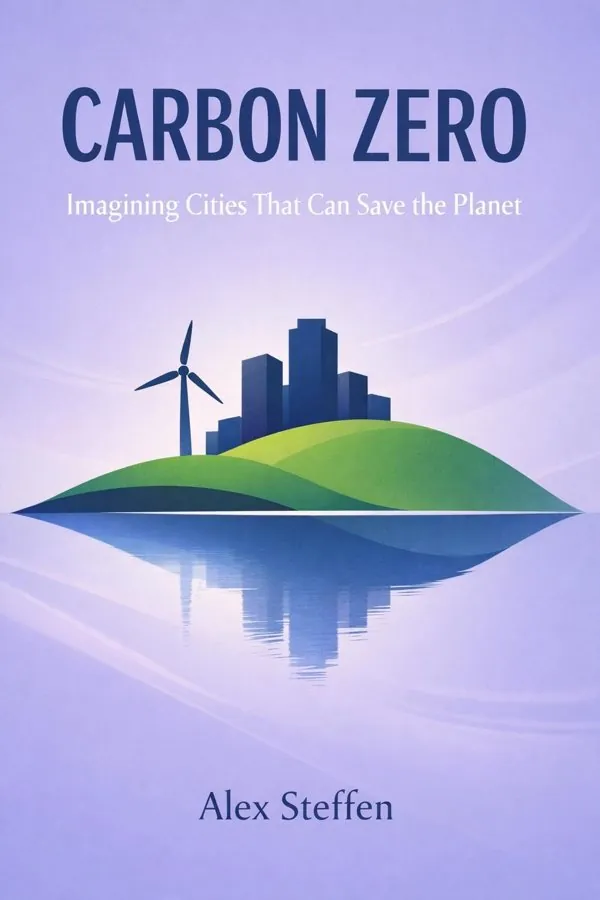
Carbon Zero: Imagining Cities That Can Save the Planet: Summary & Key Insights
by Alex Steffen
 10 min9 chaptersAudio available
Key Takeaways from Carbon Zero: Imagining Cities That Can Save the Planet
A striking truth runs through the book: most people do not choose their carbon footprint freely; their city chooses much of it for them.
One of Steffen’s most powerful claims is that suburban sprawl is not merely unattractive or inconvenient—it is a deeply carbon-intensive technology of living.
Many people hear the word density and imagine crowding, noise, and discomfort.
Few things reveal a city’s climate logic as clearly as how people move through it.
Steffen highlights a sobering fact: every building is a long-term climate decision.
What Is Carbon Zero: Imagining Cities That Can Save the Planet About?
Carbon Zero: Imagining Cities That Can Save the Planet by Alex Steffen is a environment book. Carbon Zero: Imagining Cities That Can Save the Planet argues that the fight against climate change will be won or lost in the places where most people live: cities. Alex Steffen, a leading environmental thinker, urban futurist, and former executive editor of Worldchanging, explores how urban design, transportation, housing, energy systems, and public policy can dramatically cut emissions while improving daily life. Rather than treating sustainability as sacrifice, he presents it as a practical redesign project—one that can make cities healthier, more efficient, more affordable, and more resilient. What makes this book so compelling is its combination of urgency and imagination. Steffen does not simply describe environmental problems; he shows how bad planning locks people into high-carbon lifestyles and how better systems can unlock lower-carbon futures. His ideas connect climate science with the realities of commuting, zoning, infrastructure, and consumption. For readers overwhelmed by the scale of the climate crisis, Carbon Zero offers a grounded and hopeful framework: change the systems, and individual behavior becomes easier, cheaper, and more effective. It is an essential read for anyone interested in climate action, urban innovation, and the future of modern life.
This FizzRead summary covers all 9 key chapters of Carbon Zero: Imagining Cities That Can Save the Planet in approximately 10 minutes, distilling the most important ideas, arguments, and takeaways from Alex Steffen's work. Also available as an audio summary and Key Quotes Podcast.
Carbon Zero: Imagining Cities That Can Save the Planet
Carbon Zero: Imagining Cities That Can Save the Planet argues that the fight against climate change will be won or lost in the places where most people live: cities. Alex Steffen, a leading environmental thinker, urban futurist, and former executive editor of Worldchanging, explores how urban design, transportation, housing, energy systems, and public policy can dramatically cut emissions while improving daily life. Rather than treating sustainability as sacrifice, he presents it as a practical redesign project—one that can make cities healthier, more efficient, more affordable, and more resilient.
What makes this book so compelling is its combination of urgency and imagination. Steffen does not simply describe environmental problems; he shows how bad planning locks people into high-carbon lifestyles and how better systems can unlock lower-carbon futures. His ideas connect climate science with the realities of commuting, zoning, infrastructure, and consumption. For readers overwhelmed by the scale of the climate crisis, Carbon Zero offers a grounded and hopeful framework: change the systems, and individual behavior becomes easier, cheaper, and more effective. It is an essential read for anyone interested in climate action, urban innovation, and the future of modern life.
Who Should Read Carbon Zero: Imagining Cities That Can Save the Planet?
This book is perfect for anyone interested in environment and looking to gain actionable insights in a short read. Whether you're a student, professional, or lifelong learner, the key ideas from Carbon Zero: Imagining Cities That Can Save the Planet by Alex Steffen will help you think differently.
- ✓Readers who enjoy environment and want practical takeaways
- ✓Professionals looking to apply new ideas to their work and life
- ✓Anyone who wants the core insights of Carbon Zero: Imagining Cities That Can Save the Planet in just 10 minutes
Want the full summary?
Get instant access to this book summary and 100K+ more with Fizz Moment.
Get Free SummaryAvailable on App Store • Free to download
Key Chapters
A striking truth runs through the book: most people do not choose their carbon footprint freely; their city chooses much of it for them. Alex Steffen argues that high emissions are often the predictable result of systems people are trapped inside—long commutes, isolated suburbs, inefficient buildings, weak public transit, and land-use rules that separate homes from jobs, shops, and schools. In other words, climate change is not only a matter of personal morality. It is also a design problem.
This reframing matters because it moves the conversation beyond blaming individuals for not living perfectly sustainable lives. A family living far from employment centers may have little choice but to drive. Renters in poorly insulated buildings cannot easily upgrade energy systems. Workers in cities without safe bike lanes or reliable transit cannot simply will a low-carbon commute into existence. Steffen’s insight is that the structure of urban life determines what options are available, convenient, and affordable.
He uses this perspective to challenge the fantasy that technological gadgets alone will solve the climate crisis. Efficient appliances and cleaner cars help, but if the broader urban pattern remains sprawling and inefficient, emissions remain stubbornly high. By contrast, compact neighborhoods, mixed-use zoning, and transit-rich districts can reduce emissions across transportation, housing, and consumption all at once.
Consider the difference between two lifestyles. In one, a person drives 45 minutes each way from a large detached home to work, shops in distant retail centers, and relies on energy-intensive infrastructure. In the other, a person lives near transit, works closer to home, walks to errands, and occupies a smaller, better-designed dwelling. The second lifestyle is not just greener; it is made possible by better urban systems.
Actionable takeaway: instead of asking only how individuals can emit less, ask how neighborhoods, infrastructure, and policy can make low-carbon living the default choice.
One of Steffen’s most powerful claims is that suburban sprawl is not merely unattractive or inconvenient—it is a deeply carbon-intensive technology of living. Sprawl spreads destinations far apart, makes car dependence almost unavoidable, raises infrastructure costs, consumes land, and encourages larger homes that require more energy to heat, cool, furnish, and maintain. It is a hidden emissions machine embedded in the landscape.
Steffen shows that sprawling development patterns create multiple layers of climate damage. Transportation emissions rise because distances are longer and alternatives are weaker. Building emissions rise because detached homes generally use more energy per household than compact multifamily housing. Public systems become less efficient because roads, pipes, utilities, and services must cover larger areas for fewer people. Even social life becomes less efficient, as everyday needs require planned trips instead of spontaneous proximity.
This is why he pushes readers to see land use as climate policy. A city that allows endless outward growth bakes emissions into daily life for decades. A city that encourages density near jobs and transit can dramatically lower per-capita emissions without asking residents to become environmental saints. The issue is not whether every suburb is inherently bad, but whether urban expansion continues to produce environments where driving and overconsumption are structurally rewarded.
Real-world examples support this argument. Walkable districts in cities like Copenhagen, Barcelona, or parts of New York generate far lower transport emissions than car-dominated metro fringes. Residents often travel shorter distances, rely more on public transit, and use smaller living spaces more efficiently. These places demonstrate that climate-friendly urban form is not theoretical—it already exists.
Actionable takeaway: support policies that limit sprawl and prioritize infill development, mixed-use neighborhoods, and housing near transit, because where a city grows often matters as much as how clean its energy is.
Many people hear the word density and imagine crowding, noise, and discomfort. Steffen challenges that assumption by arguing that density itself is not the problem; bad design is. Well-designed density can reduce emissions, improve access, support vibrant local economies, and create more enjoyable daily life. In fact, carbon-zero cities depend on forms of urban density that make low-energy living practical and attractive.
The climate logic is straightforward. When people live closer together, destinations are nearer, public transit becomes more viable, and shared infrastructure becomes more efficient. Apartments and attached housing typically require less energy per household than detached homes. Denser communities also make it easier to build district energy systems, local retail, public spaces, and multimodal streets. But Steffen is careful not to celebrate density in the abstract. Density must be paired with good public design, green space, affordability, and human-scale planning.
He points toward neighborhoods where residents can walk to grocery stores, schools, parks, and transit stops in minutes. These places lower the need for car ownership and save time otherwise lost to traffic. Importantly, they can also improve social cohesion by bringing people into shared spaces more often. A successful dense city is not just a compressed version of sprawl; it is a differently organized system, one built around proximity rather than separation.
This insight can be seen in “15-minute city” principles, transit-oriented development, and mixed-income housing near urban centers. Density becomes beneficial when homes, jobs, services, and mobility options are integrated. Poorly planned towers isolated by highways do not achieve this. Street-level vitality, safe walking routes, and access to daily needs do.
Actionable takeaway: when evaluating development, ask not simply whether it adds density, but whether it creates connected, walkable, mixed-use places where people can meet daily needs with less energy and less travel.
Few things reveal a city’s climate logic as clearly as how people move through it. Steffen argues that transportation is not just one emissions sector among many—it is a daily expression of urban design. If a city requires driving for almost every task, emissions remain high regardless of how efficient vehicles become. If it supports transit, cycling, and walking, low-carbon mobility becomes part of ordinary life.
This matters because transportation choices are often overestimated as personal preferences and underestimated as structural outcomes. In many regions, the question is not whether people like trains or bikes. The question is whether those options are safe, reliable, fast, affordable, and well connected. A train that arrives every 15 minutes and links homes to jobs, schools, and shopping is a real alternative. A disconnected bike lane ending at a dangerous intersection is not.
Steffen emphasizes that the greenest trip is often the trip that never has to happen. Compact land use reduces the need for long travel in the first place. After that, cities should prioritize systems in order of efficiency: walking, cycling, transit, and then cleaner vehicles for the trips that remain. Electric cars help, but they do not solve congestion, road deaths, spatial inefficiency, or the huge material footprint of car-dominated landscapes.
Practical applications are visible worldwide. Bus rapid transit systems in cities like Bogotá show how affordable transit can transform access. Protected cycling networks in Amsterdam and Paris demonstrate how quickly behavior changes when safety is designed in. Congestion pricing and reduced parking minimums can also reshape incentives away from automatic car use.
Actionable takeaway: advocate for transportation plans that reduce travel demand and expand safe, frequent alternatives to driving, rather than relying solely on cleaner cars to decarbonize mobility.
Steffen highlights a sobering fact: every building is a long-term climate decision. Because structures often last for decades, even centuries, the standards and designs chosen today determine future emissions far into the future. A poorly insulated building with inefficient heating and cooling becomes a carbon burden for years. A well-designed, efficient, adaptable building becomes part of the solution.
The book encourages readers to think beyond visible energy use and consider the broader performance of buildings. Location matters: a highly efficient home in a remote exurban area may still generate high total emissions because of transportation demands. Size matters: larger homes typically require more materials and more operational energy. Design matters: passive solar orientation, natural ventilation, superior insulation, and efficient systems can cut energy use dramatically. Policy matters too, because building codes, incentives, and financing structures often determine whether developers choose short-term savings over long-term efficiency.
Steffen’s broader point is that climate-smart buildings should be understood as part of urban ecosystems. Housing located near transit and services reduces the energy needed for daily life. Retrofitting older buildings can create jobs while cutting emissions. Multifamily housing often offers lower per-capita energy consumption than detached housing. Even office design influences emissions by affecting commute patterns and energy intensity.
Examples include deep energy retrofits in European cities, net-zero building standards in progressive municipalities, and adaptive reuse projects that preserve embodied carbon while revitalizing neighborhoods. These efforts show that building decarbonization is not just about adding solar panels; it is about rethinking what we build, where we build it, and how efficiently it serves real human needs.
Actionable takeaway: support stronger building standards, retrofits, and location-efficient housing, because every new or renovated structure should be treated as climate infrastructure, not just real estate.
A central lesson of Carbon Zero is that climate progress cannot depend mainly on asking consumers to shop their way out of a systems crisis. Steffen does not dismiss personal responsibility, but he is skeptical of the idea that buying greener products, while leaving destructive infrastructure intact, will produce changes at the required scale. The deeper challenge is to redesign the systems that shape consumption itself.
This is an important distinction. A person can buy an efficient car, but if the city is built around long-distance driving, emissions remain structurally high. A household can choose energy-saving appliances, but if the building leaks heat and relies on fossil-fuel systems, savings are limited. Consumers operate within a framework of available options, prices, regulations, and physical design. That framework determines whether sustainable behavior is mainstream or marginal.
Steffen’s critique of green consumerism is ultimately empowering. It directs attention toward places where collective action matters most: zoning reform, transit funding, clean electricity, building codes, public procurement, urban redevelopment, and civic investment. It also helps explain why some environmental messaging feels frustratingly inadequate. Telling people to recycle more or buy eco-friendly goods may create small benefits, but it does not address the carbon intensity embedded in housing markets, transportation networks, and growth models.
A practical example is food access. Buying local produce is beneficial, but if neighborhoods lack walkable grocery stores and residents must drive long distances for basic needs, the urban system remains inefficient. Likewise, an employee cannot choose a low-carbon commute if job centers are inaccessible without a car.
Actionable takeaway: pair personal sustainability choices with support for structural reforms—vote, organize, and invest in the public systems that make lower-carbon lifestyles accessible to millions, not just committed individuals.
One reason Steffen’s work stands out is that he refuses to frame climate action as pure sacrifice. He argues that many of the changes needed to reduce emissions would also make cities better places to live. Cleaner air, shorter commutes, safer streets, lower energy bills, more public space, and healthier neighborhoods are not side benefits—they are part of the case for transformation.
This is a powerful political and psychological insight. People often resist environmental action when it is presented as deprivation: smaller choices, fewer conveniences, more costs. But when climate solutions are linked to quality of life, the conversation changes. A city with reliable transit offers freedom from traffic and expensive car ownership. Energy-efficient housing lowers utility costs and improves comfort. Tree-lined streets and walkable neighborhoods support public health and local business. Mixed-use communities can reduce isolation and make daily routines less stressful.
Steffen’s optimism is not naive. He acknowledges that transition requires difficult choices, investment, and policy change. Yet he insists that the end goal is not a grim low-carbon existence. It is a more functional, beautiful, and equitable urban civilization. This helps shift climate discourse from fear alone to aspiration. Citizens are more likely to support ambitious reform when they can imagine tangible benefits in their own lives.
Examples are easy to find. Car-light districts often become more vibrant and economically active once public space is reclaimed for people. Building retrofits can reduce both emissions and energy poverty. Urban greening can lower heat stress while improving neighborhood wellbeing. In each case, decarbonization and livability reinforce each other.
Actionable takeaway: when discussing climate policy, emphasize co-benefits people can feel directly—health, savings, convenience, safety, and beauty—because better urban life is one of decarbonization’s strongest arguments.
Steffen makes clear that a truly sustainable city cannot be built on exclusion. Climate-friendly urbanism fails if it only serves affluent residents while pushing lower-income communities farther from jobs, transit, and opportunity. Equity is not an optional moral add-on to decarbonization; it is central to whether low-carbon systems will work, endure, and gain public legitimacy.
This matters because many high-emission patterns are tied to inequality. Workers priced out of central neighborhoods often face longer commutes. Renters in older, poorly maintained homes endure higher energy costs. Communities lacking political power may receive worse transit, less green space, and greater exposure to pollution and heat. If climate policy ignores these realities, it can unintentionally deepen hardship and trigger backlash.
Steffen’s framework implies that carbon-zero planning must include affordable housing near transit, inclusive zoning, accessible public services, and investment in underserved neighborhoods. It also means involving communities in planning decisions rather than imposing top-down visions. A city cannot claim climate leadership while displacing vulnerable residents in the name of sustainability.
Practical examples include transit-oriented affordable housing, weatherization programs for low-income households, fare policies that keep public transit accessible, and urban redevelopment strategies that protect existing residents from displacement. Resilience planning for heat waves, flooding, and air pollution should also prioritize those at greatest risk. Done well, climate policy can reduce both emissions and inequality by expanding access to efficient housing, mobility, and public amenities.
The larger lesson is strategic as well as ethical: broad public support for climate action grows when people see that the transition improves fairness rather than concentrating benefits at the top.
Actionable takeaway: evaluate climate proposals through an equity lens by asking who benefits, who pays, and whether low-carbon improvements remain accessible to the people who need them most.
Perhaps the deepest contribution of Carbon Zero is its insistence that imagination is practical. Steffen believes societies get stuck not only because of bad infrastructure, but also because of limited imagination. If people cannot picture cities that are cleaner, denser, more convenient, and more humane, they will cling to familiar but failing models. Cultural imagination becomes a precondition for political and physical transformation.
This is why the book places such importance on storytelling, design vision, and future-oriented thinking. Facts about climate change are necessary, but they are not always sufficient to mobilize change. People also need credible, desirable alternatives. They need to see what a low-carbon city might feel like: shorter trips, quieter streets, thriving neighborhoods, efficient homes, and systems that support daily life instead of exhausting it.
Steffen’s future-oriented approach helps break the paralysis that often accompanies environmental debate. Rather than asking only how to reduce damage, he invites readers to consider what kind of civilization they actually want to build. This creates room for ambition. Urban redesign becomes not just a defensive response to crisis, but an opportunity to correct longstanding failures in planning, equity, and public investment.
Applications of this idea appear in city vision plans, participatory design processes, speculative architecture, and public campaigns that make climate-friendly futures visible. Renderings, pilot projects, open-street programs, and model neighborhoods can all help turn abstract goals into concrete possibilities. Once people experience a better street or district, resistance to change often weakens.
Actionable takeaway: use imagination deliberately—support pilots, visual plans, community design exercises, and public storytelling that help people experience low-carbon futures as desirable, realistic, and worth fighting for.
All Chapters in Carbon Zero: Imagining Cities That Can Save the Planet
About the Author
Alex Steffen is an American environmental writer, speaker, and futurist known for his influential work on sustainability, climate change, and urban innovation. He gained broad recognition as the executive editor of Worldchanging, a groundbreaking media platform that explored practical solutions to global environmental and social challenges. Steffen’s work focuses on how design, technology, policy, and culture can help societies build more resilient and sustainable futures. He is especially respected for making complex systems thinking accessible to broad audiences and for linking climate issues to the everyday realities of cities, infrastructure, and modern life. Through his writing and public speaking, he has become a prominent voice in conversations about urbanism, decarbonization, and the need to imagine futures that are both realistic and hopeful.
Get This Summary in Your Preferred Format
Read or listen to the Carbon Zero: Imagining Cities That Can Save the Planet summary by Alex Steffen anytime, anywhere. FizzRead offers multiple formats so you can learn on your terms — all free.
Available formats: App · Audio · PDF · EPUB — All included free with FizzRead
Download Carbon Zero: Imagining Cities That Can Save the Planet PDF and EPUB Summary
Key Quotes from Carbon Zero: Imagining Cities That Can Save the Planet
“A striking truth runs through the book: most people do not choose their carbon footprint freely; their city chooses much of it for them.”
“One of Steffen’s most powerful claims is that suburban sprawl is not merely unattractive or inconvenient—it is a deeply carbon-intensive technology of living.”
“Many people hear the word density and imagine crowding, noise, and discomfort.”
“Few things reveal a city’s climate logic as clearly as how people move through it.”
“Steffen highlights a sobering fact: every building is a long-term climate decision.”
Frequently Asked Questions about Carbon Zero: Imagining Cities That Can Save the Planet
Carbon Zero: Imagining Cities That Can Save the Planet by Alex Steffen is a environment book that explores key ideas across 9 chapters. Carbon Zero: Imagining Cities That Can Save the Planet argues that the fight against climate change will be won or lost in the places where most people live: cities. Alex Steffen, a leading environmental thinker, urban futurist, and former executive editor of Worldchanging, explores how urban design, transportation, housing, energy systems, and public policy can dramatically cut emissions while improving daily life. Rather than treating sustainability as sacrifice, he presents it as a practical redesign project—one that can make cities healthier, more efficient, more affordable, and more resilient. What makes this book so compelling is its combination of urgency and imagination. Steffen does not simply describe environmental problems; he shows how bad planning locks people into high-carbon lifestyles and how better systems can unlock lower-carbon futures. His ideas connect climate science with the realities of commuting, zoning, infrastructure, and consumption. For readers overwhelmed by the scale of the climate crisis, Carbon Zero offers a grounded and hopeful framework: change the systems, and individual behavior becomes easier, cheaper, and more effective. It is an essential read for anyone interested in climate action, urban innovation, and the future of modern life.
You Might Also Like

A Life on Our Planet: My Witness Statement and a Vision for the Future
David Attenborough
10 min
A Sky Full Of Birds
Matt Merritt
10 min
Eaarth: Making a Life on a Tough New Planet
Bill McKibben
10 min
The Social Contract and Environmental Governance
Various Editors
10 min
The Wild Places
Robert Macfarlane
10 min
A World Without Ice
Henry Pollack
10 minBrowse by Category
Ready to read Carbon Zero: Imagining Cities That Can Save the Planet?
Get the full summary and 100K+ more books with Fizz Moment.