
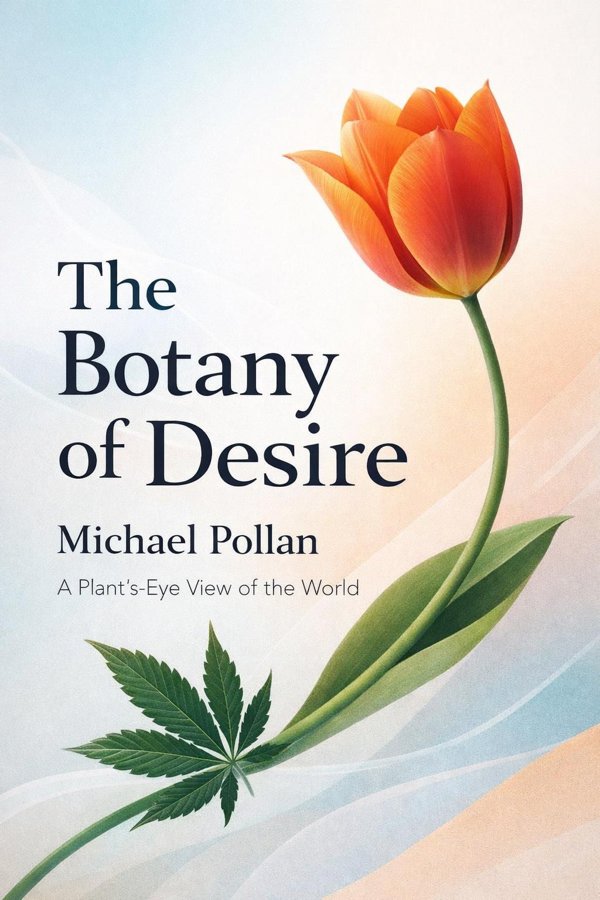
The Botany of Desire: A Plant's-Eye View of the World: Summary & Key Insights
 10 min9 chaptersAudio available
What Is The Botany of Desire: A Plant's-Eye View of the World About?
The Botany of Desire: A Plant's-Eye View of the World by Michael Pollan is a popular_sci book spanning 9 pages. In this groundbreaking work, Michael Pollan explores the complex relationship between humans and plants through four species—apples, tulips, marijuana, and potatoes—each representing a different human desire: sweetness, beauty, intoxication, and control. Pollan reveals how these plants have evolved to satisfy human needs while ensuring their own survival, offering a profound reflection on coevolution and the interconnectedness of nature and culture.
This FizzRead summary covers all 9 key chapters of The Botany of Desire: A Plant's-Eye View of the World in approximately 10 minutes, distilling the most important ideas, arguments, and takeaways from Michael Pollan's work. Also available as an audio summary and Key Quotes Podcast.
The Botany of Desire: A Plant's-Eye View of the World
In this groundbreaking work, Michael Pollan explores the complex relationship between humans and plants through four species—apples, tulips, marijuana, and potatoes—each representing a different human desire: sweetness, beauty, intoxication, and control. Pollan reveals how these plants have evolved to satisfy human needs while ensuring their own survival, offering a profound reflection on coevolution and the interconnectedness of nature and culture.
Who Should Read The Botany of Desire: A Plant's-Eye View of the World?
This book is perfect for anyone interested in popular_sci and looking to gain actionable insights in a short read. Whether you're a student, professional, or lifelong learner, the key ideas from The Botany of Desire: A Plant's-Eye View of the World by Michael Pollan will help you think differently.
- ✓Readers who enjoy popular_sci and want practical takeaways
- ✓Professionals looking to apply new ideas to their work and life
- ✓Anyone who wants the core insights of The Botany of Desire: A Plant's-Eye View of the World in just 10 minutes
Want the full summary?
Get instant access to this book summary and 100K+ more with Fizz Moment.
Get Free SummaryAvailable on App Store • Free to download
Key Chapters
Of all human cravings, sweetness is among the most primal. It signals energy, life, survival. Long before sugar became abundant, sweetness was rare, precious, and exhilarating. In the apple, nature discovered a perfect conduit through which to seduce us. The earliest apples, growing in the mountains of Central Asia, bore a wild diversity—tiny, sour, tannic fruits among occasional trees producing plump sweetness. Humans, ever attuned to the promise of sweetness, selected and spread these variations. Yet, curiously, every apple seed gives rise to a completely new genetic individual—an unpredictable experiment in taste and form. The only way to reproduce a beloved apple is through grafting, a vegetative form of cloning. This necessity bound humans and apples together in a peculiar intimacy: we became the agents ensuring the apple’s genetic survival.
The story of the apple is thus one of mutual seduction. We carried the apple around the world, and it rewarded us with sweetness and variety. In America, the apple’s fate became entwined with the spread of civilization itself. The fruit was not merely dessert—it was the source of cider, a vital and mildly intoxicating staple of frontier life. Each seed, sown by hand or scattered by pioneers, became a genetic experiment, yielding trees adapted to every clime and taste. The apple’s capacity to reinvent itself helped it colonize vast territories, and in turn, it nourished the mythos of American ingenuity and independence.
Sweetness, then, is more than flavor—it is a strategy, both biological and cultural. Our desire for sweetness gave the apple a passport to the world, and it flourished wherever we did. But sweetness also carries a warning: the same impulse that once guided us to ripeness and survival now drives our addiction to refined sugars. In seeking the apple’s sweetness, perhaps we must remember that desire, too, can overgrow its garden if left unchecked.
John Chapman, better known as Johnny Appleseed, embodies a uniquely American communion between human vision and natural proliferation. Unlike the grafted orchards of Europe, Chapman’s trees grew from seed. Each planting was a genetic experiment, creating untold new varieties. He was not, as myth often paints him, a mere folk wanderer or eccentric; he was a nurseryman, a small entrepreneur who saw in apple trees a way to accompany the nation’s westward expansion. His seedlings fed settlers with cider and sweetness, but they also reflected the democratic spirit of an unbounded land—each tree a symbol of possibility.
Chapman’s apples were rarely sweet by our modern dessert standards. They were cider apples, bitter and strong, destined for fermentation. The American frontier ran on cider, a drink safer than water, more enduring than milk, and more morale-boosting than any frontier sermon. The apple spread not by design but by abundance, seeded by human hope as much as by biological chance.
Through Chapman’s story, we glimpse the larger truth about coevolution. The apple did not adapt to us out of benevolence, nor we to it from stewardship. Each pursued its own ends, yet in doing so, they intertwined destinies. Chapman gave the apple legs; the apple gave him purpose. Together they transformed both landscape and culture. And as America later turned toward uniformity and sweetness—toward the cloned Red Delicious and the supermarket—all the wild diversity that Chapman’s seeds once embodied began to fade. The apple’s lesson is not only how desires spread life, but how easily abundance can curdle into monotony when we forget the wild origins of sweetness.
+ 7 more chapters — available in the FizzRead app
All Chapters in The Botany of Desire: A Plant's-Eye View of the World
About the Author
Michael Pollan is an American author, journalist, and professor known for his writings on food, agriculture, and the environment. His works, including 'The Omnivore’s Dilemma' and 'In Defense of Food', have shaped public discourse on sustainable eating and ecological awareness.
Get This Summary in Your Preferred Format
Read or listen to the The Botany of Desire: A Plant's-Eye View of the World summary by Michael Pollan anytime, anywhere. FizzRead offers multiple formats so you can learn on your terms — all free.
Available formats: App · Audio · PDF · EPUB — All included free with FizzRead
Download The Botany of Desire: A Plant's-Eye View of the World PDF and EPUB Summary
Key Quotes from The Botany of Desire: A Plant's-Eye View of the World
“Of all human cravings, sweetness is among the most primal.”
“John Chapman, better known as Johnny Appleseed, embodies a uniquely American communion between human vision and natural proliferation.”
Frequently Asked Questions about The Botany of Desire: A Plant's-Eye View of the World
The Botany of Desire: A Plant's-Eye View of the World by Michael Pollan is a popular_sci book that explores key ideas across 9 chapters. In this groundbreaking work, Michael Pollan explores the complex relationship between humans and plants through four species—apples, tulips, marijuana, and potatoes—each representing a different human desire: sweetness, beauty, intoxication, and control. Pollan reveals how these plants have evolved to satisfy human needs while ensuring their own survival, offering a profound reflection on coevolution and the interconnectedness of nature and culture.
More by Michael Pollan

You Might Also Like

Structures: Or Why Things Don"t Fall Down
J.E. Gordon
10 min
The Road to Wigan Pier
George Orwell
10 min
Bonk: The Curious Coupling of Science and Sex
Mary Roach
10 min
First Bite: How We Learn to Eat
Bee Wilson
10 min
In Pursuit Of The Unknown: 17 Equations That Changed The World
Ian Stewart
10 min
Napoleon's Buttons: 17 Molecules That Changed History
Penny Le Couteur and Jay Burreson
10 minBrowse by Category
Ready to read The Botany of Desire: A Plant's-Eye View of the World?
Get the full summary and 100K+ more books with Fizz Moment.