
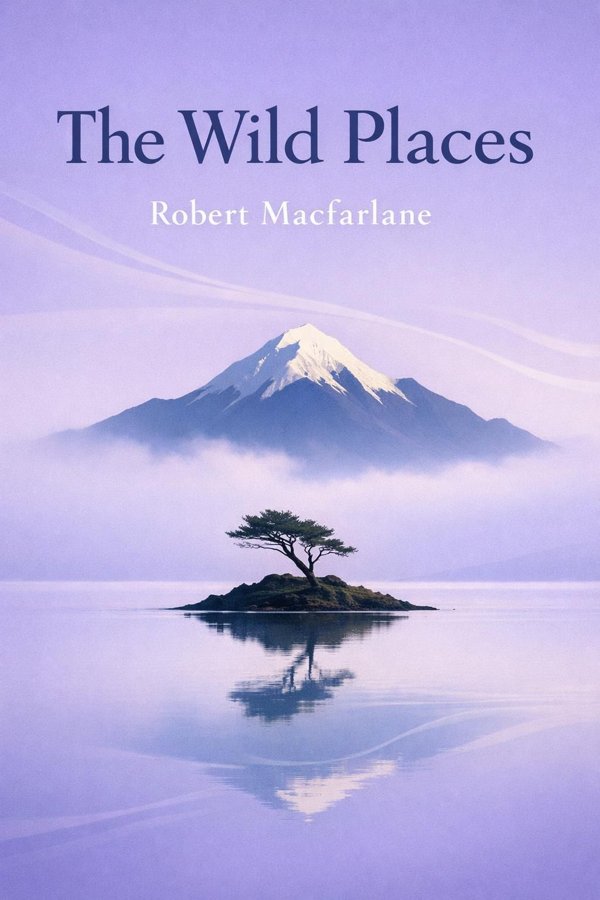
The Wild Places: Summary & Key Insights
 10 min9 chaptersAudio available
Key Takeaways from The Wild Places
A powerful idea runs through The Wild Places: the wild is not always somewhere else.
Places do not merely surround us; they shape thought, mood, and identity.
What we can name, we are more likely to notice.
To be alone in nature is not necessarily to be lonely.
No landscape is only physical.
What Is The Wild Places About?
The Wild Places by Robert Macfarlane is a environment book. What if wilderness were not a distant frontier but something still hidden in familiar landscapes, waiting to be noticed? In The Wild Places, Robert Macfarlane sets out across Britain and Ireland in search of the remaining places that feel untamed: islands, forests, moors, salt marshes, mountain ridges, and even overlooked edges of ordinary life. What begins as a physical journey soon becomes an inquiry into perception, memory, language, and belonging. Macfarlane asks not only where the wild survives, but also how modern people have learned to overlook it. The book matters because it challenges a narrow idea of nature as something remote, grand, and separate from human life. Instead, it shows that wildness can exist in small pockets, in seasonal change, in weather, and in the close attention we bring to place. Macfarlane writes with the eye of a naturalist, the ear of a poet, and the rigor of a scholar, drawing on literature, ecology, history, and firsthand travel. His authority comes not from abstract theory alone, but from walking, sleeping out, listening, and learning from the land itself. The result is a deeply moving meditation on why wild places still matter, and why protecting them begins with seeing them clearly.
This FizzRead summary covers all 9 key chapters of The Wild Places in approximately 10 minutes, distilling the most important ideas, arguments, and takeaways from Robert Macfarlane's work. Also available as an audio summary and Key Quotes Podcast.
The Wild Places
What if wilderness were not a distant frontier but something still hidden in familiar landscapes, waiting to be noticed? In The Wild Places, Robert Macfarlane sets out across Britain and Ireland in search of the remaining places that feel untamed: islands, forests, moors, salt marshes, mountain ridges, and even overlooked edges of ordinary life. What begins as a physical journey soon becomes an inquiry into perception, memory, language, and belonging. Macfarlane asks not only where the wild survives, but also how modern people have learned to overlook it.
The book matters because it challenges a narrow idea of nature as something remote, grand, and separate from human life. Instead, it shows that wildness can exist in small pockets, in seasonal change, in weather, and in the close attention we bring to place. Macfarlane writes with the eye of a naturalist, the ear of a poet, and the rigor of a scholar, drawing on literature, ecology, history, and firsthand travel. His authority comes not from abstract theory alone, but from walking, sleeping out, listening, and learning from the land itself. The result is a deeply moving meditation on why wild places still matter, and why protecting them begins with seeing them clearly.
Who Should Read The Wild Places?
This book is perfect for anyone interested in environment and looking to gain actionable insights in a short read. Whether you're a student, professional, or lifelong learner, the key ideas from The Wild Places by Robert Macfarlane will help you think differently.
- ✓Readers who enjoy environment and want practical takeaways
- ✓Professionals looking to apply new ideas to their work and life
- ✓Anyone who wants the core insights of The Wild Places in just 10 minutes
Want the full summary?
Get instant access to this book summary and 100K+ more with Fizz Moment.
Get Free SummaryAvailable on App Store • Free to download
Key Chapters
A powerful idea runs through The Wild Places: the wild is not always somewhere else. Many people imagine wilderness as a distant, dramatic realm far beyond ordinary life, but Macfarlane gradually dismantles that assumption. His journeys begin with a desire to find remote and pure landscapes, yet he comes to realize that wildness is often much nearer, embedded in hedgerows, marsh edges, coppices, riverbanks, and weather-beaten coastlines. The book asks us to reconsider the maps in our minds.
This matters because our understanding of nature shapes how we value it. If we think only vast national parks or untouched mountain ranges count as wild, we may ignore the fragile, local habitats that surround towns and villages. Macfarlane’s insight is both ecological and psychological: the ability to perceive wildness depends not only on geography, but on attention. A stand of trees at the edge of a road can feel more alive and mysterious than a famous scenic viewpoint if we enter it with openness and patience.
In practical terms, this idea changes how we move through daily life. A person does not need an expedition budget or weeks of vacation to encounter the nonhuman world in a meaningful way. Walking at dawn through a nearby common, noticing birdsong in a cemetery, or observing tides along an estuary can become acts of rediscovery. Urban dwellers can seek wild corners in parks, canals, abandoned lots, or river paths. Families can help children build this awareness by learning seasonal signs close to home rather than treating nature as a special event.
The deeper lesson is that wildness is partly a mode of relationship. It emerges when control loosens, when unpredictability remains, and when human beings stop assuming they stand at the center of every landscape. Actionable takeaway: spend one hour this week exploring a natural place within easy reach of home, and write down ten details that reveal its untamed character.
Places do not merely surround us; they shape thought, mood, and identity. Macfarlane’s travels make clear that landscapes act upon the mind in subtle but powerful ways. A wind-lashed island induces vulnerability and alertness. A dark forest alters the senses, narrowing vision while sharpening sound. Open moorland can create both freedom and exposure. The book shows that to move through a place attentively is also to be changed by it.
This insight gives The Wild Places much of its emotional force. Macfarlane is not cataloging scenery from a detached distance. He is tracing the exchange between outer terrain and inner weather. Wild places can unsettle, humble, steady, or enlarge us. They remind us that the self is more porous than we tend to think. This is especially meaningful in modern life, where many people spend most of their time indoors, on screens, or in highly managed environments designed for efficiency rather than reflection.
One practical application of this idea is to be more intentional about choosing environments that support mental clarity and emotional resilience. Instead of treating walks as mere exercise, we can ask what different settings do to our attention. A shoreline may help with grief because of its rhythms and horizons. Woodland may support concentration by slowing the eye. High ground may offer perspective when life feels crowded. Teachers, therapists, and community leaders can also use nearby landscapes as settings for conversation, recovery, and learning.
Macfarlane’s broader point is not that nature magically solves all problems, but that contact with complexity, scale, and nonhuman presence can rebalance a mind over-occupied with itself. Wild places remind us that we belong to a larger world. Actionable takeaway: when you feel mentally crowded, choose a specific type of landscape to visit and notice how your thinking shifts after thirty uninterrupted minutes there.
What we can name, we are more likely to notice. Throughout The Wild Places, Macfarlane reveals a deep fascination with the vocabulary of landscape: old place-names, regional terms, weather words, and the rich verbal traditions through which people have described land for generations. His writing suggests that language is not just decoration added after experience; it is part of how experience becomes vivid, memorable, and shareable.
This idea matters because environmental loss is often tied to linguistic loss. When words for specific features disappear, our perception can become flatter and less precise. A marsh, bog, fen, and mire are not interchangeable in feeling or ecology, and neither are grove, copse, spinney, and wood. Fine-grained language helps us see distinctions, and distinctions help us care. Macfarlane’s attention to words becomes a form of conservation, preserving not only habitats but ways of knowing them.
In practical life, this means we can enrich our relationship with place by learning its vocabulary. Birdwatchers know this instinctively: once you can distinguish a curlew from an oystercatcher, the coast becomes more alive. Gardeners experience the same shift when soil, shade, and season stop being abstract categories. Parents and educators can nurture ecological imagination by teaching children local species names and place histories rather than only generic labels. Writers, walkers, and travelers can keep notebooks of encountered words, creating a personal lexicon of landscapes.
There is also a moral implication. Careless language can make environments seem empty, interchangeable, or disposable. Precise language restores particularity. It reminds us that every place has character and story. Macfarlane’s prose models how description can become a disciplined way of paying respect. Actionable takeaway: learn five specific words connected to your local landscape this week, then use them during a walk or in a short journal entry to sharpen your perception.
To be alone in nature is not necessarily to be lonely. One of Macfarlane’s recurring discoveries is that solitude in wild places can feel intensely relational rather than empty. Alone on a ridge, in a wood, or among reeds, he becomes more aware of wind, animal traces, changing light, and his own vulnerability. Solitude strips away social noise and allows other forms of presence to emerge.
This is an important distinction in a culture that often treats aloneness as a problem to solve. The Wild Places presents solitude as a disciplined openness. When there are fewer distractions, the mind initially chatters, but then begins to settle. Sensory detail grows stronger. Fear may arise, but so may humility and gratitude. Wild solitude reminds us that being unaccompanied by people does not mean being disconnected from life. In fact, it can intensify our sense of participation in a larger living world.
Practically speaking, this insight can help people reclaim time for restorative attention. Solo walks, short overnight trips, or even an hour spent sitting quietly outdoors can cultivate patience and self-knowledge. The key is to enter without constant stimulation. No podcast, no scrolling, no pressure to produce. For those new to solitude, a nearby park, beach, or woodland path is enough. Safety matters, of course, but the principle remains: some encounters with place only unfold when conversation and devices fall away.
Macfarlane does not romanticize isolation. Solitude can be uncomfortable, especially at first. Yet that discomfort often marks the edge of a more honest encounter with both self and world. The wild resists our routines and reminds us that attention is an earned skill. Actionable takeaway: schedule one device-free solo visit to a natural place this week, stay still for at least fifteen minutes, and observe what becomes noticeable after the urge for distraction passes.
No landscape is only physical. In The Wild Places, mountains, forests, islands, and marshes are layered with stories, losses, labor, myths, and traces of past human presence. Macfarlane repeatedly shows that even places that feel remote are shaped by history: old paths, abandoned dwellings, clearances, grazing patterns, wartime remnants, and long habits of naming and dwelling. The wild is not outside time. It is full of memory.
This complicates any simplistic dream of untouched nature. Macfarlane’s landscapes are not pristine museum pieces sealed off from people. They are living terrains where human and nonhuman histories overlap. Recognizing that complexity makes our relationship to land more honest. It also broadens conservation beyond scenery and species counts to include cultural memory, local knowledge, and the stories that help communities remain connected to place.
In practical terms, this means that visiting a natural area becomes richer when we ask historical questions. Who lived here? What industries shaped it? Which species vanished or returned? Why is the path where it is? Local archives, oral histories, maps, and indigenous or regional traditions can all deepen ecological awareness. Conservation groups, schools, and walkers’ associations can use this approach to create stronger public attachment to landscapes under threat. A place people understand historically is often a place they are more willing to defend.
The broader lesson is that memory itself can be ecological. To remember a place well is to hold together its visible present and its hidden past. Macfarlane teaches that such memory resists exploitation because it transforms land from resource into relation. Actionable takeaway: choose one nearby natural site, research one historical layer of it before your next visit, and notice how that knowledge changes your sense of the landscape.
One of the quiet arguments of The Wild Places is that looking closely is an ethical act. Macfarlane’s writing is filled with details of texture, weather, light, sound, and movement, and this precision is not mere stylistic flourish. It demonstrates that attention itself can be a way of honoring the world. In an age of haste, distraction, and environmental abstraction, to notice carefully is to resist indifference.
This insight has wide relevance. Many ecological problems feel overwhelming because they are discussed at scales too large for ordinary perception: climate systems, biodiversity loss, global extraction. Those realities matter, but if they remain only abstract, people may feel helpless. Macfarlane suggests another entry point. Begin with the specific. Learn a shoreline, a stand of birch, a marsh at dusk, a seasonal migration. Intimacy with particulars creates emotional investment, and investment often leads to stewardship.
In practice, attention can be trained. Walk the same route through different seasons. Return to one tree every month. Learn the patterns of local birds. Observe cloud forms before rain. Artists, photographers, gardeners, and naturalists already know that repetition sharpens perception. Families and schools can adopt simple observation rituals, such as nature journaling or weekly visits to the same patch of ground. Conservation organizations can encourage deeper public attachment by inviting people not just to visit habitats, but to know them over time.
Macfarlane’s example reminds us that care does not begin with mastery. It begins with receptivity. You do not need expert credentials to witness the life of a place faithfully. What matters is consistency, patience, and willingness to be surprised. Actionable takeaway: pick one local natural spot and revisit it four times over the next month, recording what changes and what remains, so attention becomes the foundation of care.
A central tension in The Wild Places is the contrast between managed modern environments and the unpredictability of the nonhuman world. Contemporary life often channels people into interiors, schedules, roads, and digital systems that reduce friction and surprise. Comfort increases, but sensory range can shrink. Macfarlane’s journeys suggest that one reason wild places matter is that they disrupt this narrowing. They return us to weather, uneven ground, darkness, silence, uncertainty, and scale.
This is not an argument against modernity itself. Rather, it is a warning that too much insulation can impoverish experience. If every environment is climate-controlled, lit, mapped, and optimized, we may lose capacities that older cultures took for granted: reading sky and tide, tolerating discomfort, moving attentively through terrain, or feeling part of seasonal cycles. The wild does not merely entertain us; it recalibrates dulled senses.
Practical applications are simple but meaningful. Spend time outdoors in variable weather instead of only on ideal days. Choose routes that involve walking rather than constant transport. Camp occasionally, or at least stay outside through dusk into darkness. Let children climb, splash, and get muddy within safe limits, so nature is encountered as a living reality rather than a backdrop. Even workplaces and schools can benefit from outdoor time that is not tightly programmed, allowing spontaneity and observation to return.
Macfarlane’s deeper point is that convenience has hidden costs when it cuts us off from the textures that make life vivid and humbling. Wildness reintroduces uncertainty, and uncertainty can enlarge perception. Actionable takeaway: once this week, replace one highly controlled routine with an outdoor experience that includes some discomfort or unpredictability, and notice what awakens in your senses.
By the end of The Wild Places, Macfarlane arrives at a liberating realization: wildness is not restricted to landscapes entirely free of human influence. It can survive in edges, fragments, margins, and shared spaces where natural processes still operate with relative independence. This shifts the conversation from purity to relationship. Instead of asking only where humans are absent, Macfarlane asks where life remains unruly, self-willed, and beyond full control.
This perspective is especially important in densely inhabited countries like Britain and Ireland, where truly untouched land is rare. If we insist on a strict ideal of pristine wilderness, we may conclude that the wild has vanished and become fatalistic. Macfarlane offers a more hopeful and realistic view. A city-fringe marsh, an island shaped by centuries of use, or a woodland with old paths can still hold genuine wildness. The presence of human history does not automatically cancel nonhuman vitality.
Practically, this idea supports more inclusive environmental thinking. Urban planners can protect green corridors, wetlands, vacant lots, and river edges as meaningful habitats rather than leftover spaces. Residents can value local biodiversity without waiting for spectacular landscapes. Gardeners can leave patches untidy for insects and birds. Communities can restore ecological processes in places long considered ordinary or degraded. The aim is not to manufacture a false wilderness, but to make room for complexity and self-directed life.
The larger contribution of this idea is emotional as well as ecological. It invites people to see hope nearby. Wildness becomes not a lost ideal but an active possibility. Actionable takeaway: identify one semi-wild place in your daily environment, learn what species or processes thrive there, and treat it as a living landscape worthy of attention and protection.
Facts can inform us, but wonder is often what moves us to care. The Wild Places never becomes a dry environmental argument because Macfarlane understands that conservation is sustained not only by data and policy, but by awe, delight, and emotional attachment. His journeys are full of moments in which beauty, fear, strangeness, and surprise awaken reverence. This sense of wonder does not distract from environmental responsibility; it motivates it.
Why does this matter? Because many people know intellectually that ecosystems are under pressure, yet still feel disengaged. Information alone rarely transforms behavior. Wonder creates a bond. When someone has watched mist rise from a fen at dawn, heard geese crossing winter sky, or slept under a canopy of wind-torn branches, nature is no longer an abstract issue. It becomes part of the person’s felt life. Protection then seems less like obligation and more like loyalty.
In practical terms, wonder can be cultivated by slowing down and seeking direct encounters rather than only consuming images of nature. Visit places at unusual times, such as sunrise, dusk, or during seasonal shifts. Bring children to streams, coasts, woods, and hills often enough that fascination can deepen into familiarity. Support conservation organizations not only financially but through volunteering, citizen science, and local advocacy rooted in firsthand experience.
Macfarlane’s writing reminds us that the defense of wild places begins in perception but matures into commitment. Wonder is not passive admiration. At its best, it leads to responsibility. Actionable takeaway: create one recurring ritual of contact with the natural world, such as a weekly dawn walk or monthly visit to a wild place, and let that habit become the emotional basis of your environmental concern.
All Chapters in The Wild Places
About the Author
Robert Macfarlane is a British writer, scholar, and leading voice in contemporary nature writing. Born in 1976, he is known for books that explore landscape, language, memory, travel, and the relationship between people and the natural world. His work combines literary craftsmanship with deep research, drawing on ecology, history, folklore, and personal experience. Macfarlane studied at Cambridge and Oxford, and he has taught at the University of Cambridge, where he has been associated with English literature and environmental thought. His major books include Mountains of the Mind, The Wild Places, The Old Ways, Landmarks, and Underland, many of which have won major awards and reached international audiences. He is admired for making environmental writing both intellectually serious and vividly accessible, helping readers see familiar landscapes with renewed wonder.
Get This Summary in Your Preferred Format
Read or listen to the The Wild Places summary by Robert Macfarlane anytime, anywhere. FizzRead offers multiple formats so you can learn on your terms — all free.
Available formats: App · Audio · PDF · EPUB — All included free with FizzRead
Download The Wild Places PDF and EPUB Summary
Key Quotes from The Wild Places
“A powerful idea runs through The Wild Places: the wild is not always somewhere else.”
“Places do not merely surround us; they shape thought, mood, and identity.”
“What we can name, we are more likely to notice.”
“To be alone in nature is not necessarily to be lonely.”
“In The Wild Places, mountains, forests, islands, and marshes are layered with stories, losses, labor, myths, and traces of past human presence.”
Frequently Asked Questions about The Wild Places
The Wild Places by Robert Macfarlane is a environment book that explores key ideas across 9 chapters. What if wilderness were not a distant frontier but something still hidden in familiar landscapes, waiting to be noticed? In The Wild Places, Robert Macfarlane sets out across Britain and Ireland in search of the remaining places that feel untamed: islands, forests, moors, salt marshes, mountain ridges, and even overlooked edges of ordinary life. What begins as a physical journey soon becomes an inquiry into perception, memory, language, and belonging. Macfarlane asks not only where the wild survives, but also how modern people have learned to overlook it. The book matters because it challenges a narrow idea of nature as something remote, grand, and separate from human life. Instead, it shows that wildness can exist in small pockets, in seasonal change, in weather, and in the close attention we bring to place. Macfarlane writes with the eye of a naturalist, the ear of a poet, and the rigor of a scholar, drawing on literature, ecology, history, and firsthand travel. His authority comes not from abstract theory alone, but from walking, sleeping out, listening, and learning from the land itself. The result is a deeply moving meditation on why wild places still matter, and why protecting them begins with seeing them clearly.
More by Robert Macfarlane
You Might Also Like
A Life on Our Planet: My Witness Statement and a Vision for the Future
David Attenborough
10 min
A Sky Full Of Birds
Matt Merritt
10 min
Carbon Zero: Imagining Cities That Can Save the Planet
Alex Steffen
10 min
Eaarth: Making a Life on a Tough New Planet
Bill McKibben
10 min
The Social Contract and Environmental Governance
Various Editors
10 min
A World Without Ice
Henry Pollack
10 minBrowse by Category
Ready to read The Wild Places?
Get the full summary and 100K+ more books with Fizz Moment.