
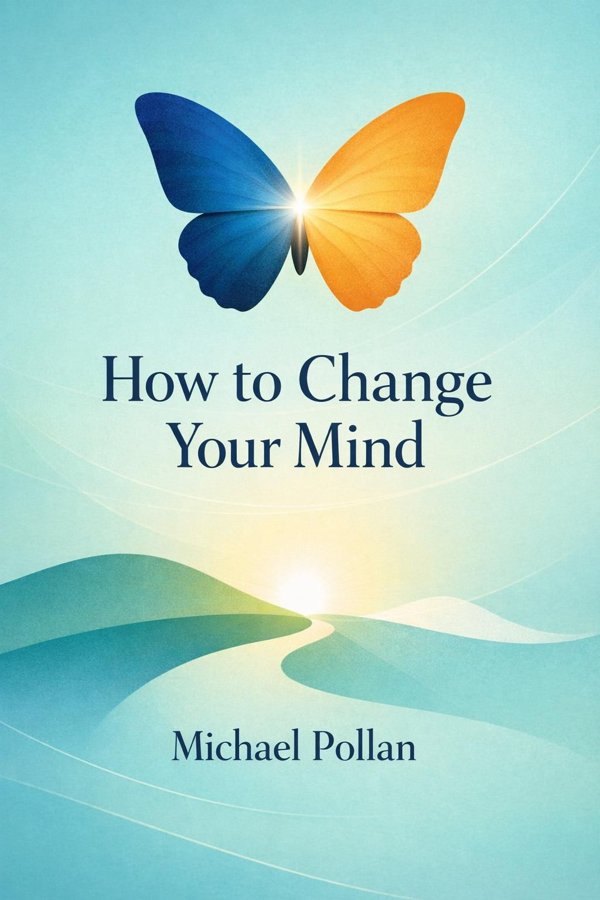
How to Change Your Mind: Summary & Key Insights
 10 min8 chaptersAudio available
What Is How to Change Your Mind About?
How to Change Your Mind by Michael Pollan is a psychology book published in 2018 spanning 8 pages. In this groundbreaking work, Michael Pollan explores the resurgence of psychedelic research and its profound implications for mental health, consciousness, and spirituality. Blending scientific inquiry, personal experience, and cultural history, Pollan examines how substances like LSD and psilocybin are being re-evaluated as tools for healing and transformation.
This FizzRead summary covers all 8 key chapters of How to Change Your Mind in approximately 10 minutes, distilling the most important ideas, arguments, and takeaways from Michael Pollan's work. Also available as an audio summary and Key Quotes Podcast.
How to Change Your Mind: What the New Science of Psychedelics Teaches Us About Consciousness, Dying, Addiction, Depression, and Transcendence
In this groundbreaking work, Michael Pollan explores the resurgence of psychedelic research and its profound implications for mental health, consciousness, and spirituality. Blending scientific inquiry, personal experience, and cultural history, Pollan examines how substances like LSD and psilocybin are being re-evaluated as tools for healing and transformation.
Who Should Read How to Change Your Mind?
This book is perfect for anyone interested in psychology and looking to gain actionable insights in a short read. Whether you're a student, professional, or lifelong learner, the key ideas from How to Change Your Mind by Michael Pollan will help you think differently.
- ✓Readers who enjoy psychology and want practical takeaways
- ✓Professionals looking to apply new ideas to their work and life
- ✓Anyone who wants the core insights of How to Change Your Mind in just 10 minutes
Want the full summary?
Get instant access to this book summary and 100K+ more with Fizz Moment.
Get Free SummaryAvailable on App Store • Free to download
Key Chapters
To understand how psychedelics went from revered scientific tools to cultural pariahs, you need to travel back to the mid-twentieth century. The story begins with an accident—a chemist named Albert Hofmann in Switzerland, in 1943, discovered LSD’s strange and powerful effects. Around the same time, psilocybin, the active ingredient in so-called magic mushrooms, was introduced to Western science through the efforts of R. Gordon Wasson and later synthesized by Hofmann himself.
In the 1950s, LSD was not yet a countercultural emblem. Psychiatrists and researchers regarded it as a kind of key—a means of understanding psychosis, or unlocking the subconscious. Institutions like the Harvard Psilocybin Project, led by Timothy Leary and Richard Alpert, explored how these compounds could expand consciousness. But by the late 1960s, psychedelics slipped from laboratories into the streets, entwining themselves with antiwar protests, rebellion, and spiritual awakening. As they became symbols of defiance, the political establishment reacted swiftly: research halted, access disappeared, and an era of scientific exploration was buried under fear.
What fascinates me is how an entire field of inquiry—so promising and rich—could be erased almost overnight. These substances were not inherently dangerous; they were powerful, and thus demanded respect. Yet, misguided moral panic replaced scientific curiosity, and for decades, a generation of psychiatrists lost a potential key to understanding consciousness and treating emotional suffering.
I felt compelled to resurrect this forgotten history because it represents more than a lost opportunity—it’s a cautionary tale about how culture dictates science. The story of psychedelics mirrors our broader struggle between curiosity and control, freedom and fear.
In recent years, a quiet revolution has begun—an unlikely one, led not by activists but by scientists in white coats. At Johns Hopkins, NYU, Imperial College London, and other institutions, researchers are once again studying psilocybin and related compounds. Their findings are astonishing, and profoundly hopeful.
I spent time with these investigators—the pioneers of this psychedelic renaissance—and discovered something remarkable: they were not seeking new forms of escapism, but new ways to heal. Trials using psilocybin-assisted therapy have shown lasting improvements for people with depression, addiction, and even existential anxiety faced by those terminally ill. These sessions are not wild trips but structured, deeply intentional experiences. A patient lies in a room, eyes covered, guided by trained therapists through an inner voyage of perception and emotion.
It’s as if science had rediscovered what indigenous and mystical traditions had long known—that under certain conditions, altered consciousness can lead to profound insight and relief. But what makes the modern revival different is its rigor. These are controlled studies, with double-blind methods, follow-ups, and peer review. The results have been so compelling that respected scientists such as Roland Griffiths have called psychedelics 'tools for studying consciousness itself.'
Witnessing this renaissance convinced me of something central: the boundary between scientific discovery and spiritual awakening is not as rigid as we once thought. In a sense, the disciplines are now meeting again—healing the mind not through suppression, but through expansion.
+ 6 more chapters — available in the FizzRead app
All Chapters in How to Change Your Mind
About the Author
Michael Pollan is an American author, journalist, and professor known for his books on food, nature, and the human mind. His works, including 'The Omnivore’s Dilemma' and 'How to Change Your Mind,' combine investigative reporting with deep philosophical reflection on human culture and the natural world.
Get This Summary in Your Preferred Format
Read or listen to the How to Change Your Mind summary by Michael Pollan anytime, anywhere. FizzRead offers multiple formats so you can learn on your terms — all free.
Available formats: App · Audio · PDF · EPUB — All included free with FizzRead
Download How to Change Your Mind PDF and EPUB Summary
Key Quotes from How to Change Your Mind
“To understand how psychedelics went from revered scientific tools to cultural pariahs, you need to travel back to the mid-twentieth century.”
“In recent years, a quiet revolution has begun—an unlikely one, led not by activists but by scientists in white coats.”
Frequently Asked Questions about How to Change Your Mind
How to Change Your Mind by Michael Pollan is a psychology book that explores key ideas across 8 chapters. In this groundbreaking work, Michael Pollan explores the resurgence of psychedelic research and its profound implications for mental health, consciousness, and spirituality. Blending scientific inquiry, personal experience, and cultural history, Pollan examines how substances like LSD and psilocybin are being re-evaluated as tools for healing and transformation.
More by Michael Pollan


You Might Also Like
The Body Keeps the Score
Bessel van der Kolk
10 min
Surrounded by Idiots
Thomas Erikson
10 min
Emotional Intelligence
Daniel Goleman
10 min
Attached
Amir Levine
10 min
Why Does He Do That
Lundy Bancroft
10 min
Women Who Run with the Wolves
Clarissa Pinkola Estés
10 minBrowse by Category
Ready to read How to Change Your Mind?
Get the full summary and 100K+ more books with Fizz Moment.