
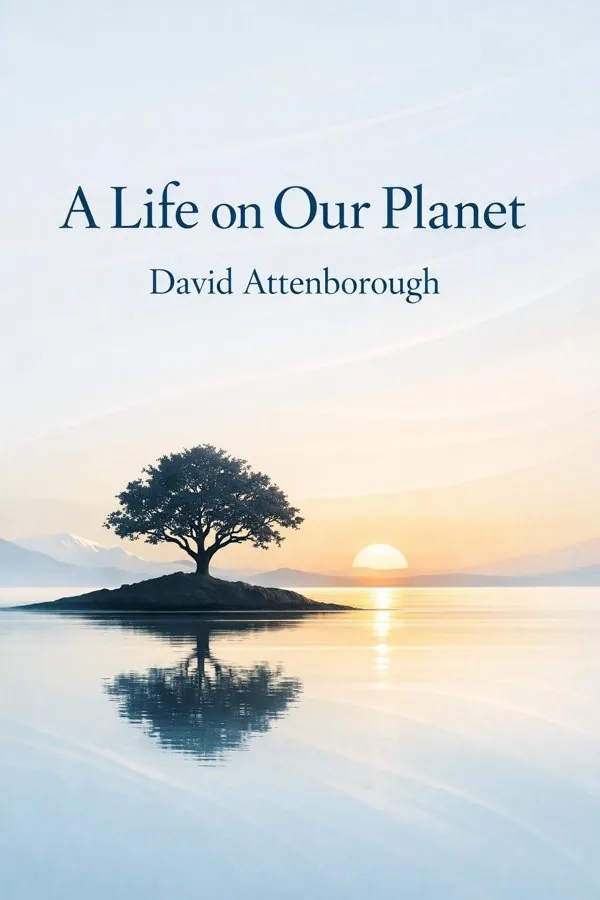
A Life on Our Planet: My Witness Statement and a Vision for the Future: Summary & Key Insights
 10 min9 chaptersAudio available
Key Takeaways from A Life on Our Planet: My Witness Statement and a Vision for the Future
The most unsettling truth in this book is that environmental collapse is not a distant possibility; it is a change that has already happened within one human lifetime.
A central insight of the book is that biodiversity is not a luxury for nature lovers; it is the operating system of life on Earth.
One of the book’s sharpest warnings is that humanity has behaved as if the planet were limitless.
Attenborough presents climate change not as an isolated environmental issue but as a threat multiplier that intensifies nearly every other ecological and social problem.
A hopeful idea running through the book is that nature can recover with remarkable speed if given the chance.
What Is A Life on Our Planet: My Witness Statement and a Vision for the Future About?
A Life on Our Planet: My Witness Statement and a Vision for the Future by David Attenborough is a environment book. A Life on Our Planet is David Attenborough’s urgent witness statement about the state of Earth. Part memoir, part environmental diagnosis, and part practical roadmap, the book draws on a lifetime spent filming the natural world across every continent and ocean. Attenborough does not simply describe environmental decline in abstract terms. He shows how, over the course of his own life, wilderness has shrunk, biodiversity has collapsed, and humanity’s demand for land, energy, and resources has pushed the planet toward instability. That personal perspective gives the book unusual force: this is not theory from a distance, but testimony from someone who has seen the change unfold firsthand. What makes the book so powerful is its balance of warning and hope. Attenborough argues that human beings are not separate from nature but dependent on it, and that our future prosperity depends on restoring the living systems we have damaged. He also offers a clear vision for renewal, from rewilding land and protecting oceans to stabilizing population growth and shifting food systems. For readers seeking a concise but profound understanding of the environmental crisis, this book is both a reckoning and a call to action from one of the world’s most trusted natural historians.
This FizzRead summary covers all 9 key chapters of A Life on Our Planet: My Witness Statement and a Vision for the Future in approximately 10 minutes, distilling the most important ideas, arguments, and takeaways from David Attenborough's work. Also available as an audio summary and Key Quotes Podcast.
A Life on Our Planet: My Witness Statement and a Vision for the Future
A Life on Our Planet is David Attenborough’s urgent witness statement about the state of Earth. Part memoir, part environmental diagnosis, and part practical roadmap, the book draws on a lifetime spent filming the natural world across every continent and ocean. Attenborough does not simply describe environmental decline in abstract terms. He shows how, over the course of his own life, wilderness has shrunk, biodiversity has collapsed, and humanity’s demand for land, energy, and resources has pushed the planet toward instability. That personal perspective gives the book unusual force: this is not theory from a distance, but testimony from someone who has seen the change unfold firsthand.
What makes the book so powerful is its balance of warning and hope. Attenborough argues that human beings are not separate from nature but dependent on it, and that our future prosperity depends on restoring the living systems we have damaged. He also offers a clear vision for renewal, from rewilding land and protecting oceans to stabilizing population growth and shifting food systems. For readers seeking a concise but profound understanding of the environmental crisis, this book is both a reckoning and a call to action from one of the world’s most trusted natural historians.
Who Should Read A Life on Our Planet: My Witness Statement and a Vision for the Future?
This book is perfect for anyone interested in environment and looking to gain actionable insights in a short read. Whether you're a student, professional, or lifelong learner, the key ideas from A Life on Our Planet: My Witness Statement and a Vision for the Future by David Attenborough will help you think differently.
- ✓Readers who enjoy environment and want practical takeaways
- ✓Professionals looking to apply new ideas to their work and life
- ✓Anyone who wants the core insights of A Life on Our Planet: My Witness Statement and a Vision for the Future in just 10 minutes
Want the full summary?
Get instant access to this book summary and 100K+ more with Fizz Moment.
Get Free SummaryAvailable on App Store • Free to download
Key Chapters
The most unsettling truth in this book is that environmental collapse is not a distant possibility; it is a change that has already happened within one human lifetime. Attenborough structures his message around the years of his own life, showing how population growth, rising carbon emissions, shrinking wilderness, and biodiversity loss accelerated as he traveled the globe filming nature. By tying planetary decline to personal chronology, he makes the crisis tangible. This is not a story of vague geological eras. It is the story of what happened between one generation’s childhood and old age.
This framing matters because people often underestimate slow-moving destruction. A forest cut back year by year, a coral reef bleached season by season, or a species reduced in number over decades can seem invisible if there is no baseline for comparison. Attenborough provides that baseline. He recalls places once abundant with wildlife that are now silent or depleted. The emotional power comes from the contrast: the world he first encountered was far richer, more resilient, and more alive than the one we inhabit now.
Readers can apply this idea by rethinking what they consider normal. If today’s degraded landscapes are treated as the standard, ambition remains too small. Communities can use historical ecological records to restore wetlands, rivers, and local habitats closer to their former health. Families can teach children what species once thrived nearby and support conservation projects that rebuild local biodiversity.
Actionable takeaway: measure environmental change against historical abundance, not current damage, and let that fuller vision shape your choices, expectations, and advocacy.
A central insight of the book is that biodiversity is not a luxury for nature lovers; it is the operating system of life on Earth. Attenborough argues that ecosystems function because countless species interact in ways that regulate climate, build soil, pollinate crops, recycle nutrients, purify water, and stabilize food chains. When biodiversity declines, those systems become brittle. Humanity may feel technologically advanced, but it still depends on healthy natural processes every day.
This challenges a common assumption that economic growth and ecological health are separate concerns. In reality, they are deeply linked. Agriculture depends on fertile soil, insect pollinators, freshwater cycles, and predictable seasons. Fisheries depend on balanced marine ecosystems. Public health depends on stable climates and intact habitats that reduce the spread of disease. Even industries far removed from wilderness rely on natural systems for raw materials, climate regulation, and social stability.
Practical examples are everywhere. Planting a single crop across vast regions may increase efficiency in the short term, but it can reduce resilience by attracting pests, exhausting soil, and increasing dependence on chemicals. By contrast, regenerative farming methods, crop rotation, hedgerows, and habitat corridors can increase biodiversity while also supporting long-term productivity. In cities, greener spaces can cool neighborhoods, support pollinators, absorb rainwater, and improve wellbeing.
Attenborough’s larger point is simple but profound: if we destroy the web of life, we weaken the foundations of civilization. Protecting nature is therefore not opposed to human flourishing; it is how human flourishing becomes possible.
Actionable takeaway: treat biodiversity as essential infrastructure and support policies, products, and local initiatives that restore living ecosystems rather than merely extracting from them.
One of the book’s sharpest warnings is that humanity has behaved as if the planet were limitless. Attenborough shows how modern economies often assume endless expansion in energy use, material consumption, land conversion, and waste production. That mindset may produce short-term gains, but it ignores the reality that Earth is a finite system with boundaries. Forests cannot be cleared forever, fish cannot be harvested beyond replenishment, and fossil fuels cannot be burned indefinitely without destabilizing climate and ecosystems.
This illusion of endless growth has been especially dangerous because many of its costs are delayed or hidden. A product may seem cheap only because the damage to forests, oceans, atmosphere, or future generations is not included in the price. Attenborough urges readers to see beyond immediate convenience and recognize that extraction-based prosperity is often borrowed from the future.
In everyday life, this insight encourages a shift from quantity to durability. Individuals can buy fewer disposable goods, reduce waste, choose repairable products, and support circular business models. Companies can redesign supply chains around efficiency, reuse, and lower ecological footprints. Governments can move away from using gross output alone as a measure of success and include indicators such as ecosystem health, emissions, and long-term resilience.
The deeper lesson is not that progress must stop, but that progress must be redefined. A society that consumes more while degrading its life-support systems is not truly advancing. Real prosperity means meeting human needs while allowing the natural world to regenerate.
Actionable takeaway: question any system, habit, or business model that depends on constant extraction, and favor forms of growth that increase wellbeing while reducing ecological harm.
Attenborough presents climate change not as an isolated environmental issue but as a threat multiplier that intensifies nearly every other ecological and social problem. Rising temperatures affect rainfall, agriculture, ice sheets, oceans, forests, and species migration. Heatwaves become more severe, droughts last longer, wildfires spread faster, and storms can become more destructive. What makes climate change especially dangerous is that it pushes natural systems beyond the conditions in which they evolved.
The book emphasizes that climate instability is tied directly to human choices, especially the burning of fossil fuels and the destruction of carbon-rich ecosystems such as forests, peatlands, mangroves, and seagrasses. These systems once stored carbon and moderated climate. When damaged, they not only lose that function but can release more carbon into the atmosphere, creating feedback loops that worsen the crisis.
Attenborough’s contribution is to connect climate with lived reality. This is not only about temperature charts. It affects crop failures, water insecurity, food prices, migration pressures, and the survival of countless species. In practical terms, the book points readers toward both mitigation and restoration. Shifting to renewable energy, improving home efficiency, using public transit, and supporting electrification reduce emissions. Protecting forests and restoring coastal ecosystems increase carbon storage while improving resilience.
Importantly, Attenborough avoids fatalism. He argues that many solutions already exist, but they require speed, scale, and political will. Climate change is severe, yet still responsive to action if societies move decisively.
Actionable takeaway: reduce your fossil-fuel dependence where possible and support climate policies that cut emissions while restoring ecosystems that naturally stabilize the planet.
A hopeful idea running through the book is that nature can recover with remarkable speed if given the chance. Attenborough highlights rewilding as a powerful way to restore ecological balance. Rewilding does not mean abandoning people or freezing landscapes in time. It means rebuilding functioning ecosystems by allowing natural processes and native species to return, especially in places where industrial activity has stripped away complexity.
This approach matters because many environmental policies focus only on reducing harm. Rewilding goes further by actively increasing ecological health. For example, restoring forests can bring back birds, insects, mammals, and fungi while improving soil, water retention, and carbon capture. Reintroducing key species can reshape entire habitats. Marine protected areas can allow fish populations to rebound, replenishing surrounding waters as ecosystems recover.
Attenborough uses such examples to demonstrate that conservation is not merely defensive. It can be regenerative. The return of life to damaged places can create benefits for local communities through tourism, cleaner water, flood prevention, and more resilient landscapes. Urban environments can also participate through native planting, river restoration, and wildlife corridors that reconnect fragmented habitats.
For readers, rewilding offers a practical alternative to despair. It shifts the question from “How do we preserve the little that remains?” to “How much living richness can we bring back?” Even small-scale actions, such as converting lawns into pollinator-friendly gardens or supporting local habitat projects, contribute to larger ecological networks.
Actionable takeaway: support restoration, not just protection, by backing rewilding efforts in your region and redesigning any land you influence to favor native species and ecological complexity.
Few human activities influence the planet more than the way we produce and consume food. Attenborough argues that agriculture sits at the center of the environmental crisis because it determines how land is used, how forests are cleared, how water is consumed, and how much pollution enters soils and rivers. Industrial food systems can produce abundance, but they often do so by simplifying landscapes, removing wildlife habitat, relying heavily on fossil fuels, and prioritizing output over resilience.
A major theme in the book is that feeding humanity does not require ever-expanding farmland. Instead, it requires smarter and more equitable systems. Diets with less resource-intensive animal consumption, more efficient farming methods, reduced food waste, and better land stewardship can free space for nature while still nourishing growing populations. This is particularly important because land spared from unnecessary expansion can be reforested or rewilded, multiplying climate and biodiversity benefits.
Attenborough does not present food solely as a personal morality issue. It is also a systems issue involving subsidies, trade, land rights, infrastructure, and public policy. Still, personal choices matter. Eating lower on the food chain more often, buying seasonal food, supporting regenerative farmers, and wasting less can all reduce ecological pressure. Schools, companies, and cities can make similar shifts at scale through procurement policies and menu design.
The broader insight is that food can either be a force for ecological destruction or a lever for renewal. Reforming food systems is one of the most practical ways to align human wellbeing with planetary limits.
Actionable takeaway: use your meals as environmental decisions by reducing waste, favoring lower-impact foods, and supporting farming practices that restore soil, habitat, and long-term resilience.
Attenborough addresses population growth with nuance, arguing that the issue cannot be reduced to numbers alone. Environmental pressure increases when more people seek higher levels of consumption on a finite planet, but the drivers of population growth are closely tied to poverty, inequality, healthcare access, and education, especially for girls and women. When societies become more secure and opportunities broaden, birth rates often fall naturally.
This is an important corrective to simplistic narratives. The environmental crisis is not caused equally by all people. High-consuming societies and elites often place far greater pressure on the planet than poorer communities with much smaller ecological footprints. Attenborough therefore links population stabilization to justice. Better education, reproductive healthcare, women’s rights, and economic security improve lives while also reducing long-term strain on ecosystems.
In practice, this means effective environmental action must include social development. Governments and international institutions can invest in maternal healthcare, schooling, and family planning. Communities can support programs that expand opportunity and reduce child mortality, since families often choose to have fewer children when survival and stability improve. Individuals can support organizations working at the intersection of environmental sustainability and human rights.
The larger lesson is that sustainability is not achieved through coercion or blame, but through conditions that allow people to thrive. When human dignity improves, environmental outcomes often improve too. Attenborough’s argument is therefore both practical and humane: a fairer world is more likely to become a sustainable world.
Actionable takeaway: support policies and organizations that expand education, healthcare, and women’s autonomy, recognizing these as core environmental solutions as well as moral imperatives.
Perhaps the book’s most important contribution is its insistence that hope is not passive optimism. Attenborough rejects both denial and despair. He argues that the future is still open, but only if humanity acts collectively and quickly. The damage already done is severe, yet the living world retains a capacity for recovery, and human societies already possess many of the tools needed to change course. Hope, in this sense, is disciplined action informed by reality.
This matters because environmental discussions often swing between complacency and paralysis. If people believe everything is fine, they do nothing. If they believe everything is lost, they also do nothing. Attenborough offers a middle path: face the scale of the crisis honestly, then commit to practical solutions at every level. That includes government policy, business transformation, scientific innovation, community restoration, and everyday choices that reinforce larger change.
Examples of collective action include expanding protected areas, decarbonizing energy systems, ending deforestation, redesigning transport, reforming agriculture, and building economies around regeneration rather than depletion. On an individual level, readers can vote with climate and biodiversity in mind, support credible organizations, reduce high-impact consumption, and talk about these issues in ways that motivate others rather than alienate them.
Attenborough’s optimism is earned, not naive. He has seen destruction, but he has also seen ecosystems rebound when pressure is removed. That evidence underpins his message: the future depends on whether we decide to become stewards instead of exploiters.
Actionable takeaway: turn concern into a concrete plan by choosing one personal habit, one community effort, and one political action that helps restore a stable, biodiverse planet.
All Chapters in A Life on Our Planet: My Witness Statement and a Vision for the Future
About the Author
David Attenborough is a British broadcaster, natural historian, and author whose work has shaped public understanding of the natural world for more than half a century. Born in 1926, he became globally known through groundbreaking BBC documentaries that brought extraordinary wildlife and ecosystems to mass audiences, including Life on Earth, The Blue Planet, and Planet Earth. His storytelling combines scientific insight, visual wonder, and deep concern for the future of life on Earth. Over time, he has become one of the world’s most respected voices on biodiversity loss, climate change, and conservation. In A Life on Our Planet, Attenborough draws on a lifetime of exploration and observation to deliver both a warning and a hopeful vision for restoring the planet.
Get This Summary in Your Preferred Format
Read or listen to the A Life on Our Planet: My Witness Statement and a Vision for the Future summary by David Attenborough anytime, anywhere. FizzRead offers multiple formats so you can learn on your terms — all free.
Available formats: App · Audio · PDF · EPUB — All included free with FizzRead
Download A Life on Our Planet: My Witness Statement and a Vision for the Future PDF and EPUB Summary
Key Quotes from A Life on Our Planet: My Witness Statement and a Vision for the Future
“The most unsettling truth in this book is that environmental collapse is not a distant possibility; it is a change that has already happened within one human lifetime.”
“A central insight of the book is that biodiversity is not a luxury for nature lovers; it is the operating system of life on Earth.”
“One of the book’s sharpest warnings is that humanity has behaved as if the planet were limitless.”
“Attenborough presents climate change not as an isolated environmental issue but as a threat multiplier that intensifies nearly every other ecological and social problem.”
“A hopeful idea running through the book is that nature can recover with remarkable speed if given the chance.”
Frequently Asked Questions about A Life on Our Planet: My Witness Statement and a Vision for the Future
A Life on Our Planet: My Witness Statement and a Vision for the Future by David Attenborough is a environment book that explores key ideas across 9 chapters. A Life on Our Planet is David Attenborough’s urgent witness statement about the state of Earth. Part memoir, part environmental diagnosis, and part practical roadmap, the book draws on a lifetime spent filming the natural world across every continent and ocean. Attenborough does not simply describe environmental decline in abstract terms. He shows how, over the course of his own life, wilderness has shrunk, biodiversity has collapsed, and humanity’s demand for land, energy, and resources has pushed the planet toward instability. That personal perspective gives the book unusual force: this is not theory from a distance, but testimony from someone who has seen the change unfold firsthand. What makes the book so powerful is its balance of warning and hope. Attenborough argues that human beings are not separate from nature but dependent on it, and that our future prosperity depends on restoring the living systems we have damaged. He also offers a clear vision for renewal, from rewilding land and protecting oceans to stabilizing population growth and shifting food systems. For readers seeking a concise but profound understanding of the environmental crisis, this book is both a reckoning and a call to action from one of the world’s most trusted natural historians.
You Might Also Like
A Sky Full Of Birds
Matt Merritt
10 min
Carbon Zero: Imagining Cities That Can Save the Planet
Alex Steffen
10 min
Eaarth: Making a Life on a Tough New Planet
Bill McKibben
10 min
The Social Contract and Environmental Governance
Various Editors
10 min
The Wild Places
Robert Macfarlane
10 min
A World Without Ice
Henry Pollack
10 minFeatured In
Browse by Category
Ready to read A Life on Our Planet: My Witness Statement and a Vision for the Future?
Get the full summary and 100K+ more books with Fizz Moment.