
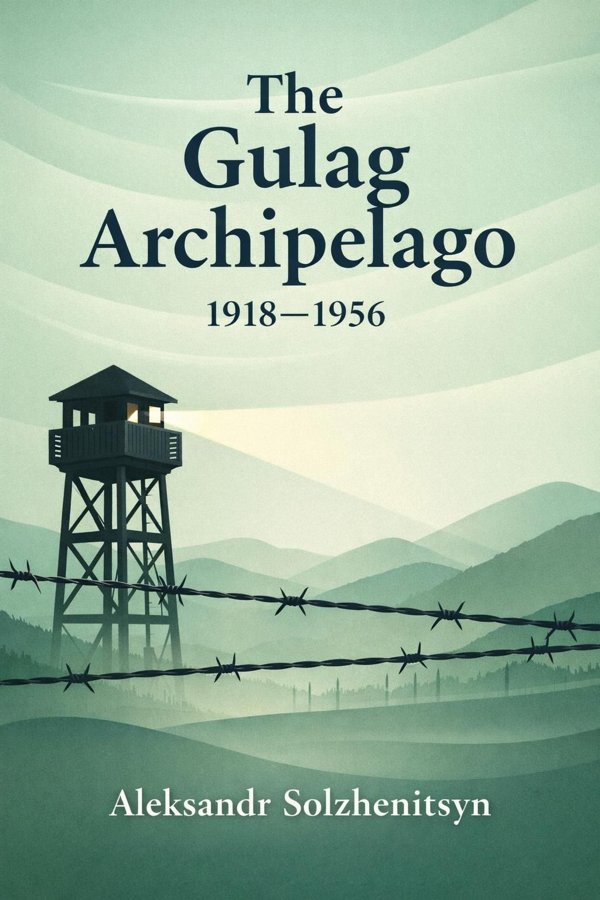
The Gulag Archipelago 1918–1956: An Experiment in Literary Investigation: Summary & Key Insights
 10 min10 chaptersAudio available
Key Takeaways from The Gulag Archipelago 1918–1956: An Experiment in Literary Investigation
Total terror often enters life in the most ordinary way: a knock at the door, a summons, a routine stop, a signature demanded on a paper you do not understand.
A confession extracted under fear tells us less about guilt than about the methods of power.
Modern cruelty becomes especially dangerous when it is organized like production.
Punishment did not begin at the camp gate; it began on the road.
The most shocking truth of the Gulag is that it was not an exception at the edges of society but a vast parallel country within the country.
What Is The Gulag Archipelago 1918–1956: An Experiment in Literary Investigation About?
The Gulag Archipelago 1918–1956: An Experiment in Literary Investigation by Aleksandr Solzhenitsyn is a world_history book spanning 10 pages. The Gulag Archipelago 1918–1956 is one of the twentieth century’s most important works of historical witness. Part memoir, part documentary record, part moral indictment, Aleksandr Solzhenitsyn reconstructs the vast Soviet system of arrests, interrogations, prisons, transit convoys, labor camps, and internal exile that swallowed millions of lives. Rather than offering a narrow personal account, he assembles a collective testimony from his own imprisonment, the recollections of fellow prisoners, and years of painstaking reflection. The result is what he calls a “literary investigation”: a work that seeks not only to describe terror, but to expose how ordinary institutions, habits, and justifications made it possible. Why does this book still matter? Because it reveals how repression grows gradually, how language hides violence, and how fear persuades societies to accept the unacceptable. Solzhenitsyn writes with the authority of a survivor and the discipline of a historian, but also with the moral urgency of someone determined that suffering not be buried under official lies. The book is monumental not just for what it records, but for the warning it issues: when power escapes law and conscience, entire nations can be turned into machinery of humiliation.
This FizzRead summary covers all 10 key chapters of The Gulag Archipelago 1918–1956: An Experiment in Literary Investigation in approximately 10 minutes, distilling the most important ideas, arguments, and takeaways from Aleksandr Solzhenitsyn's work. Also available as an audio summary and Key Quotes Podcast.
The Gulag Archipelago 1918–1956: An Experiment in Literary Investigation
The Gulag Archipelago 1918–1956 is one of the twentieth century’s most important works of historical witness. Part memoir, part documentary record, part moral indictment, Aleksandr Solzhenitsyn reconstructs the vast Soviet system of arrests, interrogations, prisons, transit convoys, labor camps, and internal exile that swallowed millions of lives. Rather than offering a narrow personal account, he assembles a collective testimony from his own imprisonment, the recollections of fellow prisoners, and years of painstaking reflection. The result is what he calls a “literary investigation”: a work that seeks not only to describe terror, but to expose how ordinary institutions, habits, and justifications made it possible.
Why does this book still matter? Because it reveals how repression grows gradually, how language hides violence, and how fear persuades societies to accept the unacceptable. Solzhenitsyn writes with the authority of a survivor and the discipline of a historian, but also with the moral urgency of someone determined that suffering not be buried under official lies. The book is monumental not just for what it records, but for the warning it issues: when power escapes law and conscience, entire nations can be turned into machinery of humiliation.
Who Should Read The Gulag Archipelago 1918–1956: An Experiment in Literary Investigation?
This book is perfect for anyone interested in world_history and looking to gain actionable insights in a short read. Whether you're a student, professional, or lifelong learner, the key ideas from The Gulag Archipelago 1918–1956: An Experiment in Literary Investigation by Aleksandr Solzhenitsyn will help you think differently.
- ✓Readers who enjoy world_history and want practical takeaways
- ✓Professionals looking to apply new ideas to their work and life
- ✓Anyone who wants the core insights of The Gulag Archipelago 1918–1956: An Experiment in Literary Investigation in just 10 minutes
Want the full summary?
Get instant access to this book summary and 100K+ more with Fizz Moment.
Get Free SummaryAvailable on App Store • Free to download
Key Chapters
Total terror often enters life in the most ordinary way: a knock at the door, a summons, a routine stop, a signature demanded on a paper you do not understand. Solzhenitsyn begins with arrest because it is the threshold through which millions passed from normal existence into the hidden world of repression. The point is not simply that innocent people were arrested, though many were. It is that arrest became a governing principle of Soviet life, designed to keep everyone uncertain, vulnerable, and obedient. Anyone could be taken: soldiers, engineers, peasants, party members, wives, students, or decorated citizens.
Solzhenitsyn shows that the power of arrest lay partly in its unpredictability. It could happen at home, at work, on a train, or at the front. The charge often mattered less than the ritual itself. Once detained, the individual entered a system in which the presumption of guilt replaced the presumption of innocence. Bureaucratic language gave the process a lawful appearance, but its real function was to sever people from family, reputation, and legal protection.
The practical lesson extends far beyond Soviet history. Whenever a state normalizes detention without transparency, weakens due process, or teaches citizens that innocence offers no safety, it creates the conditions for wider abuse. Solzhenitsyn forces readers to see that tyranny does not always begin with spectacular violence; it often begins with administrative convenience and public silence.
Actionable takeaway: pay attention to how institutions handle accusation, detention, and due process, because the health of a society is often revealed at the moment when power first lays hands on a person.
A confession extracted under fear tells us less about guilt than about the methods of power. In Solzhenitsyn’s account, interrogation is not a search for truth but a technology for manufacturing obedience. The prisoner enters a world of sleep deprivation, threats, isolation, deception, humiliation, and staged certainty. Investigators do not need facts when they possess unlimited time, coercive authority, and a state ideology that already presumes hidden enemies everywhere.
What makes these chapters so disturbing is Solzhenitsyn’s insistence that torture is not only physical. Endless questioning, false promises, pressure against family members, and the crushing loneliness of confinement can dismantle a person’s resistance. Interrogators learned to exploit personality, fatigue, and hope. Some prisoners signed absurd accusations simply to end the ordeal; others denounced acquaintances to spare relatives; still others clung to truth at enormous cost. The system rewarded confession because confession validated the system.
This idea has practical relevance whenever institutions prize closure over accuracy. In policing, intelligence work, workplace investigations, or political purges, a process becomes dangerous when authorities decide the outcome first and seek evidence later. Solzhenitsyn exposes the moral catastrophe that follows when procedure loses contact with justice.
He also asks readers to confront a harder question: how much pressure can an ordinary person endure? His answer is not self-righteous. He recognizes human weakness while condemning the machinery that exploits it.
Actionable takeaway: in any system of judgment, defend independent review, legal counsel, transparent standards of evidence, and protections against coercion, because truth cannot survive where fear becomes the chief investigative tool.
Modern cruelty becomes especially dangerous when it is organized like production. Solzhenitsyn’s image of the “conveyor” captures a system designed to process people rapidly through arrest, interrogation, sentencing, transport, labor, and replacement. Individual lives disappear into a rhythm of quotas, forms, signatures, and transfers. The cruelty is not random chaos; it is administration with a target.
In the Gulag world, officials were pressured to deliver cases, confessions, and convictions in bulk. Investigators had numbers to meet, camp commanders had labor demands, and entire agencies were incentivized to keep the flow moving. Once a person entered the conveyor, every stage reinforced the next. False confession justified sentencing; sentencing supplied labor; labor losses justified fresh arrests. The system fed itself by turning human beings into inputs.
Solzhenitsyn’s insight applies broadly to any bureaucracy that measures success by throughput while ignoring human cost. Hospitals, schools, prisons, immigration systems, and corporations can all drift toward conveyor logic when metrics replace moral judgment. Efficiency is not evil in itself, but efficiency detached from dignity becomes destructive. The book reminds us that evil often scales through paperwork rather than passion.
A practical example is how organizations may optimize output while overlooking burnout, wrongful punishment, or procedural injustice. When workers or citizens become units rather than persons, abuse becomes easier to justify. The conveyor mindset also diffuses responsibility: each participant handles only a small task and claims innocence.
Actionable takeaway: whenever you encounter a system obsessed with quotas and throughput, ask what human realities are being hidden by the numbers, and insist that accountability follow the entire process, not just isolated steps.
Punishment did not begin at the camp gate; it began on the road. Solzhenitsyn devotes powerful attention to the transit system because the journey itself was a carefully neglected form of suffering. Prisoners were packed into rail cars, prison vans, and temporary holding sites under conditions of hunger, filth, uncertainty, and exhaustion. Families often had no idea where loved ones had gone. The route was hidden, fragmented, and disorienting, as if to erase the prisoner’s previous identity before forced labor even started.
These journeys mattered because they revealed the full geography of repression. The Gulag was not just a chain of camps but a whole infrastructure of movement, sorting, and disappearance. Transit prisons and convoy routes connected city basements to Arctic mines and forest camps. The state’s power depended on these invisible corridors. Solzhenitsyn shows that logistics can become instruments of domination when secrecy and indifference rule.
This has contemporary echoes in how displaced people, detainees, refugees, or prisoners may suffer most in transfer zones where accountability is weakest. Waiting rooms, transport vehicles, border facilities, and temporary detention centers often fall outside public attention, yet they can become sites of extreme vulnerability.
Solzhenitsyn also highlights the psychological dimension of transport. The prisoner lives in radical uncertainty: not knowing destination, sentence reality, duration, or survival chances. Such uncertainty weakens solidarity and deepens dependence on rumor.
Actionable takeaway: evaluate institutions not only by their official destinations but by what happens in transit, because the hidden spaces between decision and arrival often reveal whether a system truly respects human dignity.
Extreme conditions do not simply reveal character; they also deform it. Solzhenitsyn’s account of daily life in the camps examines hunger, exhausting labor, cold, disease, arbitrary punishment, theft, privilege systems, criminal subcultures, and the constant struggle for survival. Yet he is not interested only in physical misery. He asks what such conditions do to human relationships, moral judgment, and the possibility of inner freedom.
In the camps, small advantages could determine survival: an easier work assignment, an extra ration, access to warm clothing, a place near the stove, a friend in the kitchen, a tolerated rule violation. Such scarcity pushed prisoners toward compromise, cunning, servility, or betrayal. At the same time, camp life produced moments of courage, generosity, and spiritual clarity. A crust of bread shared, a truthful word spoken, a refusal to join in cruelty—these became acts of profound significance.
Solzhenitsyn therefore rejects simplistic divisions between heroes and cowards. The camp was an environment in which morality was made brutally concrete. Decisions were rarely abstract. They involved hunger, exhaustion, and fear. This realism is one of the book’s great strengths.
For modern readers, the application is clear: environments shape conduct. Organizations and societies should not assume virtue will flourish under degrading conditions. If people are forced into competition for necessities or subjected to constant insecurity, ethical life weakens.
Actionable takeaway: create conditions in families, institutions, and workplaces that support honesty and solidarity rather than fear and scarcity, because moral behavior becomes more sustainable when dignity is materially protected.
A regime may imprison the body without fully mastering the inner life. One of Solzhenitsyn’s deepest claims is that suffering, while never desirable, can strip away illusions and force a person to confront essential questions: What do I live for? What can I refuse? What remains when status, comfort, and public identity are gone? In the camps, some prisoners became more degraded, but others discovered an unexpected spiritual resilience.
This is not sentimental optimism. Solzhenitsyn never glorifies suffering as politically acceptable or morally pure. Rather, he observes that when every external support is removed, some people recover a sharper sense of conscience. They stop living for advancement, applause, or safety and begin measuring life by truthfulness, compassion, and inward freedom. The famous moral idea running through the book is that the line between good and evil cuts through every human heart. Evil is not confined to official villains; nor is goodness reserved for martyrs. The battle is personal and continuous.
This insight gives the work its enduring philosophical force. The Gulag matters historically, but also anthropologically: it teaches what people become under pressure and how meaning survives degradation. In practical life, readers can apply this by examining their own compromises. We may never face a labor camp, but we still confront incentives to lie, conform, flatter, and excuse wrongdoing.
Actionable takeaway: strengthen your inner life through habits of truth-telling, moral reflection, and gratitude, because external freedom is fragile unless supported by a conscience that refuses to cooperate fully with falsehood.
Freedom on paper is not always freedom in reality. Solzhenitsyn shows that release from camp often meant only a transition into other forms of control: internal exile, civil restrictions, surveillance, stigma, damaged health, fractured families, and the burden of returning to a society that preferred silence. Many former prisoners discovered that they had survived the camps only to enter a life of partial nonexistence.
The practical cruelty of the system lay in this unfinished punishment. Released prisoners could be barred from major cities, denied meaningful employment, or treated as contaminated by suspicion. They had to rebuild identity after years of degradation while navigating a public culture shaped by fear. Even family reunions could be emotionally difficult; time, secrecy, and trauma had altered everyone involved. Solzhenitsyn thereby expands our understanding of state violence beyond imprisonment itself. Repression leaves administrative and psychological afterlives.
This remains relevant in discussions of incarceration, political persecution, and displacement today. Former prisoners, refugees, and victims of surveillance often face invisible sentences long after official penalties end. Without restoration of rights, truthful public memory, and social reintegration, release can become another form of abandonment.
Solzhenitsyn also underscores memory’s role in return. Survivors must decide whether to speak, conceal, forgive, accuse, or simply endure. Their choices are shaped by risk, dignity, and the fear of not being believed.
Actionable takeaway: when evaluating justice, look beyond the formal end of punishment and ask what support, rights, recognition, and social repair are needed for a person to reenter community with dignity.
The most efficient shield for injustice is a doctrine that transforms victims into obstacles and cruelty into duty. Solzhenitsyn argues that the Soviet repressive apparatus did not rely on sadism alone. It was sustained by ideological justification: class struggle, historical necessity, vigilance against enemies, and the belief that a radiant future excused present brutality. Once people accepted that certain groups were expendable in service of progress, repression acquired moral camouflage.
This is one of the book’s most important historical contributions. Solzhenitsyn is not satisfied with describing what happened; he asks how so many officials, informers, investigators, and ordinary citizens could participate. His answer is that ideology relieves people of the burden of personal conscience. It allows them to say, in effect, this is regrettable but necessary, harsh but scientific, cruel but ultimately humane. Such language turns crimes into policy and dissent into moral treason.
The warning applies everywhere. Whenever political movements insist that history guarantees their righteousness, they become tempted to treat critics as enemies of humanity rather than fellow citizens. Corporate, bureaucratic, or activist systems can fall into similar patterns when mission language suppresses scrutiny.
A practical test is whether a doctrine permits self-criticism, acknowledges limits, and respects the irreducible dignity of opponents. If not, it is already dangerous. Solzhenitsyn reminds us that people commit the worst acts not only out of hatred, but out of sincere belief that they are serving a higher good.
Actionable takeaway: distrust any ideology that asks you to ignore present suffering for the sake of promised future perfection, and keep conscience above slogans, theories, and institutional missions.
What survives tyranny if records are destroyed, witnesses die, and fear teaches silence? Solzhenitsyn’s answer is that testimony itself becomes an act of justice. The Gulag Archipelago is written not merely to inform but to restore voice to the disappeared and to challenge the social amnesia that allows crimes to fade into abstraction. By gathering hundreds of experiences into one literary investigation, he turns private suffering into public memory.
The book’s method matters as much as its subject. Solzhenitsyn combines personal recollection, reported testimony, historical patterning, irony, and moral reflection to create a form capable of confronting state lies. He knows that statistics alone cannot carry the emotional and ethical truth of mass repression. At the same time, individual anecdotes without structure can be dismissed as isolated cases. His achievement is to make memory cumulative, so that testimony builds into historical argument.
This idea has broad application in any society dealing with atrocity, censorship, or institutional abuse. Archives, oral histories, journalism, memoir, and public commemoration are not luxuries after trauma; they are part of repair. When victims are not heard, false narratives return. When witnesses speak and records are preserved, denial becomes harder.
For individual readers, the chapter points to a more personal duty: to listen carefully, record honestly, and refuse convenient forgetting. Not everyone will write a monumental book, but everyone can help preserve truth in smaller circles of family, community, and profession.
Actionable takeaway: treat memory as a civic responsibility—document what matters, honor credible testimony, and resist the pressure to forget abuses simply because they are politically inconvenient.
All Chapters in The Gulag Archipelago 1918–1956: An Experiment in Literary Investigation
About the Author
Aleksandr Solzhenitsyn (1918–2008) was a Russian novelist, historian, and one of the twentieth century’s most influential literary witnesses to political repression. Born in Kislovodsk, he studied mathematics and later served as an officer in the Soviet army during World War II. In 1945 he was arrested for criticizing Stalin in private letters and spent years in prisons, labor camps, and internal exile. Those experiences became the foundation of his writing. Solzhenitsyn gained global recognition with One Day in the Life of Ivan Denisovich and was awarded the Nobel Prize in Literature in 1970. His works, especially The Gulag Archipelago, exposed the realities of the Soviet camp system and challenged official silence. He remains a defining voice on tyranny, memory, conscience, and the moral responsibilities of literature.
Get This Summary in Your Preferred Format
Read or listen to the The Gulag Archipelago 1918–1956: An Experiment in Literary Investigation summary by Aleksandr Solzhenitsyn anytime, anywhere. FizzRead offers multiple formats so you can learn on your terms — all free.
Available formats: App · Audio · PDF · EPUB — All included free with FizzRead
Download The Gulag Archipelago 1918–1956: An Experiment in Literary Investigation PDF and EPUB Summary
Key Quotes from The Gulag Archipelago 1918–1956: An Experiment in Literary Investigation
“Total terror often enters life in the most ordinary way: a knock at the door, a summons, a routine stop, a signature demanded on a paper you do not understand.”
“A confession extracted under fear tells us less about guilt than about the methods of power.”
“Modern cruelty becomes especially dangerous when it is organized like production.”
“Punishment did not begin at the camp gate; it began on the road.”
“The most shocking truth of the Gulag is that it was not an exception at the edges of society but a vast parallel country within the country.”
Frequently Asked Questions about The Gulag Archipelago 1918–1956: An Experiment in Literary Investigation
The Gulag Archipelago 1918–1956: An Experiment in Literary Investigation by Aleksandr Solzhenitsyn is a world_history book that explores key ideas across 10 chapters. The Gulag Archipelago 1918–1956 is one of the twentieth century’s most important works of historical witness. Part memoir, part documentary record, part moral indictment, Aleksandr Solzhenitsyn reconstructs the vast Soviet system of arrests, interrogations, prisons, transit convoys, labor camps, and internal exile that swallowed millions of lives. Rather than offering a narrow personal account, he assembles a collective testimony from his own imprisonment, the recollections of fellow prisoners, and years of painstaking reflection. The result is what he calls a “literary investigation”: a work that seeks not only to describe terror, but to expose how ordinary institutions, habits, and justifications made it possible. Why does this book still matter? Because it reveals how repression grows gradually, how language hides violence, and how fear persuades societies to accept the unacceptable. Solzhenitsyn writes with the authority of a survivor and the discipline of a historian, but also with the moral urgency of someone determined that suffering not be buried under official lies. The book is monumental not just for what it records, but for the warning it issues: when power escapes law and conscience, entire nations can be turned into machinery of humiliation.
More by Aleksandr Solzhenitsyn
You Might Also Like

The Age of Capital
Eric Hobsbawm
10 min
The Gulag Archipelago
Aleksandr Solzhenitsyn
10 min
Jerusalem: The Biography
Simon Sebag Montefiore
10 min
The Anglo-Saxons
James Campbell
10 min
The Boer War
Thomas Pakenham
10 min
The Industrial Revolutionaries: The Making of the Modern World 1776–1914
Gavin Weightman
10 minBrowse by Category
Ready to read The Gulag Archipelago 1918–1956: An Experiment in Literary Investigation?
Get the full summary and 100K+ more books with Fizz Moment.