
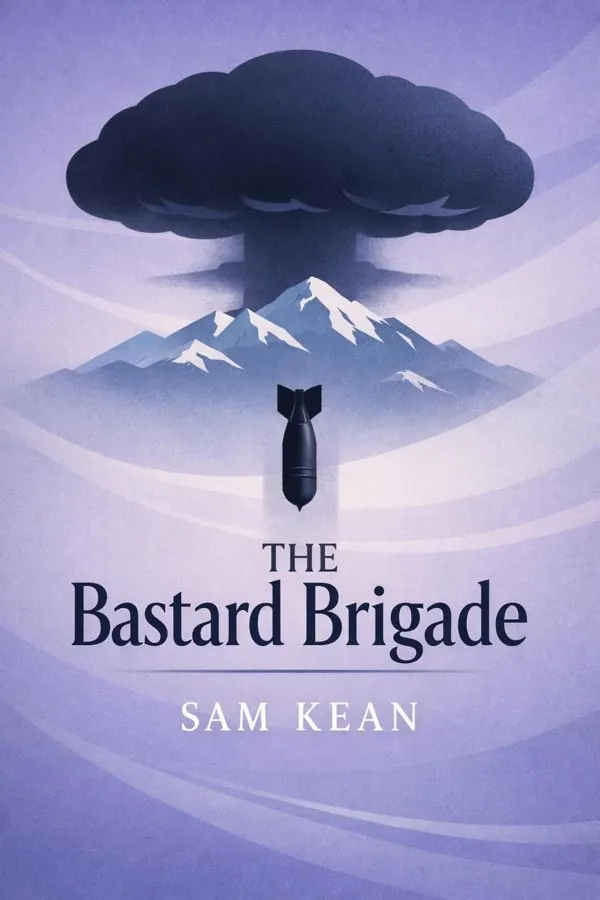
The Bastard Brigade: The True Story of the Renegade Scientists and Spies Who Sabotaged the Nazi Atomic Bomb: Summary & Key Insights
by Sam Kean
 10 min9 chaptersAudio available
Key Takeaways from The Bastard Brigade: The True Story of the Renegade Scientists and Spies Who Sabotaged the Nazi Atomic Bomb
World-changing revolutions often begin in places that seem quiet and technical, far from battlefields or parliaments.
A dangerous enemy does not need to be fully competent to justify alarm; it only needs to be potentially capable.
In crises, fear can be paralyzing, but it can also become a disciplined form of foresight.
History often turns on people who seem absurdly mismatched to their missions.
Sometimes the decisive point in a vast conflict is not an army but a material.
What Is The Bastard Brigade: The True Story of the Renegade Scientists and Spies Who Sabotaged the Nazi Atomic Bomb About?
The Bastard Brigade: The True Story of the Renegade Scientists and Spies Who Sabotaged the Nazi Atomic Bomb by Sam Kean is a world_history book spanning 8 pages. What if the outcome of World War II had depended not only on armies and generals, but on physicists, double agents, saboteurs, and one exceptionally unlikely spy? In The Bastard Brigade, Sam Kean tells the gripping true story of the race to understand atomic power before Nazi Germany could turn it into the most devastating weapon in history. Rather than treating science as an abstract backdrop, Kean shows how discoveries in nuclear physics became urgent matters of survival, drawing in refugees, military planners, resistance fighters, and eccentric geniuses. The book matters because it reveals how close the world felt to catastrophe, even when historians now know Germany never came as near to the bomb as many feared. Kean’s real achievement is showing that wartime decisions are made under uncertainty, with incomplete information and enormous consequences. He combines archival research, scientific clarity, and the pacing of a thriller to illuminate a hidden front of the war: the battle over uranium, heavy water, intelligence, and time itself. The result is a vivid history of ingenuity, fear, and moral ambiguity at the dawn of the nuclear age.
This FizzRead summary covers all 9 key chapters of The Bastard Brigade: The True Story of the Renegade Scientists and Spies Who Sabotaged the Nazi Atomic Bomb in approximately 10 minutes, distilling the most important ideas, arguments, and takeaways from Sam Kean's work. Also available as an audio summary and Key Quotes Podcast.
The Bastard Brigade: The True Story of the Renegade Scientists and Spies Who Sabotaged the Nazi Atomic Bomb
What if the outcome of World War II had depended not only on armies and generals, but on physicists, double agents, saboteurs, and one exceptionally unlikely spy? In The Bastard Brigade, Sam Kean tells the gripping true story of the race to understand atomic power before Nazi Germany could turn it into the most devastating weapon in history. Rather than treating science as an abstract backdrop, Kean shows how discoveries in nuclear physics became urgent matters of survival, drawing in refugees, military planners, resistance fighters, and eccentric geniuses.
The book matters because it reveals how close the world felt to catastrophe, even when historians now know Germany never came as near to the bomb as many feared. Kean’s real achievement is showing that wartime decisions are made under uncertainty, with incomplete information and enormous consequences. He combines archival research, scientific clarity, and the pacing of a thriller to illuminate a hidden front of the war: the battle over uranium, heavy water, intelligence, and time itself. The result is a vivid history of ingenuity, fear, and moral ambiguity at the dawn of the nuclear age.
Who Should Read The Bastard Brigade: The True Story of the Renegade Scientists and Spies Who Sabotaged the Nazi Atomic Bomb?
This book is perfect for anyone interested in world_history and looking to gain actionable insights in a short read. Whether you're a student, professional, or lifelong learner, the key ideas from The Bastard Brigade: The True Story of the Renegade Scientists and Spies Who Sabotaged the Nazi Atomic Bomb by Sam Kean will help you think differently.
- ✓Readers who enjoy world_history and want practical takeaways
- ✓Professionals looking to apply new ideas to their work and life
- ✓Anyone who wants the core insights of The Bastard Brigade: The True Story of the Renegade Scientists and Spies Who Sabotaged the Nazi Atomic Bomb in just 10 minutes
Want the full summary?
Get instant access to this book summary and 100K+ more with Fizz Moment.
Get Free SummaryAvailable on App Store • Free to download
Key Chapters
World-changing revolutions often begin in places that seem quiet and technical, far from battlefields or parliaments. In Kean’s account, the atomic age starts not with mushroom clouds but with the laboratory work of European physicists trying to understand the atom. The crucial breakthrough came with nuclear fission, the discovery that splitting uranium atoms released extraordinary energy. Scientists such as Lise Meitner, Otto Hahn, and Fritz Strassmann helped reveal this process, though politics and persecution shaped who received credit and who was forced into exile.
Kean emphasizes that scientific discovery is never isolated from human circumstances. Meitner, a Jewish physicist driven from Nazi territory, interpreted experimental results that would become central to nuclear weapons research. Her story shows how authoritarian systems can simultaneously exploit science and destroy the very communities that produce it. Once fission was understood, scientists around the world quickly realized its military implications. A chain reaction might generate power, but it might also produce a bomb unlike anything in history.
This matters beyond World War II because it illustrates how basic research can rapidly acquire political significance. Today, fields like artificial intelligence, biotechnology, and cybernetics face similar transitions from theory to strategic competition. Early warnings often come from specialists long before the public understands the stakes.
A practical lesson from this chapter is to pay attention to foundational discoveries, not just flashy end products. Institutions, leaders, and citizens should build the habit of asking: if this breakthrough scales, who controls it, who benefits, and who is endangered? Actionable takeaway: when evaluating new technology, focus early on its second-order effects, because the biggest consequences usually appear before society is ready for them.
A dangerous enemy does not need to be fully competent to justify alarm; it only needs to be potentially capable. One of Kean’s central achievements is his nuanced portrait of Germany’s Uranium Club, the loose wartime effort to explore nuclear possibilities under the Nazi regime. Germany had many advantages at the outset: elite physicists, access to industrial infrastructure, and a tradition of cutting-edge research. Scientists such as Werner Heisenberg, Carl Friedrich von Weizsäcker, and Kurt Diebner became associated with efforts to understand whether a reactor or bomb was feasible.
Yet the program was hobbled by fragmentation, political dysfunction, scarce resources, ideological interference, and strategic misjudgments. The regime undervalued long-term scientific work compared with weapons that could be deployed more quickly. Some scientists may also have lacked urgency or clarity about how to build a bomb at scale. Kean avoids simplistic conclusions. He neither turns German physicists into secret resisters nor portrays them as unstoppable masterminds. Instead, he shows a muddled, inconsistent effort that still frightened Allied leaders because no one could safely assume it would fail.
This dynamic has practical relevance in modern intelligence and risk management. Decision-makers must often respond not to certainty but to possibility. If an adversary has enough expertise, materials, and motivation, hesitation can be disastrous even when evidence remains incomplete.
The broader application is strategic humility. Organizations regularly underestimate diffuse threats because early signs appear inconsistent. Actionable takeaway: when stakes are existential, assess capabilities and trajectories rather than waiting for perfect proof of intent or success.
In crises, fear can be paralyzing, but it can also become a disciplined form of foresight. After physicists grasped what fission might make possible, Allied governments faced a terrifying question: what if Hitler got the bomb first? Kean shows how this fear galvanized scientists and officials who might otherwise have remained divided by profession, nationality, or temperament. Refugee physicists, many of them driven out by fascism, sounded the alarm. Their warnings helped inspire efforts in Britain and the United States to investigate uranium, secure raw materials, and monitor German progress.
This was not merely a scientific race. It was also a counterintelligence campaign. The Allies needed to map German research networks, intercept information, evaluate rumors, and separate genuine danger from exaggerated reports. They had to protect their own work while disrupting the enemy’s. Kean makes clear that wartime choices are rarely clean. Some actions stemmed from evidence, others from informed guesswork, and many from the simple recognition that being wrong in the optimistic direction could be fatal.
A useful modern parallel lies in public health, cybersecurity, and climate risk. Leaders must often invest before certainty arrives. Waiting for complete confirmation may feel prudent, but in fast-moving systems it can be a hidden form of recklessness. The Allied response worked in part because it treated uncertainty as a reason for preparation, not delay.
For readers, the lesson is to distinguish panic from responsible urgency. Serious threats call for organized information gathering, scenario planning, and preemptive action. Actionable takeaway: when confronting high-consequence uncertainty, build decision processes that reward early preparation instead of hindsight-driven complacency.
History often turns on people who seem absurdly mismatched to their missions. Moe Berg, a former major league catcher with a gift for languages and an unusual intellect, became one of the book’s most memorable figures precisely because he did not fit the mold of a classic operative. Kean uses Berg to show how intelligence work depends not only on brute force or glamorous espionage, but on observation, adaptability, memory, and the ability to move unnoticed through elite circles.
Berg’s assignment was extraordinary: gather information on German nuclear progress and, if necessary, act decisively against key figures such as Werner Heisenberg. His famous mission to attend one of Heisenberg’s lectures in Europe captures the tension of intelligence work at its sharpest. Berg had to listen, infer, and judge whether Germany was close to a bomb—all while carrying the burden of potentially having to kill a scientist on the spot.
The deeper point is that unconventional talent becomes invaluable when problems cross domains. Berg was useful because he combined cultural fluency, curiosity, and nerve. In modern organizations, the most effective problem-solvers are often hybrids: people who can translate between technical, strategic, and human realities. A coder who understands policy, a diplomat who grasps data, or a doctor who can lead operations may outperform narrower specialists when uncertainty is high.
Kean’s portrait of Berg is both entertaining and instructive. It reminds us that resumes do not always predict impact. Actionable takeaway: when facing complex problems, deliberately include unconventional thinkers who can connect worlds that specialists often keep separate.
Sometimes the decisive point in a vast conflict is not an army but a material. In the struggle over the Nazi atomic program, heavy water emerged as one of those critical bottlenecks. German scientists believed it might serve as a moderator in a nuclear reactor, helping sustain the reactions needed to produce plutonium or advance reactor research. The principal source was the Norsk Hydro plant at Vemork in occupied Norway, which transformed a remote industrial site into a target of global significance.
Kean recounts the remarkable sabotage operations carried out by Norwegian resistance fighters and Allied planners. These missions demanded endurance, local knowledge, and extraordinary courage in harsh terrain and weather. The success of the sabotage, along with later attacks and disruptions, complicated German efforts to obtain sufficient heavy water. Just as important, it demonstrated how logistics and supply chains can determine whether scientific theory becomes practical weaponry.
This has broad strategic application. Modern competition over semiconductors, rare earth minerals, energy infrastructure, and pharmaceutical ingredients follows a similar logic. Grand ambitions depend on mundane but essential components. If one vulnerable link breaks, the entire project slows or collapses.
For businesses and governments alike, Vemork offers a lesson in identifying chokepoints. It is not enough to know what your rival wants to build; you must know what they cannot build without. Actionable takeaway: map the critical dependencies behind any major system, because protecting or disrupting one bottleneck can matter more than confronting the whole structure directly.
Scientific progress during wartime is rarely linear; it unfolds through rivalry, improvisation, and constant revision. Kean broadens the story beyond sabotage and spying by showing how Allied scientists were also racing to understand the bomb for themselves. As Germany remained a feared possibility, British and American efforts matured into massive coordinated enterprises. The Manhattan Project is the most famous result, but Kean is especially interested in the emotional atmosphere surrounding it: uncertainty about the Germans, pressure to move quickly, and the uneasy realization that stopping one bomb race might require winning another.
This scientific front involved reactors, isotope separation, metallurgy, theoretical calculations, and an industrial scale never before applied to physics. It also required difficult collaboration among military officers, administrators, and brilliant but often temperamental researchers. Kean shows that scientific breakthroughs depend not only on ideas, but on organization. A nation able to mobilize factories, secure materials, protect secrets, and coordinate thousands of specialists can transform abstract equations into geopolitical power.
The lesson reaches well beyond war. Innovation today likewise depends on ecosystems, not lone geniuses. Whether in renewable energy, vaccine development, or advanced computing, breakthroughs emerge when research, funding, logistics, and leadership align. Admiring brilliance while neglecting systems is a recipe for disappointment.
Readers can apply this insight by examining how their own projects are structured. Are incentives aligned? Are specialists communicating? Is execution keeping pace with vision? Actionable takeaway: treat innovation as both a technical and organizational challenge, because the best idea fails if the surrounding system cannot carry it forward.
Some of the most important wartime victories involve discovering that the feared catastrophe is not as close as imagined. The Alsos Mission, one of the book’s central threads, embodied this search for truth under dangerous conditions. Its teams moved alongside Allied armies into Europe, interrogating scientists, seizing documents, inspecting laboratories, and tracking uranium supplies. Their objective was simple in theory and agonizing in practice: determine how far the Germans had really gotten.
Kean uses Alsos to reveal intelligence work as a blend of scholarship and combat. Investigators needed enough scientific literacy to interpret technical evidence, enough military protection to operate near front lines, and enough skepticism to challenge assumptions. As the mission advanced, it became increasingly clear that Germany’s atomic effort was disorganized and lagging far behind Allied fears. This was a profound strategic discovery. It validated some earlier sabotage and containment efforts while also exposing how uncertainty had magnified the threat.
In practical terms, Alsos offers a model for evidence-based decision-making. Teams did not rely on ideology or rumor; they gathered data in context, questioned sources, and revised conclusions when facts changed. Modern organizations often struggle to do the same, especially when initial narratives are emotionally satisfying. Whether auditing a company, assessing a market, or investigating a policy problem, the ability to update beliefs is invaluable.
The enduring message is not that fears were foolish, but that disciplined inquiry is the only way to calibrate them. Actionable takeaway: when stakes are high, build teams that combine domain expertise with investigative rigor, and reward them for correcting assumptions rather than defending them.
The people best equipped to confront tyranny are often those it tried hardest to exclude. A recurring strength of Kean’s narrative is his attention to refugees, émigrés, and other outsiders whose dislocation became strategically decisive. Many of the scientists warning the Allies about atomic danger had fled fascism or antisemitism. Their personal losses sharpened their sense of what was at stake, and their expertise became indispensable to Allied planning.
This pattern runs through the book. Exiles carried knowledge across borders. Resistance fighters leveraged local courage and terrain. Unusual personalities such as Berg contributed skills that bureaucracies would not normally know how to value. The so-called “bastard brigade” was not a formal institution but a coalition assembled from people who did not fit conventional categories. That is part of Kean’s larger argument: open societies, despite their messiness, can draw strength from pluralism and improvisation in ways closed regimes often cannot.
There is a modern organizational lesson here. Teams made up of similar backgrounds and assumptions may feel efficient, but they are often brittle. Diversity is not merely a moral aspiration; under pressure, it becomes a practical asset. Different perspectives improve warning systems, creativity, and resilience, especially when challenges are novel.
Readers can apply this by rethinking what counts as credibility and usefulness. Sometimes the person who sees the threat earliest is the one least integrated into the dominant culture. Actionable takeaway: build teams that include outsiders and protect dissenting expertise, because adaptability often depends on voices that initially seem inconvenient.
All Chapters in The Bastard Brigade: The True Story of the Renegade Scientists and Spies Who Sabotaged the Nazi Atomic Bomb
About the Author
Sam Kean is an American author and science journalist celebrated for making complex scientific ideas accessible through vivid storytelling. He is best known for bestselling books such as The Disappearing Spoon, The Violinist’s Thumb, Caesar’s Last Breath, and The Tale of the Dueling Neurosurgeons. Rather than presenting science as a collection of dry facts, Kean focuses on the eccentric personalities, rivalries, accidents, and moral dilemmas behind major discoveries. His work often sits at the intersection of science, history, and human drama, which makes him especially well suited to a book like The Bastard Brigade. In it, he brings together nuclear physics, wartime intelligence, and biographical narrative with unusual clarity and energy. Kean’s writing has appeared in major publications, and he is widely admired for turning technical subjects into compelling stories for general readers.
Get This Summary in Your Preferred Format
Read or listen to the The Bastard Brigade: The True Story of the Renegade Scientists and Spies Who Sabotaged the Nazi Atomic Bomb summary by Sam Kean anytime, anywhere. FizzRead offers multiple formats so you can learn on your terms — all free.
Available formats: App · Audio · PDF · EPUB — All included free with FizzRead
Download The Bastard Brigade: The True Story of the Renegade Scientists and Spies Who Sabotaged the Nazi Atomic Bomb PDF and EPUB Summary
Key Quotes from The Bastard Brigade: The True Story of the Renegade Scientists and Spies Who Sabotaged the Nazi Atomic Bomb
“World-changing revolutions often begin in places that seem quiet and technical, far from battlefields or parliaments.”
“A dangerous enemy does not need to be fully competent to justify alarm; it only needs to be potentially capable.”
“In crises, fear can be paralyzing, but it can also become a disciplined form of foresight.”
“History often turns on people who seem absurdly mismatched to their missions.”
“Sometimes the decisive point in a vast conflict is not an army but a material.”
Frequently Asked Questions about The Bastard Brigade: The True Story of the Renegade Scientists and Spies Who Sabotaged the Nazi Atomic Bomb
The Bastard Brigade: The True Story of the Renegade Scientists and Spies Who Sabotaged the Nazi Atomic Bomb by Sam Kean is a world_history book that explores key ideas across 9 chapters. What if the outcome of World War II had depended not only on armies and generals, but on physicists, double agents, saboteurs, and one exceptionally unlikely spy? In The Bastard Brigade, Sam Kean tells the gripping true story of the race to understand atomic power before Nazi Germany could turn it into the most devastating weapon in history. Rather than treating science as an abstract backdrop, Kean shows how discoveries in nuclear physics became urgent matters of survival, drawing in refugees, military planners, resistance fighters, and eccentric geniuses. The book matters because it reveals how close the world felt to catastrophe, even when historians now know Germany never came as near to the bomb as many feared. Kean’s real achievement is showing that wartime decisions are made under uncertainty, with incomplete information and enormous consequences. He combines archival research, scientific clarity, and the pacing of a thriller to illuminate a hidden front of the war: the battle over uranium, heavy water, intelligence, and time itself. The result is a vivid history of ingenuity, fear, and moral ambiguity at the dawn of the nuclear age.
More by Sam Kean
Caesar’s Last Breath: Decoding the Secrets of the Air Around Us
Sam Kean
10 min
The Violinist’s Thumb: And Other Lost Tales of Love, War, and Genius, as Written by Our Genetic Code
Sam Kean
10 min
The Tale of the Dueling Neurosurgeons: The History of the Human Brain as Revealed by True Stories of Trauma, Madness, and Recovery
Sam Kean
10 min
The Disappearing Spoon: And Other True Tales of Madness, Love, and the History of the World from the Periodic Table of the Elements
Sam Kean
10 minYou Might Also Like
The Age of Capital
Eric Hobsbawm
10 min
The Gulag Archipelago
Aleksandr Solzhenitsyn
10 min
Jerusalem: The Biography
Simon Sebag Montefiore
10 min
The Anglo-Saxons
James Campbell
10 min
The Boer War
Thomas Pakenham
10 min
The Industrial Revolutionaries: The Making of the Modern World 1776–1914
Gavin Weightman
10 minBrowse by Category
Ready to read The Bastard Brigade: The True Story of the Renegade Scientists and Spies Who Sabotaged the Nazi Atomic Bomb?
Get the full summary and 100K+ more books with Fizz Moment.