
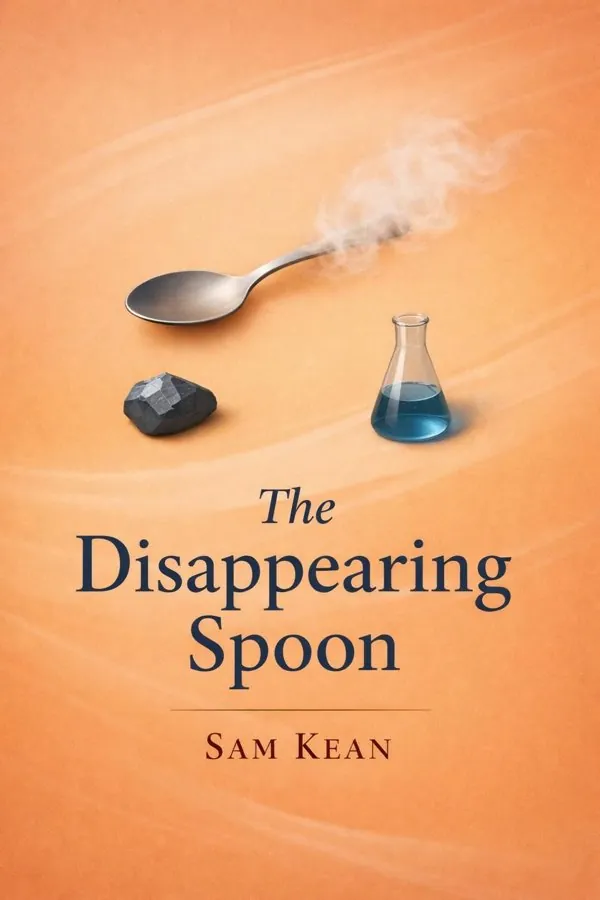
The Disappearing Spoon: And Other True Tales of Madness, Love, and the History of the World from the Periodic Table of the Elements: Summary & Key Insights
by Sam Kean
 10 min9 chaptersAudio available
What Is The Disappearing Spoon: And Other True Tales of Madness, Love, and the History of the World from the Periodic Table of the Elements About?
The Disappearing Spoon: And Other True Tales of Madness, Love, and the History of the World from the Periodic Table of the Elements by Sam Kean is a popular_sci book spanning 9 pages. A narrative exploration of the periodic table, revealing the quirky, tragic, and fascinating stories behind the elements and the scientists who discovered them. Sam Kean blends history, science, and humor to show how the elements have shaped human civilization, from wars and inventions to art and medicine.
This FizzRead summary covers all 9 key chapters of The Disappearing Spoon: And Other True Tales of Madness, Love, and the History of the World from the Periodic Table of the Elements in approximately 10 minutes, distilling the most important ideas, arguments, and takeaways from Sam Kean's work. Also available as an audio summary and Key Quotes Podcast.
The Disappearing Spoon: And Other True Tales of Madness, Love, and the History of the World from the Periodic Table of the Elements
A narrative exploration of the periodic table, revealing the quirky, tragic, and fascinating stories behind the elements and the scientists who discovered them. Sam Kean blends history, science, and humor to show how the elements have shaped human civilization, from wars and inventions to art and medicine.
Who Should Read The Disappearing Spoon: And Other True Tales of Madness, Love, and the History of the World from the Periodic Table of the Elements?
This book is perfect for anyone interested in popular_sci and looking to gain actionable insights in a short read. Whether you're a student, professional, or lifelong learner, the key ideas from The Disappearing Spoon: And Other True Tales of Madness, Love, and the History of the World from the Periodic Table of the Elements by Sam Kean will help you think differently.
- ✓Readers who enjoy popular_sci and want practical takeaways
- ✓Professionals looking to apply new ideas to their work and life
- ✓Anyone who wants the core insights of The Disappearing Spoon: And Other True Tales of Madness, Love, and the History of the World from the Periodic Table of the Elements in just 10 minutes
Want the full summary?
Get instant access to this book summary and 100K+ more with Fizz Moment.
Get Free SummaryAvailable on App Store • Free to download
Key Chapters
When Dmitri Mendeleev sat down in 1869 to organize what seemed to be an unruly zoo of substances, he faced chaos. Dozens of elements had already been discovered, yet no one could agree on how they related to one another. Mendeleev approached the problem like a man trying to arrange a deck of cards whose suits and numbers were still unknown. Drawing inspiration from the periodicities he observed—a rhythmic recurrence of properties—he built a framework that brought coherence to the chemical world. It wasn’t luck; it was intuition sharpened by relentless curiosity.
Mendeleev’s table wasn’t the first attempt, but it was the first that worked. His genius lay in leaving deliberate gaps—empty spaces where he predicted undiscovered elements would fit. This was audacious. In a century when science was still emerging from the shadows of alchemy, Mendeleev dared to claim knowledge of things no one had yet seen. When germanium, gallium, and scandium were later found, fitting his predictions perfectly, his table achieved a mythic status.
Yet, behind the structure there was a human being: a man known for his wild hair, untamed spirit, and fierce faith in the natural order. He even postponed publishing so he could attend his sister’s wedding, finishing his work on the train. The periodic table, in his eyes, was not frozen logic; it was a living language of nature. Every row and column captured the poetry of recurrence—the idea that different substances, with their wildly different natures, could resonate according to hidden harmonies.
The beauty of the periodic table lies in its predictability. Once Mendeleev laid out his system, the table transformed from a collection of facts into a machine for generating new knowledge. Suddenly, chemistry could forecast the future. The ‘missing’ elements he proposed weren’t mere guesses—they were testable prophecies about weight, density, and reactivity.
This predictive power turned the periodic table into a scientific oracle. When scientists discovered gallium, its properties matched Mendeleev’s forecasts so precisely it seemed as though nature itself had confirmed his faith. Every future modification of the table—from the noble gases to the lanthanides and actinides—would preserve that predictive spirit. The table was a window into the unseen architecture of the universe, a way of glimpsing the bones of matter.
But prediction is never purely neutral. It inflamed rivalries among chemists eager to prove or disprove Mendeleev’s model. It also pushed discovery into the realm of politics and pride. Nations began racing to fill the empty spaces and claim their place in scientific history. Each new entry in the table became not just a scientific milestone but an emblem of human will—the endless quest to reveal what lies beyond the known.
+ 7 more chapters — available in the FizzRead app
All Chapters in The Disappearing Spoon: And Other True Tales of Madness, Love, and the History of the World from the Periodic Table of the Elements
About the Author
Get This Summary in Your Preferred Format
Read or listen to the The Disappearing Spoon: And Other True Tales of Madness, Love, and the History of the World from the Periodic Table of the Elements summary by Sam Kean anytime, anywhere. FizzRead offers multiple formats so you can learn on your terms — all free.
Available formats: App · Audio · PDF · EPUB — All included free with FizzRead
Download The Disappearing Spoon: And Other True Tales of Madness, Love, and the History of the World from the Periodic Table of the Elements PDF and EPUB Summary
Key Quotes from The Disappearing Spoon: And Other True Tales of Madness, Love, and the History of the World from the Periodic Table of the Elements
“When Dmitri Mendeleev sat down in 1869 to organize what seemed to be an unruly zoo of substances, he faced chaos.”
“The beauty of the periodic table lies in its predictability.”
Frequently Asked Questions about The Disappearing Spoon: And Other True Tales of Madness, Love, and the History of the World from the Periodic Table of the Elements
The Disappearing Spoon: And Other True Tales of Madness, Love, and the History of the World from the Periodic Table of the Elements by Sam Kean is a popular_sci book that explores key ideas across 9 chapters. A narrative exploration of the periodic table, revealing the quirky, tragic, and fascinating stories behind the elements and the scientists who discovered them. Sam Kean blends history, science, and humor to show how the elements have shaped human civilization, from wars and inventions to art and medicine.
More by Sam Kean

Caesar’s Last Breath: Decoding the Secrets of the Air Around Us
Sam Kean
10 min
The Violinist’s Thumb: And Other Lost Tales of Love, War, and Genius, as Written by Our Genetic Code
Sam Kean
10 min
The Bastard Brigade: The True Story of the Renegade Scientists and Spies Who Sabotaged the Nazi Atomic Bomb
Sam Kean
10 min
The Tale of the Dueling Neurosurgeons: The History of the Human Brain as Revealed by True Stories of Trauma, Madness, and Recovery
Sam Kean
10 minYou Might Also Like

Structures: Or Why Things Don"t Fall Down
J.E. Gordon
10 min
The Road to Wigan Pier
George Orwell
10 min
Bonk: The Curious Coupling of Science and Sex
Mary Roach
10 min
First Bite: How We Learn to Eat
Bee Wilson
10 min
In Pursuit Of The Unknown: 17 Equations That Changed The World
Ian Stewart
10 min
Napoleon's Buttons: 17 Molecules That Changed History
Penny Le Couteur and Jay Burreson
10 minBrowse by Category
Ready to read The Disappearing Spoon: And Other True Tales of Madness, Love, and the History of the World from the Periodic Table of the Elements?
Get the full summary and 100K+ more books with Fizz Moment.