
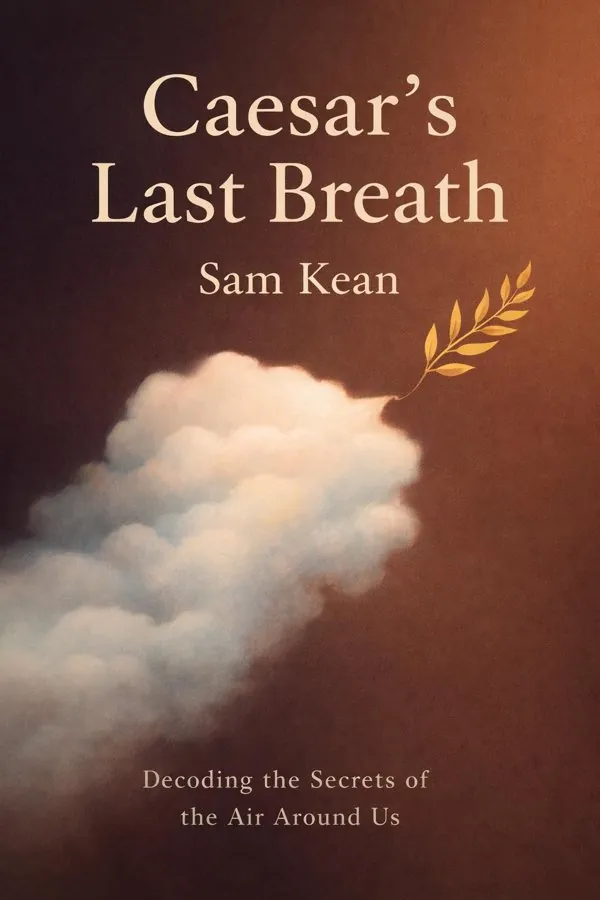
Caesar’s Last Breath: Decoding the Secrets of the Air Around Us: Summary & Key Insights
by Sam Kean
 10 min9 chaptersAudio available
Key Takeaways from Caesar’s Last Breath: Decoding the Secrets of the Air Around Us
A room that looks empty is actually teeming with matter.
The air in your lungs is older than humanity, older than mammals, older even than complex life.
The gas that keeps you alive is also one of nature’s most destructive substances.
A trace gas can govern the fate of a planet.
The idea that you may inhale molecules once breathed by Julius Caesar sounds whimsical, but it captures a serious scientific truth about mixing and probability.
What Is Caesar’s Last Breath: Decoding the Secrets of the Air Around Us About?
Caesar’s Last Breath: Decoding the Secrets of the Air Around Us by Sam Kean is a popular_sci book spanning 12 pages. Air feels invisible, weightless, and forgettable, yet it is one of the most revealing archives on Earth. In Caesar’s Last Breath, Sam Kean turns the atmosphere into a grand storyteller, showing how every breath we take contains molecules with astonishing histories—some forged in ancient volcanoes, some cycled through dinosaurs and emperors, and some altered by modern industry. What seems empty is actually crowded with chemistry, physics, biology, and memory. Kean’s central gift is his ability to make abstract science intimate. He explains the composition of air, the rise of oxygen, the behavior of carbon dioxide, and the dynamics of pollution through vivid anecdotes, historical detours, and sharp scientific storytelling. Instead of treating the atmosphere as background scenery, he presents it as the medium that links all living things across time and space. This matters because the air is not just around us—it is inside us, shaping health, climate, civilization, and the future of life on Earth. Kean, an acclaimed science writer known for making complex ideas accessible and entertaining, offers a book that is both intellectually rich and deeply human. It invites readers to see every breath as participation in a planetary drama.
This FizzRead summary covers all 9 key chapters of Caesar’s Last Breath: Decoding the Secrets of the Air Around Us in approximately 10 minutes, distilling the most important ideas, arguments, and takeaways from Sam Kean's work. Also available as an audio summary and Key Quotes Podcast.
Caesar’s Last Breath: Decoding the Secrets of the Air Around Us
Air feels invisible, weightless, and forgettable, yet it is one of the most revealing archives on Earth. In Caesar’s Last Breath, Sam Kean turns the atmosphere into a grand storyteller, showing how every breath we take contains molecules with astonishing histories—some forged in ancient volcanoes, some cycled through dinosaurs and emperors, and some altered by modern industry. What seems empty is actually crowded with chemistry, physics, biology, and memory.
Kean’s central gift is his ability to make abstract science intimate. He explains the composition of air, the rise of oxygen, the behavior of carbon dioxide, and the dynamics of pollution through vivid anecdotes, historical detours, and sharp scientific storytelling. Instead of treating the atmosphere as background scenery, he presents it as the medium that links all living things across time and space.
This matters because the air is not just around us—it is inside us, shaping health, climate, civilization, and the future of life on Earth. Kean, an acclaimed science writer known for making complex ideas accessible and entertaining, offers a book that is both intellectually rich and deeply human. It invites readers to see every breath as participation in a planetary drama.
Who Should Read Caesar’s Last Breath: Decoding the Secrets of the Air Around Us?
This book is perfect for anyone interested in popular_sci and looking to gain actionable insights in a short read. Whether you're a student, professional, or lifelong learner, the key ideas from Caesar’s Last Breath: Decoding the Secrets of the Air Around Us by Sam Kean will help you think differently.
- ✓Readers who enjoy popular_sci and want practical takeaways
- ✓Professionals looking to apply new ideas to their work and life
- ✓Anyone who wants the core insights of Caesar’s Last Breath: Decoding the Secrets of the Air Around Us in just 10 minutes
Want the full summary?
Get instant access to this book summary and 100K+ more with Fizz Moment.
Get Free SummaryAvailable on App Store • Free to download
Key Chapters
A room that looks empty is actually teeming with matter. One of Sam Kean’s most powerful moves is to dissolve the illusion that air is “nothing.” The atmosphere is a dense, active mixture of gases, particles, droplets, microbes, and chemical traces, all moving constantly and interacting in ways that sustain life. Roughly seventy-eight percent of the air is nitrogen, about twenty-one percent is oxygen, and the rest includes argon, carbon dioxide, water vapor, and a shifting cast of trace gases. That composition may sound simple, but each ingredient has an important role. Oxygen powers metabolism, nitrogen stabilizes the atmosphere and feeds ecosystems through the nitrogen cycle, and carbon dioxide helps regulate planetary temperature.
Kean makes this chemistry vivid by connecting it to everyday life. The air in a crowded subway, a pine forest, a hospital room, and a kitchen all differ in measurable ways. Humidity changes comfort. Carbon dioxide levels affect alertness indoors. Fine particulates influence respiratory health. Smells travel because airborne molecules physically enter your nose. Even a breeze against your skin is evidence that the atmosphere is dynamic and tactile, not abstract.
Understanding air as material rather than emptiness changes how we think about our environment. Ventilation matters. Indoor air quality matters. Emissions matter. So does the astonishing fact that every breath is a real exchange of atoms between your body and the wider world.
Actionable takeaway: Pay attention to the air in your immediate environment—open windows when possible, improve ventilation, and remember that “invisible” does not mean unimportant.
The air in your lungs is older than humanity, older than mammals, older even than complex life. Kean traces atmospheric history back to Earth’s violent beginnings, when the young planet was wrapped in gases released by volcanic eruptions, asteroid impacts, and deep geologic processes. Early Earth’s atmosphere looked nothing like today’s breathable mix. It was rich in carbon dioxide, methane, water vapor, and other gases that would be toxic or useless for modern human respiration.
Over immense spans of time, geology and chemistry reshaped that primordial atmosphere. Oceans formed as water condensed. Carbon dioxide dissolved into seawater and became locked away in rocks and sediments. Volcanic activity continued to replenish gases, while sunlight drove chemical reactions in the upper atmosphere. Eventually, living organisms—especially photosynthetic microbes—transformed the sky itself by releasing oxygen as a metabolic byproduct. The atmosphere became a planetary record of both nonliving and living forces.
Kean’s broader point is that air is not fixed. It is historical. Every molecule has traveled through cycles of rock, sea, sky, and organism. A carbon atom in your exhaled breath may once have been dissolved in ancient oceans, trapped in limestone, or expelled from a volcano. This perspective turns breathing into participation in deep time.
Practically, this history helps us understand why Earth is habitable and why atmospheric balance is so delicate. The conditions we take for granted emerged through unlikely interactions over billions of years.
Actionable takeaway: When thinking about climate or environmental change, resist the idea that the current atmosphere is permanent; it is a product of history and can be altered again.
The gas that keeps you alive is also one of nature’s most destructive substances. Kean treats oxygen not as a simple hero, but as a revolutionary force with a double edge. The rise of oxygen in Earth’s atmosphere enabled high-energy metabolism, larger bodies, active brains, and eventually human civilization. Without oxygen, there would be no animals as we know them and no energetic life capable of building technology, art, or empire.
But oxygen is also highly reactive. It rusts iron, degrades materials, damages cells, and fuels fire. In biological systems, oxygen creates free radicals that can harm DNA and tissues unless organisms evolve protective defenses. In this way, the very gas that made complex life possible also forced life to become more sophisticated, developing antioxidants, repair mechanisms, and intricate respiratory systems.
Kean uses stories from science history and physiology to show how oxygen’s power extends from global evolution to individual survival. Athletes train to use oxygen more efficiently. Hospitals monitor blood oxygen carefully. Climbers on Everest confront the brutal consequences of low oxygen pressure. Premature infants can be harmed by both too little and too much oxygen. The lesson is not that oxygen is good or bad, but that life depends on managing it well.
Seeing oxygen clearly also sharpens our appreciation for fire, aging, metabolism, and environmental change. Breath is not passive intake. It is a controlled encounter with a reactive element.
Actionable takeaway: Protect the systems that help your body handle oxygen well—exercise regularly, avoid smoking, and support lung health as a foundation for energy and resilience.
A trace gas can govern the fate of a planet. Carbon dioxide makes up only a small fraction of the atmosphere, yet Kean shows that small concentration does not mean small importance. CO2 is a heat-trapping gas that helps keep Earth warm enough for life. Without it, the planet would be far colder and less hospitable. But because climate systems are sensitive, relatively modest changes in carbon dioxide levels can shift temperatures, weather patterns, sea levels, and agricultural stability.
Kean excels at explaining carbon dioxide through both chemistry and consequence. The molecule absorbs outgoing infrared radiation, acting like part of the atmosphere’s thermal blanket. Natural processes such as respiration, decomposition, volcanism, and ocean exchange have moved carbon through the Earth system for eons. Human activity, especially burning fossil fuels, has rapidly added ancient carbon to the atmosphere, disrupting balances that evolved slowly over geological time.
This is not only a scientific issue; it is a civilizational one. Heat waves, drought, flooding, crop disruption, and ocean acidification all connect to atmospheric carbon. Indoor CO2 can also affect concentration in poorly ventilated spaces, showing that the gas matters at both global and personal scales. Kean’s achievement is to make climate science tangible by reminding us that every tailpipe, power plant, and wildfire participates in atmospheric chemistry.
The practical implication is sobering but empowering: atmospheric change is measurable, understandable, and responsive to collective choices.
Actionable takeaway: Reduce your carbon footprint where feasible—use energy efficiently, support cleaner infrastructure, and treat climate not as an abstraction but as chemistry in motion.
The idea that you may inhale molecules once breathed by Julius Caesar sounds whimsical, but it captures a serious scientific truth about mixing and probability. Kean uses this striking image to show that the atmosphere is a vast but shared reservoir. Over time, gases disperse globally, meaning that molecules exhaled centuries ago can become part of the air anywhere on Earth. The exact historical figure is less important than the principle: air links individuals across geography and time.
This concept has emotional and philosophical force. It undermines the fantasy of separateness. The atoms in your lungs have likely passed through plants, oceans, animals, industrial smokestacks, ancient fires, and countless human bodies. The atmosphere is a grand recycler, constantly redistributing matter. Your breath today will not stay yours. It will drift outward, mix, and eventually become part of someone else’s inhale, a leaf’s gas exchange, or a raindrop’s chemistry.
Kean uses this molecular democracy to deepen scientific curiosity. It makes diffusion, atmospheric circulation, and conservation of matter feel immediate. It also suggests a moral lesson: because air is shared, contamination is shared too. Smoke, lead, mercury, greenhouse gases, and pathogens all exploit the same connectedness.
In everyday life, this insight can make environmental responsibility feel less optional. What enters the air rarely stays local forever. The atmosphere is the most public commons we have.
Actionable takeaway: Think of each emission as entering a shared inheritance; act accordingly by minimizing pollutants and supporting policies that protect common air.
Still air is mostly an illusion. Even when the atmosphere feels calm, pressure gradients, temperature differences, Earth’s rotation, and moisture are constantly shaping invisible currents. Kean explores the physics of air movement to explain why weather changes, storms form, scents travel, and pollutants spread. Air flows from high pressure to low pressure, but that simple statement opens into a world of complexity once topography, ocean heat, and the Coriolis effect enter the picture.
This physical behavior matters because atmospheric motion distributes both benefits and dangers. Winds carry rain that feeds crops, but they can also spread wildfire smoke across continents. Jet streams influence aviation routes and weather systems. Urban design affects how heat and dirty air linger in neighborhoods. Even in homes, the movement of air changes disease transmission, thermal comfort, and mold risk.
Kean’s storytelling often reveals how scientific insight emerged from trying to understand practical problems: why storms intensify, how sailors navigate, why mountains create dangerous air patterns, or how pilots survive at altitude. The atmosphere is not a static blanket; it is a restless fluid governed by laws we can study, predict, and sometimes harness.
A better grasp of air motion makes weather reports more meaningful and environmental risks more understandable. It also explains why interventions like fans, filtration, masks, and ventilation can be so effective.
Actionable takeaway: Use the physics of airflow to your advantage—improve cross-ventilation indoors, check air-quality forecasts, and recognize that moving air can either protect health or spread harm depending on context.
Scientific progress rarely arrives as a neat sequence of facts; it emerges through rivalry, error, obsession, luck, and courage. Kean shines when recounting the human stories behind discoveries about air. The history of atmospheric science includes alchemists and chemists, balloonists and physicians, inventors and eccentrics, all trying to understand something they could not see directly. What is oxygen? Why do flames burn? How does suffocation work? Why does altitude alter consciousness? These questions were answered not only by equations, but by experiments, accidents, and fierce debate.
By turning atmospheric science into biography and adventure, Kean makes the subject memorable. Readers encounter the personalities behind concepts that are now taught as settled knowledge. This matters because it reveals science as a living process rather than a frozen body of truths. Our understanding of air advanced through trial and revision, often at significant personal risk. People inhaled dangerous substances, tested dubious equipment, and misinterpreted evidence before eventually getting closer to reality.
The practical value of this history is intellectual humility. Many confident beliefs about the natural world have later been overturned or refined. That perspective helps us appreciate both the power and the limits of current knowledge. It also encourages a healthier public attitude toward science: trust evidence, but understand that discovery is iterative.
Air science is therefore not just a set of conclusions about gases. It is a story about how human curiosity wrestles with the invisible.
Actionable takeaway: When encountering scientific claims, ask not just what we know, but how we know it; understanding the method builds better judgment than memorizing conclusions alone.
We often imagine organisms adapting to a fixed environment, but Kean emphasizes a more dynamic truth: life changes the air, and the air changes life back. Plants and microbes transformed Earth’s atmosphere through photosynthesis. Animals evolved lungs, blood chemistry, and metabolic strategies suited to available gases. Forests alter humidity and local weather. Marine plankton influence cloud formation and carbon cycling. The atmosphere is not merely a backdrop for life; it is partly made by life.
This coevolution can be seen on every scale. Your own body depends on a precise exchange of oxygen and carbon dioxide in the lungs. Plants absorb CO2 and release oxygen, tying human survival to photosynthesis. Soil microbes influence nitrogen availability, which affects crop growth and ecosystem stability. At a planetary level, shifts in atmospheric chemistry have triggered extinctions, radiations, and evolutionary innovation.
Kean also points to extreme environments to show life’s adaptability. Organisms survive in thin mountain air, toxic fumes, underground pockets, and oxygen-poor waters. These examples remind us that life is chemically inventive, but not invincible. Species thrive only within certain ranges, and rapid atmospheric disruption can outpace adaptation.
For readers, this idea reframes ecology as intimacy rather than distance. The atmosphere is not “out there.” It flows through leaves, lungs, bloodstreams, and climate systems in one continuous circuit. To damage the air is to damage the living networks that depend on it.
Actionable takeaway: Support ecosystems that maintain atmospheric balance—protect trees, value soils, and recognize biodiversity as part of the machinery that keeps air habitable.
All Chapters in Caesar’s Last Breath: Decoding the Secrets of the Air Around Us
About the Author
Sam Kean is an American science writer celebrated for turning complex scientific subjects into lively, story-driven nonfiction for general readers. Rather than presenting science as a dry collection of facts, he focuses on the people, rivalries, accidents, and surprises behind discovery. Kean is best known for books such as The Disappearing Spoon, which explores the periodic table through historical anecdotes, and The Tale of the Dueling Neurosurgeons, which examines the brain through strange cases and scientific breakthroughs. His writing has appeared in prominent publications, and he has earned a reputation for blending humor, clarity, and rigorous research. In Caesar’s Last Breath, Kean brings these strengths to the atmosphere, showing how chemistry, history, and human life are all bound together by the air we breathe.
Get This Summary in Your Preferred Format
Read or listen to the Caesar’s Last Breath: Decoding the Secrets of the Air Around Us summary by Sam Kean anytime, anywhere. FizzRead offers multiple formats so you can learn on your terms — all free.
Available formats: App · Audio · PDF · EPUB — All included free with FizzRead
Download Caesar’s Last Breath: Decoding the Secrets of the Air Around Us PDF and EPUB Summary
Key Quotes from Caesar’s Last Breath: Decoding the Secrets of the Air Around Us
“A room that looks empty is actually teeming with matter.”
“The air in your lungs is older than humanity, older than mammals, older even than complex life.”
“The gas that keeps you alive is also one of nature’s most destructive substances.”
“A trace gas can govern the fate of a planet.”
“The idea that you may inhale molecules once breathed by Julius Caesar sounds whimsical, but it captures a serious scientific truth about mixing and probability.”
Frequently Asked Questions about Caesar’s Last Breath: Decoding the Secrets of the Air Around Us
Caesar’s Last Breath: Decoding the Secrets of the Air Around Us by Sam Kean is a popular_sci book that explores key ideas across 9 chapters. Air feels invisible, weightless, and forgettable, yet it is one of the most revealing archives on Earth. In Caesar’s Last Breath, Sam Kean turns the atmosphere into a grand storyteller, showing how every breath we take contains molecules with astonishing histories—some forged in ancient volcanoes, some cycled through dinosaurs and emperors, and some altered by modern industry. What seems empty is actually crowded with chemistry, physics, biology, and memory. Kean’s central gift is his ability to make abstract science intimate. He explains the composition of air, the rise of oxygen, the behavior of carbon dioxide, and the dynamics of pollution through vivid anecdotes, historical detours, and sharp scientific storytelling. Instead of treating the atmosphere as background scenery, he presents it as the medium that links all living things across time and space. This matters because the air is not just around us—it is inside us, shaping health, climate, civilization, and the future of life on Earth. Kean, an acclaimed science writer known for making complex ideas accessible and entertaining, offers a book that is both intellectually rich and deeply human. It invites readers to see every breath as participation in a planetary drama.
More by Sam Kean
The Violinist’s Thumb: And Other Lost Tales of Love, War, and Genius, as Written by Our Genetic Code
Sam Kean
10 min
The Bastard Brigade: The True Story of the Renegade Scientists and Spies Who Sabotaged the Nazi Atomic Bomb
Sam Kean
10 min
The Tale of the Dueling Neurosurgeons: The History of the Human Brain as Revealed by True Stories of Trauma, Madness, and Recovery
Sam Kean
10 min
The Disappearing Spoon: And Other True Tales of Madness, Love, and the History of the World from the Periodic Table of the Elements
Sam Kean
10 minYou Might Also Like
Structures: Or Why Things Don"t Fall Down
J.E. Gordon
10 min
The Road to Wigan Pier
George Orwell
10 min
Bonk: The Curious Coupling of Science and Sex
Mary Roach
10 min
First Bite: How We Learn to Eat
Bee Wilson
10 min
In Pursuit Of The Unknown: 17 Equations That Changed The World
Ian Stewart
10 min
Napoleon's Buttons: 17 Molecules That Changed History
Penny Le Couteur and Jay Burreson
10 minBrowse by Category
Ready to read Caesar’s Last Breath: Decoding the Secrets of the Air Around Us?
Get the full summary and 100K+ more books with Fizz Moment.