
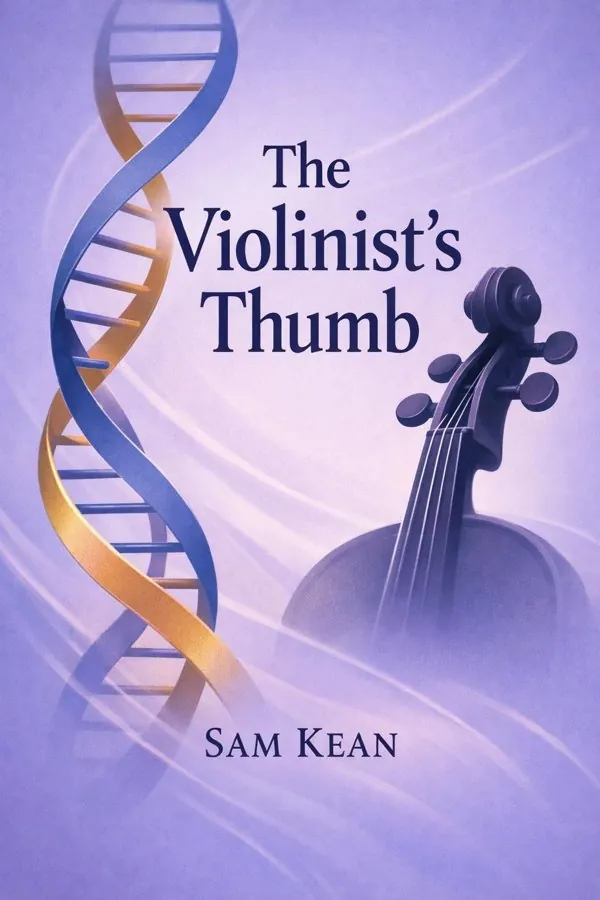
The Violinist’s Thumb: And Other Lost Tales of Love, War, and Genius, as Written by Our Genetic Code: Summary & Key Insights
by Sam Kean
 10 min8 chaptersAudio available
What Is The Violinist’s Thumb: And Other Lost Tales of Love, War, and Genius, as Written by Our Genetic Code About?
The Violinist’s Thumb: And Other Lost Tales of Love, War, and Genius, as Written by Our Genetic Code by Sam Kean is a popular_sci book spanning 8 pages. In this witty and engaging exploration of genetics, Sam Kean delves into the fascinating stories hidden within our DNA. From the quirks of evolution to the mysteries of heredity, he reveals how our genetic code has shaped human history, creativity, and even madness. Through vivid anecdotes and scientific insight, Kean connects the microscopic world of genes to the grand narratives of art, war, and discovery.
This FizzRead summary covers all 8 key chapters of The Violinist’s Thumb: And Other Lost Tales of Love, War, and Genius, as Written by Our Genetic Code in approximately 10 minutes, distilling the most important ideas, arguments, and takeaways from Sam Kean's work. Also available as an audio summary and Key Quotes Podcast.
The Violinist’s Thumb: And Other Lost Tales of Love, War, and Genius, as Written by Our Genetic Code
In this witty and engaging exploration of genetics, Sam Kean delves into the fascinating stories hidden within our DNA. From the quirks of evolution to the mysteries of heredity, he reveals how our genetic code has shaped human history, creativity, and even madness. Through vivid anecdotes and scientific insight, Kean connects the microscopic world of genes to the grand narratives of art, war, and discovery.
Who Should Read The Violinist’s Thumb: And Other Lost Tales of Love, War, and Genius, as Written by Our Genetic Code?
This book is perfect for anyone interested in popular_sci and looking to gain actionable insights in a short read. Whether you're a student, professional, or lifelong learner, the key ideas from The Violinist’s Thumb: And Other Lost Tales of Love, War, and Genius, as Written by Our Genetic Code by Sam Kean will help you think differently.
- ✓Readers who enjoy popular_sci and want practical takeaways
- ✓Professionals looking to apply new ideas to their work and life
- ✓Anyone who wants the core insights of The Violinist’s Thumb: And Other Lost Tales of Love, War, and Genius, as Written by Our Genetic Code in just 10 minutes
Want the full summary?
Get instant access to this book summary and 100K+ more with Fizz Moment.
Get Free SummaryAvailable on App Store • Free to download
Key Chapters
When we talk about DNA today, it’s easy to forget that for centuries, scientists had no idea how heredity worked. They knew something—some essence—passed traits from parent to child. In the 19th century, Gregor Mendel’s peas hinted that inheritance followed mathematical rules, but still, the physical mechanism remained elusive. For decades, researchers debated whether proteins or nucleic acids held the secret of life.
Then came a generation of determined seekers—Oswald Avery, Rosalind Franklin, James Watson, and Francis Crick—each pushing the puzzle closer to revelation. The story was not a clean, heroic march but a tangle of brilliance, rivalry, and luck. Franklin’s meticulous X-ray crystallography was crucial; her Image 51 captured the helical symmetry that Watson and Crick interpreted into their famous double helix model in 1953. What struck me most in diving into their correspondence and habits wasn’t just the science but the raw human energy—the excitement of standing on the edge of revelation.
The structure of DNA broke open biology’s black box. Suddenly, heredity was not mystical but mechanical, governed by the precise pairing of nucleotides. This insight birthed molecular biology, yet the story’s emotional landscape mattered just as much: Franklin never received her due credit in life; Watson’s own candidly opportunistic leaps reflected both genius and controversy. In tracing this lineage of discovery, we glimpse how our knowledge of life evolved as a human drama as much as a scientific one.
We often take for granted the resemblance between generations—your father’s hands, your mother’s laughter, that inexplicable family tendency toward freckles or musical pitch. Genes orchestrate these echoes, but they also harbor surprises. DNA isn’t a fixed script; it’s a symphony of chance mutations and recombinations. Each generation writes subtle variations into the score.
In exploring the inheritance of traits, I found that science repeatedly meets storytelling. Consider how hemophilia haunted royal families or how albinism appeared unpredictably in isolated villages. These weren’t curses or miracles—they were the visible footprints of genetic randomness. Even our most defining qualities come mixed with accident.
One of the humbling truths of heredity is that perfection does not exist. Mutations that seem destructive can, in certain contexts, be gifts. Carriers of sickle-cell anemia, for example, resist malaria—a grim trade-off that shaped entire populations’ survival. Our traits are not moral, not fair; they are pragmatic consequences of adaptation and luck.
In my own musings, I realized that heredity is a reminder that we’re custodians of both beauty and imperfection. Every face, every temperament, carries stories written long before memory.
+ 6 more chapters — available in the FizzRead app
All Chapters in The Violinist’s Thumb: And Other Lost Tales of Love, War, and Genius, as Written by Our Genetic Code
About the Author
Sam Kean is an American science writer known for making complex scientific topics accessible and entertaining. He is the author of several bestselling books, including 'The Disappearing Spoon' and 'The Tale of the Dueling Neurosurgeons'. His work has appeared in The New York Times Magazine, Slate, and The Atlantic.
Get This Summary in Your Preferred Format
Read or listen to the The Violinist’s Thumb: And Other Lost Tales of Love, War, and Genius, as Written by Our Genetic Code summary by Sam Kean anytime, anywhere. FizzRead offers multiple formats so you can learn on your terms — all free.
Available formats: App · Audio · PDF · EPUB — All included free with FizzRead
Download The Violinist’s Thumb: And Other Lost Tales of Love, War, and Genius, as Written by Our Genetic Code PDF and EPUB Summary
Key Quotes from The Violinist’s Thumb: And Other Lost Tales of Love, War, and Genius, as Written by Our Genetic Code
“When we talk about DNA today, it’s easy to forget that for centuries, scientists had no idea how heredity worked.”
“We often take for granted the resemblance between generations—your father’s hands, your mother’s laughter, that inexplicable family tendency toward freckles or musical pitch.”
Frequently Asked Questions about The Violinist’s Thumb: And Other Lost Tales of Love, War, and Genius, as Written by Our Genetic Code
The Violinist’s Thumb: And Other Lost Tales of Love, War, and Genius, as Written by Our Genetic Code by Sam Kean is a popular_sci book that explores key ideas across 8 chapters. In this witty and engaging exploration of genetics, Sam Kean delves into the fascinating stories hidden within our DNA. From the quirks of evolution to the mysteries of heredity, he reveals how our genetic code has shaped human history, creativity, and even madness. Through vivid anecdotes and scientific insight, Kean connects the microscopic world of genes to the grand narratives of art, war, and discovery.
More by Sam Kean
Caesar’s Last Breath: Decoding the Secrets of the Air Around Us
Sam Kean
10 min
The Bastard Brigade: The True Story of the Renegade Scientists and Spies Who Sabotaged the Nazi Atomic Bomb
Sam Kean
10 min
The Tale of the Dueling Neurosurgeons: The History of the Human Brain as Revealed by True Stories of Trauma, Madness, and Recovery
Sam Kean
10 min
The Disappearing Spoon: And Other True Tales of Madness, Love, and the History of the World from the Periodic Table of the Elements
Sam Kean
10 minYou Might Also Like
Structures: Or Why Things Don"t Fall Down
J.E. Gordon
10 min
The Road to Wigan Pier
George Orwell
10 min
Bonk: The Curious Coupling of Science and Sex
Mary Roach
10 min
First Bite: How We Learn to Eat
Bee Wilson
10 min
In Pursuit Of The Unknown: 17 Equations That Changed The World
Ian Stewart
10 min
Napoleon's Buttons: 17 Molecules That Changed History
Penny Le Couteur and Jay Burreson
10 minBrowse by Category
Ready to read The Violinist’s Thumb: And Other Lost Tales of Love, War, and Genius, as Written by Our Genetic Code?
Get the full summary and 100K+ more books with Fizz Moment.