

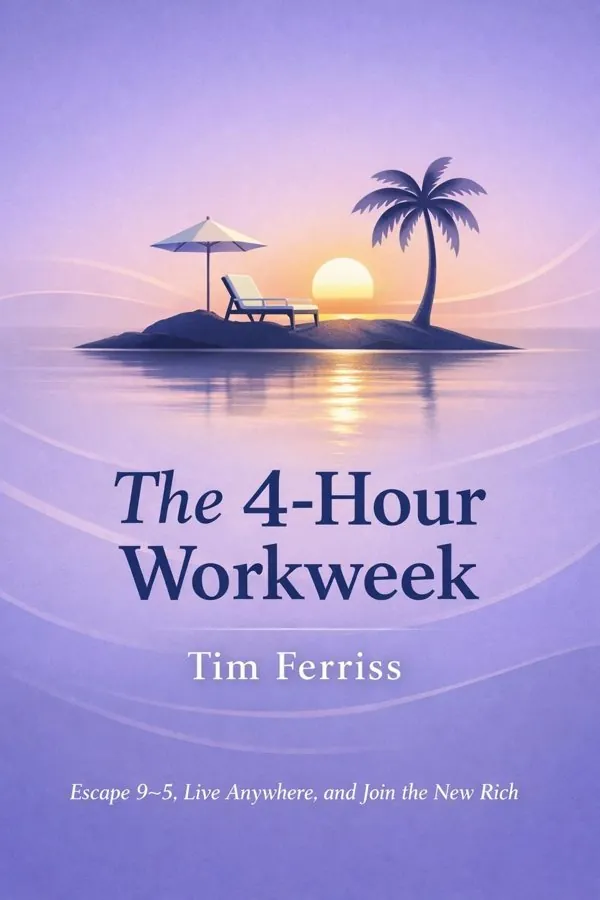
The 4-Hour Workweek: Summary & Key Insights
by Tim Ferriss
 10 min9 chaptersAudio available
Key Takeaways from The 4-Hour Workweek
Most people never question the script they have inherited: work hard for decades, save aggressively, retire late, and only then begin living fully.
People are often less trapped by reality than by vague anxiety.
Being busy is often a form of avoidance disguised as virtue.
Freedom becomes much more realistic when income is not tied directly to every hour you work.
One of Ferriss’s most controversial ideas is outsourcing, but its deeper principle is not luxury.
What Is The 4-Hour Workweek About?
The 4-Hour Workweek by Tim Ferriss is a productivity book published in 2012 spanning 7 pages. What if the real goal of work were not to fill your calendar, but to fund your freedom? In The 4-Hour Workweek, Tim Ferriss challenges one of modern life’s most persistent assumptions: that success must come from long hours, delayed gratification, and a steady climb toward retirement. Instead, he argues for “lifestyle design,” a way of structuring income, time, and mobility so you can enjoy life now rather than someday. The book blends productivity strategy, entrepreneurship advice, negotiation tactics, and unconventional career thinking into a blueprint for escaping the 9-to-5 treadmill. Ferriss explores how to eliminate low-value tasks, automate income through lean businesses, outsource routine work, and create the freedom to travel or pursue meaningful projects. Whether or not readers literally work four hours a week, the book matters because it reframes the purpose of work itself. Ferriss writes with the authority of someone who tested these ideas in his own business, transforming burnout into a highly mobile, efficient lifestyle. The result is a provocative guide for anyone who wants more results, more control, and far more life outside work.
This FizzRead summary covers all 9 key chapters of The 4-Hour Workweek in approximately 10 minutes, distilling the most important ideas, arguments, and takeaways from Tim Ferriss's work. Also available as an audio summary and Key Quotes Podcast.
The 4-Hour Workweek
What if the real goal of work were not to fill your calendar, but to fund your freedom? In The 4-Hour Workweek, Tim Ferriss challenges one of modern life’s most persistent assumptions: that success must come from long hours, delayed gratification, and a steady climb toward retirement. Instead, he argues for “lifestyle design,” a way of structuring income, time, and mobility so you can enjoy life now rather than someday. The book blends productivity strategy, entrepreneurship advice, negotiation tactics, and unconventional career thinking into a blueprint for escaping the 9-to-5 treadmill. Ferriss explores how to eliminate low-value tasks, automate income through lean businesses, outsource routine work, and create the freedom to travel or pursue meaningful projects. Whether or not readers literally work four hours a week, the book matters because it reframes the purpose of work itself. Ferriss writes with the authority of someone who tested these ideas in his own business, transforming burnout into a highly mobile, efficient lifestyle. The result is a provocative guide for anyone who wants more results, more control, and far more life outside work.
Who Should Read The 4-Hour Workweek?
This book is perfect for anyone interested in productivity and looking to gain actionable insights in a short read. Whether you're a student, professional, or lifelong learner, the key ideas from The 4-Hour Workweek by Tim Ferriss will help you think differently.
- ✓Readers who enjoy productivity and want practical takeaways
- ✓Professionals looking to apply new ideas to their work and life
- ✓Anyone who wants the core insights of The 4-Hour Workweek in just 10 minutes
Want the full summary?
Get instant access to this book summary and 100K+ more with Fizz Moment.
Get Free SummaryAvailable on App Store • Free to download
Key Chapters
Most people never question the script they have inherited: work hard for decades, save aggressively, retire late, and only then begin living fully. Ferriss’s first major insight is that this script is not inevitable. He argues that many people do not actually want to be millionaires; they want what they imagine millionaires can do: travel freely, choose their projects, avoid drudgery, and enjoy autonomy. In other words, the true target is not wealth for its own sake, but freedom of time and attention.
This idea becomes the foundation of “lifestyle design.” Instead of building your life around a career ladder, you design work around the life you want. Ferriss contrasts the “deferred-life plan” with the concept of “mini-retirements,” shorter periods of adventure, recovery, or exploration spread throughout life rather than postponed until old age. He encourages readers to define the experiences they want, calculate the real cost of those experiences, and then build systems that support them.
For example, someone may assume they need a huge salary to feel successful, when in reality they may need a lower monthly income but far greater control over when and where they work. Another person may realize that status purchases are consuming the very freedom they claim to value. Ferriss pushes readers to ask better questions: What excites me? What would I do if I were not afraid? Which obligations are self-created?
The practical power of this idea lies in clarity. Once you define your ideal lifestyle concretely, you can evaluate jobs, businesses, and commitments against that standard. Actionable takeaway: write a “freedom definition” that lists the experiences, schedule, location, and income you actually want, then use it as the benchmark for every major work decision.
People are often less trapped by reality than by vague anxiety. Ferriss introduces one of the book’s most memorable tools: fear-setting. Instead of focusing only on goals and positive visualization, he recommends breaking fear into specific, manageable parts. This method helps expose how much of our hesitation comes from exaggerated, unexamined assumptions.
The exercise works in three stages. First, define the worst-case scenario if you take the action you are considering, such as leaving a job, starting a side business, negotiating remote work, or traveling abroad. Second, list what you could do to prevent those bad outcomes or reduce their damage. Third, estimate how you would repair things if the worst happened anyway. Ferriss then flips the frame and asks an even more important question: what is the cost of inaction? What happens if you avoid change for six months, a year, or three years?
This is powerful because indecision often feels safe while quietly generating regret, boredom, stagnation, and dependency. A feared move, such as pitching a new consulting offer, may carry some risk. But staying put may carry the bigger long-term cost. By quantifying both possibilities, readers can make decisions based on evidence rather than emotion.
In practical terms, fear-setting can be used before major career transitions, difficult conversations, or entrepreneurial bets. Someone afraid to ask for a flexible schedule might realize the likely downside is mild embarrassment, while the upside is a dramatically better quality of life. Actionable takeaway: choose one decision you have been postponing and complete a fear-setting worksheet, including the hidden cost of doing nothing.
Being busy is often a form of avoidance disguised as virtue. Ferriss argues that most productivity advice starts too late, teaching people how to do more when the real problem is that they should be doing less. His approach begins with elimination: cutting the trivial many so attention can be focused on the vital few.
Two principles anchor this idea. The first is the 80/20 rule, also known as the Pareto principle: a small portion of inputs usually produces the majority of results. In business, this might mean 20 percent of customers generate 80 percent of revenue, while another 20 percent create most complaints and headaches. In personal work, a few activities likely drive most progress, while many meetings, emails, and obligations add little value.
The second principle is Parkinson’s law: tasks expand to fill the time allotted. If you give yourself all day to answer email, email becomes your day. If you limit communication to a short window, you are forced to prioritize, respond clearly, and move on. Ferriss recommends setting tighter deadlines, creating strict communication boundaries, and aggressively questioning recurring tasks.
Examples are everywhere. A manager may discover that weekly status meetings can be replaced by a short shared update. A freelancer may identify that two clients account for nearly all profit and decide to phase out the rest. An employee may find that constant inbox monitoring destroys deep work and switch to checking messages twice daily.
The broader lesson is that productivity is not about squeezing more into every hour. It is about defending your limited attention from low-value demands. Actionable takeaway: list your current tasks, clients, and obligations, identify the 20 percent that create the most results, and eliminate, reduce, or redesign the rest.
Freedom becomes much more realistic when income is not tied directly to every hour you work. Ferriss’s answer is the “muse,” a small, low-maintenance business designed to generate cash flow with minimal ongoing effort. Unlike startups built for prestige, fundraising, or explosive scale, a muse is built for lifestyle support. Its purpose is simple: fund freedom while requiring as little of your time as possible.
Ferriss outlines a practical process for creating such a business. Start by finding a narrowly defined market with an urgent need. Then test product demand before investing heavily. Rather than spend months building something elaborate, you can create a basic offer, run a small ad test, launch a simple website, or pre-sell a product to gauge real interest. This emphasis on validation protects against one of the biggest entrepreneurial mistakes: creating before confirming demand.
The next step is simplification. Ferriss advocates products and services that can be fulfilled with minimal complexity, often through suppliers, digital delivery, or outsourced support. Examples might include a specialized e-commerce product, an online information product, or a simple B2B service with standardized delivery. The ideal muse is profitable, niche, easy to explain, and not overly dependent on the founder’s constant involvement.
This idea remains compelling because many people think entrepreneurship automatically means chaos, huge risk, and endless work. Ferriss reframes it as a tool for autonomy, not just ambition. The goal is not to build the biggest company possible, but to create an income engine that serves your life. Actionable takeaway: identify one narrow customer problem you understand, then design the smallest testable offer you can launch within two weeks.
One of Ferriss’s most controversial ideas is outsourcing, but its deeper principle is not luxury. It is leverage. He argues that many capable people waste enormous cognitive energy on repetitive, low-value tasks simply because they have never learned to delegate. The real cost is not only time but attention fragmentation, decision fatigue, and slower progress on meaningful work.
Ferriss recommends starting small. Rather than outsourcing critical decisions immediately, begin with clear, low-risk tasks: scheduling, research, travel planning, inbox triage, data entry, or customer support. The process requires systems. You must define outcomes, provide examples, establish deadlines, and create feedback loops. Delegation fails when instructions are vague or when people expect mind-reading instead of process.
This concept applies beyond hiring a virtual assistant. Teams can outsource internally by standardizing recurring work and assigning ownership. Entrepreneurs can use contractors, software, and agencies to reduce manual effort. Individuals can also “personal outsource” by paying for services that free up valuable hours, from grocery delivery to bookkeeping. Ferriss asks readers to calculate the value of their time and compare that to the cost of delegation.
A useful example is email management. If a founder spends two hours a day sorting, answering, and organizing routine messages, that time could potentially be systematized through templates, filters, or delegated support. The founder then regains time for strategy, product development, or sales.
The heart of the lesson is that doing everything yourself may feel responsible, but it often traps you in maintenance mode. Actionable takeaway: choose three repetitive tasks you perform weekly, write simple step-by-step instructions for each, and test delegating one of them this month.
Many workers assume freedom requires quitting, when in some cases it begins with renegotiating. Ferriss offers strategies for testing remote work, flexible schedules, and performance-based arrangements within an existing job. His insight is that employers often care less about where work happens than whether results improve, but they need evidence, not ideology.
He advises making the case gradually. Instead of asking for a permanent remote arrangement upfront, propose a trial period. Frame the request around measurable benefits: fewer interruptions, greater productivity, longer availability windows, or reduced office overhead. It helps to document performance, show how communication will remain smooth, and anticipate managerial concerns in advance.
This approach turns flexibility into an experiment rather than a confrontation. A worker might request one remote day per week for two weeks, then present productivity gains. Another might suggest a compressed schedule or asynchronous workflow with agreed response times. Ferriss emphasizes that negotiation works best when your value is visible and your role is not defined purely by presence.
The idea extends to self-employment as well. Clients often default to unnecessary calls, fixed hours, or cumbersome review cycles. Clear scope, deliverables, and communication systems can create freedom without hurting quality. Ferriss’s larger point is that many workplace constraints persist because nobody questions them intelligently.
In a world where remote and hybrid work have become more normalized, this chapter feels especially relevant. Freedom often starts not with rebellion but with a well-structured proposal backed by outcomes. Actionable takeaway: identify one flexibility improvement that would significantly improve your life, then craft a trial proposal that focuses on measurable results and reduced risk for the other side.
Information overload creates the illusion of engagement while quietly destroying clarity. Ferriss argues that most people consume far more news, email, meetings, and digital input than is useful. The result is anxiety, distraction, and reactive thinking. His answer is a low-information diet: reduce nonessential inputs so your mind can focus on what matters.
This is not an argument for ignorance. It is an argument for selectivity. Ferriss notes that urgent news is rarely missed because truly important information finds its way to you. Meanwhile, constant checking of headlines, messages, and feeds often adds little practical value. Much of it is emotionally stimulating but operationally irrelevant.
The same applies to communication. Ferriss recommends reducing interruptions by setting expectations, using concise responses, and encouraging decision-making without constant approval. For instance, instead of inviting endless back-and-forth email threads, you can ask others to present one recommended solution along with the problem. This trains better judgment and reduces dependence.
Practical examples include checking news once a week rather than daily, turning off noncritical notifications, batching communication into fixed windows, and unsubscribing from low-value newsletters. Professionals who make these changes often notice improved concentration, lower stress, and more time for high-leverage work such as writing, planning, selling, or building.
The key insight is that attention is shaped as much by what you refuse as by what you pursue. A disciplined information diet protects creativity and strategic thought. Actionable takeaway: conduct a seven-day information audit, then eliminate or batch the sources that consume time without materially improving your decisions or results.
Retirement is one of the most deeply accepted ideas in modern work culture, yet Ferriss treats it as a questionable default. He argues that postponing joy, curiosity, travel, and self-renewal until late life is both risky and unnecessary. Energy, health, and opportunity vary over time, and many experiences are best enjoyed earlier rather than deferred indefinitely.
His alternative is the mini-retirement: taking planned periods throughout life to step away from routine work and pursue interests, travel, rest, learning, or personal projects. These breaks are not framed as laziness or escape, but as a more intelligent distribution of life experience. They can also sharpen perspective, reduce burnout, and reveal what work is worth returning to.
A mini-retirement does not have to mean a year abroad. It could be two months in another country, six weeks focused on a creative project, or a seasonal pause after an intense work cycle. The important part is intentional design. Ferriss encourages readers to think in terms of mobility, reduced fixed costs, and income systems that support periodic freedom.
This idea has practical implications even for people with conventional jobs. Savings goals can be oriented toward temporary freedom rather than only long-term retirement. Career breaks can be planned instead of treated as emergencies. Families can design simpler lifestyles that make occasional time off possible.
At its core, the mini-retirement challenges the notion that life must be endured now and enjoyed later. Actionable takeaway: define one meaningful experience you have been postponing for “someday,” estimate its true cost in time and money, and build a concrete six-to-twelve-month plan to make it happen sooner.
Many people treat discipline as the solution to every productivity problem, but Ferriss argues that systems matter more than willpower. If your business, job, or daily routine depends on constant personal effort to function, you have built a fragile machine. The real path to freedom is creating systems that continue producing results with less direct involvement from you.
This mindset applies to business processes, personal habits, and decision-making. In a company, systems might include standard operating procedures, automated invoicing, templated customer communication, and clear escalation rules. In personal productivity, systems might involve calendar boundaries, default meal choices, weekly reviews, and pre-committed priorities. The goal is to reduce repeated decision-making and make good outcomes easier.
Ferriss’s own examples often involve automation and documentation. If a task happens repeatedly, write the steps down. If an approval happens often, create criteria for deciding without you. If a question is common, turn the answer into a template or FAQ. This is how workload shrinks over time instead of expanding forever.
The deeper insight is philosophical. Self-sacrifice is often admired because it looks committed, but it is a poor long-term operating model. Systems create reliability without requiring heroics. They make businesses more transferable, teams more effective, and individuals less exhausted.
Anyone who has ever felt indispensable should examine whether that indispensability is actually a design flaw. Actionable takeaway: choose one recurring area of work or life that depends too heavily on memory or effort, then turn it into a written, repeatable system with clear triggers and steps.
All Chapters in The 4-Hour Workweek
About the Author
Tim Ferriss is an American author, entrepreneur, investor, and podcast host best known for popularizing lifestyle design and unconventional productivity strategies. He rose to international prominence with The 4-Hour Workweek, a bestseller that challenged traditional assumptions about careers, retirement, and time management. He later wrote other widely read books, including The 4-Hour Body and The 4-Hour Chef, each combining self-experimentation with practical frameworks for performance and learning. Beyond publishing, Ferriss has invested in technology companies and built a major media presence through The Tim Ferriss Show, where he interviews high performers from business, athletics, science, and the arts. His work consistently explores leverage, experimentation, skill acquisition, and how to design a more intentional life.
Get This Summary in Your Preferred Format
Read or listen to the The 4-Hour Workweek summary by Tim Ferriss anytime, anywhere. FizzRead offers multiple formats so you can learn on your terms — all free.
Available formats: App · Audio · PDF · EPUB — All included free with FizzRead
Download The 4-Hour Workweek PDF and EPUB Summary
Key Quotes from The 4-Hour Workweek
“Most people never question the script they have inherited: work hard for decades, save aggressively, retire late, and only then begin living fully.”
“People are often less trapped by reality than by vague anxiety.”
“Being busy is often a form of avoidance disguised as virtue.”
“Freedom becomes much more realistic when income is not tied directly to every hour you work.”
“One of Ferriss’s most controversial ideas is outsourcing, but its deeper principle is not luxury.”
Frequently Asked Questions about The 4-Hour Workweek
The 4-Hour Workweek by Tim Ferriss is a productivity book that explores key ideas across 9 chapters. What if the real goal of work were not to fill your calendar, but to fund your freedom? In The 4-Hour Workweek, Tim Ferriss challenges one of modern life’s most persistent assumptions: that success must come from long hours, delayed gratification, and a steady climb toward retirement. Instead, he argues for “lifestyle design,” a way of structuring income, time, and mobility so you can enjoy life now rather than someday. The book blends productivity strategy, entrepreneurship advice, negotiation tactics, and unconventional career thinking into a blueprint for escaping the 9-to-5 treadmill. Ferriss explores how to eliminate low-value tasks, automate income through lean businesses, outsource routine work, and create the freedom to travel or pursue meaningful projects. Whether or not readers literally work four hours a week, the book matters because it reframes the purpose of work itself. Ferriss writes with the authority of someone who tested these ideas in his own business, transforming burnout into a highly mobile, efficient lifestyle. The result is a provocative guide for anyone who wants more results, more control, and far more life outside work.
Compare The 4-Hour Workweek

More by Tim Ferriss
You Might Also Like



Featured In
Browse by Category
Ready to read The 4-Hour Workweek?
Get the full summary and 100K+ more books with Fizz Moment.