
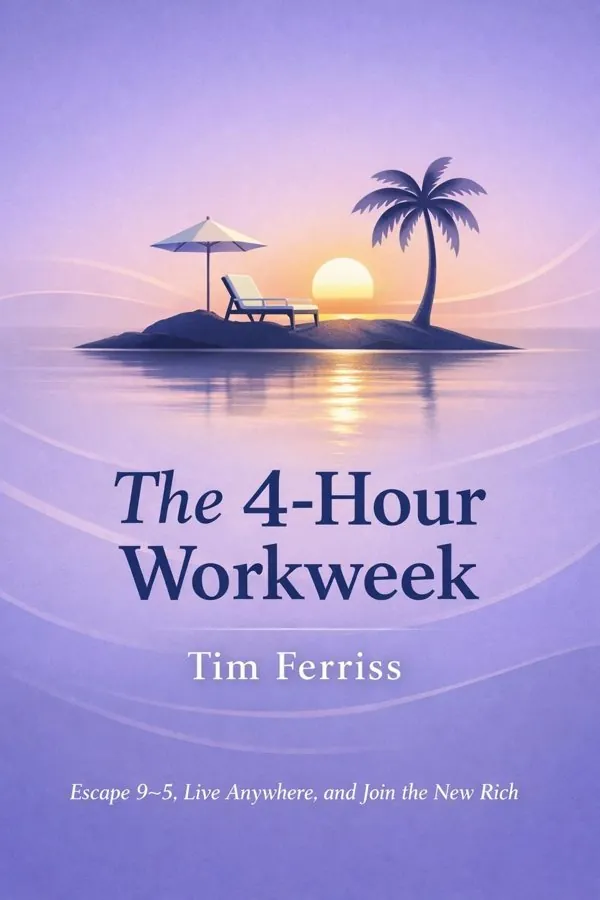
The 4-Hour Workweek: Escape 9–5, Live Anywhere, and Join the New Rich: Summary & Key Insights
by Tim Ferriss
 10 min9 chaptersAudio available
Key Takeaways from The 4-Hour Workweek: Escape 9–5, Live Anywhere, and Join the New Rich
Most people treat wealth as a number, but Ferriss argues that real wealth is control over your time.
People often live by default because they never stop to define what they actually want.
Being busy is often a form of laziness: lazy thinking, lazy prioritizing, and lazy avoidance.
Freedom does not come from working faster forever; it comes from building systems that operate without you.
The real test of freedom is simple: can your life function without your physical presence in one fixed place?
What Is The 4-Hour Workweek: Escape 9–5, Live Anywhere, and Join the New Rich About?
The 4-Hour Workweek: Escape 9–5, Live Anywhere, and Join the New Rich by Tim Ferriss is a productivity book spanning 8 pages. What if the goal of work were not retirement decades from now, but freedom right now? In The 4-Hour Workweek, Tim Ferriss challenges one of modern life’s most accepted assumptions: that success means working long hours today in exchange for security and enjoyment later. Instead, he argues for “lifestyle design,” a way of living built around mobility, meaningful experiences, and intelligent systems rather than constant hustle. The book shows readers how to question inherited ideas about careers, reduce unnecessary work, automate income, and create more time for what matters most. Part manifesto and part practical playbook, the book became influential because it spoke to a growing frustration with burnout, overwork, and the emptiness of performative busyness. Ferriss draws on his own experience as an entrepreneur who escaped exhausting work patterns by redesigning his business and personal life. Whether or not readers adopt his methods literally, his core challenge remains powerful: stop assuming that the default path is the only path. For anyone interested in productivity, remote work, entrepreneurship, or building a life with greater autonomy, this book remains provocative, useful, and highly readable.
This FizzRead summary covers all 9 key chapters of The 4-Hour Workweek: Escape 9–5, Live Anywhere, and Join the New Rich in approximately 10 minutes, distilling the most important ideas, arguments, and takeaways from Tim Ferriss's work. Also available as an audio summary and Key Quotes Podcast.
The 4-Hour Workweek: Escape 9–5, Live Anywhere, and Join the New Rich
What if the goal of work were not retirement decades from now, but freedom right now? In The 4-Hour Workweek, Tim Ferriss challenges one of modern life’s most accepted assumptions: that success means working long hours today in exchange for security and enjoyment later. Instead, he argues for “lifestyle design,” a way of living built around mobility, meaningful experiences, and intelligent systems rather than constant hustle. The book shows readers how to question inherited ideas about careers, reduce unnecessary work, automate income, and create more time for what matters most.
Part manifesto and part practical playbook, the book became influential because it spoke to a growing frustration with burnout, overwork, and the emptiness of performative busyness. Ferriss draws on his own experience as an entrepreneur who escaped exhausting work patterns by redesigning his business and personal life. Whether or not readers adopt his methods literally, his core challenge remains powerful: stop assuming that the default path is the only path. For anyone interested in productivity, remote work, entrepreneurship, or building a life with greater autonomy, this book remains provocative, useful, and highly readable.
Who Should Read The 4-Hour Workweek: Escape 9–5, Live Anywhere, and Join the New Rich?
This book is perfect for anyone interested in productivity and looking to gain actionable insights in a short read. Whether you're a student, professional, or lifelong learner, the key ideas from The 4-Hour Workweek: Escape 9–5, Live Anywhere, and Join the New Rich by Tim Ferriss will help you think differently.
- ✓Readers who enjoy productivity and want practical takeaways
- ✓Professionals looking to apply new ideas to their work and life
- ✓Anyone who wants the core insights of The 4-Hour Workweek: Escape 9–5, Live Anywhere, and Join the New Rich in just 10 minutes
Want the full summary?
Get instant access to this book summary and 100K+ more with Fizz Moment.
Get Free SummaryAvailable on App Store • Free to download
Key Chapters
Most people treat wealth as a number, but Ferriss argues that real wealth is control over your time. This is the foundation of his idea of the “New Rich,” people who prioritize freedom, flexibility, mobility, and meaningful experiences over delayed gratification and status symbols. In the traditional script, you work hard for forty years, save aggressively, and hope to enjoy life later. The New Rich reject this bargain. They ask a different question: why postpone mini-retirements, adventure, creativity, and autonomy until old age when they can be built into life now?
Ferriss does not define wealth simply as income. Two people can earn the same salary and live radically different lives depending on how much of their time is under their own control. Someone making less money with automated systems, remote work, and low fixed expenses may be far richer in lived experience than someone with a high salary but no freedom. This reframing matters because it shifts the goal from accumulation to design.
A practical example is choosing a modest, location-independent lifestyle over a prestige job that demands eighty-hour weeks. Another is creating a business that requires management by exception rather than constant oversight. Ferriss pushes readers to measure success by “what you can do, when you can do it, where you can do it, and with whom.”
Actionable takeaway: redefine your personal definition of wealth by listing what freedom, mobility, and meaningful experiences would look like in your life, then use that as your success metric instead of title or salary alone.
People often live by default because they never stop to define what they actually want. Ferriss begins the DEAL framework with Definition because vague ambition produces vague lives. Many chase “success” without examining the assumptions behind it. They want more money, but for what? A promotion, but at what cost? A safer life, but is it also a smaller one? Ferriss insists that clarity is the first act of rebellion against conventional living.
This chapter encourages readers to separate excitement from obligation. Instead of asking what seems realistic, ask what would be thrilling. Ferriss suggests examining fears, dreams, and personal constraints to uncover how much of life is self-imposed. He also highlights the danger of abstract goals. “Be happy” is unusable. “Spend three months in Spain while running a lean online business” is concrete and testable.
He pushes readers to identify “dreamlines,” timelines attached to desired outcomes. These may include learning a language, taking a mini-retirement, training for a sport, or launching a small product business. By pricing these dreams, many discover they cost less than assumed. What appears impossible often becomes achievable once translated into monthly income targets rather than total lifetime wealth.
For example, someone who dreams of traveling with family for six months may realize that reducing housing costs, working remotely, and creating a modest side income is enough. Definition turns fantasy into planning.
Actionable takeaway: write three specific life goals for the next 6 to 12 months, estimate their real monthly cost, and identify the minimum income and flexibility required to make them possible.
Being busy is often a form of laziness: lazy thinking, lazy prioritizing, and lazy avoidance. Ferriss’s most controversial productivity argument is that doing more is not the answer. Doing less, but better, is. In the Elimination phase, he draws heavily on the Pareto Principle and Parkinson’s Law. The first suggests that a small portion of efforts create most results; the second says work expands to fill the time available. Together, they form a brutal challenge to conventional productivity advice.
Ferriss asks readers to identify the few activities, clients, tasks, and information inputs that produce the majority of desired outcomes. If 20 percent of customers generate 80 percent of revenue, focus there. If meetings rarely produce anything meaningful, reduce or eliminate them. If constant email checking fractures attention, move to scheduled communication windows. The point is not to become more efficient at everything. It is to stop doing what does not matter.
Practical applications include creating a “not-to-do” list, limiting email checks to once or twice daily, setting aggressive deadlines, batching similar tasks, and questioning recurring obligations. Ferriss also advocates low-information diets, reducing news and trivial inputs that create the illusion of awareness while consuming mental bandwidth.
This approach is especially relevant in modern knowledge work, where endless responsiveness can masquerade as productivity. Elimination is about defending attention from noise so that meaningful work can happen.
Actionable takeaway: audit your last two weeks of work and identify the top 20 percent of activities that drove real results, then eliminate, delegate, or reduce three recurring low-value tasks immediately.
Freedom does not come from working faster forever; it comes from building systems that operate without you. Ferriss’s Automation stage focuses on creating income and workflows that demand minimal day-to-day involvement. This includes outsourcing low-value tasks, using virtual assistants, setting clear process rules, and building businesses around low-maintenance models such as direct-to-consumer products, digital goods, or outsourced fulfillment.
The key insight is that many people remain trapped not because they lack ambition, but because they are indispensable to every detail of their own operation. Ferriss argues that if your business or career depends on your constant presence, you do not own a system; the system owns you. Automation is therefore less about laziness and more about architecture.
Ferriss gives examples like hiring virtual assistants to manage scheduling, research, customer service, or administrative work. He also recommends testing product ideas with small, low-risk experiments rather than building elaborate companies upfront. A simple online store, third-party shipping, and standardized support can replace a traditional business model full of overhead and manual effort.
For individuals who are not entrepreneurs, automation can still apply. Set up recurring bill payments, standardized onboarding documents, canned responses, and project templates. Remove repeated decisions wherever possible.
Of course, automation requires trust, documentation, and clear metrics. Delegation fails when instructions are vague or when owners micromanage everything after assigning it.
Actionable takeaway: choose one repetitive task you perform weekly, document the process in simple steps, and either automate it with software or delegate it to another person this month.
The real test of freedom is simple: can your life function without your physical presence in one fixed place? Ferriss’s Liberation phase asks readers to move from theory to lived independence. This often means negotiating remote work, proving output rather than hours, and reducing the cultural dependence on office visibility. For Ferriss, liberation is not merely leaving a job. It is gaining permission structures and practical systems that let you live and work on your own terms.
A major obstacle is that many employers equate presence with productivity. Ferriss recommends reversing this assumption by first increasing measurable output, then requesting temporary remote arrangements framed around company benefits. If productivity improves, remote work becomes easier to justify. This is not about demanding freedom before demonstrating value; it is about building evidence that autonomy enhances results.
Liberation can also mean geographic arbitrage: living in a lower-cost location while earning from higher-value markets. A person earning online income in dollars may create a much richer lifestyle in Lisbon, Medellín, or Chiang Mai than in an expensive city with high fixed costs. Ferriss encourages readers to see location as a variable, not a prison.
Still, liberation is psychological as much as logistical. Many remain tied to familiar routines because uncertainty feels threatening. The point is not to travel endlessly, but to create the ability to choose.
Actionable takeaway: design a 30-day liberation experiment by identifying what parts of your work can be done remotely, what proof of output you can provide, and what location or schedule change you want to test first.
People are often less limited by reality than by unexamined fear. One of Ferriss’s most enduring tools is “fear-setting,” a practical exercise that counters paralysis by making vague anxiety concrete. Instead of asking only, “What if I fail?” Ferriss suggests three questions: what is the worst that could happen, how could I repair the damage, and what is the cost of inaction if I do nothing?
This method is powerful because fear grows in ambiguity. When worries remain undefined, they feel absolute. But once broken into scenarios and responses, they often become manageable. Losing money on a test business might mean a few thousand dollars and a lesson. Taking a mini-retirement might slow a career briefly, but perhaps not irreparably. Asking to work remotely might lead to discomfort or rejection, but silence guarantees the status quo.
Ferriss also emphasizes the hidden danger of comfort. People overestimate the risk of action and underestimate the cost of delay. Years can pass in mild dissatisfaction because the pain is tolerable. Fear-setting reveals that postponement has consequences too: regret, lost energy, unused talent, and dreams permanently deferred.
In practical use, someone considering a side business might list the downside, such as wasted time, then define prevention and repair steps like setting a budget cap, using small tests, and preserving savings. The result is not reckless confidence but informed courage.
Actionable takeaway: pick one avoided decision and complete a fear-setting page for it today, including the worst case, repair strategies, and the likely emotional and practical cost of not acting for another year.
Time is finite, but attention is the real bottleneck. Ferriss argues that many people do not need more hours; they need fewer distractions and stronger filters. This idea deepens the Elimination principle by showing that effectiveness depends less on calendar optimization than on concentrated energy. A ten-hour day fragmented by messages, meetings, and multitasking often produces less than three deeply focused hours.
Ferriss challenges the worship of availability. Constant responsiveness may make people feel important, but it usually weakens output. Instead, he promotes interruption-free blocks, batch processing, and clear communication boundaries. This means turning off notifications, scheduling communication windows, creating office hours, and resisting the urge to react instantly to every request.
He also points out that not all tasks deserve equal mental quality. Deep, creative, strategic, or high-leverage work should happen during peak energy periods. Administrative tasks can be grouped and handled later. This is a useful principle for students, managers, founders, and freelancers alike. The quality of thought matters more than the quantity of hours logged.
A practical example is reserving the first ninety minutes of each day for your most important project before checking inboxes or chats. Another is using a simple question repeatedly: “If this were the only thing I accomplished today, would the day feel meaningful?” That question instantly exposes false urgency.
Actionable takeaway: create one daily 60- to 90-minute distraction-free block for your highest-value work and move email, messages, and administrative tasks into predefined batches outside that window.
Retirement is a poor compensation for a life spent postponing living. Ferriss criticizes the standard model in which people endure decades of routine and stress in exchange for the hope of leisure at the end. He proposes “mini-retirements” instead: shorter periods of travel, reflection, learning, or reinvention distributed throughout life. This idea reflects his broader philosophy that enjoyment, exploration, and recovery should not be delayed until old age.
The argument is both practical and philosophical. Practically, health, energy, curiosity, and family circumstances change over time. The adventures you dream about at 30 may not be equally available at 70. Philosophically, a life built entirely around future reward trains people to ignore the present. Mini-retirements interrupt this pattern and create room for growth.
Ferriss does not suggest irresponsible escape. He suggests intentional design. A mini-retirement might involve taking three months abroad between jobs, arranging a remote period with an employer, or using an automated business to step away temporarily. During that time, someone might learn a language, volunteer, recover from burnout, or rethink career direction.
This concept is especially relevant in a world where careers are no longer linear and lifelong employment is less secure. Waiting for one final reward at the end is not always realistic.
Actionable takeaway: plan one realistic mini-retirement, even if only two to four weeks to start, with a purpose beyond rest, such as learning, rebuilding health, exploring a place deeply, or testing a different way of living.
Big ideas only matter if they survive contact with real life. One reason The 4-Hour Workweek resonated with so many readers is that Ferriss supports his philosophy with examples of people who redesigned their work and lifestyles in concrete ways. These case studies show that the principles of definition, elimination, automation, and liberation are not abstract theories but adaptable tools.
Some examples involve entrepreneurs who simplify product offerings, outsource customer support, and run businesses remotely. Others involve employees who negotiate remote arrangements by demonstrating improved results outside the office. There are also stories of people using low-cost travel, language immersion, or career breaks to create richer lives without waiting for retirement. The details differ, but the pattern is consistent: each person stopped treating the default path as inevitable.
The case studies matter because they reveal an important nuance. Ferriss is not offering one perfect lifestyle template. He is offering a method for experimentation. For one person, success may mean a lean online company and world travel. For another, it may mean a reduced workweek, more family time, and freedom from email after 5 p.m. The spirit of the book is not imitation but customization.
These stories also expose the role of incremental testing. Few people leap instantly from cubicle to global freedom. More often, they run pilot projects, outsource one task, negotiate one policy change, or spend one month living differently. Transformation often begins small.
Actionable takeaway: choose one case-study-style experiment for the next 30 days, such as reducing meetings, testing a side product, or trying a remote workflow, and treat it as a prototype for a larger life redesign.
All Chapters in The 4-Hour Workweek: Escape 9–5, Live Anywhere, and Join the New Rich
About the Author
Tim Ferriss is an American entrepreneur, investor, author, and podcast host known for popularizing lifestyle design and experimental self-improvement. He rose to international prominence with The 4-Hour Workweek, a bestselling book that challenged conventional assumptions about careers, productivity, and retirement. Ferriss later wrote other successful books, including The 4-Hour Body and The 4-Hour Chef, expanding his reputation as a writer who distills complex topics into practical frameworks. He is also the host of The Tim Ferriss Show, one of the world’s most influential podcasts, where he interviews top performers from business, sports, science, and the arts. Across his work, Ferriss is known for testing ideas firsthand, emphasizing high-leverage habits, and encouraging readers to question default ways of living and working.
Get This Summary in Your Preferred Format
Read or listen to the The 4-Hour Workweek: Escape 9–5, Live Anywhere, and Join the New Rich summary by Tim Ferriss anytime, anywhere. FizzRead offers multiple formats so you can learn on your terms — all free.
Available formats: App · Audio · PDF · EPUB — All included free with FizzRead
Download The 4-Hour Workweek: Escape 9–5, Live Anywhere, and Join the New Rich PDF and EPUB Summary
Key Quotes from The 4-Hour Workweek: Escape 9–5, Live Anywhere, and Join the New Rich
“Most people treat wealth as a number, but Ferriss argues that real wealth is control over your time.”
“People often live by default because they never stop to define what they actually want.”
“Being busy is often a form of laziness: lazy thinking, lazy prioritizing, and lazy avoidance.”
“Freedom does not come from working faster forever; it comes from building systems that operate without you.”
“The real test of freedom is simple: can your life function without your physical presence in one fixed place?”
Frequently Asked Questions about The 4-Hour Workweek: Escape 9–5, Live Anywhere, and Join the New Rich
The 4-Hour Workweek: Escape 9–5, Live Anywhere, and Join the New Rich by Tim Ferriss is a productivity book that explores key ideas across 9 chapters. What if the goal of work were not retirement decades from now, but freedom right now? In The 4-Hour Workweek, Tim Ferriss challenges one of modern life’s most accepted assumptions: that success means working long hours today in exchange for security and enjoyment later. Instead, he argues for “lifestyle design,” a way of living built around mobility, meaningful experiences, and intelligent systems rather than constant hustle. The book shows readers how to question inherited ideas about careers, reduce unnecessary work, automate income, and create more time for what matters most. Part manifesto and part practical playbook, the book became influential because it spoke to a growing frustration with burnout, overwork, and the emptiness of performative busyness. Ferriss draws on his own experience as an entrepreneur who escaped exhausting work patterns by redesigning his business and personal life. Whether or not readers adopt his methods literally, his core challenge remains powerful: stop assuming that the default path is the only path. For anyone interested in productivity, remote work, entrepreneurship, or building a life with greater autonomy, this book remains provocative, useful, and highly readable.
More by Tim Ferriss

You Might Also Like

Browse by Category
Ready to read The 4-Hour Workweek: Escape 9–5, Live Anywhere, and Join the New Rich?
Get the full summary and 100K+ more books with Fizz Moment.