
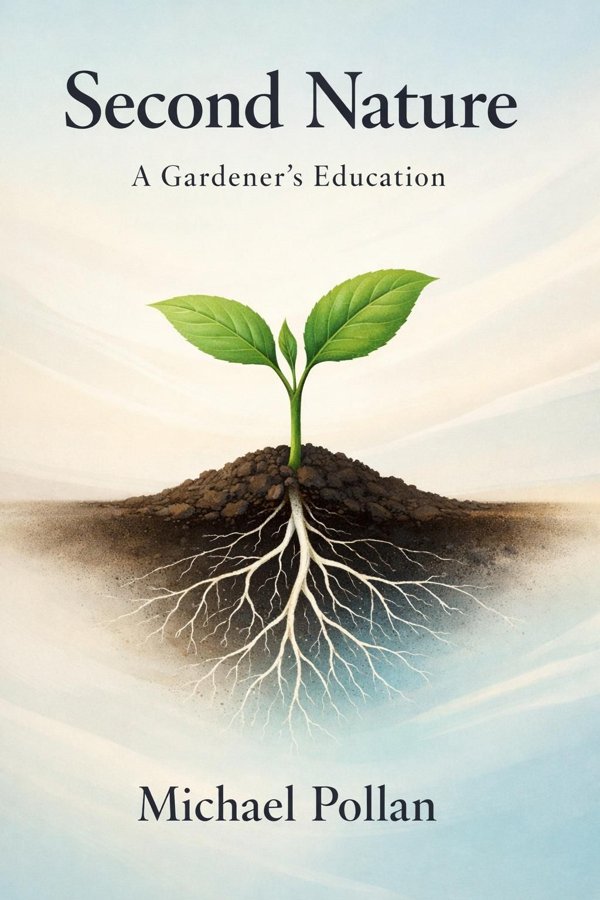
Second Nature: A Gardener's Education: Summary & Key Insights
 10 min6 chaptersAudio available
What Is Second Nature: A Gardener's Education About?
Second Nature: A Gardener's Education by Michael Pollan is a environment book spanning 6 pages. In this reflective and eloquent work, Michael Pollan explores the relationship between humans and nature through the lens of gardening. He examines how cultivation transforms both the land and the gardener, blending philosophy, environmental thought, and personal narrative to reveal the moral and aesthetic dimensions of working with the natural world.
This FizzRead summary covers all 6 key chapters of Second Nature: A Gardener's Education in approximately 10 minutes, distilling the most important ideas, arguments, and takeaways from Michael Pollan's work. Also available as an audio summary and Key Quotes Podcast.
Second Nature: A Gardener's Education
In this reflective and eloquent work, Michael Pollan explores the relationship between humans and nature through the lens of gardening. He examines how cultivation transforms both the land and the gardener, blending philosophy, environmental thought, and personal narrative to reveal the moral and aesthetic dimensions of working with the natural world.
Who Should Read Second Nature: A Gardener's Education?
This book is perfect for anyone interested in environment and looking to gain actionable insights in a short read. Whether you're a student, professional, or lifelong learner, the key ideas from Second Nature: A Gardener's Education by Michael Pollan will help you think differently.
- ✓Readers who enjoy environment and want practical takeaways
- ✓Professionals looking to apply new ideas to their work and life
- ✓Anyone who wants the core insights of Second Nature: A Gardener's Education in just 10 minutes
Want the full summary?
Get instant access to this book summary and 100K+ more with Fizz Moment.
Get Free SummaryAvailable on App Store • Free to download
Key Chapters
Every gardener begins with a question: What separates the cultivated plot from the wild field beyond? In my first seasons, when the Connecticut land seemed to resist every spade and seed, I felt that line acutely. The wilderness loomed at the edge of the garden fence, indifferent to my effort. Yet the more time I spent clearing, planting, and pruning, the more the dichotomy dissolved. I began to see that the garden and the wild are not opposites; they are dialectical partners. The garden exists because of human intention, but it cannot thrive without acknowledging the autonomy of nature.
America, I realized, has always worshiped the idea of wilderness as pure and untouched. We inherited this from a cultural mythology that saw civilization as corruption and nature as redemption. But when we enshrine wilderness as a sacred realm, we banish ourselves from our own landscape. In the safe, curated wilderness we visit on weekends, nature becomes spectacle rather than relationship. The garden, however, insists on intimacy. Here, we are not visitors but participants. We alter and are altered.
Working in my garden forced me to confront the American tendency to idealize untouched nature while ignoring the managed ecosystems that actually sustain us. The cultivated space, for all its imperfections, represents an ethical middle ground—a place where knowledge and care can act to heal rather than exploit. Through cultivation, we acknowledge our dependence while asserting responsibility. The soil beneath our hands ceases to be abstract earth; it becomes a living community to which we belong.
My grandfather’s garden was my first teacher, though I did not recognize its lessons until much later. His backyard, with its tomato vines and fruit trees, embodied a kind of old-world wisdom—a belief that tending the land linked one generation to the next. He gardened not for leisure, but for order, meaning, and self-reliance. The rituals of his cultivation expressed faith in human effort and respect for the rhythms of growth.
When I inherited his tools, I inherited more than metal and wood. I inherited a moral philosophy. Watching his deliberate gestures—how he placed the seed, read the weather, spoke to the plants—I saw how gardening can anchor a person in time and place. In that small rectangle of earth, he found continuity amid change.
Years later, as I struggled to coax life from my own stony Connecticut soil, I understood that his garden was not a retreat from the world but a model for living within it. Cultivation asks us to be attentive, to cooperate with the processes we cannot fully predict or command. It teaches stewardship—not domination. My grandfather’s garden represented a form of domestic ecology: a relationship of care that connects one’s household to the greater biosphere.
Through this inheritance, I came to believe that learning to garden is learning to accept responsibility for the world we shape. The act is humble, but its implications are profound: when we pick up a spade, we engage in a dialogue that spans generations, joining memory and hope.
+ 4 more chapters — available in the FizzRead app
All Chapters in Second Nature: A Gardener's Education
About the Author
Michael Pollan is an American author, journalist, and professor known for his writings on food, agriculture, and the environment. His works, including 'The Omnivore’s Dilemma' and 'In Defense of Food', have shaped public discourse on sustainable living and the ethics of consumption.
Get This Summary in Your Preferred Format
Read or listen to the Second Nature: A Gardener's Education summary by Michael Pollan anytime, anywhere. FizzRead offers multiple formats so you can learn on your terms — all free.
Available formats: App · Audio · PDF · EPUB — All included free with FizzRead
Download Second Nature: A Gardener's Education PDF and EPUB Summary
Key Quotes from Second Nature: A Gardener's Education
“Every gardener begins with a question: What separates the cultivated plot from the wild field beyond?”
“My grandfather’s garden was my first teacher, though I did not recognize its lessons until much later.”
Frequently Asked Questions about Second Nature: A Gardener's Education
Second Nature: A Gardener's Education by Michael Pollan is a environment book that explores key ideas across 6 chapters. In this reflective and eloquent work, Michael Pollan explores the relationship between humans and nature through the lens of gardening. He examines how cultivation transforms both the land and the gardener, blending philosophy, environmental thought, and personal narrative to reveal the moral and aesthetic dimensions of working with the natural world.
More by Michael Pollan
You Might Also Like
A Life on Our Planet: My Witness Statement and a Vision for the Future
David Attenborough
10 min
A Sky Full Of Birds
Matt Merritt
10 min
Carbon Zero: Imagining Cities That Can Save the Planet
Alex Steffen
10 min
Eaarth: Making a Life on a Tough New Planet
Bill McKibben
10 min
The Social Contract and Environmental Governance
Various Editors
10 min
The Wild Places
Robert Macfarlane
10 minBrowse by Category
Ready to read Second Nature: A Gardener's Education?
Get the full summary and 100K+ more books with Fizz Moment.