
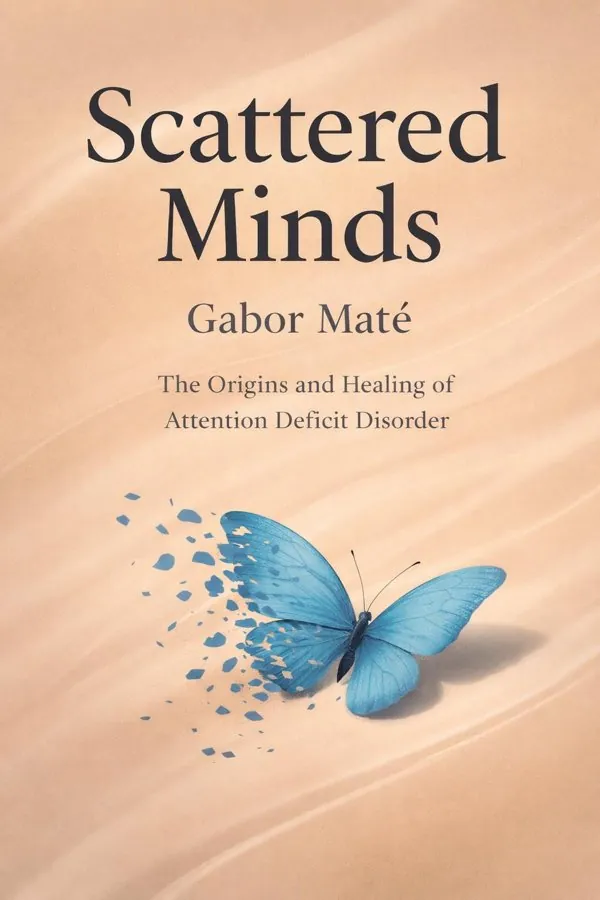
Scattered Minds: Summary & Key Insights
by Gabor Maté
 10 min9 chaptersAudio available
Key Takeaways from Scattered Minds
One of the most illuminating aspects of Scattered Minds is that it does not speak about ADD from a distance.
A diagnosis can clarify, but it can also narrow our vision.
Attention is often treated as a purely mental skill, but Maté shows that it is rooted in emotional life.
Few ideas in Scattered Minds are more important than Maté’s emphasis on attachment.
What if many ADD traits are not signs of failure, but adaptations to early stress?
What Is Scattered Minds About?
Scattered Minds by Gabor Maté is a psychology book published in 1999 spanning 5 pages. In Scattered Minds, physician Gabor Maté challenges one of the most common assumptions about Attention Deficit Disorder: that it is simply a hardwired, inherited brain disease. Drawing from clinical practice, scientific research, and his own lived experience with attention difficulties, Maté presents a far more nuanced and compassionate view. He argues that ADD is not a moral failing or a fixed defect, but a developmental response shaped by stress, emotional disconnection, and early relational experiences that influence the growing brain. What makes this book so powerful is its refusal to reduce people to diagnoses. Instead, Maté explores how attention, self-regulation, impulse control, and emotional resilience develop through attachment and environment. He shows that symptoms often make sense when seen in the context of a person’s history. The book matters because it reframes ADD from something to be merely managed into something to be deeply understood. For parents, adults with ADD, educators, and anyone interested in the psychology of human development, Scattered Minds offers both insight and hope. Maté’s authority comes not only from medicine, but from his humane ability to connect neuroscience, relationships, and healing into one coherent perspective.
This FizzRead summary covers all 9 key chapters of Scattered Minds in approximately 10 minutes, distilling the most important ideas, arguments, and takeaways from Gabor Maté's work. Also available as an audio summary and Key Quotes Podcast.
Scattered Minds
In Scattered Minds, physician Gabor Maté challenges one of the most common assumptions about Attention Deficit Disorder: that it is simply a hardwired, inherited brain disease. Drawing from clinical practice, scientific research, and his own lived experience with attention difficulties, Maté presents a far more nuanced and compassionate view. He argues that ADD is not a moral failing or a fixed defect, but a developmental response shaped by stress, emotional disconnection, and early relational experiences that influence the growing brain.
What makes this book so powerful is its refusal to reduce people to diagnoses. Instead, Maté explores how attention, self-regulation, impulse control, and emotional resilience develop through attachment and environment. He shows that symptoms often make sense when seen in the context of a person’s history.
The book matters because it reframes ADD from something to be merely managed into something to be deeply understood. For parents, adults with ADD, educators, and anyone interested in the psychology of human development, Scattered Minds offers both insight and hope. Maté’s authority comes not only from medicine, but from his humane ability to connect neuroscience, relationships, and healing into one coherent perspective.
Who Should Read Scattered Minds?
This book is perfect for anyone interested in psychology and looking to gain actionable insights in a short read. Whether you're a student, professional, or lifelong learner, the key ideas from Scattered Minds by Gabor Maté will help you think differently.
- ✓Readers who enjoy psychology and want practical takeaways
- ✓Professionals looking to apply new ideas to their work and life
- ✓Anyone who wants the core insights of Scattered Minds in just 10 minutes
Want the full summary?
Get instant access to this book summary and 100K+ more with Fizz Moment.
Get Free SummaryAvailable on App Store • Free to download
Key Chapters
One of the most illuminating aspects of Scattered Minds is that it does not speak about ADD from a distance. Maté begins with a deeply personal recognition: the restless mind, impulsivity, forgetfulness, emotional reactivity, and difficulty sustaining focus are not abstract clinical traits but lived realities. This matters because it changes the tone of the entire discussion. Instead of portraying people with ADD as broken or deficient, he presents their experience as human, understandable, and worthy of compassion.
Maté describes attention difficulties as a fracture in regulation rather than a lack of intelligence or willpower. Many people with ADD can focus intensely on what excites them yet struggle enormously with routine demands, organization, and time management. This paradox often produces shame. A person may think, “If I can concentrate on one thing for hours, why can’t I answer emails, finish chores, or stay organized?” Maté’s answer is that the issue is not laziness but inconsistency in the brain’s ability to regulate attention and emotion.
This perspective helps adults reinterpret lifelong patterns. The child called careless, dramatic, disorganized, or oppositional may actually have been coping with dysregulated attention. Parents can also use this framework to respond differently to a child who seems defiant but is actually overwhelmed.
A practical application is to replace character judgments with observation. Instead of saying, “I’m irresponsible,” say, “I lose focus when I feel stressed, pressured, or emotionally flooded.” That shift opens the door to problem-solving rather than self-attack.
Actionable takeaway: For one week, notice when attention breaks down and record the emotional context. Look for patterns of stress, boredom, shame, or disconnection before blaming yourself or your child.
A diagnosis can clarify, but it can also narrow our vision. Maté does not reject brain science; rather, he argues that the conventional medical model of ADD often stops too soon. Standard explanations emphasize genetics, neurotransmitters, and brain deficits. While these factors may play a role, Maté believes they do not fully explain why attention regulation develops the way it does in actual human lives.
His central critique is that biology is frequently treated as destiny. Once ADD is labeled as a purely inherited disorder, the search for meaning tends to end. Medication may help symptoms, and Maté acknowledges that, but symptom relief alone does not answer deeper questions: Why does one child develop severe dysregulation and another not? What conditions shape the circuits responsible for impulse control, emotional balance, and sustained attention? How do relationships affect the developing brain?
This broader frame does not deny neurology; it expands it. The brain is not a static machine assembled at birth. It develops in interaction with the environment, especially early caregiving relationships. That means ADD should be understood developmentally, not just chemically.
In practical terms, this changes how families and professionals respond. Instead of asking only, “What medication fits?” they can also ask, “What stresses are present? What support is missing? What patterns of connection or disconnection shape daily functioning?” A teacher might realize a student’s inattention worsens under criticism. A parent may see that a child’s impulsivity spikes after conflict or emotional isolation.
Actionable takeaway: If you are thinking about ADD, build a two-part framework: consider both symptom management and developmental context. Ask what happened, not only what is wrong.
Attention is often treated as a purely mental skill, but Maté shows that it is rooted in emotional life. The capacity to focus, inhibit impulses, and stay organized depends on brain systems that develop in response to the child’s environment. In his view, chronic stress, emotional uncertainty, and relational strain can disrupt this development, leaving the child more distractible, reactive, and internally scattered.
This idea is especially powerful because it shifts attention from behavior alone to the conditions that produce behavior. A child who cannot sit still may not simply have “too much energy.” That child may be living in a state of subtle alarm. Even if a household is not overtly abusive, emotional tension, parental distress, inconsistency, or a lack of attuned presence can place the nervous system under strain. When the brain is busy scanning for safety or managing stress, concentration suffers.
Adults can recognize this pattern in themselves as well. Many people notice that their focus collapses during conflict, loneliness, overwhelm, or pressure. They can perform brilliantly in stimulating, meaningful situations but fall apart when emotionally depleted. This is not random. Emotional regulation and attentional regulation are deeply linked.
A practical example is the difference between correction and co-regulation. If a child is fidgeting and distracted, repeated commands may escalate stress. A calm tone, physical proximity, predictable routines, and emotionally steady support may help more. For adults, sleep, reduced overstimulation, and emotionally grounding habits can improve focus more than self-criticism ever will.
Actionable takeaway: Before treating distractibility as a discipline problem, assess the stress climate. Ask what emotional conditions might be undermining attention and what would increase safety, predictability, and calm.
Few ideas in Scattered Minds are more important than Maté’s emphasis on attachment. He argues that a child’s ability to regulate attention and emotions grows out of secure relationships. In early life, children do not self-regulate alone; they borrow stability from caregivers. Through repeated experiences of being soothed, seen, and responded to, the brain gradually develops the circuits needed for impulse control, calm focus, and emotional resilience.
When attachment is strained, even for understandable reasons, development can be affected. This does not mean parents must be perfect or that blame is useful. In fact, Maté strongly resists blaming parents. Caregivers are often stressed, unsupported, traumatized, or doing their best under difficult circumstances. The point is not guilt but understanding. If a parent is emotionally unavailable because of depression, overwork, marital conflict, or their own unresolved pain, the child may experience disconnection even in a loving home.
This helps explain why some children become clingy, explosive, inattentive, or oppositional. Their behavior may reflect a nervous system that has not fully internalized safety and regulation. The solution, then, is not simply stricter discipline. It is renewed connection.
Practical applications include creating one-on-one time without correction, using eye contact and gentle tone before giving instructions, and prioritizing relationship over compliance in tense moments. Adults with ADD can also apply this concept inwardly by noticing how old attachment wounds still shape their reactions to criticism, rejection, or demands.
Actionable takeaway: Strengthen regulation through connection. Each day, create at least one brief moment of undivided, nonjudgmental presence with your child or with yourself through reflective self-attunement.
What if many ADD traits are not signs of failure, but adaptations to early stress? Maté invites readers to consider symptoms as meaningful responses rather than meaningless malfunctions. In this view, distractibility can function as a way of escaping discomfort. Hyperactivity may discharge inner tension. Impulsivity may arise when the nervous system prioritizes immediate action over reflective pause. Emotional volatility may reflect a low threshold for overwhelm, not a lack of character.
This reframing is profoundly liberating. People with ADD often carry years of shame because their behavior has been interpreted morally. They have been told they are selfish, lazy, careless, immature, or unmotivated. But when symptoms are understood as adaptations, the goal changes from punishment to healing. We become curious about what the mind and body learned to do in order to cope.
For example, an adult who constantly seeks stimulation may not just be thrill-seeking; they may be trying to outrun emptiness or underarousal. A child who daydreams in class may not be defiant; they may be mentally leaving a state of tension. These patterns may have been useful once, even if they now create problems.
This does not mean symptoms are harmless or should be romanticized. Missed deadlines, damaged relationships, and poor self-esteem are real consequences. But change becomes more possible when people are approached with understanding rather than condemnation.
Actionable takeaway: The next time a symptom appears, ask, “What purpose might this behavior be serving right now?” Replace judgment with curiosity, then look for a healthier way to meet the same need.
Often the deepest wound of ADD is not the condition itself but the identity built around it. Maté shows how repeated misunderstanding creates a layer of shame that can become more damaging than inattention or impulsivity. When children are constantly corrected, compared, or scolded for traits they cannot fully control, they begin to see themselves as fundamentally flawed. Over time, this internal story undermines confidence, motivation, and even the willingness to try.
A child who hears “You never listen” may eventually stop believing they can listen. An adult who has failed repeatedly at organization may conclude, “I ruin everything.” Shame narrows possibility. It also increases stress, which can worsen the very symptoms a person is trying to overcome. This creates a vicious cycle: symptoms trigger criticism, criticism produces shame, shame increases dysregulation, and dysregulation leads to more symptoms.
Maté’s compassionate stance offers an alternative. Instead of using labels as verdicts, he treats them as starting points for deeper understanding. Diagnosis can help explain struggles, but it should never become a prison sentence or an identity stripped of complexity.
Practically, this means changing language in homes, schools, and self-talk. Replace global condemnations with specific observations. “You’re so careless” becomes “This task was hard to track today.” “I’m a mess” becomes “I need systems that match how my brain works.” Such shifts are not cosmetic; they reduce shame and preserve dignity.
Actionable takeaway: Identify one recurring shaming phrase you use toward yourself or someone else and rewrite it in neutral, accurate language that focuses on behavior and support rather than character.
If ADD is shaped by development, then healing is possible through development too. Maté does not offer a quick fix. Instead, he points toward awareness as the beginning of change. Many people with ADD live in automaticity, reacting before reflecting, scattering attention before noticing what triggered the shift. The first step is learning to observe internal states with honesty and patience.
This is where mindfulness becomes especially valuable. By noticing impulses, emotions, and bodily sensations in real time, a person creates a small but critical pause between feeling and action. That pause can soften reactivity and improve regulation. An adult might notice the urge to abandon a boring task and ask, “Am I under-stimulated, anxious, ashamed, or emotionally flooded?” A parent might notice their own frustration rising before harshly correcting a child.
Maté emphasizes that awareness is not self-monitoring in a punitive sense. It is compassionate witnessing. The point is not to become a perfect manager of the self, but to understand the self well enough to respond differently. This may include journaling, therapy, meditation, body-based practices, or honest conversations that uncover old emotional patterns.
In daily life, conscious awareness can be paired with practical support: timers, visual reminders, external structure, task chunking, and protected focus periods. Internal insight and external systems work best together.
Actionable takeaway: Build a two-minute pause into one recurring challenge each day. Before reacting, switching tasks, or correcting a child, stop and name what you are feeling, what you need, and what choice would be most regulating.
Parents often feel trapped between two painful beliefs: either their child’s behavior is intentional and must be controlled, or something is wrong that no relationship can influence. Maté offers a third path. He argues that parenting cannot single-handedly erase ADD symptoms, but the quality of connection in the parent-child relationship can significantly affect how those symptoms are expressed, managed, and healed.
Compassionate parenting does not mean permissiveness. It means seeing behavior in context. A child who melts down over transitions may need more preparation and co-regulation, not more punishment. A child who resists homework may need help breaking tasks into steps, reducing overwhelm, and preserving self-respect. What matters is whether correction happens inside a secure relationship or inside chronic tension.
This approach also asks parents to examine their own stress. Children are exquisitely sensitive to adult emotional states. A parent who is rushed, ashamed, angry, or emotionally absent may unintentionally amplify a child’s dysregulation. Often the most effective intervention is not another technique for the child but greater support and self-regulation for the parent.
Examples include using routines instead of repeated verbal commands, creating calm transitions, offering physical closeness when a child is overstimulated, and praising effort rather than demanding perfect performance. These small changes build safety and competence over time.
Actionable takeaway: Choose one daily conflict, such as mornings or homework, and redesign it around connection first: fewer commands, more predictability, calmer tone, and one concrete support that lowers stress.
One of the quiet myths surrounding ADD is that improvement should come through trying harder. Maté dismantles this assumption by showing that willpower alone cannot compensate for developmental gaps in regulation. People with ADD often know exactly what they should do. Their struggle lies in doing it consistently, especially under stress, boredom, or emotional strain. Knowledge is not the same as capacity.
This insight is important because it redirects effort toward building conditions for success rather than demanding constant self-overriding. If someone repeatedly fails to remember appointments, the answer is not endless self-lecturing but systems that reduce reliance on fragile working memory. If a child cannot sustain focus through long, unstructured assignments, the solution may be shorter intervals, supervision, movement breaks, and emotional encouragement.
Support can take many forms: medication, therapy, coaching, community, routines, environmental design, sleep protection, exercise, and emotionally meaningful work. Maté does not reduce healing to any single method. Instead, he suggests that change becomes realistic when the person is supported both neurologically and relationally.
This is especially relevant for adults who have internalized the idea that they are lazy because they function inconsistently. In reality, many are expending enormous effort just to do ordinary tasks. Proper support does not create weakness; it makes true responsibility possible.
Actionable takeaway: Stop asking where you need more willpower and ask where you need more structure. Identify one recurring failure point and add a concrete support system, such as reminders, accountability, body doubling, or task simplification.
All Chapters in Scattered Minds
About the Author
Gabor Maté is a Hungarian-Canadian physician and bestselling author whose work focuses on trauma, addiction, stress, childhood development, and the relationship between emotional life and physical health. Born in Budapest in 1944 and later raised in Canada, he spent years practicing family medicine and working with patients facing mental health and substance use challenges. Maté is widely respected for bringing together neuroscience, clinical observation, and compassionate insight in ways that challenge conventional medical thinking. His books often explore how early experiences shape adult behavior, illness, and resilience. In addition to Scattered Minds, he is the author of When the Body Says No, In the Realm of Hungry Ghosts, and The Myth of Normal. His writing has made him an influential voice in trauma-informed and developmental approaches to health.
Get This Summary in Your Preferred Format
Read or listen to the Scattered Minds summary by Gabor Maté anytime, anywhere. FizzRead offers multiple formats so you can learn on your terms — all free.
Available formats: App · Audio · PDF · EPUB — All included free with FizzRead
Download Scattered Minds PDF and EPUB Summary
Key Quotes from Scattered Minds
“One of the most illuminating aspects of Scattered Minds is that it does not speak about ADD from a distance.”
“A diagnosis can clarify, but it can also narrow our vision.”
“Attention is often treated as a purely mental skill, but Maté shows that it is rooted in emotional life.”
“Few ideas in Scattered Minds are more important than Maté’s emphasis on attachment.”
“What if many ADD traits are not signs of failure, but adaptations to early stress?”
Frequently Asked Questions about Scattered Minds
Scattered Minds by Gabor Maté is a psychology book that explores key ideas across 9 chapters. In Scattered Minds, physician Gabor Maté challenges one of the most common assumptions about Attention Deficit Disorder: that it is simply a hardwired, inherited brain disease. Drawing from clinical practice, scientific research, and his own lived experience with attention difficulties, Maté presents a far more nuanced and compassionate view. He argues that ADD is not a moral failing or a fixed defect, but a developmental response shaped by stress, emotional disconnection, and early relational experiences that influence the growing brain. What makes this book so powerful is its refusal to reduce people to diagnoses. Instead, Maté explores how attention, self-regulation, impulse control, and emotional resilience develop through attachment and environment. He shows that symptoms often make sense when seen in the context of a person’s history. The book matters because it reframes ADD from something to be merely managed into something to be deeply understood. For parents, adults with ADD, educators, and anyone interested in the psychology of human development, Scattered Minds offers both insight and hope. Maté’s authority comes not only from medicine, but from his humane ability to connect neuroscience, relationships, and healing into one coherent perspective.
More by Gabor Maté

When the Body Says No
Gabor Maté
10 min
The Myth of Normal: Trauma, Illness, and Healing in a Toxic Culture
Gabor Maté
10 min
In The Realm Of Hungry Ghosts: Close Encounters With Addiction
Gabor Maté
10 min
Hold On to Your Kids: Why Parents Need to Matter More Than Peers
Gordon Neufeld, Gabor Maté
10 minYou Might Also Like
The Body Keeps the Score
Bessel van der Kolk
10 min
Surrounded by Idiots
Thomas Erikson
10 min
Emotional Intelligence
Daniel Goleman
10 min
Attached
Amir Levine
10 min
Why Does He Do That
Lundy Bancroft
10 min
Women Who Run with the Wolves
Clarissa Pinkola Estés
10 minFeatured In
Browse by Category
Ready to read Scattered Minds?
Get the full summary and 100K+ more books with Fizz Moment.