
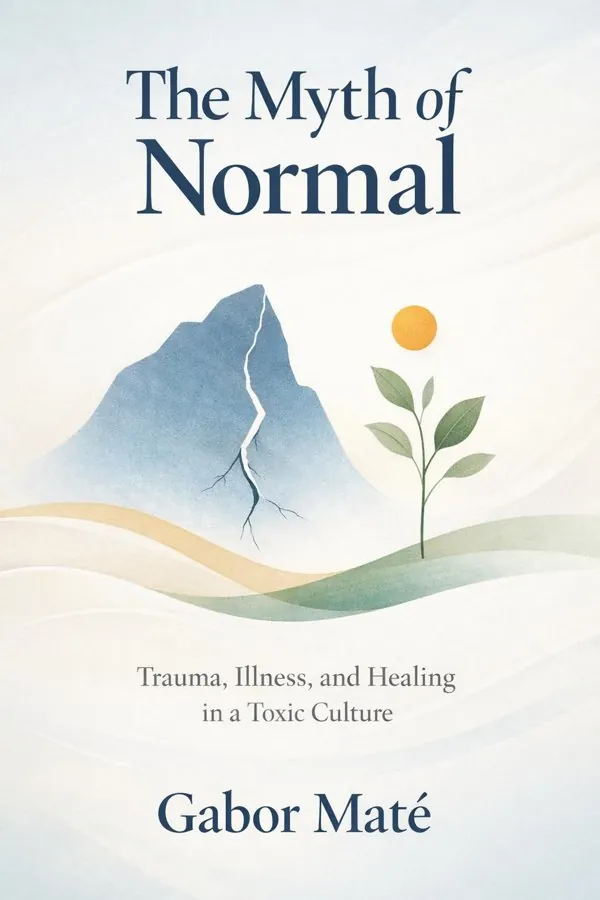
The Myth of Normal: Trauma, Illness, and Healing in a Toxic Culture: Summary & Key Insights
by Gabor Maté
 10 min9 chaptersAudio available
Key Takeaways from The Myth of Normal: Trauma, Illness, and Healing in a Toxic Culture
What if the real problem is not that so many people are broken, but that the environment shaping them is?
Modern medicine often treats the body like a machine and emotions like a side issue.
Many people think trauma refers only to dramatic events such as war, assault, or disaster.
The child’s first task is not independence.
A society quick to condemn addiction often fails to ask the most important question: what pain is the person trying to escape?
What Is The Myth of Normal: Trauma, Illness, and Healing in a Toxic Culture About?
The Myth of Normal: Trauma, Illness, and Healing in a Toxic Culture by Gabor Maté is a mental_health book spanning 7 pages. In The Myth of Normal, Gabor Maté challenges one of the most unquestioned assumptions in modern life: that the way we live is basically healthy, and that illness is mostly a matter of bad luck, faulty genes, or individual weakness. Drawing on decades of medical practice, trauma research, neuroscience, and patient stories, Maté argues that many forms of physical and psychological suffering are deeply connected to chronic stress, emotional repression, disconnection, and the pressures of a culture that prizes productivity over presence. In his view, trauma is not only what happens in extreme circumstances. It is also what happens inside us when our needs for safety, attachment, authenticity, and belonging are unmet. That insight makes this book both unsettling and liberating. It reframes anxiety, addiction, autoimmune disease, and burnout not as isolated failures, but as meaningful responses to an unhealthy environment. Maté writes with the authority of a physician and the compassion of someone who has spent a lifetime listening closely to pain. The result is a powerful invitation to rethink health, normality, and what genuine healing requires.
This FizzRead summary covers all 9 key chapters of The Myth of Normal: Trauma, Illness, and Healing in a Toxic Culture in approximately 10 minutes, distilling the most important ideas, arguments, and takeaways from Gabor Maté's work. Also available as an audio summary and Key Quotes Podcast.
The Myth of Normal: Trauma, Illness, and Healing in a Toxic Culture
In The Myth of Normal, Gabor Maté challenges one of the most unquestioned assumptions in modern life: that the way we live is basically healthy, and that illness is mostly a matter of bad luck, faulty genes, or individual weakness. Drawing on decades of medical practice, trauma research, neuroscience, and patient stories, Maté argues that many forms of physical and psychological suffering are deeply connected to chronic stress, emotional repression, disconnection, and the pressures of a culture that prizes productivity over presence. In his view, trauma is not only what happens in extreme circumstances. It is also what happens inside us when our needs for safety, attachment, authenticity, and belonging are unmet. That insight makes this book both unsettling and liberating. It reframes anxiety, addiction, autoimmune disease, and burnout not as isolated failures, but as meaningful responses to an unhealthy environment. Maté writes with the authority of a physician and the compassion of someone who has spent a lifetime listening closely to pain. The result is a powerful invitation to rethink health, normality, and what genuine healing requires.
Who Should Read The Myth of Normal: Trauma, Illness, and Healing in a Toxic Culture?
This book is perfect for anyone interested in mental_health and looking to gain actionable insights in a short read. Whether you're a student, professional, or lifelong learner, the key ideas from The Myth of Normal: Trauma, Illness, and Healing in a Toxic Culture by Gabor Maté will help you think differently.
- ✓Readers who enjoy mental_health and want practical takeaways
- ✓Professionals looking to apply new ideas to their work and life
- ✓Anyone who wants the core insights of The Myth of Normal: Trauma, Illness, and Healing in a Toxic Culture in just 10 minutes
Want the full summary?
Get instant access to this book summary and 100K+ more with Fizz Moment.
Get Free SummaryAvailable on App Store • Free to download
Key Chapters
What if the real problem is not that so many people are broken, but that the environment shaping them is? That is the provocative starting point of The Myth of Normal. Maté argues that many societies, especially wealthy industrialized ones, mistake dysfunction for normality. We celebrate busyness, reward self-sacrifice, normalize loneliness, and accept chronic stress as the price of success. Then we act surprised when people become anxious, depressed, addicted, inflamed, exhausted, or emotionally numb.
For Maté, toxicity is not only about pollution or harmful substances. It also describes a culture that fragments human beings from their bodies, feelings, and communities. A workplace that glorifies overwork, a family system that suppresses emotional truth, or a digital environment that keeps people overstimulated and disconnected can all become sources of chronic strain. Under these conditions, illness is not simply an individual defect. It can be an understandable response to impossible demands.
This perspective shifts the question from “What is wrong with you?” to “What has happened to you, and what are you living inside of?” A teenager glued to a phone, a parent running on burnout, or an employee with chronic pain may all be adapting to a larger system that erodes well-being while calling itself progress.
A practical application is to examine your own “normal.” If your routine leaves no time for rest, reflection, honest relationships, or emotional expression, your distress may not be a personal failure. It may be feedback. Notice which parts of your lifestyle are socially rewarded but internally depleting. Actionable takeaway: choose one culturally normalized habit that harms your well-being, such as constant availability or overwork, and set a clear boundary against it this week.
Modern medicine often treats the body like a machine and emotions like a side issue. Maté rejects that split completely. One of his core arguments is that the body and mind are inseparable, and that long-term emotional stress can shape physical health in profound ways. Suppressed anger, chronic anxiety, unresolved grief, and the pressure to always appear fine do not simply stay in the mind. They affect the nervous system, immune function, hormone balance, digestion, and inflammation.
Maté draws on clinical experience and scientific research to show that many illnesses cannot be fully understood without examining a person’s life story. Someone with autoimmune disease may have spent decades pleasing others while ignoring their own needs. A person with chronic pain may carry unresolved trauma that keeps the body in a state of alarm. This does not mean people cause their own illnesses or that biology does not matter. It means the body records experience, especially repeated stress and emotional suppression.
This idea has practical implications. Instead of seeing symptoms only as enemies to eliminate, we can also ask what they are communicating. Fatigue might be a message about depletion. Panic may signal a nervous system pushed beyond capacity. Digestive issues can reflect chronic tension and vigilance. Treatment still matters, but so does listening.
A useful practice is to connect physical symptoms with emotional states. Keep a short journal for a week noting when pain, headaches, tension, or exhaustion intensify. Ask what was happening emotionally beforehand. Were you saying yes when you meant no? Were you hiding distress? Actionable takeaway: treat one recurring symptom this week not only as a problem to manage, but as information about how you are living and feeling.
Many people think trauma refers only to dramatic events such as war, assault, or disaster. Maté broadens that definition. Trauma, in his account, is not only what happens to us. It is also what happens inside us as a result. Specifically, trauma is the lasting wound created when overwhelming stress, pain, or neglect forces us to disconnect from ourselves in order to survive.
This distinction matters because it explains why people with seemingly ordinary childhoods may still carry deep wounds. A child does not need a catastrophic event to experience trauma. A consistently emotionally unavailable parent, pressure to be perfect, subtle rejection of feelings, or chronic household tension can all teach a child that their authentic self is unsafe. To preserve attachment, they may suppress anger, hide sadness, become hyper-responsible, or tune out bodily signals. These adaptations help in the short term but often create problems later.
Adults may then struggle with intimacy, boundaries, self-trust, or unexplained anxiety without recognizing the source. They wonder why they overreact, shut down, or feel empty, because their history does not look traumatic enough by conventional standards. Maté’s framework validates these quieter forms of suffering and helps people see that survival strategies can outlast the conditions that created them.
In practice, this means paying attention to moments of disconnection. Do you go numb during conflict? Do you instantly dismiss your own hurt? Do you feel compelled to perform rather than simply be? These may be signs of old adaptations still running the show. Actionable takeaway: the next time you feel triggered, ask not “What is wrong with me?” but “What old protection might be getting activated right now?”
The child’s first task is not independence. It is secure attachment. Maté emphasizes that early development powerfully shapes how the nervous system, emotional life, and even the immune system function later on. Human beings come into the world biologically wired for connection, attunement, and safety. When caregivers are consistently present and emotionally responsive, children learn that the world is manageable and that their feelings can be tolerated. When this is absent, children adapt in ways that may later become sources of distress.
A child cannot choose between attachment and authenticity. If expressing anger, sadness, sensitivity, or need threatens connection with caregivers, attachment usually wins. The child hides parts of themselves to preserve love. This tradeoff may produce a highly competent adult who excels in school or work but feels inwardly fragmented, anxious, or chronically driven. The adaptation once protected the relationship; later it may undermine health.
Maté’s point is not to blame parents, many of whom are themselves stressed, unsupported, or traumatized. Rather, he highlights how social conditions affect caregiving. Economic pressure, isolation, racism, overwork, and lack of community support all shape what families can offer. Childhood development is therefore not just a private issue but a social one.
A practical application is to become curious about your recurring patterns. If you constantly seek approval, fear conflict, or feel guilty resting, these may be echoes of early adaptation rather than fixed personality traits. Parents can also use this insight by prioritizing emotional attunement over perfection. Actionable takeaway: identify one adult pattern that may have roots in childhood adaptation, and respond to it today with curiosity rather than self-judgment.
A society quick to condemn addiction often fails to ask the most important question: what pain is the person trying to escape? Maté has spent years working with people struggling with substance use and compulsive behavior, and his conclusion is clear. Addiction is less about pleasure than about relief. It is an attempt to soothe unbearable emotional states, emptiness, shame, loneliness, or disconnection.
This applies not only to drugs and alcohol but also to work, food, shopping, pornography, gaming, social media, and achievement. The object of addiction differs; the underlying dynamic is often the same. A person finds something that temporarily changes how they feel, and because they lack safer or more supported ways to regulate distress, they return to it again and again. This does not remove responsibility, but it does replace moralism with understanding.
Maté argues that trauma is a major driver of addiction because trauma disrupts self-regulation and leaves people desperate for ways to numb, stimulate, or control inner chaos. A person who was neglected may experience substances as the first reliable comfort they have ever known. Someone overwhelmed by shame may use success itself as an addictive anesthetic.
In practical terms, healing addiction requires more than willpower or punishment. It requires connection, safety, honesty, and compassionate exploration of underlying pain. If you have a compulsive habit, start by asking what emotional state typically comes before it. Is it boredom, loneliness, rejection, anxiety, or self-hatred? That answer is often more useful than judging the behavior. Actionable takeaway: the next time you feel an urge toward a compulsive behavior, pause for sixty seconds and name the feeling you are trying not to feel.
One of Maté’s most powerful insights is that human beings have two essential needs: attachment and authenticity. We need connection with others, and we need to remain true to our own experience. In healthy development, these needs support each other. But in many families and cultures, they come into conflict. When being fully oneself threatens acceptance, people often abandon authenticity in order to preserve belonging.
This tradeoff may look socially successful. A person becomes agreeable, high-performing, helpful, undemanding, or endlessly cheerful. Others praise them for being easy, strong, or reliable. Yet the cost can be enormous. Buried anger may become depression. Chronic people-pleasing can lead to resentment, burnout, or illness. The inability to say no may show up as fatigue, anxiety, or a life that feels strangely unlived.
Maté links this loss of authenticity to many forms of suffering because suppressing the self requires constant internal effort. The body must silence signals, override instincts, and maintain a socially acceptable mask. Over time, this can produce emotional numbness and physiological stress. Someone may look composed while living far from their own truth.
The practical lesson is that authenticity is not selfishness. It is a condition of health. This can begin with small acts: admitting disappointment, declining an obligation, naming discomfort, or noticing when you smile automatically to keep peace. Authenticity does not mean acting out every feeling; it means not abandoning yourself to secure approval.
Actionable takeaway: choose one low-risk situation this week in which you normally perform or appease, and practice expressing your genuine preference clearly and kindly.
Healing does not mean returning to who you were before pain. Often it means becoming whole in a way you were never previously allowed to be. Maté presents healing as a process of integration: reconnecting with the body, emotions, history, and relationships that trauma or chronic stress may have fragmented. The goal is not to erase the past but to stop living unconsciously inside its patterns.
Awareness is the first step. Many people move through life driven by automatic responses without realizing they are adaptations. They overwork when anxious, withdraw when vulnerable, become hyper-independent when hurt, or numb themselves when overwhelmed. Bringing these patterns into consciousness creates choice. Integration then involves allowing previously rejected emotions and experiences to be felt, understood, and linked to their original context.
Maté emphasizes that healing is relational as well as internal. Safe relationships, therapeutic support, honest conversation, and compassionate witnessing can help regulate the nervous system and restore trust. Practices such as mindfulness, somatic awareness, trauma-informed therapy, journaling, and reflective rest can all support the process. What matters most is not any single technique but the quality of presence brought to one’s inner life.
A practical example is learning to pause when activated. Instead of immediately reacting, fixing, pleasing, or escaping, you notice your breath, bodily sensations, and emotional state. That pause interrupts old conditioning. Over time, repeated moments of awareness create new patterns.
Actionable takeaway: build a five-minute daily check-in where you ask three questions: What am I feeling? Where do I sense it in my body? What might I need right now that I usually ignore?
People rarely heal through shame. Yet shame is one of the most common responses to trauma, illness, and emotional struggle. Maté insists that compassion is not sentimental softness but a practical necessity. Without it, people remain trapped in defensive patterns, secrecy, and self-attack. With it, they can begin to face difficult truths without becoming overwhelmed or collapsing into blame.
Compassion starts with understanding that many behaviors that now seem destructive once served a protective function. Perfectionism may have secured approval. Emotional shutdown may have prevented humiliation. Addiction may have numbed unbearable pain. When people view these responses only as weaknesses, they intensify inner conflict. When they see them as adaptations, they gain the emotional safety needed to change.
This compassionate lens also applies to others. Parents, partners, colleagues, and even institutions often act from their own unhealed wounds and pressures. Recognizing this does not excuse harm, but it prevents simplistic judgment. It allows accountability without dehumanization.
In daily life, self-compassion can look surprisingly concrete. It means noticing your self-talk after a mistake. It means replacing “I’m ridiculous for feeling this way” with “Something in me is having a hard time.” It means understanding that healing may involve grief, anger, and setbacks, not just positive growth.
A useful exercise is to imagine speaking to yourself the way you would speak to a distressed child or close friend. Would you mock them for struggling, or would you offer steadiness and curiosity? Actionable takeaway: when you catch yourself in harsh self-criticism this week, pause and rephrase the thought in compassionate language that still tells the truth.
Personal healing matters, but Maté is clear that it is not enough to ask individuals to adapt better to unhealthy conditions. If the culture itself is producing widespread dysregulation, isolation, and illness, then healing must also be social and political. A society that undermines caregiving, commodifies attention, intensifies inequality, and treats human worth as economic output will keep generating distress faster than individuals can recover from it.
This broader perspective is one of the book’s most important contributions. It links trauma not only to family history but also to systems: colonization, racism, poverty, workplace exploitation, medical reductionism, and the erosion of community life. In such environments, even loving families struggle to provide the consistency and presence children need. Health therefore depends partly on conditions that make humanity livable.
Examples include family policies that support caregivers, schools that understand trauma, healthcare that addresses emotional and social roots of illness, and communities designed around connection rather than competition. At a smaller scale, it can mean workplaces that respect boundaries, neighborhoods that reduce isolation, and social norms that allow vulnerability rather than rewarding constant performance.
For readers, this idea prevents a common trap: turning healing into another individual achievement project. It reminds us that some suffering is not yours alone to solve. You may need therapy and reflection, but you may also need fairer structures, more humane expectations, and collective support.
Actionable takeaway: identify one social condition affecting your well-being, such as overwork, isolation, or lack of support, and take one collective step toward change by asking for help, starting a conversation, or supporting a community initiative.
All Chapters in The Myth of Normal: Trauma, Illness, and Healing in a Toxic Culture
About the Author
Gabor Maté is a Hungarian-Canadian physician, author, and speaker widely known for his work on trauma, addiction, stress, and childhood development. Born in Budapest and later emigrating to Canada, he spent decades practicing medicine in areas ranging from family practice to palliative care and addiction treatment. His clinical work, especially with people facing substance dependence and chronic illness, shaped his conviction that emotional life and physical health are deeply interconnected. Maté’s writing blends medical insight, neuroscience, psychology, and compassionate social analysis, making complex subjects accessible to general readers. He is the author of several influential books, including In the Realm of Hungry Ghosts and When the Body Says No. Through his books and lectures, he has become a leading voice on how trauma and culture shape human well-being.
Get This Summary in Your Preferred Format
Read or listen to the The Myth of Normal: Trauma, Illness, and Healing in a Toxic Culture summary by Gabor Maté anytime, anywhere. FizzRead offers multiple formats so you can learn on your terms — all free.
Available formats: App · Audio · PDF · EPUB — All included free with FizzRead
Download The Myth of Normal: Trauma, Illness, and Healing in a Toxic Culture PDF and EPUB Summary
Key Quotes from The Myth of Normal: Trauma, Illness, and Healing in a Toxic Culture
“What if the real problem is not that so many people are broken, but that the environment shaping them is?”
“Modern medicine often treats the body like a machine and emotions like a side issue.”
“Many people think trauma refers only to dramatic events such as war, assault, or disaster.”
“The child’s first task is not independence.”
“A society quick to condemn addiction often fails to ask the most important question: what pain is the person trying to escape?”
Frequently Asked Questions about The Myth of Normal: Trauma, Illness, and Healing in a Toxic Culture
The Myth of Normal: Trauma, Illness, and Healing in a Toxic Culture by Gabor Maté is a mental_health book that explores key ideas across 9 chapters. In The Myth of Normal, Gabor Maté challenges one of the most unquestioned assumptions in modern life: that the way we live is basically healthy, and that illness is mostly a matter of bad luck, faulty genes, or individual weakness. Drawing on decades of medical practice, trauma research, neuroscience, and patient stories, Maté argues that many forms of physical and psychological suffering are deeply connected to chronic stress, emotional repression, disconnection, and the pressures of a culture that prizes productivity over presence. In his view, trauma is not only what happens in extreme circumstances. It is also what happens inside us when our needs for safety, attachment, authenticity, and belonging are unmet. That insight makes this book both unsettling and liberating. It reframes anxiety, addiction, autoimmune disease, and burnout not as isolated failures, but as meaningful responses to an unhealthy environment. Maté writes with the authority of a physician and the compassion of someone who has spent a lifetime listening closely to pain. The result is a powerful invitation to rethink health, normality, and what genuine healing requires.
More by Gabor Maté

You Might Also Like
Big Feelings: How to Be Okay When Things Are Not Okay
Liz Fosslien, Mollie West Duffy
10 min
Creative Arts Therapies Handbook: Art, Music and Dance Therapy Practices for Wellbeing
Susan I. Buchalter
10 min
Emotional First Aid: Healing Rejection, Guilt, Failure, and Other Everyday Hurts
Guy Winch
10 min
Lost Connections: Why You're Depressed and How to Find Hope
Johann Hari
10 min
No Time to Panic: How to Stop Worrying and Embrace Life
Matt Gutman
10 min
Overcoming Mobbing: A Recovery Guide for Workplace Aggression and Bullying
Maureen Duffy, Len Sperry
10 minBrowse by Category
Ready to read The Myth of Normal: Trauma, Illness, and Healing in a Toxic Culture?
Get the full summary and 100K+ more books with Fizz Moment.