
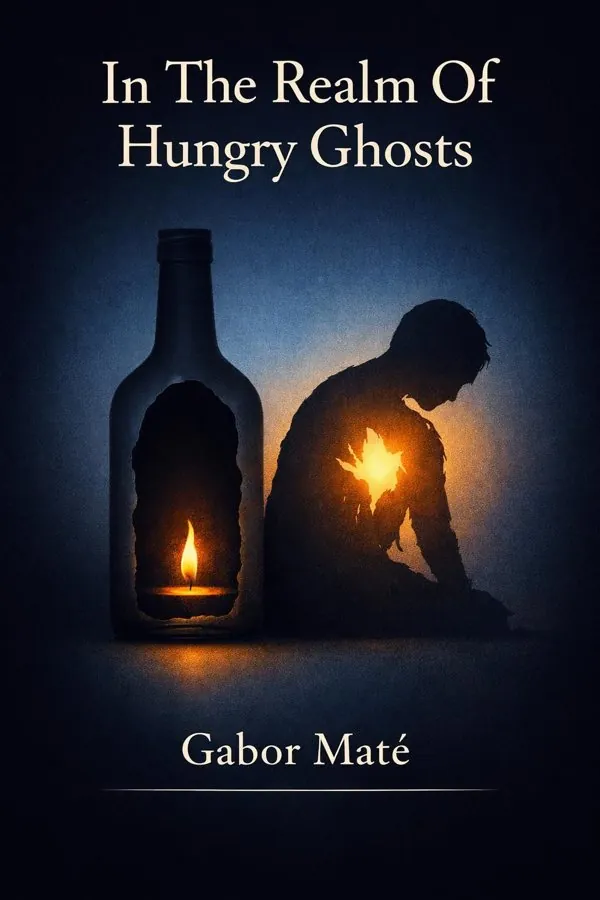
In The Realm Of Hungry Ghosts: Close Encounters With Addiction: Summary & Key Insights
by Gabor Maté
 10 min9 chaptersAudio available
Key Takeaways from In The Realm Of Hungry Ghosts: Close Encounters With Addiction
The most important question about addiction is not why the addiction exists, but why the pain exists.
The people society calls addicts are often carrying histories that most observers never see.
Addiction is not a failure of intelligence; it is a learned brain response shaped by experience.
What happens in childhood does not stay in childhood; it becomes part of the body, the brain, and the emotional life of the adult.
Addiction thrives in environments where stress is chronic, overwhelming, and unresolved.
What Is In The Realm Of Hungry Ghosts: Close Encounters With Addiction About?
In The Realm Of Hungry Ghosts: Close Encounters With Addiction by Gabor Maté is a mental_health book spanning 11 pages. In The Realm Of Hungry Ghosts: Close Encounters With Addiction is Gabor Maté’s powerful exploration of what addiction really is, where it comes from, and why so many conventional responses fail to heal it. Drawing on his years as a physician working in Vancouver’s Downtown Eastside, Maté brings readers into close contact with people living at the sharp edge of substance use, trauma, poverty, and social abandonment. Rather than treating addiction as a moral flaw or a matter of weak will, he presents it as a desperate attempt to soothe unbearable emotional pain, often rooted in childhood trauma, chronic stress, and disconnection. What makes this book so important is its combination of scientific rigor and deep humanity. Maté integrates neuroscience, psychology, medicine, and vivid patient stories to show how addiction alters the brain while also revealing why people become vulnerable to it in the first place. His perspective is compassionate without being naive, and critical without losing hope. For anyone trying to understand addiction in themselves, a loved one, or society at large, this book offers a more honest and humane framework for healing.
This FizzRead summary covers all 9 key chapters of In The Realm Of Hungry Ghosts: Close Encounters With Addiction in approximately 10 minutes, distilling the most important ideas, arguments, and takeaways from Gabor Maté's work. Also available as an audio summary and Key Quotes Podcast.
In The Realm Of Hungry Ghosts: Close Encounters With Addiction
In The Realm Of Hungry Ghosts: Close Encounters With Addiction is Gabor Maté’s powerful exploration of what addiction really is, where it comes from, and why so many conventional responses fail to heal it. Drawing on his years as a physician working in Vancouver’s Downtown Eastside, Maté brings readers into close contact with people living at the sharp edge of substance use, trauma, poverty, and social abandonment. Rather than treating addiction as a moral flaw or a matter of weak will, he presents it as a desperate attempt to soothe unbearable emotional pain, often rooted in childhood trauma, chronic stress, and disconnection.
What makes this book so important is its combination of scientific rigor and deep humanity. Maté integrates neuroscience, psychology, medicine, and vivid patient stories to show how addiction alters the brain while also revealing why people become vulnerable to it in the first place. His perspective is compassionate without being naive, and critical without losing hope. For anyone trying to understand addiction in themselves, a loved one, or society at large, this book offers a more honest and humane framework for healing.
Who Should Read In The Realm Of Hungry Ghosts: Close Encounters With Addiction?
This book is perfect for anyone interested in mental_health and looking to gain actionable insights in a short read. Whether you're a student, professional, or lifelong learner, the key ideas from In The Realm Of Hungry Ghosts: Close Encounters With Addiction by Gabor Maté will help you think differently.
- ✓Readers who enjoy mental_health and want practical takeaways
- ✓Professionals looking to apply new ideas to their work and life
- ✓Anyone who wants the core insights of In The Realm Of Hungry Ghosts: Close Encounters With Addiction in just 10 minutes
Want the full summary?
Get instant access to this book summary and 100K+ more with Fizz Moment.
Get Free SummaryAvailable on App Store • Free to download
Key Chapters
The most important question about addiction is not why the addiction exists, but why the pain exists. That shift in perspective changes everything. Gabor Maté argues that addiction is rarely about pleasure alone. It is usually an attempt to relieve distress, numb emptiness, silence shame, regulate fear, or briefly create a sense of comfort that life otherwise withholds. Whether the object is heroin, alcohol, gambling, work, shopping, sex, or digital distraction, the addictive process follows a similar pattern: craving, temporary relief, loss of control, and harmful consequences.
Maté defines addiction through several features: compulsive engagement, short-term relief, long-term suffering, impaired control, and persistence despite negative outcomes. This framework matters because it expands the conversation beyond illegal drugs. A corporate executive compulsively overworking, a teenager endlessly scrolling for validation, and a person dependent on opioids may be driven by different circumstances, but all may be trying to manage inner discomfort they do not know how to face directly.
This broader definition also challenges the common habit of ranking addictions morally. Society may condemn some dependencies while rewarding others, even when both emerge from the same emotional wound. The key issue is not the substance or behavior itself, but the relationship a person has with it and the need it serves.
A practical way to apply this insight is to examine any recurring habit with curiosity rather than judgment. Ask: What feeling am I trying not to feel? What relief does this behavior provide? What does it cost me afterward? These questions move us from blame to understanding. The actionable takeaway is simple: whenever you encounter addiction, start by looking for the pain underneath it.
The people society calls addicts are often carrying histories that most observers never see. In Vancouver’s Downtown Eastside, Maté worked among individuals whose lives had been shaped by neglect, abuse, homelessness, racism, mental illness, and relentless instability. Many had lost jobs, families, homes, teeth, health, and hope. Yet Maté insists that if we look closely, we find not monsters or failures but human beings adapting to unbearable circumstances with the tools available to them.
This idea matters because labels flatten reality. Once someone is categorized as a junkie, alcoholic, or hopeless case, the public feels less obligation to understand them. But Maté’s clinical stories reveal wit, tenderness, intelligence, loyalty, and longing even in those most consumed by substance use. Their addictions do not erase their humanity; they exist alongside it. In fact, the contradiction is part of the tragedy: many addicted people are deeply sensitive individuals whose pain has simply overwhelmed their capacity to cope.
These stories also expose how treatment can fail when it focuses only on stopping the behavior. If a person’s drug use is tied to terror, grief, loneliness, or traumatic memory, removing the drug without addressing those realities may intensify suffering rather than resolve it. Compassion, therefore, is not sentimental. It is clinically relevant.
In everyday life, this insight invites us to reconsider how we speak about people who struggle. A family member may be more than their relapse. A coworker’s irritability may hide dependency. A homeless person may carry a trauma history no one ever helped them process. The actionable takeaway is to replace labels with questions: What has this person lived through, and what need is their behavior trying to meet?
Addiction is not a failure of intelligence; it is a learned brain response shaped by experience. Maté explains that addictive substances and behaviors hijack the brain’s reward, motivation, and self-regulation systems. Dopamine drives anticipation and pursuit, endorphins soothe pain, and other neurochemicals reinforce whatever brings temporary relief. Over time, the brain becomes trained to seek the addictive experience whenever distress appears. What begins as a coping strategy can become an entrenched neural pathway.
But Maté’s argument is subtler than the simple claim that drugs change the brain. He emphasizes that vulnerable brains are often formed before the addiction begins. Early stress, emotional deprivation, and trauma can impair the development of circuits involved in impulse control, emotional regulation, and reward sensitivity. In that sense, addiction is not just something that happens to the brain later; it often builds on developmental patterns laid down much earlier.
This perspective helps explain why some people can use a substance recreationally and walk away, while others become deeply dependent. It is not merely a matter of character. It reflects differences in how the brain has been shaped by biology and life experience. The brain is plastic, but it is not neutral.
Practically, this means recovery should include more than abstinence. It should also involve creating new experiences that gradually retrain the nervous system: stable relationships, therapy, mindfulness, physical activity, sleep, meaningful work, and safe routine. These experiences do not offer instant relief, but they build capacity over time. The actionable takeaway is to treat addictive behavior as a conditioned brain pattern that can be changed through repeated experiences of safety, connection, and self-awareness.
What happens in childhood does not stay in childhood; it becomes part of the body, the brain, and the emotional life of the adult. One of Maté’s central arguments is that addiction is strongly linked to early experiences of trauma, neglect, loss, and inconsistent caregiving. Trauma does not only mean extreme violence. It can also include chronic emotional absence, unpredictability, humiliation, or the repeated experience of not feeling seen and soothed.
Children depend on caregivers not just for food and shelter, but for nervous-system regulation. When caregivers are frightening, overwhelmed, unavailable, or emotionally disconnected, children must adapt. Some become hypervigilant. Some numb themselves. Some disconnect from their feelings. These adaptations may help them survive childhood, but later become vulnerabilities. An adult who cannot tolerate distress, trust closeness, or calm their inner state may discover that substances or compulsive behaviors do that job quickly.
Maté does not present childhood adversity as destiny. Many people endure difficult beginnings without developing addiction, and many addicted people had loving elements in their upbringing. Still, the pattern is too consistent to ignore: unhealed childhood pain often reappears as adult compulsion. Recognizing this link changes the goal of healing. The task is not simply to eliminate the symptom, but to understand the original wound.
A practical application is to explore personal history without self-pity or blame. Journaling, trauma-informed therapy, support groups, and reflective conversations can help people identify unmet needs from early life. Even parents can use this insight preventively by prioritizing attunement, emotional presence, and repair after conflict. The actionable takeaway is to ask not only what habit you want to stop, but what younger part of you still needs safety, grief, and care.
Addiction thrives in environments where stress is chronic, overwhelming, and unresolved. Maté shows that stress is not just an unpleasant feeling; it is a biological condition that affects hormones, attention, immunity, mood, and behavior. When the body is repeatedly flooded with stress responses, people become more impulsive, less reflective, and more likely to seek immediate relief. In that state, addictive substances and behaviors can feel less like indulgences and more like emergency medicine.
This is why relapse is often tied to life pressure. A person may sincerely want sobriety yet return to use when confronted by loneliness, conflict, financial instability, shame, grief, or even success that brings new emotional demands. The addiction has become linked to regulation. Under stress, the nervous system reaches for familiar solutions, even destructive ones.
Maté also broadens the discussion beyond individuals. Communities under economic precarity, discrimination, unsafe housing, or social isolation experience stress that is structural, not merely personal. In such settings, addiction cannot be fully understood apart from context. Telling stressed people to make better choices while leaving their conditions untouched is both ineffective and unjust.
In practical terms, recovery requires stress reduction as much as insight. That may include regular sleep, predictable routine, boundaries, exercise, breathing practices, peer support, trauma therapy, and reducing exposure to chaotic environments where possible. Families can help by lowering criticism and increasing stability. Organizations can help by designing systems that reduce burnout rather than glorify it. The actionable takeaway is to identify your major stress triggers and build at least two non-destructive regulation practices you can use before craving takes over.
People often talk about addiction as if it were simply a series of bad decisions. Maté does not deny agency, but he strongly challenges the idea that addicted people are fully free at the moment of compulsion. When brain circuits of craving, stress, and reward have been repeatedly conditioned, and when emotional pain is intense, the space for choice narrows dramatically. A person may know the consequences and still be unable to stop. That contradiction is not hypocrisy; it is the essence of addiction.
This distinction matters because moralistic thinking produces shame, and shame deepens addiction. If people believe their dependency proves they are weak or broken, they are more likely to hide, isolate, and return to the very behavior that offers temporary escape. By contrast, understanding the limits on choice opens the door to realistic help. It allows us to ask what conditions increase freedom rather than merely demanding willpower.
Maté’s view does not eliminate responsibility. Instead, it reframes it. Responsibility is not about blame for having a wounded nervous system. It is about participating in healing once the pattern is recognized. This is a more humane and practical standard. It acknowledges that people may not have chosen the roots of their addiction, but they can gradually build the conditions for recovery.
In everyday life, this means replacing statements like “Just stop” with support that increases capacity: treatment access, emotional safety, accountability without humiliation, and tools for regulation. For self-reflection, it means noticing where you expect perfection rather than progress. The actionable takeaway is to stop equating compulsion with character failure and start asking what support would make healthier choices more possible.
Addiction is personal, but it is never only personal. Maté argues that social conditions such as poverty, inequality, racism, family breakdown, consumerism, and disconnection create fertile ground for addictive behavior. In places like the Downtown Eastside, addiction is woven into a broader ecosystem of trauma, exclusion, and survival. The drug problem cannot be separated from housing insecurity, violence, inadequate healthcare, and a culture that discards vulnerable people.
Yet Maté also points out that mainstream society is saturated with normalized addictions. We celebrate overwork, constant stimulation, compulsive consumption, and performance-driven identity. The same culture that condemns street addiction often rewards dependency on status, shopping, achievement, and distraction. This hypocrisy matters because it reveals addiction not as an abnormality confined to the margins, but as an exaggerated expression of a deeper social malaise: chronic disconnection from self, others, and meaning.
This perspective has policy implications. Punishment alone cannot solve addiction because it does not address the conditions that make it likely. Harm reduction, trauma-informed care, income stability, family support, early childhood intervention, and accessible mental health services are not soft alternatives; they are evidence-based responses to a complex social problem.
At a personal level, readers can apply this insight by examining the environments that reinforce their own compulsions. Are you surrounded by stress, comparison, isolation, or constant digital stimulation? Are your habits supported by a culture that rewards self-avoidance? The actionable takeaway is to change not only the behavior you want to break, but also the environment and social norms that keep feeding it.
Healing begins when people are met as human beings rather than as problems to be managed. One of the book’s strongest messages is that compassion is not an optional extra in addiction treatment; it is a core condition of recovery. Many addicted people have spent their lives being judged, abandoned, controlled, or misunderstood. When healthcare providers, family members, or institutions respond with more contempt, they reinforce the same emotional wounds that fuel the addiction.
Compassion does not mean permissiveness. Maté is clear that harmful behavior has consequences and that boundaries matter. But compassion changes the tone and purpose of intervention. Instead of punishing people for symptoms, it seeks to understand what the symptoms are accomplishing and how healthier alternatives can be built. This approach supports harm reduction, honest conversation, and relationship-based care.
Maté also turns the lens toward himself, reflecting on his own compulsions, blind spots, and emotional patterns. This self-awareness strengthens his argument: addiction is not something that happens only to other people. The line between caregiver and patient is thinner than we like to imagine. Recognizing our own vulnerabilities makes empathy more genuine and less patronizing.
In practical terms, compassion can look like listening before advising, setting boundaries without contempt, acknowledging shame without amplifying it, and supporting small steps rather than demanding instant transformation. For professionals, it means seeing behavior in context. For families, it means staying connected without enabling. The actionable takeaway is to practice one compassionate response this week, toward yourself or someone else, by replacing judgmental language with curious, respectful attention.
The opposite of addiction is not mere sobriety; it is connection. Maté’s broader vision of recovery goes beyond quitting substances to restoring relationship with one’s body, emotions, history, community, and sense of meaning. Because addiction fragments the self, healing requires integration. People need more than detox or discipline. They need experiences that make life bearable, truthful, and worth inhabiting.
This is why stories of recovery in the book are rarely neat. Progress often involves relapse, grief, insight, and rebuilding trust over time. There is no single formula. Some people benefit most from therapy, some from peer groups, some from spiritual practice, some from medication, some from creative work, and most from a combination. What unites effective paths is not ideology but reconnection: to emotions that were numbed, to relationships that were damaged, and to a self that no longer needs constant escape.
Maté’s integration of science and humanity is especially powerful here. Neuroscience explains why change is hard, while compassion explains why it is possible. The brain can heal, but usually in the context of safety and repetition. New habits stick when they are supported by belonging, routine, honest self-knowledge, and environments that do not retraumatize.
For readers, the practical lesson is to think of recovery as construction, not subtraction. Ask what must be built once the addictive behavior loses its role. What sources of connection, pleasure, purpose, and regulation will take its place? The actionable takeaway is to create a recovery map with three elements: one supportive relationship, one daily regulating practice, and one meaningful activity that gives you a reason to stay present.
All Chapters in In The Realm Of Hungry Ghosts: Close Encounters With Addiction
About the Author
Gabor Maté is a Hungarian-Canadian physician, bestselling author, and internationally recognized voice on addiction, trauma, stress, and childhood development. After immigrating to Canada, he built a medical career that included family practice, palliative care, and work with people facing severe substance dependence in Vancouver’s Downtown Eastside. His clinical experience shaped his conviction that emotional suffering and early life adversity play a central role in many forms of illness and compulsive behavior. Maté is known for combining neuroscience, psychology, and compassionate inquiry in both his writing and public speaking. His notable books include When the Body Says No, Scattered Minds, In The Realm Of Hungry Ghosts, and The Myth of Normal. He is widely admired for bringing empathy and depth to difficult conversations about healing.
Get This Summary in Your Preferred Format
Read or listen to the In The Realm Of Hungry Ghosts: Close Encounters With Addiction summary by Gabor Maté anytime, anywhere. FizzRead offers multiple formats so you can learn on your terms — all free.
Available formats: App · Audio · PDF · EPUB — All included free with FizzRead
Download In The Realm Of Hungry Ghosts: Close Encounters With Addiction PDF and EPUB Summary
Key Quotes from In The Realm Of Hungry Ghosts: Close Encounters With Addiction
“The most important question about addiction is not why the addiction exists, but why the pain exists.”
“The people society calls addicts are often carrying histories that most observers never see.”
“Addiction is not a failure of intelligence; it is a learned brain response shaped by experience.”
“What happens in childhood does not stay in childhood; it becomes part of the body, the brain, and the emotional life of the adult.”
“Addiction thrives in environments where stress is chronic, overwhelming, and unresolved.”
Frequently Asked Questions about In The Realm Of Hungry Ghosts: Close Encounters With Addiction
In The Realm Of Hungry Ghosts: Close Encounters With Addiction by Gabor Maté is a mental_health book that explores key ideas across 9 chapters. In The Realm Of Hungry Ghosts: Close Encounters With Addiction is Gabor Maté’s powerful exploration of what addiction really is, where it comes from, and why so many conventional responses fail to heal it. Drawing on his years as a physician working in Vancouver’s Downtown Eastside, Maté brings readers into close contact with people living at the sharp edge of substance use, trauma, poverty, and social abandonment. Rather than treating addiction as a moral flaw or a matter of weak will, he presents it as a desperate attempt to soothe unbearable emotional pain, often rooted in childhood trauma, chronic stress, and disconnection. What makes this book so important is its combination of scientific rigor and deep humanity. Maté integrates neuroscience, psychology, medicine, and vivid patient stories to show how addiction alters the brain while also revealing why people become vulnerable to it in the first place. His perspective is compassionate without being naive, and critical without losing hope. For anyone trying to understand addiction in themselves, a loved one, or society at large, this book offers a more honest and humane framework for healing.
More by Gabor Maté
You Might Also Like
Big Feelings: How to Be Okay When Things Are Not Okay
Liz Fosslien, Mollie West Duffy
10 min
Creative Arts Therapies Handbook: Art, Music and Dance Therapy Practices for Wellbeing
Susan I. Buchalter
10 min
Emotional First Aid: Healing Rejection, Guilt, Failure, and Other Everyday Hurts
Guy Winch
10 min
Lost Connections: Why You're Depressed and How to Find Hope
Johann Hari
10 min
No Time to Panic: How to Stop Worrying and Embrace Life
Matt Gutman
10 min
Overcoming Mobbing: A Recovery Guide for Workplace Aggression and Bullying
Maureen Duffy, Len Sperry
10 minBrowse by Category
Ready to read In The Realm Of Hungry Ghosts: Close Encounters With Addiction?
Get the full summary and 100K+ more books with Fizz Moment.