

Make Time: Summary & Key Insights
by Jake Knapp
 10 min8 chaptersAudio available
Key Takeaways from Make Time
Most people let their day get defined by urgency instead of importance.
Attention does not remain intact by accident; it must be protected by design.
A surprising amount of life runs on default settings.
Time management often fails because it ignores the body.
People often search for one ideal productivity system that will solve everything at once.
What Is Make Time About?
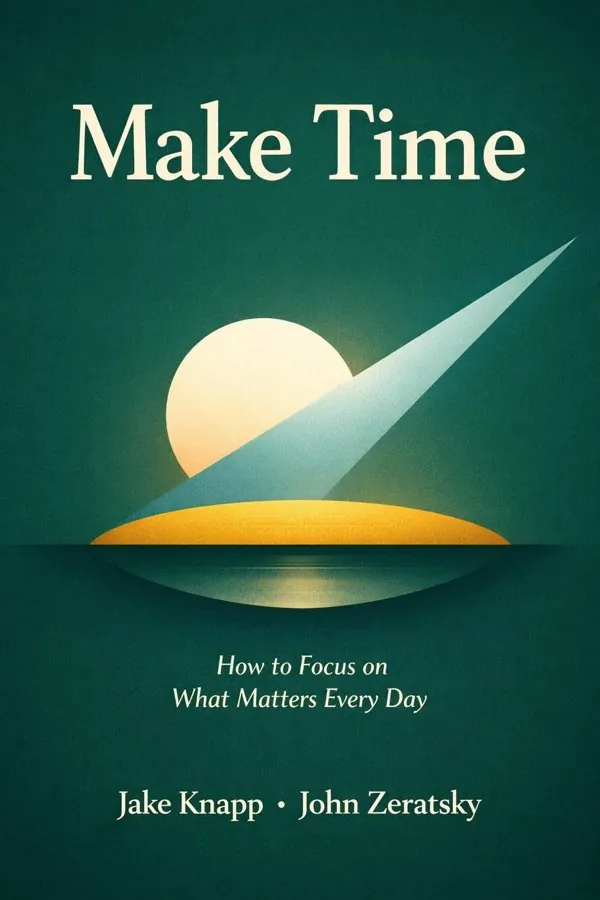
Make Time by Jake Knapp is a productivity book published in 2017 spanning 7 pages. Modern life is designed to fragment attention. Email, meetings, social feeds, breaking news, and endless to-do lists keep us reactive, busy, and exhausted—yet strangely unsure whether we spent the day on what truly matters. In Make Time, Jake Knapp and John Zeratsky offer a practical alternative: instead of trying to do everything faster, choose what matters most today and deliberately create space for it. The book is not about becoming a productivity machine. It is about reclaiming your time, energy, and focus from systems that profit from distraction. Built around dozens of small, flexible tactics rather than one rigid method, Make Time helps readers design days with more intention. The authors draw on their experience at Google, YouTube, and Google Ventures, where they observed how technology shapes behavior and how even highly successful people can lose control of their attention. Their approach combines behavioral psychology, workplace insight, and real-world experimentation. The result is an accessible, highly usable guide for anyone who feels busy but unfulfilled and wants a more meaningful, sustainable way to work and live.
This FizzRead summary covers all 8 key chapters of Make Time in approximately 10 minutes, distilling the most important ideas, arguments, and takeaways from Jake Knapp's work. Also available as an audio summary and Key Quotes Podcast.
Make Time
Modern life is designed to fragment attention. Email, meetings, social feeds, breaking news, and endless to-do lists keep us reactive, busy, and exhausted—yet strangely unsure whether we spent the day on what truly matters. In Make Time, Jake Knapp and John Zeratsky offer a practical alternative: instead of trying to do everything faster, choose what matters most today and deliberately create space for it. The book is not about becoming a productivity machine. It is about reclaiming your time, energy, and focus from systems that profit from distraction.
Built around dozens of small, flexible tactics rather than one rigid method, Make Time helps readers design days with more intention. The authors draw on their experience at Google, YouTube, and Google Ventures, where they observed how technology shapes behavior and how even highly successful people can lose control of their attention. Their approach combines behavioral psychology, workplace insight, and real-world experimentation. The result is an accessible, highly usable guide for anyone who feels busy but unfulfilled and wants a more meaningful, sustainable way to work and live.
Who Should Read Make Time?
This book is perfect for anyone interested in productivity and looking to gain actionable insights in a short read. Whether you're a student, professional, or lifelong learner, the key ideas from Make Time by Jake Knapp will help you think differently.
- ✓Readers who enjoy productivity and want practical takeaways
- ✓Professionals looking to apply new ideas to their work and life
- ✓Anyone who wants the core insights of Make Time in just 10 minutes
Want the full summary?
Get instant access to this book summary and 100K+ more with Fizz Moment.
Get Free SummaryAvailable on App Store • Free to download
Key Chapters
Most people let their day get defined by urgency instead of importance. That is the central problem Make Time asks you to confront. If you do not consciously decide what deserves your best attention, your inbox, calendar, and notifications will decide for you. Knapp and Zeratsky propose a simple but powerful practice: pick one “Highlight” each day—the activity, project, or experience that would make the day feel worthwhile if completed or meaningfully advanced.
The Highlight is not necessarily the biggest task or the most profitable one. It is the thing that matters most today. It might be writing a proposal, preparing for a key conversation, taking your child to the park, finishing a workout, or making progress on a creative project. By naming a Highlight in advance, you create a filter for decisions throughout the day. When distractions arise, you can ask: does this support my Highlight or pull me away from it?
The authors suggest three ways to choose a Highlight: urgency, satisfaction, or joy. Sometimes the most important thing is an imminent deadline. Other days, it is something deeply fulfilling that you keep postponing. The key is intentionality. Instead of drifting, you commit.
In practice, this might mean blocking two hours for deep work before meetings begin, protecting an evening for family, or doing your most meaningful task before opening communication apps. The Highlight gives shape to the day and prevents the common feeling of being busy without having done anything that mattered.
Actionable takeaway: Every morning, write down one Highlight in a notebook or calendar and reserve time for it before the day gets crowded.
Attention does not remain intact by accident; it must be protected by design. One of Make Time’s most useful insights is that willpower is unreliable in environments built to capture and monetize your focus. Phones buzz, apps refresh, platforms recommend more content, and work culture rewards immediate responsiveness. In that setting, trying to “be more disciplined” is often not enough.
The authors introduce the idea of laser mode: periods of concentrated, uninterrupted focus devoted to your Highlight. To enter laser mode, you reduce the chance of interruption before it starts. This might mean putting your phone in another room, logging out of social media, using website blockers, closing email, wearing headphones, or physically relocating to a quieter space. The point is to shape the environment so focus becomes easier than distraction.
This idea matters because distraction is not only lost time; it is lost cognitive quality. Every interruption creates switching costs. Returning to a task after checking messages can take minutes, and repeated interruptions destroy momentum. Creative thinking, strategic planning, and complex problem-solving all require sustained attention.
Make Time encourages readers to build rituals around focus. A short pre-work routine, a dedicated workspace, a timer, or a specific playlist can signal the brain that it is time to concentrate. Even a single 60- to 90-minute session of genuine focus can be more valuable than a whole day of fragmented effort.
In everyday life, designed attention might look like scheduling meetings later in the day, disabling nonessential notifications, or creating “office hours” for communication so your best mental energy goes first to meaningful work.
Actionable takeaway: Pick one recurring distraction and remove it for your next focus session by changing the environment, not just your intentions.
A surprising amount of life runs on default settings. You check email when you wake up because that is what you always do. You carry your phone everywhere because everyone does. You say yes to meetings because they appear on the calendar. Make Time argues that many of these defaults are inherited from technology companies, workplaces, and social habits—not consciously chosen by you.
The book distinguishes between two especially powerful defaults: the Busy Bandwagon and Infinity Pools. The Busy Bandwagon is the cultural belief that being constantly occupied, available, and overloaded is a sign of importance. It nudges people toward packed calendars, rapid replies, and performative busyness. Infinity Pools are apps and platforms with no natural stopping point—social feeds, news sites, streaming queues, and endless video recommendations. They are designed to keep you engaged far longer than intended.
Recognizing defaults is liberating because it reveals that many time problems are structural, not personal failures. If your day gets swallowed by meetings, notifications, and scrolling, the issue may not be laziness or lack of ambition. It may be that you are following systems optimized for someone else’s goals.
The authors encourage experimentation with new defaults: remove email from your phone, stop wearing a smartwatch, unsubscribe from low-value newsletters, turn off breaking news alerts, make entertainment less frictionless, or set social apps to log you out automatically. These changes sound small, but they shift what is easiest to do.
Once defaults become visible, choice returns. You can build a life around attention and meaning instead of urgency and consumption.
Actionable takeaway: Identify one default you never consciously chose—such as morning email or constant news checking—and replace it with a new rule for the next seven days.
Time management often fails because it ignores the body. Make Time emphasizes that focus is not only a scheduling problem; it is also an energy problem. If you are tired, overstimulated, hungry, sedentary, or mentally overloaded, even the best calendar system will break down. To make time for what matters, you must support the biological conditions that make attention possible.
Knapp and Zeratsky draw on common-sense principles that mirror how humans lived long before digital overload: move your body, eat real food, sleep enough, spend time outdoors, and be careful with stimulants and constant mental input. These are not presented as perfectionist wellness rules. They are practical levers for improving your capacity to focus and feel present.
For example, a short walk can restore clarity better than forcing yourself through another tired hour at your desk. Stable meals can prevent the energy crashes that lead to procrastination. Better sleep can make it easier to resist distraction the next day. Even reducing low-quality screen time in the evening can improve recovery and morning alertness.
The broader lesson is that productivity should not be detached from vitality. If your system helps you complete tasks but leaves you drained, reactive, and irritable, it is not truly working. Sustainable effectiveness comes from aligning your habits with how attention and energy really operate.
In practice, this may mean taking walking meetings, protecting a consistent bedtime, limiting caffeine after noon, or beginning the day without immediately flooding your brain with digital input. Small physical changes can produce disproportionately large cognitive gains.
Actionable takeaway: Choose one energy habit to improve this week—sleep, movement, food, or screen use—and observe how it affects your focus on your daily Highlight.
People often search for one ideal productivity system that will solve everything at once. Make Time rejects that mindset. Instead of promising a universal framework, the book offers a large menu of tactics that readers can test, combine, and adapt. This experimental approach is one of its greatest strengths. It accepts that different people have different jobs, personalities, seasons of life, and constraints.
The authors divide their ideas into four stages—Highlight, Laser, Energize, and Reflect—but they repeatedly stress flexibility. You are not expected to implement every tactic. In fact, trying to overhaul your life overnight would probably fail. The better strategy is to start small, notice what works, and build your own personalized toolkit.
This matters because behavior change becomes easier when it feels like experimentation rather than self-judgment. If a tactic does not help, it is not evidence that you are bad at productivity. It simply means the tactic was not a fit. That mindset reduces shame and encourages curiosity.
Examples of small tactics include setting a timer for focused work, leaving your phone in a drawer, creating a shutdown ritual, writing tomorrow’s Highlight before bed, using paper instead of digital notes for planning, or batching low-value tasks into one short block. None of these changes is dramatic alone, but together they can reshape the texture of a day.
The book’s philosophy is practical: do more of what helps, less of what hurts, and keep adjusting. Progress comes from iteration, not perfection.
Actionable takeaway: Pick just two tactics from different areas—one for focus and one for energy—and test them for five days before deciding whether to keep them.
Without reflection, busyness blurs into habit. One of Make Time’s most effective ideas is the use of daily reflection to learn from your own experience. Rather than assuming a tactic should work in theory, Knapp and Zeratsky encourage readers to observe what actually happened: Did you complete your Highlight? When did you feel focused? What drained your energy? Which changes made the day better?
This reflective loop matters because self-knowledge is highly specific. One person does their best deep work at 7 a.m.; another peaks late at night. Some people need complete silence; others focus better with ambient sound. Certain foods may leave you sluggish, certain meetings may derail your concentration, and certain routines may consistently improve your mood. Reflection helps uncover these patterns.
The authors recommend simple tracking rather than elaborate journaling. A few notes at the end of the day can be enough. You might record your Highlight, whether you made time for it, your energy level, and one thing to try tomorrow. Over time, these observations become data. You stop relying on vague impressions and start seeing what truly supports meaningful work.
Reflection also creates a healthier relationship with productivity. Instead of defining success as perfect control over every hour, you treat each day as a learning opportunity. A difficult day becomes useful if it teaches you something about your environment, rhythms, or habits.
In practical terms, this could mean noticing that afternoon meetings consistently ruin your Highlight, that reading before bed helps sleep, or that checking social media during breaks makes it harder to restart work. Once seen, these patterns can be changed.
Actionable takeaway: End each day with a two-minute review: write your Highlight, whether you honored it, and one adjustment to test tomorrow.
The tools you use shape the life you live. Make Time does not argue that technology is evil; rather, it insists that digital tools should be used consciously instead of passively accepted. This distinction is crucial. Many apps and devices are designed by talented teams whose success depends on maximizing your engagement, not your fulfillment. If you do not set boundaries, those incentives will quietly set them for you.
The authors write from inside the technology world, which gives their critique unusual credibility. They understand how products are engineered to trigger habits: notifications exploit curiosity, streaks encourage repetition, feeds remove stopping cues, and personalized recommendations keep attention flowing. Their answer is not total rejection but intentional friction.
Intentional friction means making distracting behavior slightly harder and meaningful behavior slightly easier. Delete apps you rarely value. Keep your phone charger away from the bed. Use “do not disturb” aggressively. Switch your screen to grayscale if colors draw you in. Read on a dedicated e-reader instead of a multipurpose phone. Keep a notebook nearby so moments of boredom can become moments of thought rather than reflexive scrolling.
This approach gives users agency. Instead of asking, “How can I control myself around irresistible tools?” you ask, “How can I redesign my relationship with these tools?” That shift is empowering because it recognizes that behavior is shaped by context.
Applied well, technology becomes a support for deliberate living—helping you navigate, create, and connect—without dominating every spare moment.
Actionable takeaway: Audit your devices today and remove or disable one digital feature that steals more attention than value.
One of the book’s most liberating messages is that busyness and meaningful accomplishment are not the same. In many workplaces and social environments, speed, responsiveness, and visible overload are treated as signs of dedication. But Make Time challenges that assumption. A day full of messages answered, meetings attended, and tabs switched is not necessarily a day well spent.
The problem with busyness is that it rewards activity over impact. It encourages people to clear shallow tasks while avoiding the slower, more demanding work that creates value: thinking deeply, writing carefully, making decisions, learning, building relationships, or producing original work. Busyness can even feel productive because it offers constant motion and quick hits of completion. Yet at the end of the week, the things that mattered most may still be untouched.
By centering the Highlight and protecting laser time, the authors redefine success in more honest terms. What did you make progress on that mattered? Did you direct your attention or surrender it? Did your day reflect your priorities or merely other people’s demands?
This idea applies beyond work. A socially packed weekend can still feel empty if it lacks rest, presence, or joy. Parenting can become logistical management instead of connection. Hobbies can disappear under administrative noise. The cure is not doing less for its own sake; it is doing what matters with greater clarity.
Once you stop worshipping busyness, you gain permission to slow down, say no, leave space unscheduled, and value depth over display.
Actionable takeaway: At the end of tomorrow, judge the day by one question only: Did I spend meaningful time on what matters most, not merely stay busy?
All Chapters in Make Time
About the Author
Jake Knapp is a designer, investor, and bestselling author known for helping teams work more effectively and make better use of their time. He spent more than a decade at Google, where he contributed to products such as Gmail and Google Meet, and later joined Google Ventures, where he created the Design Sprint process to help startups solve problems quickly. Alongside John Zeratsky and Braden Kowitz, he co-authored Sprint, and with Zeratsky he wrote Make Time, a practical guide to focus and intentional living in a distracted world. Knapp’s work draws on product design, behavioral psychology, and real-world experimentation. He is widely respected for translating complex ideas about attention, decision-making, and productivity into concrete methods that individuals and teams can apply immediately.
Get This Summary in Your Preferred Format
Read or listen to the Make Time summary by Jake Knapp anytime, anywhere. FizzRead offers multiple formats so you can learn on your terms — all free.
Available formats: App · Audio · PDF · EPUB — All included free with FizzRead
Download Make Time PDF and EPUB Summary
Key Quotes from Make Time
“Most people let their day get defined by urgency instead of importance.”
“Attention does not remain intact by accident; it must be protected by design.”
“A surprising amount of life runs on default settings.”
“Time management often fails because it ignores the body.”
“People often search for one ideal productivity system that will solve everything at once.”
Frequently Asked Questions about Make Time
Make Time by Jake Knapp is a productivity book that explores key ideas across 8 chapters. Modern life is designed to fragment attention. Email, meetings, social feeds, breaking news, and endless to-do lists keep us reactive, busy, and exhausted—yet strangely unsure whether we spent the day on what truly matters. In Make Time, Jake Knapp and John Zeratsky offer a practical alternative: instead of trying to do everything faster, choose what matters most today and deliberately create space for it. The book is not about becoming a productivity machine. It is about reclaiming your time, energy, and focus from systems that profit from distraction. Built around dozens of small, flexible tactics rather than one rigid method, Make Time helps readers design days with more intention. The authors draw on their experience at Google, YouTube, and Google Ventures, where they observed how technology shapes behavior and how even highly successful people can lose control of their attention. Their approach combines behavioral psychology, workplace insight, and real-world experimentation. The result is an accessible, highly usable guide for anyone who feels busy but unfulfilled and wants a more meaningful, sustainable way to work and live.
More by Jake Knapp

You Might Also Like
Featured In
Browse by Category
Ready to read Make Time?
Get the full summary and 100K+ more books with Fizz Moment.