
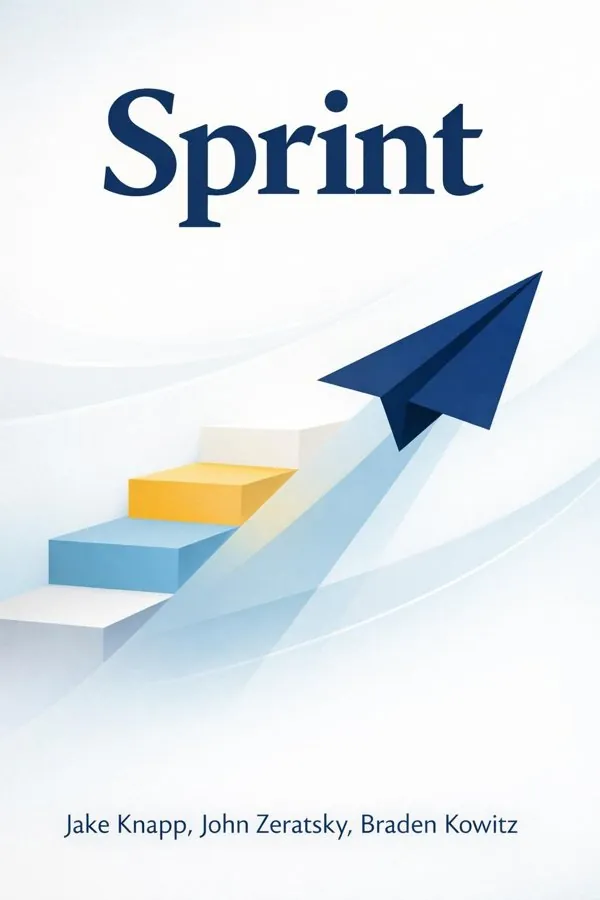
Sprint: How to Solve Big Problems and Test New Ideas in Just Five Days: Summary & Key Insights
by Jake Knapp, John Zeratsky, Braden Kowitz
 10 min7 chaptersAudio available
What Is Sprint: How to Solve Big Problems and Test New Ideas in Just Five Days About?
Sprint: How to Solve Big Problems and Test New Ideas in Just Five Days by Jake Knapp, John Zeratsky, Braden Kowitz is a entrepreneurship book spanning 7 pages. Sprint is a practical guide that introduces a unique five-day process for solving tough problems, developing prototypes, and testing ideas with customers. Created by Jake Knapp at Google Ventures and refined with over 150 startups, the book provides a step-by-step framework for teams to move quickly from idea to tested solution. It is designed for teams of any size, from startups to large corporations, to accelerate innovation and decision-making.
This FizzRead summary covers all 7 key chapters of Sprint: How to Solve Big Problems and Test New Ideas in Just Five Days in approximately 10 minutes, distilling the most important ideas, arguments, and takeaways from Jake Knapp, John Zeratsky, Braden Kowitz's work. Also available as an audio summary and Key Quotes Podcast.
Sprint: How to Solve Big Problems and Test New Ideas in Just Five Days
Sprint is a practical guide that introduces a unique five-day process for solving tough problems, developing prototypes, and testing ideas with customers. Created by Jake Knapp at Google Ventures and refined with over 150 startups, the book provides a step-by-step framework for teams to move quickly from idea to tested solution. It is designed for teams of any size, from startups to large corporations, to accelerate innovation and decision-making.
Who Should Read Sprint: How to Solve Big Problems and Test New Ideas in Just Five Days?
This book is perfect for anyone interested in entrepreneurship and looking to gain actionable insights in a short read. Whether you're a student, professional, or lifelong learner, the key ideas from Sprint: How to Solve Big Problems and Test New Ideas in Just Five Days by Jake Knapp, John Zeratsky, Braden Kowitz will help you think differently.
- ✓Readers who enjoy entrepreneurship and want practical takeaways
- ✓Professionals looking to apply new ideas to their work and life
- ✓Anyone who wants the core insights of Sprint: How to Solve Big Problems and Test New Ideas in Just Five Days in just 10 minutes
Want the full summary?
Get instant access to this book summary and 100K+ more with Fizz Moment.
Get Free SummaryAvailable on App Store • Free to download
Key Chapters
A sprint is designed around a deceptively simple idea: small teams can accomplish in five focused days what might otherwise take months. The week follows a very intentional arc — Monday through Friday — where each day serves a distinct purpose. The flow moves from mapping and understanding to deciding, building, and testing. The rhythm of the week becomes both discipline and catalyst, forcing clear priorities while maintaining creative energy.
On Monday, the team begins by understanding the problem and setting a long-term goal. By Tuesday, attention shifts toward possible solutions — everyone sketches ideas individually, ensuring diversity of thought. Wednesday is the decisive midpoint, when the group reviews all ideas, critiques them, and commits to one direction. That same day, the team creates a storyboard — a detailed plan for the prototype. Thursday is execution: the goal is not to build a perfect product but to make a realistic artifact that customers can interact with. Friday culminates in testing. Real users engage with the prototype as the team watches silently, learning firsthand which assumptions hold and which crumble.
This flow mirrors the natural cycle of design thinking — empathize, define, ideate, prototype, and test — but condenses it into a single, high-intensity week. The sprint builds in structured collaboration while reducing friction. There’s no waiting for a chain of approvals, no vague meetings with unclear outcomes. Instead, it’s about learning fast, with evidence rather than opinion guiding the next step.
The first day sets the foundation. We begin by mapping the problem space, establishing a clear understanding of the challenge, and deciding what success looks like. Every sprint starts with a long-term goal — a north star that frames our efforts. We then work backward, identifying the obstacles standing in the way of that goal. The outcome of this day isn’t a complete plan, but a shared understanding among the entire team.
The map we create is a simple diagram that shows how customers move through our product or system, where decisions are made, and where pain points appear. This visual frame provides context for the week. But equally important are the expert interviews. On Monday afternoon, we bring in people within or outside the organization who deeply understand the problem. They offer insight into customer behavior, technical constraints, competitive dynamics, and past experiments. Everyone takes notes silently, writing down key ideas and forming rough ‘How Might We’ questions — short prompts that reframe insights into opportunities.
By the end of the day, the team converges on a single, narrow target: one piece of the larger problem that, if solved, will have an outsized impact. This decision focus is liberating. Instead of trying to boil the ocean, everyone commits to exploring one important, testable slice of the challenge.
+ 5 more chapters — available in the FizzRead app
All Chapters in Sprint: How to Solve Big Problems and Test New Ideas in Just Five Days
About the Authors
Jake Knapp is a designer and facilitator who created the Design Sprint process at Google Ventures. John Zeratsky and Braden Kowitz, also partners at GV, contributed their expertise in product design and user experience. Together, they have helped numerous startups and established companies innovate more effectively.
Get This Summary in Your Preferred Format
Read or listen to the Sprint: How to Solve Big Problems and Test New Ideas in Just Five Days summary by Jake Knapp, John Zeratsky, Braden Kowitz anytime, anywhere. FizzRead offers multiple formats so you can learn on your terms — all free.
Available formats: App · Audio · PDF · EPUB — All included free with FizzRead
Download Sprint: How to Solve Big Problems and Test New Ideas in Just Five Days PDF and EPUB Summary
Key Quotes from Sprint: How to Solve Big Problems and Test New Ideas in Just Five Days
“A sprint is designed around a deceptively simple idea: small teams can accomplish in five focused days what might otherwise take months.”
“We begin by mapping the problem space, establishing a clear understanding of the challenge, and deciding what success looks like.”
Frequently Asked Questions about Sprint: How to Solve Big Problems and Test New Ideas in Just Five Days
Sprint: How to Solve Big Problems and Test New Ideas in Just Five Days by Jake Knapp, John Zeratsky, Braden Kowitz is a entrepreneurship book that explores key ideas across 7 chapters. Sprint is a practical guide that introduces a unique five-day process for solving tough problems, developing prototypes, and testing ideas with customers. Created by Jake Knapp at Google Ventures and refined with over 150 startups, the book provides a step-by-step framework for teams to move quickly from idea to tested solution. It is designed for teams of any size, from startups to large corporations, to accelerate innovation and decision-making.
You Might Also Like

Lean Analytics
Alistair Croll, Benjamin Yoskovitz
10 min
21 Days To A Big Idea: Creating Breakthrough Business Concepts
Bryan Mattimore
10 min
Sam Walton: Made in America: My Story
Sam Walton
10 min
10x Is Easier Than 2x: How World-Class Entrepreneurs Achieve More by Doing Less
Dan Sullivan, Benjamin Hardy
10 min
12 Months to $1 Million: How to Pick a Winning Product, Build a Real Business, and Become a Seven-Figure Entrepreneur
Ryan Daniel Moran
10 min
24 Assets: Create a Digital, Scalable, Valuable Business
Daniel Priestley
10 minBrowse by Category
Ready to read Sprint: How to Solve Big Problems and Test New Ideas in Just Five Days?
Get the full summary and 100K+ more books with Fizz Moment.