
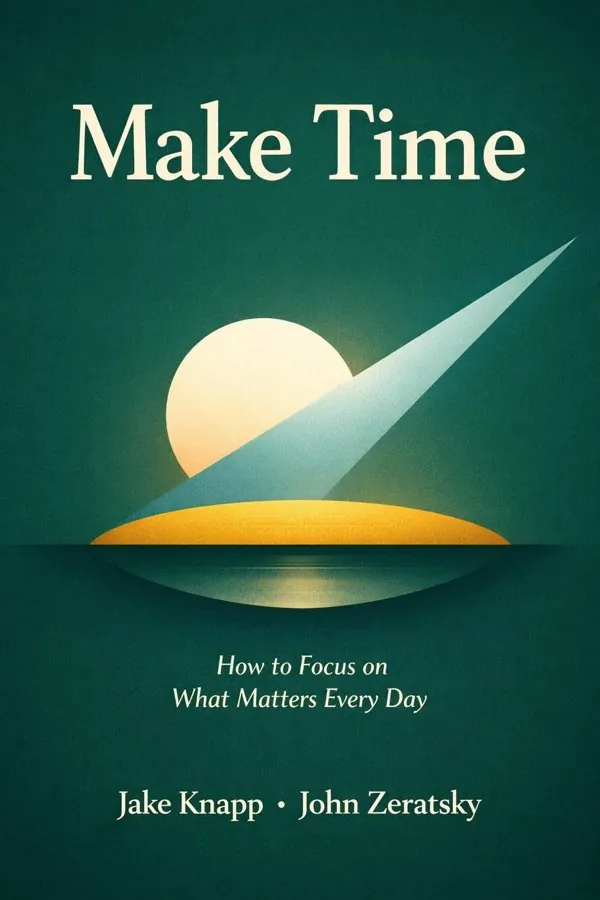
Make Time: How to Focus on What Matters Every Day: Summary & Key Insights
 10 min8 chaptersAudio available
Key Takeaways from Make Time: How to Focus on What Matters Every Day
Most productivity systems fail for a simple reason: they assume life will behave itself.
A day without a clear priority is easily consumed by other people’s demands.
Attention is rarely lost all at once; it is stolen in tiny fragments.
Many people think they lack discipline, when the real problem is that their tools are designed to hijack attention.
Focus is not just a cognitive skill; it is a physical state.
What Is Make Time: How to Focus on What Matters Every Day About?
Make Time: How to Focus on What Matters Every Day by Jake Knapp, John Zeratsky is a productivity book spanning 6 pages. Make Time is a practical and refreshingly humane productivity book about taking back control of your attention in a world engineered to fragment it. Rather than promising perfect efficiency, Jake Knapp and John Zeratsky offer a flexible daily framework for helping people spend time on what matters most. Built around four repeatable steps—Highlight, Laser, Energize, and Reflect—the book shows how to choose a meaningful priority, protect focus, support physical and mental energy, and learn from each day through small experiments. What makes the book stand out is its rejection of rigid systems and productivity guilt. Knapp and Zeratsky argue that most people are not bad at focus; they are simply trapped inside defaults created by busy culture and attention-hungry technology. Their solution is not to do more, but to be more intentional. Drawing on their experience at Google, Google Ventures, and the development of the Design Sprint process, they combine behavioral science, design thinking, and firsthand experimentation into a toolkit anyone can use. The result is an accessible guide for readers who want calmer days, better attention, and a more deliberate life.
This FizzRead summary covers all 8 key chapters of Make Time: How to Focus on What Matters Every Day in approximately 10 minutes, distilling the most important ideas, arguments, and takeaways from Jake Knapp, John Zeratsky's work. Also available as an audio summary and Key Quotes Podcast.
Make Time: How to Focus on What Matters Every Day
Make Time is a practical and refreshingly humane productivity book about taking back control of your attention in a world engineered to fragment it. Rather than promising perfect efficiency, Jake Knapp and John Zeratsky offer a flexible daily framework for helping people spend time on what matters most. Built around four repeatable steps—Highlight, Laser, Energize, and Reflect—the book shows how to choose a meaningful priority, protect focus, support physical and mental energy, and learn from each day through small experiments.
What makes the book stand out is its rejection of rigid systems and productivity guilt. Knapp and Zeratsky argue that most people are not bad at focus; they are simply trapped inside defaults created by busy culture and attention-hungry technology. Their solution is not to do more, but to be more intentional. Drawing on their experience at Google, Google Ventures, and the development of the Design Sprint process, they combine behavioral science, design thinking, and firsthand experimentation into a toolkit anyone can use. The result is an accessible guide for readers who want calmer days, better attention, and a more deliberate life.
Who Should Read Make Time: How to Focus on What Matters Every Day?
This book is perfect for anyone interested in productivity and looking to gain actionable insights in a short read. Whether you're a student, professional, or lifelong learner, the key ideas from Make Time: How to Focus on What Matters Every Day by Jake Knapp, John Zeratsky will help you think differently.
- ✓Readers who enjoy productivity and want practical takeaways
- ✓Professionals looking to apply new ideas to their work and life
- ✓Anyone who wants the core insights of Make Time: How to Focus on What Matters Every Day in just 10 minutes
Want the full summary?
Get instant access to this book summary and 100K+ more with Fizz Moment.
Get Free SummaryAvailable on App Store • Free to download
Key Chapters
Most productivity systems fail for a simple reason: they assume life will behave itself. Make Time begins with the opposite assumption. Days are messy, work is unpredictable, and attention is constantly under attack. Instead of giving readers a rigid schedule or a universal morning routine, Jake Knapp and John Zeratsky introduce a flexible four-part system that can adapt to real life. The framework consists of Highlight, Laser, Energize, and Reflect. Together, these steps help you decide what matters, protect your focus, support your energy, and improve through trial and error.
The authors call modern distractions “defaults.” These defaults include endless email, social media, reactive meetings, and the cultural pressure to stay busy. Left unexamined, they decide your day for you. Make Time is about replacing those defaults with deliberate choices. You do not need to overhaul your life overnight. Instead, you select a few tactics, test them, and see what helps you create a day that feels meaningful.
For example, one person might use Highlight to protect two hours for writing, Laser to silence notifications, Energize to take a midday walk, and Reflect to note whether that combination improved focus. Another might use the same framework for family time, study, or a personal project. The system works because it is modular, not dogmatic.
The deeper lesson is that productivity is not about squeezing more tasks into every hour. It is about designing days you can look back on with satisfaction. Actionable takeaway: treat each day as a small experiment and use the four-part framework to build intention instead of relying on default behavior.
A day without a clear priority is easily consumed by other people’s demands. That is why the first step in Make Time is to choose a daily Highlight: the activity, project, or moment that would make the day feel worthwhile if it actually happened. This is not necessarily the most urgent task. It is the thing that matters most today, whether because it is deeply meaningful, highly satisfying, or critically important.
The authors suggest three ways to choose a Highlight. You can pick something urgent, such as finishing a client presentation. You can pick something satisfying, like finally repairing a neglected part of your home. Or you can pick something joyful and meaningful, such as spending uninterrupted time with your child or making progress on a long-term creative project. The key is that the Highlight becomes the day’s emotional center of gravity.
This concept matters because modern to-do lists encourage fragmentation. When every task appears equal, shallow work fills the day. A Highlight cuts through that noise. It helps you schedule your best attention in advance rather than hoping meaningful work will somehow happen in the leftover margins.
In practice, a Highlight works best when it is specific and visible on your calendar. “Work on book” is vague. “Draft chapter outline from 9:00 to 10:30” is concrete. “Family time” is abstract. “Phone-free dinner and walk from 6:30 to 8:00” is easier to protect.
A Highlight does not guarantee perfect execution, but it creates direction. At the end of the day, you can ask a simple question: did I make time for what mattered? Actionable takeaway: every morning, choose one Highlight and put dedicated time for it on your calendar before distractions claim your day.
Attention is rarely lost all at once; it is stolen in tiny fragments. A glance at email becomes ten minutes. One notification opens a spiral of tabs. A quick check of social media leaves your mind buzzing long after the screen goes dark. In Make Time, the Laser step is about creating the conditions for sustained concentration. The authors argue that focus is not merely a matter of willpower. It is a product of environment, technology, and design.
To build Laser time, they recommend reducing the number of chances distraction gets. That might mean logging out of social apps, turning your phone grayscale, wearing headphones, closing extra browser tabs, or using a separate device for important work. It can also mean redesigning your physical space: sitting away from high-traffic areas, leaving your phone in another room, or keeping only the materials needed for the task at hand.
The goal is not monk-like isolation or total digital rejection. It is to make focus easier than distraction. This often involves pre-commitment. If you decide in advance that the first hour after breakfast is for your Highlight and your phone stays out of reach, you no longer need to renegotiate with temptation every five minutes.
Laser also includes being realistic about attention cycles. Deep focus may come in 30-, 60-, or 90-minute blocks. Protecting one or two strong windows of concentration can be more valuable than trying to remain perfectly focused all day.
In daily life, this could mean scheduling focused work before opening inboxes, batching communication into designated windows, or telling coworkers when you are unavailable. Actionable takeaway: identify your biggest distraction source today and create one friction point that makes it harder to interrupt your focus.
Many people think they lack discipline, when the real problem is that their tools are designed to hijack attention. One of Make Time’s most powerful insights is that technology is not neutral. Apps, devices, and platforms are built to maximize engagement, not to protect your priorities. Infinite feeds, autoplay, notifications, unread badges, and algorithmic recommendations all push you toward reactive behavior. If you use these tools without intention, they will quietly script your day.
Knapp and Zeratsky encourage readers to become suspicious of convenience. The easiest option is not always the best one. If every spare moment is filled by checking a phone, boredom disappears—but so do reflection, presence, and creative thought. The authors recommend consciously redesigning your relationship with technology. That does not necessarily mean deleting everything. It means separating genuinely useful tools from compulsive loops.
Practical strategies include removing social apps from your phone while keeping them on your computer, disabling nonessential notifications, using “Do Not Disturb,” signing out after each session, or keeping a low-friction phone for calls and texts while reserving a laptop for intentional online tasks. Even small design changes can alter behavior dramatically because they interrupt automatic habits.
This principle applies beyond social media. News consumption, email, messaging platforms, and streaming services can all become default escapes. When these defaults dominate, your own priorities become secondary. Reclaiming time begins with noticing which technologies create value and which merely consume attention.
The larger message is empowering: you are allowed to set rules for your devices instead of letting devices set rules for you. Actionable takeaway: audit your most-used apps and remove, disable, or restrict one digital default that repeatedly steals time from what matters.
Focus is not just a cognitive skill; it is a physical state. The Energize step in Make Time recognizes that attention depends heavily on the condition of the body. When you are underslept, sedentary, overstimulated, or running on sugar and stress, concentration becomes fragile. Instead of treating productivity as purely mental, Knapp and Zeratsky argue that better days start with better energy.
Their advice is grounded in a simple idea: human brains evolved for movement, daylight, social interaction, rest, and real food, not for endless sitting under artificial light while switching between screens. You do not need a perfect wellness routine to benefit from this insight. Modest actions can produce meaningful gains. A walk outside can restore alertness. A glass of water and a healthy lunch can prevent an afternoon crash. Even brief exercise can improve mood and executive function.
The authors also challenge the common dependence on caffeine as a substitute for energy management. Coffee is not inherently bad, but using stimulants to bulldoze through exhaustion can create spikes and crashes that make focus less stable. Likewise, late-night screen use can erode sleep quality, reducing next-day attention.
In practice, Energize might mean standing up every hour, taking walking meetings, eating simpler meals during workdays, getting sunlight early in the morning, or setting a bedtime alarm. It could also mean protecting downtime and reducing unnecessary commitments that leave you chronically depleted.
The point is not to become an elite athlete. It is to realize that the ability to make time for what matters depends on having enough physical and mental capacity to show up. Actionable takeaway: pick one energy-supporting habit—sleep, movement, food, or sunlight—and make it part of tomorrow’s plan.
Improvement rarely comes from grand resolutions; it comes from paying attention to what actually works. That is the purpose of the Reflect step in Make Time. At the end of the day, the authors encourage a brief review: Did you make time for your Highlight? Did you feel focused? What affected your energy? Which tactics helped, and which ones failed? This simple reflection transforms productivity from self-judgment into experimentation.
The book’s tone is notably nonpunitive. If a tactic does not work, that is not evidence of personal weakness. It is data. Maybe your Highlight was too vague. Maybe you chose a focus block after lunch when your energy naturally dips. Maybe notifications from one app proved harder to ignore than expected. Reflection helps you notice patterns and adjust with more intelligence.
This mindset is powerful because it avoids all-or-nothing thinking. Many people abandon useful systems after one chaotic day. Make Time proposes something more forgiving: keep the framework, change the tactics. Over time, you create a personalized playbook based on your own rhythms, responsibilities, and vulnerabilities.
For example, you might discover that writing goes best before opening email, that walking boosts your afternoon attention, or that phone use after dinner harms sleep and therefore hurts the next day’s Highlight. Small observations like these compound. They help you stop copying other people’s routines and start building one that fits your life.
A brief daily note can be enough: Highlight chosen, focus quality, energy level, and one lesson. In a week, patterns become visible. Actionable takeaway: spend two minutes each evening recording what helped and what hindered your day, then use one insight to adjust tomorrow’s approach.
One of the book’s quiet but radical arguments is that busyness has become a cultural default. Many people equate packed calendars, constant responsiveness, and visible exhaustion with importance. Make Time challenges this belief. Being busy can feel productive, but it often means your time is being spent reactively rather than intentionally. The danger is not just inefficiency; it is the gradual loss of agency.
The authors distinguish between tasks that create motion and activities that create meaning. Email, messaging, and meetings can keep you occupied all day without advancing the work or relationships that matter most. This is why the Highlight is so central: it creates a counterweight to the social pressure of busyness. Instead of measuring a day by how many things you touched, you measure it by whether you invested in something valuable.
This shift has emotional consequences. Many readers will recognize the hollow feeling of being exhausted without feeling accomplished. That often happens when the day is full of inputs but empty of deliberate progress. A meaningful day may include fewer completed tasks, but more of the right kind of effort.
In practical terms, this could mean saying no to low-value commitments, reducing meeting time, batching administrative work, or redefining success around creative progress, quality attention, or personal presence. For a parent, a meaningful Highlight might be an hour of uninterrupted family time. For a student, it might be concentrated study on a difficult subject. For an entrepreneur, it might be strategic thinking rather than endless inbox maintenance.
The core insight is simple: activity is not the same as impact. Actionable takeaway: choose one recurring obligation this week and ask whether it supports what matters or merely sustains the appearance of busyness.
People often assume life improvement requires dramatic reinvention, but Make Time argues for the opposite. Lasting change usually comes from small, practical shifts that alter daily behavior. The book includes dozens of tactics because the authors want readers to test many low-risk adjustments rather than wait for perfect motivation or a complete lifestyle reset.
This experimental approach matters because motivation is unreliable. When a tactic is small enough, you can use it even on difficult days. For instance, charging your phone outside the bedroom may improve sleep without demanding heroic discipline. Starting your Highlight before opening email can protect focus without changing your entire career. Taking a ten-minute walk can lift energy without requiring a full workout program. Each tactic nudges the environment so the desired behavior becomes more likely.
The authors also understand that different lives require different tools. A freelancer, a parent, a student, and a manager will face distinct constraints. That is why Make Time offers principles rather than rigid commandments. The best tactic is the one you will actually use. Over time, repeated small wins build confidence and create identity change: you become someone who chooses attention instead of surrendering it.
An important aspect of this idea is iteration. If one tactic fails, try another. Maybe website blockers annoy you, but leaving your phone in another room works. Maybe early morning focus is unrealistic, but evening Highlight time succeeds. Progress comes from adaptation, not perfection.
The beauty of small tactics is that they lower resistance while still producing visible results. Actionable takeaway: choose one tiny behavior change that supports your Highlight and commit to testing it for the next three days.
All Chapters in Make Time: How to Focus on What Matters Every Day
About the Authors
Jake Knapp and John Zeratsky are designers, authors, and former Google and Google Ventures colleagues known for translating design thinking into practical everyday tools. Jake Knapp is best known for creating the Design Sprint, a widely adopted process for rapid problem-solving, innovation, and product testing. John Zeratsky is a designer, writer, and behavior-focused thinker whose work explores habits, attention, and intentional living. Together, they co-authored the bestselling book Sprint before turning their attention to personal productivity in Make Time. Their work stands out for its blend of experimentation, clarity, and real-world usefulness. Rather than promoting abstract theory, they draw on years of experience designing systems, products, and workflows that help people make better decisions and spend their time more deliberately.
Get This Summary in Your Preferred Format
Read or listen to the Make Time: How to Focus on What Matters Every Day summary by Jake Knapp, John Zeratsky anytime, anywhere. FizzRead offers multiple formats so you can learn on your terms — all free.
Available formats: App · Audio · PDF · EPUB — All included free with FizzRead
Download Make Time: How to Focus on What Matters Every Day PDF and EPUB Summary
Key Quotes from Make Time: How to Focus on What Matters Every Day
“Most productivity systems fail for a simple reason: they assume life will behave itself.”
“A day without a clear priority is easily consumed by other people’s demands.”
“Attention is rarely lost all at once; it is stolen in tiny fragments.”
“Many people think they lack discipline, when the real problem is that their tools are designed to hijack attention.”
“Focus is not just a cognitive skill; it is a physical state.”
Frequently Asked Questions about Make Time: How to Focus on What Matters Every Day
Make Time: How to Focus on What Matters Every Day by Jake Knapp, John Zeratsky is a productivity book that explores key ideas across 8 chapters. Make Time is a practical and refreshingly humane productivity book about taking back control of your attention in a world engineered to fragment it. Rather than promising perfect efficiency, Jake Knapp and John Zeratsky offer a flexible daily framework for helping people spend time on what matters most. Built around four repeatable steps—Highlight, Laser, Energize, and Reflect—the book shows how to choose a meaningful priority, protect focus, support physical and mental energy, and learn from each day through small experiments. What makes the book stand out is its rejection of rigid systems and productivity guilt. Knapp and Zeratsky argue that most people are not bad at focus; they are simply trapped inside defaults created by busy culture and attention-hungry technology. Their solution is not to do more, but to be more intentional. Drawing on their experience at Google, Google Ventures, and the development of the Design Sprint process, they combine behavioral science, design thinking, and firsthand experimentation into a toolkit anyone can use. The result is an accessible guide for readers who want calmer days, better attention, and a more deliberate life.
More by Jake Knapp, John Zeratsky

You Might Also Like


Browse by Category
Ready to read Make Time: How to Focus on What Matters Every Day?
Get the full summary and 100K+ more books with Fizz Moment.