
Books About Stoicism — Ancient Wisdom for Modern Life
Stoicism is having a renaissance — and for good reason. These books teach you how to find calm in chaos, focus on what you can control, and live with purpose.

 10 min read
All About Love
by bell hooks
In All About Love, bell hooks takes a word that is used constantly and asks a disarming question: what do we actually mean by it? Her answer is both philosophical and practical. Love, she argues, is not a feeling we fall into, a reward we passively receive, or a private romance detached from the world. It is an ethical practice built from care, commitment, trust, responsibility, respect, and honest knowledge. From that starting point, hooks examines why so many people hunger for love yet struggle to give or receive it well. What makes this book so powerful is the way hooks connects personal pain to social structures. She shows how patriarchy, childhood emotional neglect, consumer culture, and fear of vulnerability distort our understanding of love. Drawing on memoir, social criticism, feminist thought, and spiritual reflection, she offers a language for healing relationships without ignoring power or injustice. hooks writes with unusual authority because she combines intellectual rigor with emotional clarity, making this book both a critique of modern culture and a guide to living differently. All About Love remains essential for anyone seeking healthier relationships, stronger communities, and a more humane vision of freedom.
Key Takeaways
- 1Childhood Teaches Our First Love Lessons — Most adults do not enter relationships as blank slates; they carry a childhood education in love that often goes unquest…
- 2Love Requires Honesty and Clear Communication — A relationship can survive disappointment more easily than deception, because love cannot grow where truth is consistent…
- 3Self-Acceptance Makes Love More Possible — Many people seek love as if another person can supply the worth they do not feel inside, but hooks argues that this ofte…
 10 min read
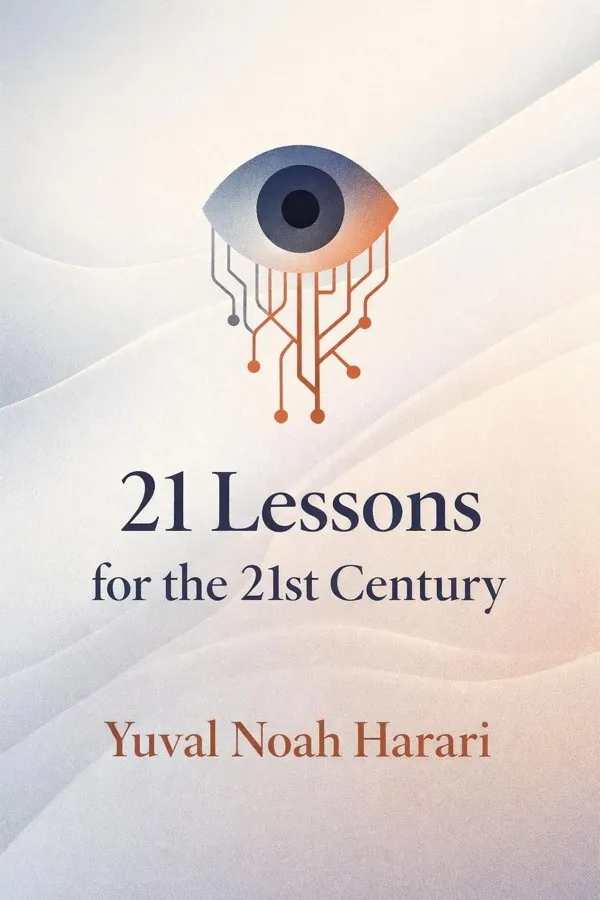
21 Lessons for the 21st Century
by Yuval Noah Harari
In this thought-provoking collection of essays, Yuval Noah Harari explores the most pressing issues facing humanity in the 21st century, including technology, politics, religion, and the future of work. Drawing on history, philosophy, and science, Harari examines how rapid technological change and global interconnectedness challenge our understanding of truth, freedom, and meaning.
Key Takeaways
- 1The Technological Challenge — When historians reflect on our era, they may describe it as the age when intelligence decoupled from consciousness. Arti…
- 2The Political Challenge — The political world we inherited was built for the industrial age, not for the digital one. The twentieth century taught…
- 3Despair and Hope
 10 min read
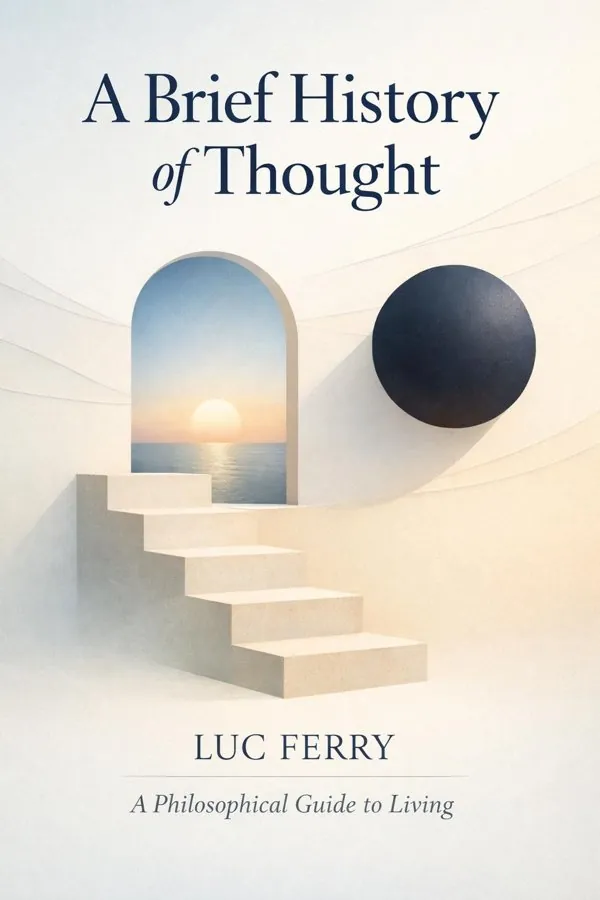
A Brief History of Thought: A Philosophical Guide to Living
by Luc Ferry
In this accessible introduction to Western philosophy, Luc Ferry traces the evolution of thought from ancient wisdom to modern philosophy. He explores the great existential questions and the answers offered by major thinkers such as Socrates, Descartes, Kant, and Nietzsche, providing readers with a clear and engaging guide to understanding the meaning of life and the human condition.
Key Takeaways
- 1Ancient Greek Philosophy: The Emergence of Rational Thought and the Concept of the Cosmos as Order — The story of philosophical thought begins in ancient Greece, where humankind first attempted to explain the world withou…
- 2Socrates and the Birth of Ethics: The Focus on Self-Knowledge and the Moral Dimension of Human Life — It was Socrates who turned the gaze of philosophy inward. While his predecessors studied nature, he studied the soul. Th…
- 3Plato’s Idealism: The World of Ideas and the Pursuit of Truth Beyond Appearances
 10 min read
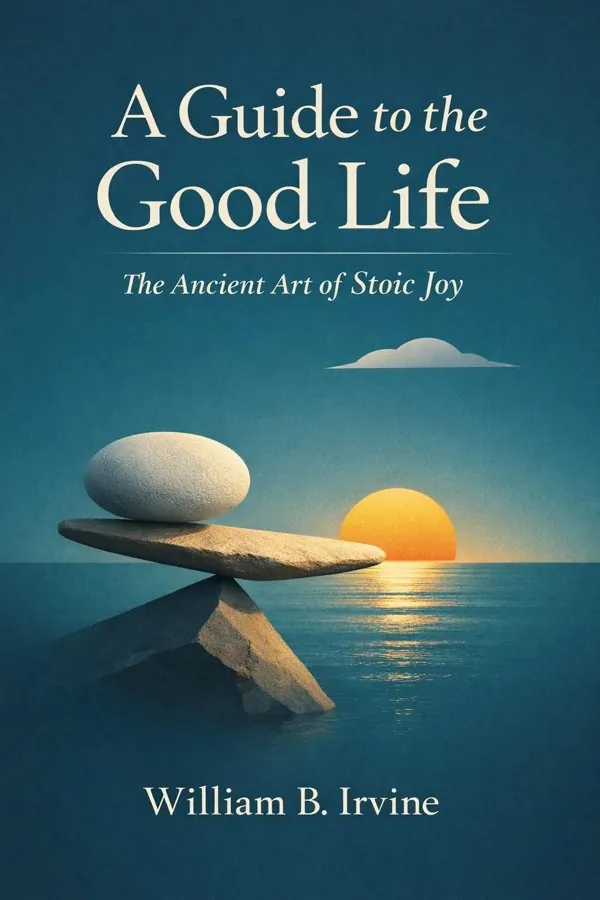
A Guide to the Good Life: The Ancient Art of Stoic Joy
by William B. Irvine
This book introduces readers to Stoic philosophy and shows how its principles can be applied to modern life to achieve tranquility and satisfaction. Irvine explains how ancient Stoic thinkers such as Seneca and Epictetus developed practical techniques for managing desire, handling adversity, and cultivating inner peace. Through accessible examples and exercises, the author demonstrates how Stoicism can help individuals lead a more meaningful and joyful life.
Key Takeaways
- 1The Origins of Stoicism: An Ancient Philosophy for Modern Lives — To understand how Stoicism can serve us today, we must first return to its beginnings. Around 300 BCE, in the aftermath …
- 2The Goal: Tranquility, Not Pleasure — When we think of happiness, we typically imagine satisfaction, excitement, or delight. The Stoics proposed a radical alt…
- 3The Dichotomy of Control: Freedom from the Uncontrollable
 10 min read
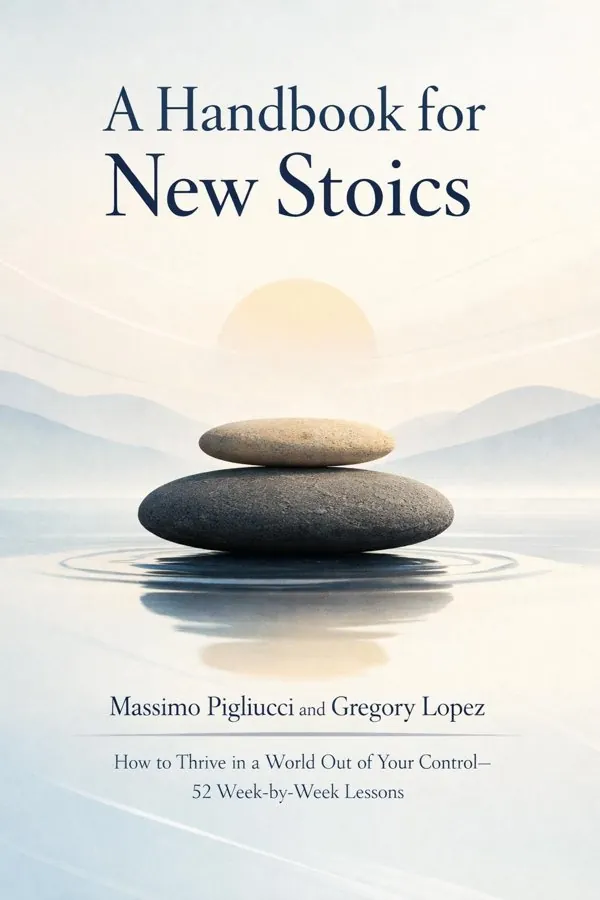
A Handbook for New Stoics: How to Thrive in a World Out of Your Control—52 Week-by-Week Lessons
by Massimo Pigliucci, Gregory Lopez
A Handbook for New Stoics offers a year-long program of weekly exercises designed to help readers apply Stoic philosophy to modern life. Drawing on ancient wisdom from thinkers like Epictetus and Seneca, the authors guide readers through practical reflections and actions to cultivate resilience, mindfulness, and emotional balance in the face of life's challenges.
Key Takeaways
- 1Understanding Control — The first step in practicing Stoicism is learning to distinguish between what is under our control and what is not—a tea…
- 2Perception and Judgment — Once you have established what you can control, the next focus is on how you perceive and judge events. In Stoicism, emo…
- 3Emotions and Rationality
 10 min read
A History of Western Philosophy
by Bertrand Russell
A History of Western Philosophy is Bertrand Russell’s sweeping account of how the West learned to think about reality, knowledge, ethics, politics, and religion. Spanning from the early Greek thinkers to twentieth-century analytic philosophy, the book is far more than a chronological survey of famous names. Russell shows how philosophy emerges from lived history: from the rise of Greek city-states, to the authority of the medieval Church, to the scientific revolution, the Enlightenment, and the modern crisis of certainty. His great gift is to make difficult ideas intelligible without draining them of depth or drama. What makes this book endure is its double perspective. Russell explains what philosophers believed, but he also judges them—sometimes sharply—according to logic, evidence, and human consequences. That combination of narrative, criticism, and wit makes the book both intellectually demanding and surprisingly readable. Russell was one of the twentieth century’s most important philosophers and a founder of analytic philosophy, so he writes not as a distant historian but as a thinker deeply engaged in the questions he describes. The result is a classic work that helps readers understand not only philosophy’s past, but the assumptions shaping modern life.
Key Takeaways
- 1Philosophy Begins When Myth Becomes Inquiry — Civilizations change when they stop asking who controls the world and start asking how it works. Russell begins with the…
- 2Socrates Turned Thought Toward the Good Life — A culture becomes philosophically serious when it asks not only what the world is made of, but what a person ought to be…
- 3Philosophy Changes With Political Upheaval — Ideas do not float above history; they harden, soften, or break under political pressure. One of Russell’s most importan…
 10 min read
A Manual For Living
by Epictetus
A Manual for Living presents the essence of Stoic philosophy through concise aphorisms that guide readers toward happiness, tranquility, and virtue in everyday life. This compact work distills Epictetus’s timeless teachings on self-mastery, rational thought, and acceptance of what cannot be controlled, offering practical wisdom for achieving serenity and moral strength.
Key Takeaways
- 1Distinction Between What Is Within Our Control and What Is Not — Every lesson I impart builds upon this foundation: freedom lies in recognizing what belongs to you and what does not. Yo…
- 2Aligning Desires and Aversions with Reason — If you wish to be free, you must rewrite the script of desire. Want what reason teaches is right; turn away from what re…
- 3Maintaining Tranquility Through Acceptance
 10 min read
A Monk's Guide to Happiness: Meditation in the 21st Century
by Gelong Thubten
A Monk's Guide to Happiness explores how ancient Buddhist meditation practices can help people find lasting happiness in the modern world. Written by Gelong Thubten, a Buddhist monk and meditation teacher, the book offers practical guidance on mindfulness, compassion, and emotional resilience, showing how to cultivate inner peace amid the pressures of contemporary life.
Key Takeaways
- 1Defining Happiness — Happiness, in the world today, is often confused with excitement, pleasure, or comfort. But these are transient. The joy…
- 2The Nature of the Mind — The mind is both our greatest friend and our greatest challenge. It can create heaven or hell depending on how we relate…
- 3The Science of Meditation
 10 min read
A Theory of Justice
by John Rawls
A Theory of Justice es una obra de filosofía política y ética publicada en 1971 por el filósofo estadounidense John Rawls. En ella, Rawls desarrolla la teoría de la justicia como equidad, proponiendo un modelo de sociedad en el que los principios de justicia serían elegidos por individuos racionales en una posición original de igualdad. La obra busca ofrecer una alternativa al utilitarismo y establecer una base moral para las instituciones democráticas.
Key Takeaways
- 1The Original Position — At the core of my argument lies the concept of the Original Position—a hypothetical situation that serves as a moral com…
- 2The Veil of Ignorance — The Veil of Ignorance is the instrument that ensures the purity of choice within the Original Position. It is the mechan…
- 3Two Principles of Justice
 10 min read
A Thousand Plateaus: Capitalism and Schizophrenia
by Gilles Deleuze, Félix Guattari
A Thousand Plateaus is one of the most challenging and influential works of twentieth-century philosophy. Written by Gilles Deleuze and Félix Guattari as the second volume of Capitalism and Schizophrenia, it refuses the idea that thought must move in a straight line toward a final system. Instead, it presents philosophy as a field of connections, movements, intensities, and experiments. Across its “plateaus,” the book explores concepts such as the rhizome, multiplicity, the body without organs, deterritorialization, becoming, and the war machine, all aimed at helping readers think beyond rigid structures of identity, authority, and representation. Why does it matter? Because Deleuze and Guattari offer not just theories, but a new style of thinking for politics, culture, psychology, art, and everyday life. They challenge hierarchical models of knowledge and expose how institutions organize desire, behavior, and social order. Deleuze, a major philosopher of difference and creativity, and Guattari, a psychoanalyst and political activist, combine philosophical rigor with radical experimentation. The result is a book that remains essential for readers seeking fresh ways to understand power, subjectivity, and change in a complex world.
Key Takeaways
- 1Rhizome Instead of the Tree — What if knowledge does not grow from a single root, but spreads through unpredictable connections? That is the startling…
- 2Multiplicity Beyond Individual Identity — We are less like isolated individuals than like moving bundles of relations. In “One or Several Wolves?” Deleuze and Gua…
- 3Strata, Layers, and Geology of Morals — Reality is not fixed substance but layered organization. In “The Geology of Morals,” Deleuze and Guattari describe the w…
 10 min read
A Treatise of Human Nature
by David Hume
A Treatise of Human Nature is a philosophical work by Scottish thinker David Hume, first published in 1739–1740. It seeks to establish a comprehensive science of human nature based on empirical observation and reasoning. Hume explores the foundations of human understanding, emotions, and morality, arguing that all knowledge derives from sensory experience and that reason is subordinate to passion. The work profoundly influenced later philosophy, psychology, and cognitive science.
Key Takeaways
- 1Book I – Of the Understanding — To understand human nature, we must begin by examining how we come to know anything at all. All human knowledge arises f…
- 2Book II – Of the Passions — Having examined understanding, I now turn to the passions—the movements of the soul that give life its color and drive. …
- 3Book III – Of Morals
 10 min read
A Vindication of the Rights of Woman: With Strictures on Political and Moral Subjects
by Mary Wollstonecraft
A Vindication of the Rights of Woman is a seminal feminist essay written by Mary Wollstonecraft in 1792. In this work, Wollstonecraft argues that women should receive a rational education and enjoy the same fundamental rights as men. She criticizes social norms that perpetuate female subordination and advocates for intellectual and moral equality between the sexes. The text is considered a cornerstone of feminist thought and Enlightenment philosophy.
Key Takeaways
- 1Critique of False Refinement — In my observations of society, I have seen that what passes for elegance and refinement often masks a corruption of mora…
- 2Education and Reason — If there is one fountain from which all the miseries of women flow, it is miseducation. Society has so long mistaken the…
- 3Virtue and Independence
 10 min read
After Virtue: A Study in Moral Theory
by Alasdair MacIntyre
What happens when a society keeps using moral words like “justice,” “rights,” and “duty,” but no longer shares the worldview that once gave those words meaning? In After Virtue, Alasdair MacIntyre argues that this is the defining condition of modern moral life. We still debate ethics passionately, but our arguments often go nowhere because they rest on broken fragments of older traditions rather than a living, coherent moral framework. The result is confusion, relativism, and a culture in which moral claims are often reduced to preference, power, or emotional reaction. MacIntyre’s book matters because it does more than criticize modern ethics. It traces how we arrived here, especially through the collapse of the Enlightenment project to justify morality on purely rational, universal grounds. In its place, he revives an Aristotelian vision centered on virtue, human flourishing, shared practices, and moral communities. MacIntyre writes with unusual authority as one of the most influential moral philosophers of the twentieth century, combining historical depth, philosophical precision, and a penetrating diagnosis of modernity. After Virtue is essential reading for anyone trying to understand why moral disagreement feels so intractable—and what a better ethical life might require.
Key Takeaways
- 1Emotivism and the collapse of moral language — A striking feature of modern moral debate is that people argue intensely while lacking any shared standard for settling …
- 2Managerial morality in an emotivist age — When moral language loses objective grounding, power rarely disappears; it simply changes its costume. MacIntyre argues …
- 3Aristotle, Thomism, and moral coherence — Ethics becomes clearer when human life is understood as directed toward a purpose. MacIntyre turns to pre-Enlightenment …
 10 min read
An Enquiry Concerning Human Understanding
by David Hume
An Enquiry Concerning Human Understanding is David Hume’s brilliant investigation into how the human mind forms beliefs, reaches conclusions, and mistakes habit for certainty. First published in 1748, the book asks deceptively simple questions: Where do our ideas come from? Why do we believe the future will resemble the past? What justifies belief in causes, miracles, or even a stable external world? Hume’s answers reshaped philosophy by showing that much of what we call knowledge rests not on logical proof, but on experience, custom, and psychological expectation. This work matters because it challenges intellectual overconfidence. Hume does not merely criticize bad arguments; he reveals the limits of reason itself. In doing so, he helped define modern empiricism, skepticism, cognitive science, and scientific thinking. His writing remains strikingly relevant in an age of misinformation, ideological certainty, and statistical prediction. Hume was uniquely qualified to make this argument: a central figure of the Scottish Enlightenment, he combined philosophical rigor with psychological insight and literary clarity. This Enquiry is both a classic of Western philosophy and a timeless guide to thinking more carefully about what we really know.
Key Takeaways
- 1All Ideas Begin in Experience — The mind feels vast and inventive, yet Hume’s first claim is disarmingly simple: our thoughts never arise from nowhere. …
- 2The Mind Connects Ideas by Habit — Thought rarely moves at random. One memory calls up another, one image suggests the next, and one event makes us anticip…
- 3Reason Cannot Justify Induction — One of Hume’s most famous insights begins with an ordinary assumption: because the sun has risen every day before, it wi…
 10 min read
An Enquiry Concerning the Principles of Morals
by David Hume
An Enquiry Concerning the Principles of Morals is a philosophical work by David Hume, first published in 1751. It explores the foundations of moral judgment, arguing that morality is rooted in human sentiment rather than divine command or rational deduction. Hume distinguishes between natural and artificial virtues, emphasizing benevolence and social utility as central to moral evaluation. The text is considered one of the most refined expressions of Hume’s moral philosophy and a cornerstone of Enlightenment ethics.
Key Takeaways
- 1Section I – General Remarks — Before diving into the specific virtues, I found it essential to distinguish two methods of moral philosophy. One is the…
- 2Section II – Of Benevolence — Among all the sentiments that move humanity, benevolence stands out as the most universally esteemed. Wherever there are…
- 3Section III – Of Justice
Want the full summary?
Get instant access to this book summary and 100K+ more with Fizz Moment.
Get Free SummaryAvailable on App Store • Free to download
About This List
Stoicism is having a renaissance — and for good reason. These books teach you how to find calm in chaos, focus on what you can control, and live with purpose.
This list features 15 carefully selected books. With FizzRead, you can read AI-powered summaries of each book in just 15 minutes. Get the key takeaways and start applying the insights immediately.
Ready to start reading?
Get instant access to all 15 book summaries and 100K+ more with FizzRead.