
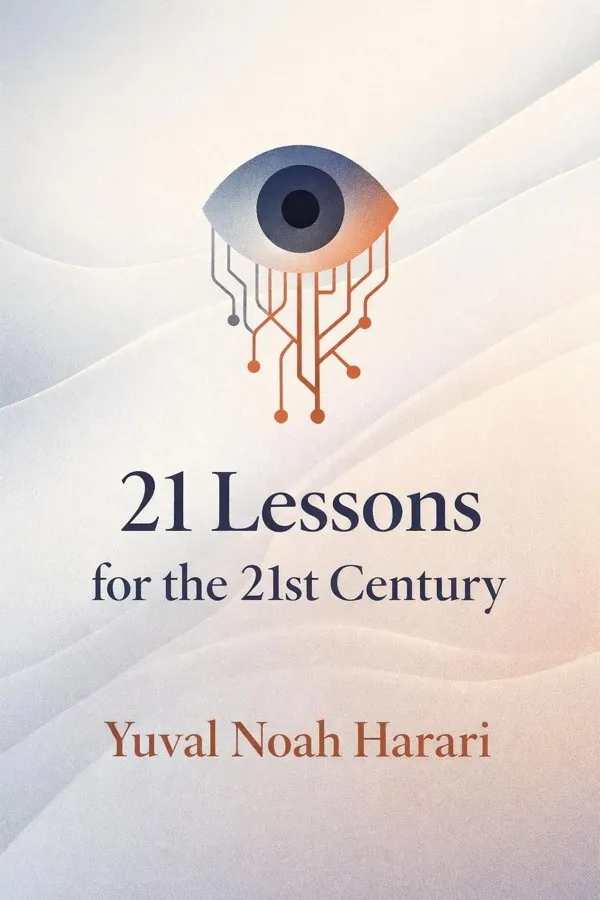
21 Lessons for the 21st Century: Summary & Key Insights
 10 min7 chaptersAudio available
What Is 21 Lessons for the 21st Century About?
21 Lessons for the 21st Century by Yuval Noah Harari is a philosophy book published in 2018 spanning 7 pages. In this thought-provoking collection of essays, Yuval Noah Harari explores the most pressing issues facing humanity in the 21st century, including technology, politics, religion, and the future of work. Drawing on history, philosophy, and science, Harari examines how rapid technological change and global interconnectedness challenge our understanding of truth, freedom, and meaning.
This FizzRead summary covers all 7 key chapters of 21 Lessons for the 21st Century in approximately 10 minutes, distilling the most important ideas, arguments, and takeaways from Yuval Noah Harari's work. Also available as an audio summary and Key Quotes Podcast.
21 Lessons for the 21st Century
In this thought-provoking collection of essays, Yuval Noah Harari explores the most pressing issues facing humanity in the 21st century, including technology, politics, religion, and the future of work. Drawing on history, philosophy, and science, Harari examines how rapid technological change and global interconnectedness challenge our understanding of truth, freedom, and meaning.
Who Should Read 21 Lessons for the 21st Century?
This book is perfect for anyone interested in philosophy and looking to gain actionable insights in a short read. Whether you're a student, professional, or lifelong learner, the key ideas from 21 Lessons for the 21st Century by Yuval Noah Harari will help you think differently.
- ✓Readers who enjoy philosophy and want practical takeaways
- ✓Professionals looking to apply new ideas to their work and life
- ✓Anyone who wants the core insights of 21 Lessons for the 21st Century in just 10 minutes
Want the full summary?
Get instant access to this book summary and 100K+ more with Fizz Moment.
Get Free SummaryAvailable on App Store • Free to download
Key Chapters
When historians reflect on our era, they may describe it as the age when intelligence decoupled from consciousness. Artificial intelligence has already surpassed human capability in specific tasks—from playing Go to managing investment portfolios—and yet it does so without awareness, intention, or emotion. This distinction matters because until recently, intelligence meant something uniquely human. For millennia, we used intelligence to exploit other animals and shape the environment; now we have created entities that may outstrip us in this very domain.
Automation threatens not only traditional factory labor but also professions we once considered immune—doctors, lawyers, even artists. As algorithms learn from massive data sets, they begin to predict patterns with such efficiency that human judgment feels antiquated. The question is not whether machines will replace humans, but how we will redefine human value in a world governed by algorithmic competence.
Economically, this could lead to the rise of a 'useless class'—millions of people whose skills no longer have market relevance. Politically, it may render old social contracts meaningless. Our sense of worth has long been tied to work, productivity, and contribution; but what happens when intelligence no longer requires consciousness to produce value? The challenge is to rethink education, welfare, and even identity to accommodate a reality where humans may play supporting roles to non-human decision-makers. My message is not to fear technology, but to question how we direct it. Algorithms are not destiny; they are tools, and the moral question is who controls them and for what purpose.
The political world we inherited was built for the industrial age, not for the digital one. The twentieth century taught us to think in terms of nation-states and ideologies—liberalism, socialism, nationalism. But in an era defined by the flow of data, viruses, and carbon dioxide, borders lose much of their meaning. Problems like climate change and cyberwarfare are inherently global, yet our political imagination remains painfully local.
Nationalist movements are resurgent not because globalization has failed, but because it has succeeded too well in destabilizing traditional identities. People crave belonging, and when they feel rudderless, they retreat into the familiar symbols of flag and tribe. However, no nation can solve global warming alone; no border can stop malware; no leader can isolate their citizens from the consequences of global algorithms. The collapse of shared truth also erodes democracy: when discourse is driven by viral emotions instead of verified facts, public reason deteriorates into noise.
Liberal democracy, once our most successful political technology, now faces pressure from both internal exhaustion and external manipulation. Authoritarian systems may seem efficient in handling complexity, but they do so by sacrificing freedom for control. The solution lies not in nostalgia but in reinvention. We must rethink governance as a form of global coordination, not merely national assertion, while preserving the dignity of individuals amidst the machinery of interdependence.
+ 5 more chapters — available in the FizzRead app
All Chapters in 21 Lessons for the 21st Century
About the Author
Yuval Noah Harari is an Israeli historian and professor at the Hebrew University of Jerusalem. He is best known for his international bestsellers 'Sapiens: A Brief History of Humankind' and 'Homo Deus: A Brief History of Tomorrow'. His works explore the intersection of history, science, and philosophy, focusing on the evolution and future of human societies.
Get This Summary in Your Preferred Format
Read or listen to the 21 Lessons for the 21st Century summary by Yuval Noah Harari anytime, anywhere. FizzRead offers multiple formats so you can learn on your terms — all free.
Available formats: App · Audio · PDF · EPUB — All included free with FizzRead
Download 21 Lessons for the 21st Century PDF and EPUB Summary
Key Quotes from 21 Lessons for the 21st Century
“When historians reflect on our era, they may describe it as the age when intelligence decoupled from consciousness.”
“The political world we inherited was built for the industrial age, not for the digital one.”
Frequently Asked Questions about 21 Lessons for the 21st Century
21 Lessons for the 21st Century by Yuval Noah Harari is a philosophy book that explores key ideas across 7 chapters. In this thought-provoking collection of essays, Yuval Noah Harari explores the most pressing issues facing humanity in the 21st century, including technology, politics, religion, and the future of work. Drawing on history, philosophy, and science, Harari examines how rapid technological change and global interconnectedness challenge our understanding of truth, freedom, and meaning.
More by Yuval Noah Harari
You Might Also Like



Featured In
Browse by Category
Ready to read 21 Lessons for the 21st Century?
Get the full summary and 100K+ more books with Fizz Moment.