
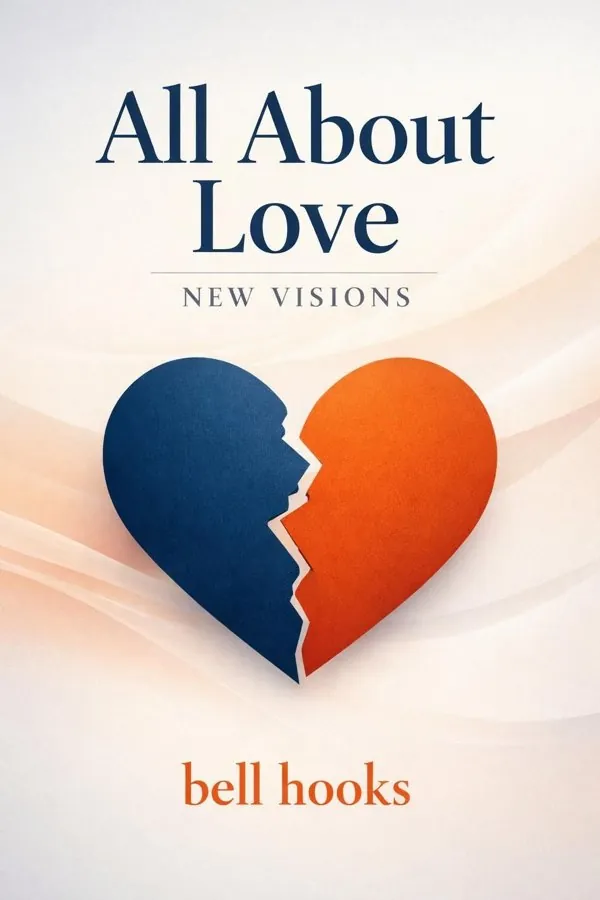
All About Love: Summary & Key Insights
by bell hooks
 10 min9 chaptersAudio available
Key Takeaways from All About Love
Most adults do not enter relationships as blank slates; they carry a childhood education in love that often goes unquestioned.
A relationship can survive disappointment more easily than deception, because love cannot grow where truth is consistently avoided.
Many people seek love as if another person can supply the worth they do not feel inside, but hooks argues that this often turns relationships into rescue fantasies.
When love is reduced to chemistry or personal preference, it loses its depth; hooks restores that depth by framing love as a spiritual practice.
One of hooks’s boldest claims is that many failures of love are not just personal but political.
What Is All About Love About?
All About Love by bell hooks is a philosophy book published in 2000 spanning 9 pages. In All About Love, bell hooks takes a word that is used constantly and asks a disarming question: what do we actually mean by it? Her answer is both philosophical and practical. Love, she argues, is not a feeling we fall into, a reward we passively receive, or a private romance detached from the world. It is an ethical practice built from care, commitment, trust, responsibility, respect, and honest knowledge. From that starting point, hooks examines why so many people hunger for love yet struggle to give or receive it well. What makes this book so powerful is the way hooks connects personal pain to social structures. She shows how patriarchy, childhood emotional neglect, consumer culture, and fear of vulnerability distort our understanding of love. Drawing on memoir, social criticism, feminist thought, and spiritual reflection, she offers a language for healing relationships without ignoring power or injustice. hooks writes with unusual authority because she combines intellectual rigor with emotional clarity, making this book both a critique of modern culture and a guide to living differently. All About Love remains essential for anyone seeking healthier relationships, stronger communities, and a more humane vision of freedom.
This FizzRead summary covers all 9 key chapters of All About Love in approximately 10 minutes, distilling the most important ideas, arguments, and takeaways from bell hooks's work. Also available as an audio summary and Key Quotes Podcast.
All About Love
In All About Love, bell hooks takes a word that is used constantly and asks a disarming question: what do we actually mean by it? Her answer is both philosophical and practical. Love, she argues, is not a feeling we fall into, a reward we passively receive, or a private romance detached from the world. It is an ethical practice built from care, commitment, trust, responsibility, respect, and honest knowledge. From that starting point, hooks examines why so many people hunger for love yet struggle to give or receive it well.
What makes this book so powerful is the way hooks connects personal pain to social structures. She shows how patriarchy, childhood emotional neglect, consumer culture, and fear of vulnerability distort our understanding of love. Drawing on memoir, social criticism, feminist thought, and spiritual reflection, she offers a language for healing relationships without ignoring power or injustice. hooks writes with unusual authority because she combines intellectual rigor with emotional clarity, making this book both a critique of modern culture and a guide to living differently. All About Love remains essential for anyone seeking healthier relationships, stronger communities, and a more humane vision of freedom.
Who Should Read All About Love?
This book is perfect for anyone interested in philosophy and looking to gain actionable insights in a short read. Whether you're a student, professional, or lifelong learner, the key ideas from All About Love by bell hooks will help you think differently.
- ✓Readers who enjoy philosophy and want practical takeaways
- ✓Professionals looking to apply new ideas to their work and life
- ✓Anyone who wants the core insights of All About Love in just 10 minutes
Want the full summary?
Get instant access to this book summary and 100K+ more with Fizz Moment.
Get Free SummaryAvailable on App Store • Free to download
Key Chapters
Most adults do not enter relationships as blank slates; they carry a childhood education in love that often goes unquestioned. bell hooks begins here because the family is usually the first place we learn what care, power, safety, and intimacy mean. If a child grows up in a home where punishment is called love, silence replaces tenderness, or obedience matters more than truth, that child may come to associate love with fear, control, or emotional uncertainty. Later in life, these patterns can feel normal even when they are harmful.
hooks argues that many families sincerely claim to love their children while failing to practice love as a disciplined ethic. A parent may provide food and shelter yet offer little emotional presence. Another may say, "I do this because I love you," while humiliating or dominating the child. These contradictions teach children that love and abuse can coexist, which makes it harder for them to recognize manipulation in adult relationships.
This insight has practical consequences. It helps explain why some people chase approval, avoid vulnerability, or feel uncomfortable with kindness. It also reframes healing: instead of blaming ourselves for relational struggles, we can examine the original scripts we inherited. Reflection, therapy, journaling, and honest conversations about family patterns can all interrupt these learned distortions.
Actionable takeaway: Write down three messages about love you absorbed in childhood, then ask whether each one leads to trust and freedom or to fear and control.
A relationship can survive disappointment more easily than deception, because love cannot grow where truth is consistently avoided. hooks insists that honesty is not a minor virtue added to love; it is one of the conditions that makes love possible. In a culture that rewards image management, politeness, and emotional concealment, many people learn to lie not only to others but also to themselves. They say they are fine when they are resentful, promise commitment when they are uncertain, or avoid difficult conversations to preserve comfort.
For hooks, this refusal of truth erodes intimacy. If partners, friends, or family members cannot name what they feel, need, fear, or believe, they create a false closeness built on performance. Communication, then, is not merely about speaking more often. It is about developing the courage to tell the truth with care and the humility to hear truths that may unsettle us.
In practice, this means replacing vague, defensive habits with specific, accountable language. Instead of silent withdrawal, one might say, "I felt hurt when that happened, and I need to understand it better." Instead of pretending certainty, one might admit confusion. Honest communication also includes listening without instantly punishing vulnerability.
This idea matters beyond romance. Workplaces, friendships, and communities also decay when people perform connection but avoid truth. hooks asks us to see honesty as a discipline that protects dignity rather than threatening it.
Actionable takeaway: In your next important conversation, state one truth you have been avoiding and pair it with one genuine question for the other person.
Many people seek love as if another person can supply the worth they do not feel inside, but hooks argues that this often turns relationships into rescue fantasies. Love flourishes when we have some capacity to value ourselves, because self-acceptance reduces the desperation, denial, and dependency that can distort intimacy. Without it, we may tolerate mistreatment, shape-shift for approval, or demand constant reassurance from others.
hooks does not present self-love as vanity or self-absorption. She treats it as an honest and often difficult practice of recognizing one’s inherent value while also taking responsibility for one’s growth. To love oneself is to refuse self-contempt, but it is also to reject habits that undermine one’s own well-being. That means setting boundaries, honoring rest, choosing truthful relationships, and refusing to define oneself solely through others’ desires.
A practical example is the difference between companionship and emotional outsourcing. A person grounded in self-acceptance can enjoy closeness without asking a partner to erase every insecurity. They can receive criticism without collapsing and can leave a relationship that repeatedly dishonors them. Likewise, parenting and friendship improve when people are not constantly searching for others to fill an inner void.
Self-acceptance is not achieved once and for all. It grows through reflection, compassionate self-examination, spiritual practice, and communities that affirm our humanity. hooks suggests that mature love begins when we stop confusing self-erasure with devotion.
Actionable takeaway: Choose one daily behavior that reflects self-respect, such as setting a boundary, speaking kindly to yourself, or ending a draining interaction.
When love is reduced to chemistry or personal preference, it loses its depth; hooks restores that depth by framing love as a spiritual practice. She does not mean spirituality in a narrow or dogmatic sense. Rather, she points to a way of living oriented toward connection, transcendence, compassion, and reverence for life. In this view, love asks us to move beyond ego, possession, and immediate gratification toward a deeper recognition of our interdependence.
This spiritual dimension matters because modern life often fragments people. Consumer culture encourages us to seek fulfillment through accumulation, status, or fantasy. A spiritual understanding of love resists that fragmentation. It reminds us that love is not just about what we feel in private moments but about how we inhabit the world: how we forgive, how we remain present, how we serve, and how we cultivate hope.
hooks draws attention to practices that nourish this orientation, such as prayer, meditation, contemplation, and meaningful rituals of care. Even simple acts can take on spiritual weight when done intentionally: listening without interruption, sharing a meal with gratitude, or choosing mercy over retaliation. Love becomes a discipline that shapes character.
This perspective also helps in times of suffering. When relationships end or trust is broken, a spiritual framework can keep us from collapsing into cynicism. It invites us to continue believing that love is real, even when particular experiences have been painful.
Actionable takeaway: Build a small daily ritual that reconnects love with presence, such as five minutes of silence, gratitude, or intentional attention to someone you care about.
One of hooks’s boldest claims is that many failures of love are not just personal but political. Patriarchy trains people, especially men, to equate strength with domination, emotional restraint, and control. Under those conditions, vulnerability is treated as weakness, tenderness as softness, and emotional honesty as risk. The result is not power but relational impoverishment: people become less able to know themselves and less able to love others well.
hooks is careful not to reduce individuals to stereotypes, but she shows how gender socialization shapes emotional life. Women may be taught to overgive, endure mistreatment, or define themselves through service. Men may be taught to suppress feeling, fear dependency, and seek authority rather than mutuality. Both are harmed. Love requires openness, accountability, and care, yet patriarchy often rewards the opposite.
In everyday life, this can appear in familiar patterns: a father who provides financially but cannot express affection, a husband who mistakes control for protection, or a woman who believes sacrifice without reciprocity is proof of devotion. hooks invites readers to see these not as isolated quirks but as outcomes of a wider culture.
Her solution is not blame but transformation. People must unlearn the scripts that make genuine love difficult. That means teaching boys emotional literacy, encouraging girls to value themselves beyond pleasing others, and building relationships based on shared dignity rather than hierarchy.
Actionable takeaway: Notice one gendered belief you absorbed about love, such as "real strength means not needing anyone," and consciously replace it with a more loving principle.
If love requires mutual recognition and respect, then any movement that challenges domination also expands the possibility of love. hooks presents feminism not as hostility toward men or family life, but as a liberating framework that rejects exploitation and insists on equality. In that sense, feminism is deeply relevant to love because love cannot thrive where one person is expected to obey, disappear, or carry the emotional burdens of everyone else.
This idea is especially important because many people imagine politics and intimacy as separate spheres. hooks refuses that separation. A home shaped by sexism, for example, cannot simply be made loving through good intentions. If one partner has more authority, more freedom, and fewer emotional responsibilities, then the relationship rests on imbalance. Feminism helps expose those inequalities and offers tools for creating more reciprocal bonds.
Practical applications are straightforward but transformative: partners can divide labor fairly, discuss money transparently, respect each other’s ambitions, and reject assumptions that caregiving belongs naturally to women. Parents can raise children without rigid gender expectations. Communities can value care work instead of treating it as invisible.
hooks also argues that feminism benefits men by freeing them from the emotional deadening demanded by patriarchal masculinity. Equality is not a threat to love; it is one of its prerequisites. Where domination ends, honesty and mutual growth become more possible.
Actionable takeaway: Examine one relationship for hidden imbalances in labor, authority, or emotional responsibility, and start a conversation about making it more equitable.
Modern culture often treats romantic partnership as the highest or only meaningful form of love, but hooks pushes against this narrow focus. A life centered only on coupledom can become isolated, fragile, and overly burdened. Love must also be practiced in friendships, neighborhoods, families, and collective life. Community love broadens the horizon of care, reminding us that human flourishing depends on networks of trust and belonging, not just one intimate bond.
hooks sees individualism as a major obstacle here. When people are taught to think primarily in terms of personal success and private fulfillment, they may neglect the practices that sustain communal well-being. Yet loneliness, alienation, and social mistrust increase when people stop investing in one another. A loving community is built through ordinary acts: checking on a neighbor, mentoring younger people, participating in shared rituals, offering help without immediate reward, and taking responsibility for the social environment we create together.
This insight is especially relevant in times of crisis. Illness, grief, unemployment, and social upheaval reveal how much we need support beyond the romantic pair. Community love also strengthens accountability. It gives people more than one place to belong and more than one voice to rely on.
In practical terms, hooks invites readers to ask where they are building durable ties. Love becomes less abstract when it is enacted in repeated, local forms of care.
Actionable takeaway: Strengthen one non-romantic bond this week by offering concrete support, initiating a meaningful conversation, or joining a community space where care can be practiced.
To love deeply is to become vulnerable to loss, and hooks does not avoid this difficult truth. She explores how grief exposes the seriousness of love: when someone dies, leaves, betrays us, or changes beyond recognition, we confront how attached, open, and dependent we have allowed ourselves to be. In a culture that often wants quick recovery and emotional efficiency, grief can feel inconvenient or embarrassing. hooks instead treats it as part of love’s reality.
What matters is how we respond. Unprocessed grief can harden into cynicism, numbness, or fear of future intimacy. People who have been hurt may decide that detachment is safer than devotion. But hooks warns that refusing love to avoid pain ultimately shrinks life. The goal is not to eliminate sorrow; it is to mourn honestly without abandoning the belief that love remains worthwhile.
Practically, this means making space for remembrance, ritual, tears, and storytelling rather than rushing to "move on." It also means understanding that endings do not erase meaning. A relationship may end and still have contained real care, growth, and beauty. Grief can deepen us if it leads to greater tenderness instead of defensive closure.
This perspective is useful not only after death or breakup, but after any rupture: estrangement, disappointment, or changed identity. hooks suggests that mature love includes the courage to feel loss fully.
Actionable takeaway: If you are carrying unresolved grief, name one specific loss and create one gentle practice of acknowledgment, such as writing a letter, sharing a memory, or marking an anniversary.
Perhaps the book’s central insight is that love is best understood as a verb rather than a feeling. hooks draws from M. Scott Peck’s definition of love as the will to nurture one’s own or another’s spiritual growth, then expands it into a fuller ethic involving care, affection, recognition, respect, commitment, trust, and honest communication. This definition matters because feelings are unstable. We can feel desire without care, attachment without respect, or passion without responsibility. If we confuse those states with love, we excuse behavior that is selfish or harmful.
Treating love as a practice changes the standard by which relationships are judged. Instead of asking only, "Do I feel intensely?" we ask, "Are we acting in ways that foster growth and dignity?" A parent who listens, protects, and tells the truth is practicing love. A friend who shows up consistently in hard times is practicing love. A partner who takes responsibility for harm and works to change is practicing love. By contrast, jealousy, possessiveness, cruelty, and manipulation cannot be rebranded as love simply because they are intense.
This framework is practical because it gives people observable criteria. Love can be measured in patterns of behavior, not just declarations. It also returns agency to us: if love is a practice, then it can be learned, strengthened, and renewed.
Actionable takeaway: Choose one relationship and evaluate it according to hooks’s core elements of love: care, commitment, trust, responsibility, respect, and honest communication.
All Chapters in All About Love
About the Author
bell hooks, born Gloria Jean Watkins in 1952, was an American author, feminist theorist, educator, and cultural critic whose work transformed discussions of race, gender, class, education, and intimacy. She wrote more than thirty books, including Ain’t I a Woman?, Feminism Is for Everybody, Teaching to Transgress, and All About Love. Using the pen name bell hooks, taken from her maternal great-grandmother, she emphasized ideas over personal celebrity. Her writing combined sharp social analysis with emotional honesty and accessibility, allowing her to reach both academic and general readers. hooks consistently challenged systems of domination while advocating for community, self-recovery, and love as a force for personal and political transformation. She died in 2021, leaving a profound intellectual and moral legacy.
Get This Summary in Your Preferred Format
Read or listen to the All About Love summary by bell hooks anytime, anywhere. FizzRead offers multiple formats so you can learn on your terms — all free.
Available formats: App · Audio · PDF · EPUB — All included free with FizzRead
Download All About Love PDF and EPUB Summary
Key Quotes from All About Love
“Most adults do not enter relationships as blank slates; they carry a childhood education in love that often goes unquestioned.”
“A relationship can survive disappointment more easily than deception, because love cannot grow where truth is consistently avoided.”
“Many people seek love as if another person can supply the worth they do not feel inside, but hooks argues that this often turns relationships into rescue fantasies.”
“When love is reduced to chemistry or personal preference, it loses its depth; hooks restores that depth by framing love as a spiritual practice.”
“One of hooks’s boldest claims is that many failures of love are not just personal but political.”
Frequently Asked Questions about All About Love
All About Love by bell hooks is a philosophy book that explores key ideas across 9 chapters. In All About Love, bell hooks takes a word that is used constantly and asks a disarming question: what do we actually mean by it? Her answer is both philosophical and practical. Love, she argues, is not a feeling we fall into, a reward we passively receive, or a private romance detached from the world. It is an ethical practice built from care, commitment, trust, responsibility, respect, and honest knowledge. From that starting point, hooks examines why so many people hunger for love yet struggle to give or receive it well. What makes this book so powerful is the way hooks connects personal pain to social structures. She shows how patriarchy, childhood emotional neglect, consumer culture, and fear of vulnerability distort our understanding of love. Drawing on memoir, social criticism, feminist thought, and spiritual reflection, she offers a language for healing relationships without ignoring power or injustice. hooks writes with unusual authority because she combines intellectual rigor with emotional clarity, making this book both a critique of modern culture and a guide to living differently. All About Love remains essential for anyone seeking healthier relationships, stronger communities, and a more humane vision of freedom.
More by bell hooks

You Might Also Like



Featured In
Browse by Category
Ready to read All About Love?
Get the full summary and 100K+ more books with Fizz Moment.