
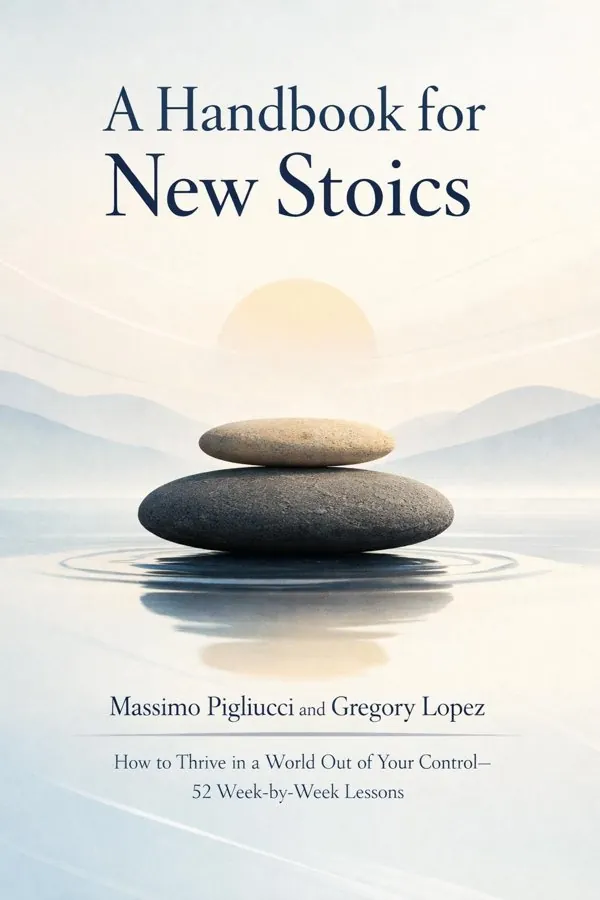
A Handbook for New Stoics: How to Thrive in a World Out of Your Control—52 Week-by-Week Lessons: Summary & Key Insights
by Massimo Pigliucci, Gregory Lopez
 10 min12 chaptersAudio available
What Is A Handbook for New Stoics: How to Thrive in a World Out of Your Control—52 Week-by-Week Lessons About?
A Handbook for New Stoics: How to Thrive in a World Out of Your Control—52 Week-by-Week Lessons by Massimo Pigliucci, Gregory Lopez is a eastern_wisdom book spanning 12 pages. A Handbook for New Stoics offers a year-long program of weekly exercises designed to help readers apply Stoic philosophy to modern life. Drawing on ancient wisdom from thinkers like Epictetus and Seneca, the authors guide readers through practical reflections and actions to cultivate resilience, mindfulness, and emotional balance in the face of life's challenges.
This FizzRead summary covers all 12 key chapters of A Handbook for New Stoics: How to Thrive in a World Out of Your Control—52 Week-by-Week Lessons in approximately 10 minutes, distilling the most important ideas, arguments, and takeaways from Massimo Pigliucci, Gregory Lopez's work. Also available as an audio summary and Key Quotes Podcast.
A Handbook for New Stoics: How to Thrive in a World Out of Your Control—52 Week-by-Week Lessons
A Handbook for New Stoics offers a year-long program of weekly exercises designed to help readers apply Stoic philosophy to modern life. Drawing on ancient wisdom from thinkers like Epictetus and Seneca, the authors guide readers through practical reflections and actions to cultivate resilience, mindfulness, and emotional balance in the face of life's challenges.
Who Should Read A Handbook for New Stoics: How to Thrive in a World Out of Your Control—52 Week-by-Week Lessons?
This book is perfect for anyone interested in eastern_wisdom and looking to gain actionable insights in a short read. Whether you're a student, professional, or lifelong learner, the key ideas from A Handbook for New Stoics: How to Thrive in a World Out of Your Control—52 Week-by-Week Lessons by Massimo Pigliucci, Gregory Lopez will help you think differently.
- ✓Readers who enjoy eastern_wisdom and want practical takeaways
- ✓Professionals looking to apply new ideas to their work and life
- ✓Anyone who wants the core insights of A Handbook for New Stoics: How to Thrive in a World Out of Your Control—52 Week-by-Week Lessons in just 10 minutes
Want the full summary?
Get instant access to this book summary and 100K+ more with Fizz Moment.
Get Free SummaryAvailable on App Store • Free to download
Key Chapters
The first step in practicing Stoicism is learning to distinguish between what is under our control and what is not—a teaching that originates from Epictetus, who said that some things are up to us, and others are not. This may sound simple, but it is the most radical and freeing idea in all of Stoic philosophy.
In modern life, we often act as though our happiness depends on external forces—on jobs, relationships, or outcomes. Yet, when we internalize the dichotomy of control, we begin to see that none of those things truly belongs to us. What belongs to us are our judgments, intentions, and actions. Everything else—our reputation, wealth, health, even how others treat us—is ultimately subject to chance.
Throughout the book’s first set of exercises, we invite you to pause each day and ask: “Is this within my control?” This question alone can dismantle anxiety. When you learn to draw clear boundaries around what you can and cannot influence, you start to reclaim energy and focus. You stop trying to manage the uncontrollable and instead commit to what is genuinely yours—your character, your reason, and your effort.
We illustrate this through modern examples. Imagine waiting for a crucial email response—you cannot control when or how the sender replies, but you can control your mindset while waiting. You can channel your attention toward preparing alternate plans or practicing patience. This shift turns helpless waiting into active living.
Epictetus urged his students not to wish for events to unfold as they desire, but to desire events to unfold as they do. In practice, this means accepting reality without resistance while still exercising the power to act rightly within it. Once you grasp this, even small disruptions—like traffic delays or unexpected criticism—become opportunities for virtue rather than excuses for frustration. The dichotomy of control becomes the cornerstone of serenity and empowerment.
Once you have established what you can control, the next focus is on how you perceive and judge events. In Stoicism, emotions do not arise directly from the world—they arise from our interpretations of the world. When we say something 'made us angry,' we overlook the truth that anger emerges from how we judge that situation.
We guide you through exercises inspired by Epictetus and Marcus Aurelius to examine those judgments in real time. When something disturbs you, pause and ask: “What judgment am I making here?” This practice uncovers hidden assumptions—beliefs about fairness, importance, and permanence. Through rational reflection, you can revise them. Marcus frequently reminded himself: 'You are not disturbed by things, but by your opinions about things.'
Take a simple example: you miss an appointment. You can judge this as a disaster or as a minor inconvenience. The event itself is neutral; your perception makes it positive or negative. By adjusting judgment through reasoned reflection, you reclaim emotional balance.
Stoicism does not ask you to suppress emotion; it asks you to understand it. When emotions are guided by rational appraisal, they become signals rather than tyrants. You learn to turn irritation into curiosity, disappointment into resilience, fear into preparation. Week by week, you practice perceiving with clarity, until circumstances that once seemed overwhelming begin to feel manageable.
The power of perception is thus a moral power—it determines the quality of your inner life. By mastering judgment, you become your own philosopher in the everyday world, able to transform the ordinary into a lesson in wisdom.
+ 10 more chapters — available in the FizzRead app
All Chapters in A Handbook for New Stoics: How to Thrive in a World Out of Your Control—52 Week-by-Week Lessons
About the Authors
Massimo Pigliucci is a professor of philosophy at the City College of New York and a leading scholar on Stoicism. Gregory Lopez is the founder of the New York City Stoics Meetup and co-founder of The Stoic Fellowship, dedicated to promoting Stoic practice worldwide.
Get This Summary in Your Preferred Format
Read or listen to the A Handbook for New Stoics: How to Thrive in a World Out of Your Control—52 Week-by-Week Lessons summary by Massimo Pigliucci, Gregory Lopez anytime, anywhere. FizzRead offers multiple formats so you can learn on your terms — all free.
Available formats: App · Audio · PDF · EPUB — All included free with FizzRead
Download A Handbook for New Stoics: How to Thrive in a World Out of Your Control—52 Week-by-Week Lessons PDF and EPUB Summary
Key Quotes from A Handbook for New Stoics: How to Thrive in a World Out of Your Control—52 Week-by-Week Lessons
“This may sound simple, but it is the most radical and freeing idea in all of Stoic philosophy.”
“Once you have established what you can control, the next focus is on how you perceive and judge events.”
Frequently Asked Questions about A Handbook for New Stoics: How to Thrive in a World Out of Your Control—52 Week-by-Week Lessons
A Handbook for New Stoics: How to Thrive in a World Out of Your Control—52 Week-by-Week Lessons by Massimo Pigliucci, Gregory Lopez is a eastern_wisdom book that explores key ideas across 12 chapters. A Handbook for New Stoics offers a year-long program of weekly exercises designed to help readers apply Stoic philosophy to modern life. Drawing on ancient wisdom from thinkers like Epictetus and Seneca, the authors guide readers through practical reflections and actions to cultivate resilience, mindfulness, and emotional balance in the face of life's challenges.
You Might Also Like
A New Earth
Eckhart Tolle
10 min
The Daily Stoic
Ryan Holiday, Stephen Hanselman
10 min
Buddhism: Plain and Simple
Steve Hagen
10 min
Enchiridion
Epictetus
10 min
The Book of Tea
Kakuzō Okakura
10 min
The Light We Give: How Sikh Wisdom Can Transform Your Life
Simran Jeet Singh
10 minFeatured In
Browse by Category
Ready to read A Handbook for New Stoics: How to Thrive in a World Out of Your Control—52 Week-by-Week Lessons?
Get the full summary and 100K+ more books with Fizz Moment.