
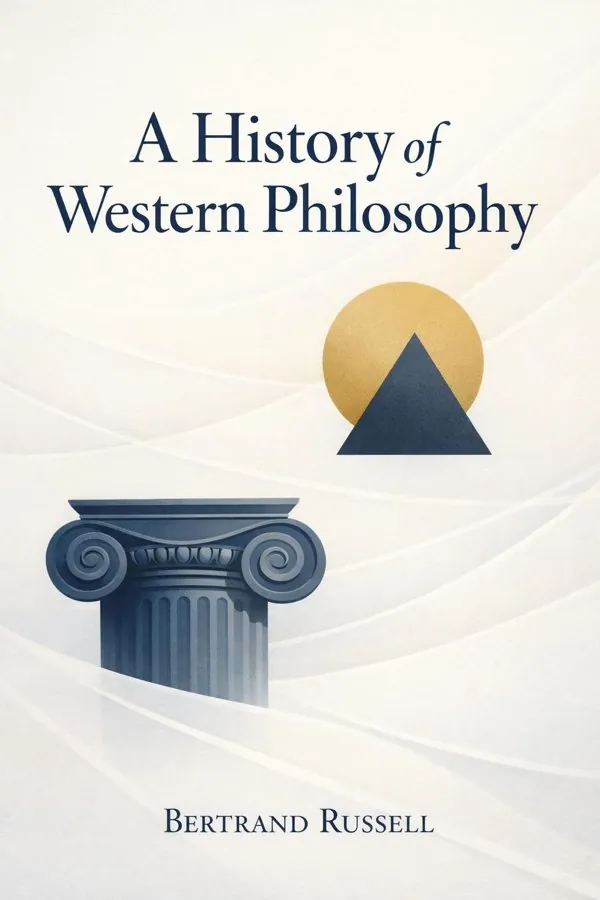
A History of Western Philosophy: Summary & Key Insights
 10 min9 chaptersAudio available
Key Takeaways from A History of Western Philosophy
Civilizations change when they stop asking who controls the world and start asking how it works.
A culture becomes philosophically serious when it asks not only what the world is made of, but what a person ought to become.
Ideas do not float above history; they harden, soften, or break under political pressure.
When a new spiritual authority organizes society, philosophy must renegotiate its place.
A new picture of nature forces a new picture of knowledge.
What Is A History of Western Philosophy About?
A History of Western Philosophy by Bertrand Russell is a western_phil book spanning 11 pages. A History of Western Philosophy is Bertrand Russell’s sweeping account of how the West learned to think about reality, knowledge, ethics, politics, and religion. Spanning from the early Greek thinkers to twentieth-century analytic philosophy, the book is far more than a chronological survey of famous names. Russell shows how philosophy emerges from lived history: from the rise of Greek city-states, to the authority of the medieval Church, to the scientific revolution, the Enlightenment, and the modern crisis of certainty. His great gift is to make difficult ideas intelligible without draining them of depth or drama. What makes this book endure is its double perspective. Russell explains what philosophers believed, but he also judges them—sometimes sharply—according to logic, evidence, and human consequences. That combination of narrative, criticism, and wit makes the book both intellectually demanding and surprisingly readable. Russell was one of the twentieth century’s most important philosophers and a founder of analytic philosophy, so he writes not as a distant historian but as a thinker deeply engaged in the questions he describes. The result is a classic work that helps readers understand not only philosophy’s past, but the assumptions shaping modern life.
This FizzRead summary covers all 9 key chapters of A History of Western Philosophy in approximately 10 minutes, distilling the most important ideas, arguments, and takeaways from Bertrand Russell's work. Also available as an audio summary and Key Quotes Podcast.
A History of Western Philosophy
A History of Western Philosophy is Bertrand Russell’s sweeping account of how the West learned to think about reality, knowledge, ethics, politics, and religion. Spanning from the early Greek thinkers to twentieth-century analytic philosophy, the book is far more than a chronological survey of famous names. Russell shows how philosophy emerges from lived history: from the rise of Greek city-states, to the authority of the medieval Church, to the scientific revolution, the Enlightenment, and the modern crisis of certainty. His great gift is to make difficult ideas intelligible without draining them of depth or drama.
What makes this book endure is its double perspective. Russell explains what philosophers believed, but he also judges them—sometimes sharply—according to logic, evidence, and human consequences. That combination of narrative, criticism, and wit makes the book both intellectually demanding and surprisingly readable. Russell was one of the twentieth century’s most important philosophers and a founder of analytic philosophy, so he writes not as a distant historian but as a thinker deeply engaged in the questions he describes. The result is a classic work that helps readers understand not only philosophy’s past, but the assumptions shaping modern life.
Who Should Read A History of Western Philosophy?
This book is perfect for anyone interested in western_phil and looking to gain actionable insights in a short read. Whether you're a student, professional, or lifelong learner, the key ideas from A History of Western Philosophy by Bertrand Russell will help you think differently.
- ✓Readers who enjoy western_phil and want practical takeaways
- ✓Professionals looking to apply new ideas to their work and life
- ✓Anyone who wants the core insights of A History of Western Philosophy in just 10 minutes
Want the full summary?
Get instant access to this book summary and 100K+ more with Fizz Moment.
Get Free SummaryAvailable on App Store • Free to download
Key Chapters
Civilizations change when they stop asking who controls the world and start asking how it works. Russell begins with the Pre-Socratic philosophers because they mark that decisive turn. In Ionia and southern Italy, thinkers such as Thales, Anaximander, Heraclitus, Parmenides, Empedocles, and Democritus tried to explain nature without relying solely on mythic genealogy or divine caprice. Their answers now seem strange—water, fire, atoms, the One—but their importance lies less in being correct than in inventing rational explanation.
Russell shows that the earliest philosophy was inseparable from science. Thales proposed a natural origin of things; Heraclitus emphasized change; Parmenides insisted that reason can contradict appearance; Democritus imagined a universe built from indivisible particles. These were not isolated curiosities. They introduced patterns of thought that still define inquiry today: looking for underlying principles, distrusting first impressions, and testing broad explanations against observed reality.
The practical value of this chapter is easy to miss if we treat it as intellectual archaeology. In modern life, we face similar choices whenever we encounter rumor, ideology, or oversimplified explanations. Do we accept inherited narratives, or do we ask what evidence supports them? A manager investigating why a team is underperforming, a citizen assessing political claims, or a student questioning social assumptions is repeating the Pre-Socratic move from story to analysis.
Russell’s deeper point is that philosophy begins not with answers but with disciplined wonder. The first thinkers did not solve the universe; they made it discussable. Actionable takeaway: when confronted with a puzzling problem, resist easy narratives and ask, “What underlying principle would explain the facts best?”
A culture becomes philosophically serious when it asks not only what the world is made of, but what a person ought to become. With Socrates, and then Plato and Aristotle, philosophy shifts from cosmology to ethics, politics, knowledge, and the structure of human flourishing. Russell treats this trio as foundational because they define many of the questions that later philosophy keeps revisiting.
Socrates, as Russell presents him, embodies the examined life. He challenged complacent certainty by exposing contradictions in accepted beliefs. Courage, justice, piety, virtue—people claimed to understand them, but under questioning their confidence dissolved. Plato transformed Socratic inquiry into a grand metaphysical vision. The visible world, he argued, is unstable and incomplete; genuine knowledge concerns eternal Forms such as justice, beauty, and the good. Aristotle, more empirical and systematic, criticized Plato’s separation of Forms from the world and built an account of logic, causation, ethics, and politics rooted in observation and classification.
Russell admires and resists each of them. He respects Socratic honesty, sees Plato as brilliant but politically dangerous when ideal theory becomes authoritarian, and values Aristotle’s breadth while noting his scientific limitations. Their practical relevance is enormous. Socratic questioning helps in decision-making and conflict resolution; Platonic idealism reminds us to measure institutions against standards higher than convenience; Aristotelian ethics teaches that good character is formed by habit, not sentiment.
In everyday terms, these thinkers ask: Are your beliefs coherent? What kind of life is worth pursuing? What habits make excellence possible? A teacher refining classroom norms, a parent trying to model integrity, or a leader balancing ideals with realities can learn from all three. Actionable takeaway: choose one important belief this week and question it Socratically—define it, test it, and align your habits with your best reasoned conclusion.
Ideas do not float above history; they harden, soften, or break under political pressure. One of Russell’s most important themes is that philosophy reflects the emotional climate of its age. After the decline of the Greek city-state and the rise of vast empires, confidence in civic participation weakened. Hellenistic and Roman philosophy responded by turning inward. Instead of asking how to build the ideal polis, philosophers increasingly asked how the individual can find stability in an unstable world.
Russell explores schools such as Stoicism, Epicureanism, Skepticism, and later Roman adaptations. The Stoics taught self-mastery, rational order, and acceptance of what lies beyond our control. Epicureans sought tranquility through measured pleasure, freedom from fear, and friendship rather than excess. Skeptics suspended judgment, doubting whether certainty is possible. These responses differ, but all reveal a civilization coping with diminished public agency.
Their modern relevance is striking. In periods of economic uncertainty, institutional distrust, or social fragmentation, many people make similar moves: they retreat into personal wellness, emotional discipline, selective detachment, or radical doubt. Russell helps us see these not merely as lifestyle preferences but as philosophical strategies shaped by historical conditions.
The value of this insight is practical as well as historical. If your organization is going through turmoil, you may need Stoic resilience. If anxiety and comparison are ruining your peace, Epicurean simplicity may help more than ambition. If your information environment is flooded with overconfident claims, a dose of Skepticism can protect judgment. Yet Russell also warns that inward philosophies can become passive if detached from justice and collective responsibility.
Actionable takeaway: identify whether your current stress calls for acceptance, simplification, or healthy doubt—and apply the right philosophical tool without abandoning your responsibilities to others.
When a new spiritual authority organizes society, philosophy must renegotiate its place. Russell’s account of Christian philosophy and the Middle Ages shows how Greek reason was not simply replaced by faith, but absorbed, disciplined, and redirected. Thinkers such as Augustine, Boethius, Anselm, Aquinas, and later scholastics attempted to reconcile revelation with rational inquiry. The result was one of the most creative and contested syntheses in Western thought.
Augustine drew on Plato to frame inwardness, sin, grace, and the restless human search for God. Anselm used reason to formulate arguments for divine existence. Aquinas, drawing heavily from Aristotle, built a grand intellectual architecture in which faith and reason support one another while remaining distinct. Russell, writing as a secular philosopher, is often critical of theology when it begins from doctrines fixed in advance. Yet he also recognizes the technical sophistication of medieval logic and the seriousness with which scholastic thinkers pursued coherence.
The larger lesson is that philosophy often works under constraints—religious, political, institutional—and must decide whether to serve authority, reinterpret it, or challenge it. That problem is still with us. In universities, companies, and public discourse, people often reason inside frameworks they did not choose. The question becomes: how honestly can one think when some conclusions are protected from criticism?
This section helps readers understand modern debates about science and religion, moral authority, and the role of tradition. It also invites humility. Even if we reject medieval premises, we can admire the rigor with which they argued from them. Actionable takeaway: examine one belief you regard as unquestionable and ask whether you hold it because it is true, inherited, comforting, or institutionally rewarded.
A new picture of nature forces a new picture of knowledge. Russell treats the Renaissance and the scientific revolution as decisive because they loosened the authority of scholastic systems and made observation, mathematics, and experiment central to understanding reality. Copernicus displaced Earth from the cosmic center, Galileo mathematized motion, and Newton revealed a universe governed by intelligible laws. Philosophy could no longer proceed as though ancient authority settled the structure of the world.
This transition produced excitement and anxiety. If nature operates according to discoverable laws, human reason gains extraordinary power. But if inherited certainties collapse, what becomes of moral and metaphysical order? Russell shows that the rise of modern science encouraged intellectual independence while also raising new doubts about the senses, causality, freedom, and the place of mind in a mechanistic universe.
In practical life, this shift underlies the modern habit of evidence-based thinking. We expect claims about medicine, economics, climate, or education to be tested rather than revered. Yet Russell also helps us see the limits of scientific prestige. A scientific method can clarify what is, but it cannot by itself determine what ought to be valued. Data can tell a city where accidents happen; philosophy must still debate how much freedom, safety, and equity matter in public design.
Readers can apply this insight in any setting where expertise is invoked. Respect evidence, but do not confuse technical knowledge with complete wisdom. A company may optimize productivity while neglecting dignity; a government may quantify outcomes while ignoring justice. Russell’s history makes clear that science transformed philosophy because it changed standards of proof, not because it eliminated the need for reflection. Actionable takeaway: ask of every major claim, “What is the evidence?” and then ask the equally important second question, “What values guide how we use that evidence?”
The modern age did not simply celebrate reason; it split over what reason is allowed to know. Russell’s treatment of the Age of Reason and Enlightenment centers on a powerful tension between rationalists such as Descartes, Spinoza, and Leibniz, and empiricists such as Locke, Berkeley, and Hume. Both camps sought secure knowledge, but they disagreed about its source.
For Descartes, certainty begins in clear and distinct ideas grasped by the thinking self. Spinoza used geometric rigor to build a vast metaphysical system in which God and nature are one substance. Leibniz imagined a universe composed of monads governed by pre-established harmony. In contrast, Locke argued that the mind begins as a blank slate shaped by experience. Berkeley attacked material substance and claimed that to be is to be perceived. Hume drove empiricism to a skeptical conclusion, questioning causation, personal identity, and the rational basis of many beliefs we take for granted.
Russell presents this debate not as a museum piece but as a permanent intellectual fault line. In daily life, we still ask whether trust should be placed in innate principles, abstract models, and logical systems, or in observation, experiment, and lived experience. Policy design, legal interpretation, education, and artificial intelligence all replay this conflict. Should you trust the elegant theory or the messy data? The best answer is often neither alone.
Russell’s own sympathies lean toward clarity, logic, and empirically constrained thought, but he appreciates the ambition of rationalism and the discipline of empiricism. Together they teach that certainty is difficult and that intellectual humility is not weakness but strength. Actionable takeaway: when making an important judgment, test your reasoning from both sides—what follows logically from your assumptions, and what actual experience supports or contradicts them?
Every philosophy of society reveals what it fears most: chaos, tyranny, inequality, or stagnation. Russell’s discussion of political thought—from Hobbes and Locke to Rousseau and beyond—shows that philosophy is never only speculative. It shapes constitutions, rights, revolutions, and the boundaries of authority.
Hobbes, writing under the shadow of civil war, imagined a state of nature so insecure that strong sovereign power seemed necessary for peace. Locke defended natural rights, limited government, and consent, helping lay intellectual foundations for liberal democracy. Rousseau criticized artificial inequality and argued that legitimate political order must express the general will rather than merely protect property or privilege. Russell examines these thinkers critically, showing how each system captures part of political truth while risking distortion when absolutized.
The practical relevance is immediate. Modern democracies still wrestle with Hobbesian security, Lockean liberty, and Rousseauian collective legitimacy. Public health debates, surveillance policy, free speech controversies, taxation, and social welfare all involve different balances between individual rights and common goods. Russell helps readers avoid simplistic slogans by showing that political ideas arise from concrete historical fears and hopes.
He also suggests that abstract political ideals must be judged by human consequences. A theory may sound noble yet enable repression; another may protect liberty while ignoring structural inequality. Philosophical literacy therefore matters for citizenship. It helps us notice what assumptions are hidden in speeches, laws, and institutions.
Whether you are voting, leading a team, or negotiating family rules, the same issue appears in miniature: how do we preserve order without crushing autonomy, and honor freedom without dissolving cooperation? Actionable takeaway: the next time you encounter a political argument, identify what it is prioritizing—security, liberty, equality, or legitimacy—and then ask what human cost that priority may impose.
Some philosophies do not merely explain the world; they attempt to reveal the hidden logic of consciousness and history itself. Russell treats Kant, Hegel, and their critics as towering but dangerous figures in this respect. Kant argued that the mind is not a passive receiver of experience; it actively structures experience through forms and categories. We know phenomena—the world as it appears to us—but not things as they are in themselves. This was a revolutionary attempt to reconcile science with the limits of metaphysical knowledge.
Hegel radicalized the project. For him, reality is historical, rational, and developmental. Contradictions are not failures of thought but engines of progress within Spirit’s unfolding self-understanding. Russell admired Kant’s seriousness but often viewed post-Kantian idealism, especially Hegel’s, with suspicion. He believed it too easily transformed obscurity into profundity and political success into philosophical necessity.
Yet Russell also recognizes why these thinkers mattered. They forced philosophy to confront subjectivity, historical change, and the social conditions of thought. Later critics such as Schopenhauer, Nietzsche, and others rejected optimistic system-building, emphasizing will, conflict, irrationality, and the fragility of values.
This matters today because many modern debates assume one of these positions without naming it. Some people think reality is shaped by interpretive frameworks; others think history has a direction; still others distrust all grand narratives. In organizational life, for instance, a leader may assume resistance is merely a stage in progress, while a critic insists that conflict reflects deeper power struggles rather than rational development.
Russell’s lesson is caution toward sweeping theories that make everything fit. Actionable takeaway: if a worldview claims to explain all history, all conflict, or all human behavior, pause and look for what evidence it excludes, simplifies, or excuses.
As the modern world industrialized, democratized, and fractured, philosophy widened its field. Russell’s later chapters trace how nineteenth- and twentieth-century thinkers responded to capitalism, social change, scientific advance, and the crisis of traditional certainties. Marx interpreted history through class conflict and material conditions, arguing that ideas often mask economic structures. Nietzsche attacked moral complacency and exposed the will to power beneath supposedly universal values. Utilitarians such as Bentham and Mill sought to ground ethics and policy in consequences for happiness and welfare.
Russell then turns toward developments especially close to his own work: modern logic and analytic philosophy. Frege, Peano, and Russell himself tried to bring precision to philosophical problems through formal analysis. Questions that had long been clouded by vague language could now be reframed more clearly. This culminates in a vision of philosophy less as system-building and more as conceptual clarification.
At the same time, other movements—especially pragmatism in figures such as William James and John Dewey—judged ideas by their practical consequences and role in experience. Russell respected the emphasis on usefulness but resisted any tendency to blur the distinction between what works and what is true.
These later chapters are crucial because they explain the intellectual world we still inhabit: suspicion of ideology, focus on language, concern with social power, and interest in what beliefs do in practice. In business, law, activism, and science, these approaches remain alive. Marx prompts us to ask who benefits; Nietzsche asks what values conceal; analytic philosophy asks what exactly we mean; pragmatism asks what difference an idea makes in action.
Actionable takeaway: when evaluating any important claim, run a four-part test—clarify the language, inspect the incentives, examine the values behind it, and ask what practical results follow if people act on it.
All Chapters in A History of Western Philosophy
About the Author
Bertrand Russell (1872–1970) was a British philosopher, logician, mathematician, and public intellectual whose work helped shape modern analytic philosophy. Born into an aristocratic family, he studied at Cambridge and went on to make major contributions to logic, the philosophy of language, epistemology, and the foundations of mathematics. With Alfred North Whitehead, he coauthored Principia Mathematica, one of the most influential works in symbolic logic. Russell was also a prolific essayist and social critic, known for his clear prose, skepticism of dogma, and defense of reason, liberty, and peace. He spoke out on education, religion, war, and nuclear disarmament throughout his life. In 1950, he received the Nobel Prize in Literature for his wide-ranging writings and his commitment to humanitarian ideals and freedom of thought.
Get This Summary in Your Preferred Format
Read or listen to the A History of Western Philosophy summary by Bertrand Russell anytime, anywhere. FizzRead offers multiple formats so you can learn on your terms — all free.
Available formats: App · Audio · PDF · EPUB — All included free with FizzRead
Download A History of Western Philosophy PDF and EPUB Summary
Key Quotes from A History of Western Philosophy
“Civilizations change when they stop asking who controls the world and start asking how it works.”
“A culture becomes philosophically serious when it asks not only what the world is made of, but what a person ought to become.”
“Ideas do not float above history; they harden, soften, or break under political pressure.”
“When a new spiritual authority organizes society, philosophy must renegotiate its place.”
“A new picture of nature forces a new picture of knowledge.”
Frequently Asked Questions about A History of Western Philosophy
A History of Western Philosophy by Bertrand Russell is a western_phil book that explores key ideas across 9 chapters. A History of Western Philosophy is Bertrand Russell’s sweeping account of how the West learned to think about reality, knowledge, ethics, politics, and religion. Spanning from the early Greek thinkers to twentieth-century analytic philosophy, the book is far more than a chronological survey of famous names. Russell shows how philosophy emerges from lived history: from the rise of Greek city-states, to the authority of the medieval Church, to the scientific revolution, the Enlightenment, and the modern crisis of certainty. His great gift is to make difficult ideas intelligible without draining them of depth or drama. What makes this book endure is its double perspective. Russell explains what philosophers believed, but he also judges them—sometimes sharply—according to logic, evidence, and human consequences. That combination of narrative, criticism, and wit makes the book both intellectually demanding and surprisingly readable. Russell was one of the twentieth century’s most important philosophers and a founder of analytic philosophy, so he writes not as a distant historian but as a thinker deeply engaged in the questions he describes. The result is a classic work that helps readers understand not only philosophy’s past, but the assumptions shaping modern life.
More by Bertrand Russell
You Might Also Like
A Little History of Philosophy
Nigel Warburton
10 min
Areopagitica
John Milton
10 min
How To Think Like A Philosopher: Essential Principles For Clear Thinking
Peter Cave
10 min
Language, Truth and Logic
A. J. Ayer
10 min
The Age of Reason
Thomas Paine
10 min
The Essays
Michel De Montaigne
10 minFeatured In
Browse by Category
Ready to read A History of Western Philosophy?
Get the full summary and 100K+ more books with Fizz Moment.