
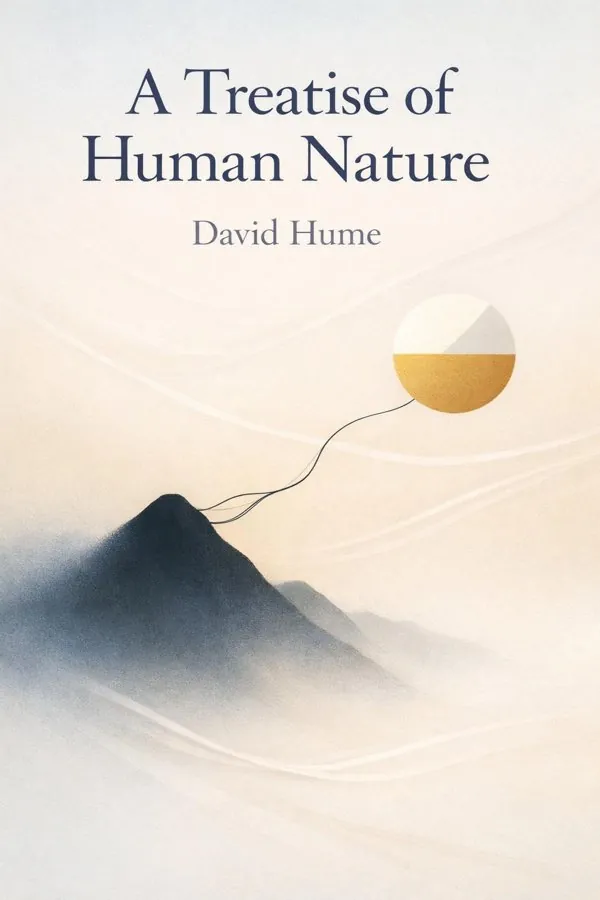
A Treatise of Human Nature: Summary & Key Insights
by David Hume
 10 min3 chaptersAudio available
What Is A Treatise of Human Nature About?
A Treatise of Human Nature by David Hume is a western_phil book spanning 3 pages. A Treatise of Human Nature is a philosophical work by Scottish thinker David Hume, first published in 1739–1740. It seeks to establish a comprehensive science of human nature based on empirical observation and reasoning. Hume explores the foundations of human understanding, emotions, and morality, arguing that all knowledge derives from sensory experience and that reason is subordinate to passion. The work profoundly influenced later philosophy, psychology, and cognitive science.
This FizzRead summary covers all 3 key chapters of A Treatise of Human Nature in approximately 10 minutes, distilling the most important ideas, arguments, and takeaways from David Hume's work. Also available as an audio summary and Key Quotes Podcast.
A Treatise of Human Nature
A Treatise of Human Nature is a philosophical work by Scottish thinker David Hume, first published in 1739–1740. It seeks to establish a comprehensive science of human nature based on empirical observation and reasoning. Hume explores the foundations of human understanding, emotions, and morality, arguing that all knowledge derives from sensory experience and that reason is subordinate to passion. The work profoundly influenced later philosophy, psychology, and cognitive science.
Who Should Read A Treatise of Human Nature?
This book is perfect for anyone interested in western_phil and looking to gain actionable insights in a short read. Whether you're a student, professional, or lifelong learner, the key ideas from A Treatise of Human Nature by David Hume will help you think differently.
- ✓Readers who enjoy western_phil and want practical takeaways
- ✓Professionals looking to apply new ideas to their work and life
- ✓Anyone who wants the core insights of A Treatise of Human Nature in just 10 minutes
Want the full summary?
Get instant access to this book summary and 100K+ more with Fizz Moment.
Get Free SummaryAvailable on App Store • Free to download
Key Chapters
To understand human nature, we must begin by examining how we come to know anything at all. All human knowledge arises from two sources: impressions and ideas. Impressions are the vivid, immediate experiences—what we see, feel, hear, and taste. Ideas are faint copies of these impressions retained in the mind. Every thought we have can be traced to an original sensory impression; there are no innate ideas implanted by divine design. The mind itself is a kind of theater where perceptions succeed one another, creating the illusion of continuity.
In the first part, I dissect the origin of ideas, distinguishing between simple and complex ones. A simple idea is a direct copy of an impression—the color red, the chill of winter air, the sound of music. Complex ideas arise when the mind combines simple ones using three principles of association: resemblance, contiguity in time or place, and cause and effect. These principles are the glue of imagination. When we think of a loved one, we may also imagine the places we shared or anticipate their next action—all connected through those associative links.
I then turn to space and time, insisting that these notions are not innate frames of understanding but constructions of the mind based on repeated sensory sequences. We measure time through succession, and space through the arrangement of visible and tangible objects. This discovery undermines metaphysical doctrines that claim space and time exist independently of perception.
Next, I explore causation, perhaps the most debated subject of modern thought. We never actually perceive a necessary connection between cause and effect; we merely observe events constantly conjoined—one follows another, and habit teaches us to expect repetition. Thus, belief in causality is not a logical deduction but a feeling, a product of custom arising from experience. Through this lens, scientific inference itself becomes an extension of human habit: we expect the sun to rise tomorrow because it has always done so, not because we can grasp the metaphysical link binding yesterday to tomorrow.
Finally, I confront skepticism. Once we admit that all ideas stem from experience and habit, we must also acknowledge the limits of human reason. Can we prove that the world exists independently of our perceptions? Can we sustain a belief in a stable self when experiences are fleeting? The answer is uncertain. We live by faith in continuity, supported by instinct rather than reasoning. Skepticism, far from destroying philosophy, reminds us that reason does not stand alone—it rests upon the natural operations of the human mind, the very instincts we depend on to navigate existence.
Having examined understanding, I now turn to the passions—the movements of the soul that give life its color and drive. For too long, philosophy treated emotions as intrusions upon reason, as disturbances to the pure clarity of thought. I reject that prejudice outright. The passions are central: they guide our will, direct our judgment, and define our humanity. Indeed, reason serves them, not the other way around.
I begin with the study of pride and humility. These arise from our perception of ourselves and the things connected to us. Pride grows when we perceive qualities or possessions tied to ourselves as pleasing; humility when we perceive them as degrading. The connection between self and object—through resemblance, causation, or contiguity—creates the emotional response. A luxurious house can awaken pride because it reflects upon the self’s power or taste; poverty may stir humility, not because it is logically worse, but because its association with the self excites pain.
Next, I examine love and hatred, which are equally dependent on association and sympathy. When we see another’s qualities as agreeable, we feel love; when their traits provoke discomfort, we feel hatred. Sympathy allows us to share in both the joy and the suffering of others, transmitting their passions into our own hearts. This simple mechanism, though humble in description, explains much of human sociability. It is through sympathy that society becomes possible—that we relate, admire, resent, and forgive.
In the third part, I turn to the direct passions—will, desire, aversion, hope, and fear. These arise immediately from pleasure and pain. The will itself is nothing more than the internal impression that leads directly to bodily motion. Hope and fear alternate depending on the uncertainty of fortune, reflecting our mind’s constant oscillation between attraction to happiness and aversion to misery. Through these passions, we become moral agents, moved not by pure reasoning but by emotional impulses grounded in experience.
Ultimately, the passions reveal the natural hierarchy within human nature. Reason instructs us about means, but the ends are set by our desires. This recognition transforms moral philosophy from a cold abstraction into a living study of motivation. To understand virtue, justice, or love, one must first grasp the dynamics of the passions. They are neither irrational forces to be conquered nor divine commands to be obeyed—they are the very machinery of humanity.
+ 1 more chapters — available in the FizzRead app
All Chapters in A Treatise of Human Nature
About the Author
David Hume (1711–1776) was a Scottish philosopher, historian, and essayist known for his influential system of philosophical empiricism, skepticism, and naturalism. His works, including A Treatise of Human Nature and An Enquiry Concerning Human Understanding, shaped modern thought on epistemology, ethics, and the philosophy of mind.
Get This Summary in Your Preferred Format
Read or listen to the A Treatise of Human Nature summary by David Hume anytime, anywhere. FizzRead offers multiple formats so you can learn on your terms — all free.
Available formats: App · Audio · PDF · EPUB — All included free with FizzRead
Download A Treatise of Human Nature PDF and EPUB Summary
Key Quotes from A Treatise of Human Nature
“To understand human nature, we must begin by examining how we come to know anything at all.”
“Having examined understanding, I now turn to the passions—the movements of the soul that give life its color and drive.”
Frequently Asked Questions about A Treatise of Human Nature
A Treatise of Human Nature by David Hume is a western_phil book that explores key ideas across 3 chapters. A Treatise of Human Nature is a philosophical work by Scottish thinker David Hume, first published in 1739–1740. It seeks to establish a comprehensive science of human nature based on empirical observation and reasoning. Hume explores the foundations of human understanding, emotions, and morality, arguing that all knowledge derives from sensory experience and that reason is subordinate to passion. The work profoundly influenced later philosophy, psychology, and cognitive science.
More by David Hume
You Might Also Like
A Little History of Philosophy
Nigel Warburton
10 min
Areopagitica
John Milton
10 min
How To Think Like A Philosopher: Essential Principles For Clear Thinking
Peter Cave
10 min
Language, Truth and Logic
A. J. Ayer
10 min
The Age of Reason
Thomas Paine
10 min
The Essays
Michel De Montaigne
10 minFeatured In
Browse by Category
Ready to read A Treatise of Human Nature?
Get the full summary and 100K+ more books with Fizz Moment.