
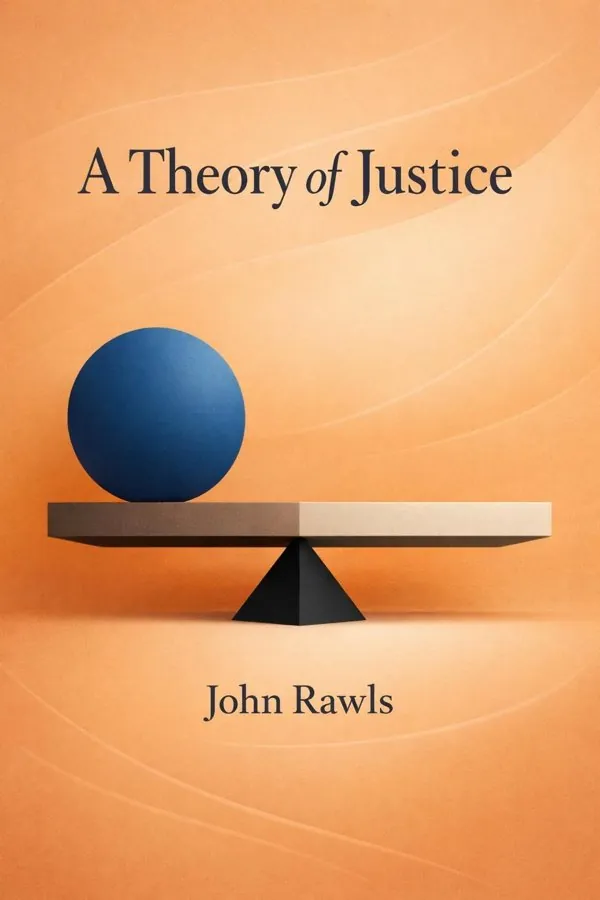
A Theory of Justice: Summary & Key Insights
by John Rawls
 10 min9 chaptersAudio available
What Is A Theory of Justice About?
A Theory of Justice by John Rawls is a western_phil book spanning 9 pages. A Theory of Justice es una obra de filosofía política y ética publicada en 1971 por el filósofo estadounidense John Rawls. En ella, Rawls desarrolla la teoría de la justicia como equidad, proponiendo un modelo de sociedad en el que los principios de justicia serían elegidos por individuos racionales en una posición original de igualdad. La obra busca ofrecer una alternativa al utilitarismo y establecer una base moral para las instituciones democráticas.
This FizzRead summary covers all 9 key chapters of A Theory of Justice in approximately 10 minutes, distilling the most important ideas, arguments, and takeaways from John Rawls's work. Also available as an audio summary and Key Quotes Podcast.
A Theory of Justice
A Theory of Justice es una obra de filosofía política y ética publicada en 1971 por el filósofo estadounidense John Rawls. En ella, Rawls desarrolla la teoría de la justicia como equidad, proponiendo un modelo de sociedad en el que los principios de justicia serían elegidos por individuos racionales en una posición original de igualdad. La obra busca ofrecer una alternativa al utilitarismo y establecer una base moral para las instituciones democráticas.
Who Should Read A Theory of Justice?
This book is perfect for anyone interested in western_phil and looking to gain actionable insights in a short read. Whether you're a student, professional, or lifelong learner, the key ideas from A Theory of Justice by John Rawls will help you think differently.
- ✓Readers who enjoy western_phil and want practical takeaways
- ✓Professionals looking to apply new ideas to their work and life
- ✓Anyone who wants the core insights of A Theory of Justice in just 10 minutes
Want the full summary?
Get instant access to this book summary and 100K+ more with Fizz Moment.
Get Free SummaryAvailable on App Store • Free to download
Key Chapters
At the core of my argument lies the concept of the Original Position—a hypothetical situation that serves as a moral compass for determining just principles. Imagine rational individuals coming together to decide the terms of their social cooperation. They are self-interested enough to care about their own well-being but are rationally constrained to make choices under conditions that rule out bias. In this situation, they know nothing of their social status, wealth, natural talents, or even their conception of the good. This thought experiment is not a historical account but a conceptual device that helps us model fairness.
The Original Position represents equality of moral status: each participant is free and equal, possessing the same rights in the selection process. This setting mirrors the idea of social contract theory—but instead of historical bargaining, it embodies a moral agreement. It asks: what principles would rational persons choose to govern the basic institutions of society if they did not know their position within it? My claim is that under such fair conditions, they would agree on principles that protect liberty and equality because no one would risk being disadvantaged under unjust arrangements.
Through the veil of ignorance, we eliminate arbitrary contingencies from the reasoning process. People would thus adopt a risk-averse stance—preferring principles that safeguard them even if they turned out to be among the least advantaged. The outcome is not utilitarian aggregation but fairness: a social framework that respects every person as an equally entitled moral agent.
The Veil of Ignorance is the instrument that ensures the purity of choice within the Original Position. It is the mechanism that strips individuals of identifying information—class, race, gender, talent, preferences, faith, and social connections—so that they can judge principles solely on universal grounds. The philosophical purpose of this device is to transform moral intuition into rational impartiality.
Through this veil, we step into a space of pure fairness. The idea is that justice should not reflect luck or privilege but the equal moral worth of all persons. This thought experiment reveals how deeply our judgments about justice often derive from bias and circumstance. By imagining ourselves behind the veil, we are compelled to reason from the standpoint of everyone, not just from our own interests. The results, as I argue, naturally converge toward principles that protect basic liberties and structure inequalities only to help those who are worst off.
The Veil of Ignorance thus serves as a moral equalizer, a way to reconstruct the idea of the social contract as something grounded in genuine fairness. It is a philosophical tool that embodies impartiality—the condition under which any principle of justice merits moral legitimacy.
+ 7 more chapters — available in the FizzRead app
All Chapters in A Theory of Justice
About the Author
John Rawls (1921–2002) fue un filósofo estadounidense, profesor en la Universidad de Harvard, y una de las figuras más influyentes en la filosofía política contemporánea. Su trabajo se centra en la justicia, la equidad y la estructura moral de las instituciones políticas. A Theory of Justice es considerada su obra más importante y ha tenido un impacto duradero en la teoría política moderna.
Get This Summary in Your Preferred Format
Read or listen to the A Theory of Justice summary by John Rawls anytime, anywhere. FizzRead offers multiple formats so you can learn on your terms — all free.
Available formats: App · Audio · PDF · EPUB — All included free with FizzRead
Download A Theory of Justice PDF and EPUB Summary
Key Quotes from A Theory of Justice
“At the core of my argument lies the concept of the Original Position—a hypothetical situation that serves as a moral compass for determining just principles.”
“The Veil of Ignorance is the instrument that ensures the purity of choice within the Original Position.”
Frequently Asked Questions about A Theory of Justice
A Theory of Justice by John Rawls is a western_phil book that explores key ideas across 9 chapters. A Theory of Justice es una obra de filosofía política y ética publicada en 1971 por el filósofo estadounidense John Rawls. En ella, Rawls desarrolla la teoría de la justicia como equidad, proponiendo un modelo de sociedad en el que los principios de justicia serían elegidos por individuos racionales en una posición original de igualdad. La obra busca ofrecer una alternativa al utilitarismo y establecer una base moral para las instituciones democráticas.
You Might Also Like
A Little History of Philosophy
Nigel Warburton
10 min
Areopagitica
John Milton
10 min
How To Think Like A Philosopher: Essential Principles For Clear Thinking
Peter Cave
10 min
Language, Truth and Logic
A. J. Ayer
10 min
The Age of Reason
Thomas Paine
10 min
The Essays
Michel De Montaigne
10 minFeatured In
Browse by Category
Ready to read A Theory of Justice?
Get the full summary and 100K+ more books with Fizz Moment.