
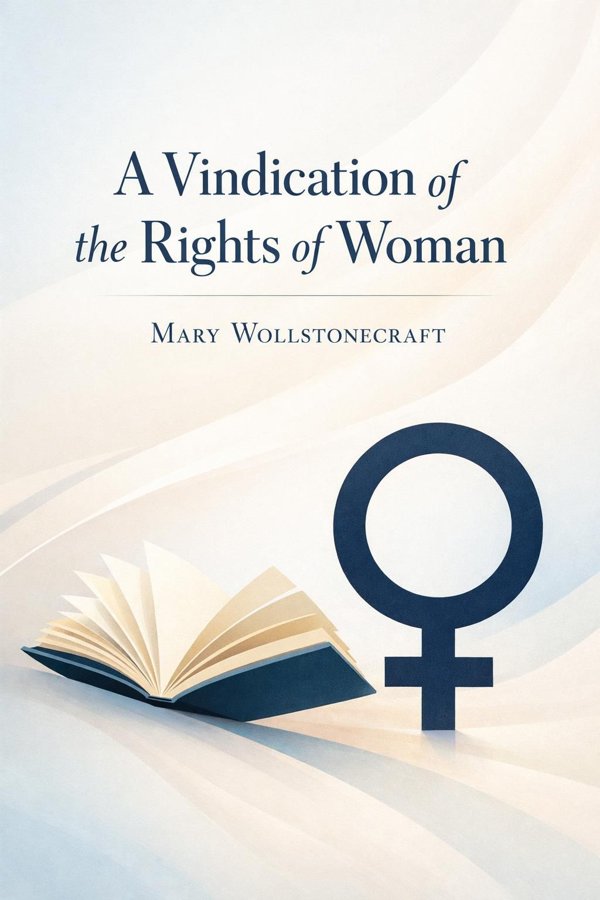
A Vindication of the Rights of Woman: With Strictures on Political and Moral Subjects: Summary & Key Insights
 10 min8 chaptersAudio available
What Is A Vindication of the Rights of Woman: With Strictures on Political and Moral Subjects About?
A Vindication of the Rights of Woman: With Strictures on Political and Moral Subjects by Mary Wollstonecraft is a western_phil book spanning 8 pages. A Vindication of the Rights of Woman is a seminal feminist essay written by Mary Wollstonecraft in 1792. In this work, Wollstonecraft argues that women should receive a rational education and enjoy the same fundamental rights as men. She criticizes social norms that perpetuate female subordination and advocates for intellectual and moral equality between the sexes. The text is considered a cornerstone of feminist thought and Enlightenment philosophy.
This FizzRead summary covers all 8 key chapters of A Vindication of the Rights of Woman: With Strictures on Political and Moral Subjects in approximately 10 minutes, distilling the most important ideas, arguments, and takeaways from Mary Wollstonecraft's work. Also available as an audio summary and Key Quotes Podcast.
A Vindication of the Rights of Woman: With Strictures on Political and Moral Subjects
A Vindication of the Rights of Woman is a seminal feminist essay written by Mary Wollstonecraft in 1792. In this work, Wollstonecraft argues that women should receive a rational education and enjoy the same fundamental rights as men. She criticizes social norms that perpetuate female subordination and advocates for intellectual and moral equality between the sexes. The text is considered a cornerstone of feminist thought and Enlightenment philosophy.
Who Should Read A Vindication of the Rights of Woman: With Strictures on Political and Moral Subjects?
This book is perfect for anyone interested in western_phil and looking to gain actionable insights in a short read. Whether you're a student, professional, or lifelong learner, the key ideas from A Vindication of the Rights of Woman: With Strictures on Political and Moral Subjects by Mary Wollstonecraft will help you think differently.
- ✓Readers who enjoy western_phil and want practical takeaways
- ✓Professionals looking to apply new ideas to their work and life
- ✓Anyone who wants the core insights of A Vindication of the Rights of Woman: With Strictures on Political and Moral Subjects in just 10 minutes
Want the full summary?
Get instant access to this book summary and 100K+ more with Fizz Moment.
Get Free SummaryAvailable on App Store • Free to download
Key Chapters
In my observations of society, I have seen that what passes for elegance and refinement often masks a corruption of morals. Women are trained to please, not to think; to charm rather than to act. Their entire education is structured to produce creatures of delicate nerves and superficial sentiments, as though fragility were the mark of virtue. I call this false refinement—a distortion of nature that breeds both vanity and weakness. The cult of sensibility, which my contemporaries so admire, is in truth an infection that saps moral strength. It teaches women to indulge emotion without the discipline of understanding, to prize beauty above virtue.
True delicacy is not the same as affectation. Virtue demands firmness of principle, not softness of temper. The fashionable woman of my time learns to faint in the presence of moral difficulty; I would rather see her stand erect in reason. This false refinement not only degrades women but corrupts men, who become childish themselves by worshiping idols of weakness. Thus, both sexes are chained by the same delusion—men ruling by caprice, women submitting by habit. Against such corruption, I assert that the only true refinement is that of the mind, where reason and virtue polish the human soul into harmony with moral law.
If there is one fountain from which all the miseries of women flow, it is miseducation. Society has so long mistaken the object of female instruction that it scarcely remembers what education truly means. Girls are taught to decorate themselves, to sing prettily, to paint trifles. But who will teach them to think, to judge, to act? Reason is not a masculine property; it is the divine faculty that distinguishes the human species. Yet women are deprived of its cultivation, confined to fancy rather than understanding.
When people declare that women are naturally inferior, I answer that nature has never been fairly tried. Give them the same opportunities, and they will manifest the same virtues. An education that appeals to reason, not vanity, would produce women of sound judgment and moral courage. They would cease to be the slaves of opinion and become the companions of men in the pursuit of truth. For a society built on rational education will not only elevate women, but purify the manners of men, establishing mutual respect as the foundation of domestic and civic life.
+ 6 more chapters — available in the FizzRead app
All Chapters in A Vindication of the Rights of Woman: With Strictures on Political and Moral Subjects
About the Author
Mary Wollstonecraft (1759–1797) was a British writer, philosopher, and advocate of women's rights. She is best known for her work A Vindication of the Rights of Woman, regarded as one of the earliest foundational texts of modern feminism. Her ideas influenced later generations of social reformers and feminists.
Get This Summary in Your Preferred Format
Read or listen to the A Vindication of the Rights of Woman: With Strictures on Political and Moral Subjects summary by Mary Wollstonecraft anytime, anywhere. FizzRead offers multiple formats so you can learn on your terms — all free.
Available formats: App · Audio · PDF · EPUB — All included free with FizzRead
Download A Vindication of the Rights of Woman: With Strictures on Political and Moral Subjects PDF and EPUB Summary
Key Quotes from A Vindication of the Rights of Woman: With Strictures on Political and Moral Subjects
“In my observations of society, I have seen that what passes for elegance and refinement often masks a corruption of morals.”
“If there is one fountain from which all the miseries of women flow, it is miseducation.”
Frequently Asked Questions about A Vindication of the Rights of Woman: With Strictures on Political and Moral Subjects
A Vindication of the Rights of Woman: With Strictures on Political and Moral Subjects by Mary Wollstonecraft is a western_phil book that explores key ideas across 8 chapters. A Vindication of the Rights of Woman is a seminal feminist essay written by Mary Wollstonecraft in 1792. In this work, Wollstonecraft argues that women should receive a rational education and enjoy the same fundamental rights as men. She criticizes social norms that perpetuate female subordination and advocates for intellectual and moral equality between the sexes. The text is considered a cornerstone of feminist thought and Enlightenment philosophy.
You Might Also Like
A Little History of Philosophy
Nigel Warburton
10 min
Areopagitica
John Milton
10 min
How To Think Like A Philosopher: Essential Principles For Clear Thinking
Peter Cave
10 min
Language, Truth and Logic
A. J. Ayer
10 min
The Age of Reason
Thomas Paine
10 min
The Essays
Michel De Montaigne
10 minFeatured In
Browse by Category
Ready to read A Vindication of the Rights of Woman: With Strictures on Political and Moral Subjects?
Get the full summary and 100K+ more books with Fizz Moment.