
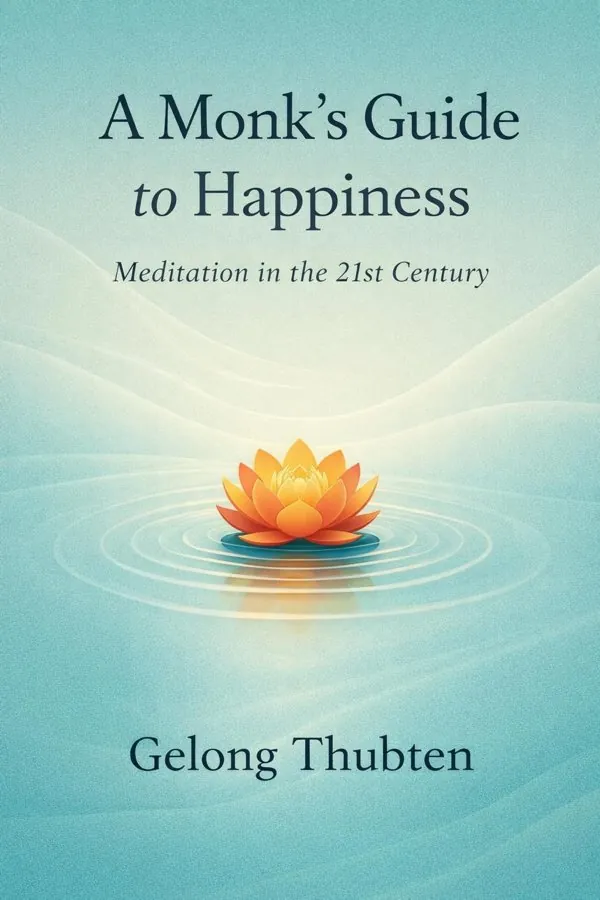
A Monk's Guide to Happiness: Meditation in the 21st Century: Summary & Key Insights
 10 min10 chaptersAudio available
What Is A Monk's Guide to Happiness: Meditation in the 21st Century About?
A Monk's Guide to Happiness: Meditation in the 21st Century by Gelong Thubten is a eastern_wisdom book spanning 10 pages. A Monk's Guide to Happiness explores how ancient Buddhist meditation practices can help people find lasting happiness in the modern world. Written by Gelong Thubten, a Buddhist monk and meditation teacher, the book offers practical guidance on mindfulness, compassion, and emotional resilience, showing how to cultivate inner peace amid the pressures of contemporary life.
This FizzRead summary covers all 10 key chapters of A Monk's Guide to Happiness: Meditation in the 21st Century in approximately 10 minutes, distilling the most important ideas, arguments, and takeaways from Gelong Thubten's work. Also available as an audio summary and Key Quotes Podcast.
A Monk's Guide to Happiness: Meditation in the 21st Century
A Monk's Guide to Happiness explores how ancient Buddhist meditation practices can help people find lasting happiness in the modern world. Written by Gelong Thubten, a Buddhist monk and meditation teacher, the book offers practical guidance on mindfulness, compassion, and emotional resilience, showing how to cultivate inner peace amid the pressures of contemporary life.
Who Should Read A Monk's Guide to Happiness: Meditation in the 21st Century?
This book is perfect for anyone interested in eastern_wisdom and looking to gain actionable insights in a short read. Whether you're a student, professional, or lifelong learner, the key ideas from A Monk's Guide to Happiness: Meditation in the 21st Century by Gelong Thubten will help you think differently.
- ✓Readers who enjoy eastern_wisdom and want practical takeaways
- ✓Professionals looking to apply new ideas to their work and life
- ✓Anyone who wants the core insights of A Monk's Guide to Happiness: Meditation in the 21st Century in just 10 minutes
Want the full summary?
Get instant access to this book summary and 100K+ more with Fizz Moment.
Get Free SummaryAvailable on App Store • Free to download
Key Chapters
Happiness, in the world today, is often confused with excitement, pleasure, or comfort. But these are transient. The joy that comes from an expensive purchase, an achievement, or a compliment fades quickly. We pursue the high again and again, often more desperately. Yet this cycle only tightens the knot of discontent.
When I first began to practice, I too wondered what happiness really meant. The Tibetan masters taught that real happiness is freedom — freedom from the compulsions of craving and aversion. It is not dependent on conditions. Imagine sitting quietly and feeling content for no reason at all. Imagine being at peace even when life is difficult. That is the kind of happiness meditation cultivates.
The modern mistake is to treat happiness as a goal. But every time we chase it, it runs away. The more we crave permanency in a world of change, the more fragile our peace becomes. Genuine happiness does not reject pleasure or success, but it no longer depends upon them. It arises naturally when the mind learns to stay in the present and see everything with clarity and kindness.
True joy, therefore, is not the same as feeling good all the time. It is the deep stability that can walk hand in hand with sadness, pain, or disappointment without being destroyed by them. The core of this book is to help you taste that kind of happiness.
The mind is both our greatest friend and our greatest challenge. It can create heaven or hell depending on how we relate to it. In meditation, we begin to see that our thoughts are like clouds passing across the vast sky of awareness. They come and go, yet the sky itself remains clear and open.
Most of us, however, mistake the clouds for the sky. We identify ourselves with every passing thought — I am angry, I am not good enough, I will never succeed — and in doing so, we imprison ourselves. The practice of mindfulness invites us to step back, to observe the thoughts and emotions as they arise and dissolve without clinging to them.
In this way, we develop what Buddhists call ‘insight’: the ability to see the impermanent and selfless nature of experience. We learn that emotions themselves are not the enemy; it is our resistance to them that causes suffering. When we let feelings flow freely, they naturally transform.
Understanding the mind also requires compassion. We have been conditioning ourselves for years — through habits, fear, and self-doubt — so patience is essential. The mind can be trained, just as the body can be strengthened. Each moment of awareness is a moment of healing, a small return to our natural clarity.
+ 8 more chapters — available in the FizzRead app
All Chapters in A Monk's Guide to Happiness: Meditation in the 21st Century
About the Author
Gelong Thubten is a British Buddhist monk, meditation teacher, and speaker. He was ordained in the Kagyu tradition of Tibetan Buddhism and has taught mindfulness and meditation in universities, corporations, and healthcare institutions worldwide. His work focuses on integrating ancient wisdom with modern living.
Get This Summary in Your Preferred Format
Read or listen to the A Monk's Guide to Happiness: Meditation in the 21st Century summary by Gelong Thubten anytime, anywhere. FizzRead offers multiple formats so you can learn on your terms — all free.
Available formats: App · Audio · PDF · EPUB — All included free with FizzRead
Download A Monk's Guide to Happiness: Meditation in the 21st Century PDF and EPUB Summary
Key Quotes from A Monk's Guide to Happiness: Meditation in the 21st Century
“Happiness, in the world today, is often confused with excitement, pleasure, or comfort.”
“The mind is both our greatest friend and our greatest challenge.”
Frequently Asked Questions about A Monk's Guide to Happiness: Meditation in the 21st Century
A Monk's Guide to Happiness: Meditation in the 21st Century by Gelong Thubten is a eastern_wisdom book that explores key ideas across 10 chapters. A Monk's Guide to Happiness explores how ancient Buddhist meditation practices can help people find lasting happiness in the modern world. Written by Gelong Thubten, a Buddhist monk and meditation teacher, the book offers practical guidance on mindfulness, compassion, and emotional resilience, showing how to cultivate inner peace amid the pressures of contemporary life.
You Might Also Like
A New Earth
Eckhart Tolle
10 min
The Daily Stoic
Ryan Holiday, Stephen Hanselman
10 min
Buddhism: Plain and Simple
Steve Hagen
10 min
Enchiridion
Epictetus
10 min
The Book of Tea
Kakuzō Okakura
10 min
The Light We Give: How Sikh Wisdom Can Transform Your Life
Simran Jeet Singh
10 minFeatured In
Browse by Category
Ready to read A Monk's Guide to Happiness: Meditation in the 21st Century?
Get the full summary and 100K+ more books with Fizz Moment.