
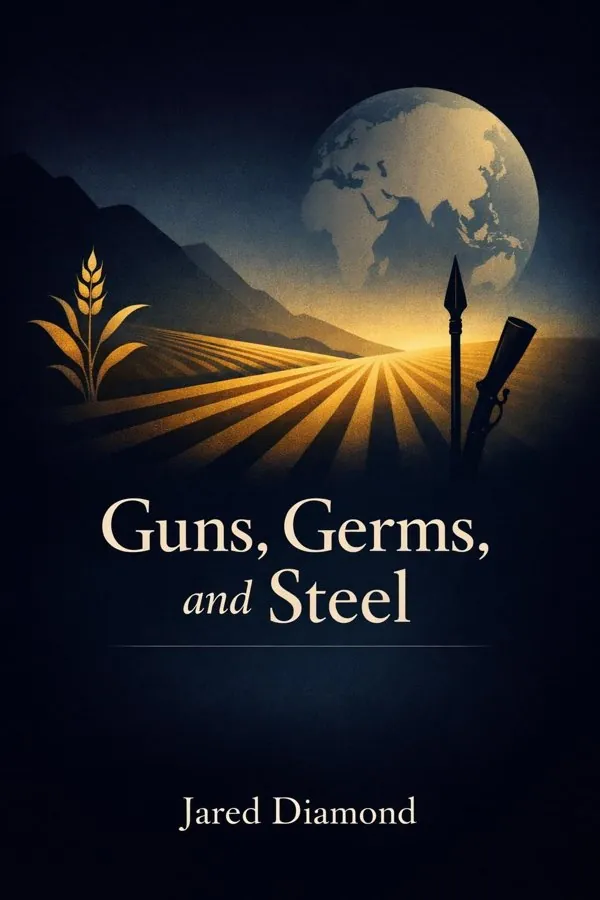
Guns Germs and Steel: Summary & Key Insights
 10 min13 chaptersAudio available
Key Takeaways from Guns Germs and Steel
The book begins with a question that is both personal and world-historical.
The Polynesian islands are one of his clearest examples.
Diamond places human history on a very long timeline.
Why did agriculture appear early in some regions and late or not at all in others?
Geography, in Diamond’s framework, is not just background scenery.
What Is Guns Germs and Steel About?
Guns Germs and Steel by Jared Diamond is a history book published in 1997 spanning 13 pages. Why did some societies develop writing, steel weapons, large empires, and ocean-crossing ships, while others did not? That deceptively simple question sits at the center of Guns, Germs, and Steel, one of the most influential history books of the modern era. In this sweeping work, Jared Diamond challenges the comforting but dangerous idea that global inequality can be explained by differences in intelligence, culture, or race. Instead, he argues that the deepest causes of historical dominance were geographical and ecological: access to domesticable crops and animals, the spread of disease, the shape of continents, and the ability of ideas to travel. What makes this book matter is not just its bold thesis, but its scale. Diamond connects anthropology, geography, biology, and history into one big explanation for how the modern world took shape. He asks readers to zoom out from kings and battles and look instead at seeds, livestock, climate, and migration routes. Diamond, a geographer and historian at UCLA and Pulitzer Prize winner for this book, brings unusual interdisciplinary authority to the subject. The result is a provocative, readable framework for understanding why power accumulated unevenly across the globe—and why that history still matters today.
This FizzRead summary covers all 13 key chapters of Guns Germs and Steel in approximately 10 minutes, distilling the most important ideas, arguments, and takeaways from Jared Diamond's work. Also available as an audio summary and Key Quotes Podcast.
Guns, Germs, and Steel: The Fates of Human Societies
Why did some societies develop writing, steel weapons, large empires, and ocean-crossing ships, while others did not? That deceptively simple question sits at the center of Guns, Germs, and Steel, one of the most influential history books of the modern era. In this sweeping work, Jared Diamond challenges the comforting but dangerous idea that global inequality can be explained by differences in intelligence, culture, or race. Instead, he argues that the deepest causes of historical dominance were geographical and ecological: access to domesticable crops and animals, the spread of disease, the shape of continents, and the ability of ideas to travel.
What makes this book matter is not just its bold thesis, but its scale. Diamond connects anthropology, geography, biology, and history into one big explanation for how the modern world took shape. He asks readers to zoom out from kings and battles and look instead at seeds, livestock, climate, and migration routes. Diamond, a geographer and historian at UCLA and Pulitzer Prize winner for this book, brings unusual interdisciplinary authority to the subject. The result is a provocative, readable framework for understanding why power accumulated unevenly across the globe—and why that history still matters today.
Who Should Read Guns Germs and Steel?
This book is perfect for anyone interested in history and looking to gain actionable insights in a short read. Whether you're a student, professional, or lifelong learner, the key ideas from Guns Germs and Steel by Jared Diamond will help you think differently.
- ✓Readers who enjoy history and want practical takeaways
- ✓Professionals looking to apply new ideas to their work and life
- ✓Anyone who wants the core insights of Guns Germs and Steel in just 10 minutes
Want the full summary?
Get instant access to this book summary and 100K+ more with Fizz Moment.
Get Free SummaryAvailable on App Store • Free to download
Key Chapters
The book begins with a question that is both personal and world-historical. In New Guinea, a local leader named Yali asked Jared Diamond why white people had produced so much “cargo”—technology, manufactured goods, ships, tools, and systems of power—while New Guineans had produced comparatively little of it. Diamond treats this not as a question about individual merit, but as a question about the long-term forces that shape societies. Why did some people end up with guns, steel, and writing, while others did not?
Diamond’s answer is one of the book’s most important contributions: history’s inequalities are not proof of superiority. They are the result of different starting conditions. Some regions had a large number of wild plants suitable for farming, animals that could be domesticated, and climates that supported stable food production. Those advantages created population growth, surplus food, social specialization, political organization, and eventually advanced technology. Other regions, equally rich in human creativity, faced steeper environmental limits.
A useful takeaway here is to question surface-level explanations. When we see unequal outcomes—between nations, regions, or institutions—it is tempting to blame talent or effort alone. Diamond urges us to look deeper at systems, incentives, and inherited conditions. Yali’s question is powerful because it reframes history from moral judgment to structural explanation.
To test his theory, Diamond looks for what he calls “natural experiments of history”—cases where related peoples ended up with very different societies because they lived in different environments. The Polynesian islands are one of his clearest examples. Settled by people with shared ancestry, language roots, and seafaring traditions, these islands varied dramatically in size, climate, soils, and resources. Because the settlers started from a broadly similar cultural base, the differences that later emerged offer strong evidence for the power of environment.
On large, fertile islands with abundant resources, populations grew denser. Food surpluses allowed specialization: some people became chiefs, priests, artisans, or warriors rather than farmers. Hierarchies solidified, warfare became more organized, and complex political systems emerged. On small atolls with limited fresh water and poor soils, populations stayed smaller and societies remained more egalitarian. The contrast suggests that geography can shape not just economics, but social structure and political complexity.
The practical insight is that institutions often grow out of material conditions. A society with reliable surplus can support bureaucracy, administration, and standing armies; one struggling to secure basic resources cannot. Diamond’s method also offers a lesson in critical thinking: compare like with like. Instead of explaining outcomes with stereotypes, look for controlled comparisons that reveal how context changes development.
Diamond places human history on a very long timeline. For most of our species’ existence, humans lived as hunter-gatherers, relying on mobility, local ecological knowledge, and flexible social organization. That way of life was not primitive in any simplistic sense; it was often adaptive, efficient, and deeply sophisticated. But it placed limits on population size, storage, and specialization. The major turning point came when some groups shifted toward food production, which changed almost everything about how societies could grow.
Once people could produce more food than they immediately consumed, they could settle in one place, store grain, raise children more rapidly, and support non-farming specialists. Over time, this led to chiefs, kings, tax systems, armies, temples, and administrators. In other words, the evolution of human societies was not a sudden leap from “simple” to “advanced,” but a gradual accumulation of changes driven by food, density, and organization.
One example is the transition from scattered bands to larger villages and then to states. As population rose, conflict management, leadership, and decision-making became more complex. Diamond’s broader point is that social complexity usually follows material capacity. A modern lesson from this idea is that institutions are easier to build when the basics—food security, infrastructure, and stability—are already in place. Grand political systems rarely emerge in a vacuum; they rest on practical foundations.
Why did agriculture appear early in some regions and late or not at all in others? Diamond argues that the answer lies less in human ingenuity than in what nature made available. Not all wild plants are suitable for domestication. The best early crops had traits such as large edible seeds, high nutritional value, fast growth, and the ability to be stored. Southwest Asia had several such species, including wheat and barley, giving local populations a head start in building agricultural societies.
The same principle applies to animals. Many large mammals cannot be domesticated because they are too aggressive, breed poorly in captivity, grow too slowly, or panic under confinement. Eurasia happened to possess several domesticable large mammals—such as cattle, sheep, goats, pigs, and horses—while many other continents did not. That mattered enormously. Domestic animals supplied meat, milk, labor, transport, fertilizer, hides, and eventually military advantages.
Diamond’s argument highlights the importance of hidden constraints. People in different parts of the world did not all fail or succeed equally at farming because of effort; they inherited different menus of possibility. Actionable insight for readers: when evaluating growth—whether in business, education, or societies—pay attention to available inputs. Outcomes are often shaped by the quality of the starting resources more than by desire alone.
Geography, in Diamond’s framework, is not just background scenery. It is an active force that channels the movement of crops, animals, technologies, and people. One of his most famous arguments concerns continental axes. Eurasia stretches largely east to west, which means many regions share similar day lengths, climates, and seasonal patterns. A crop domesticated in one part of Eurasia could often spread across vast distances without needing major biological adaptation. The same was true, to some degree, for animals and technologies.
By contrast, the Americas and Africa have stronger north-south axes, crossing tropical, temperate, desert, and subarctic zones. As a result, a crop or farming package successful in one area often struggled to spread to another. Mountains, deserts, jungles, and other barriers slowed exchange further. This helps explain why innovations diffused unevenly and why some regions remained relatively isolated.
The broader lesson is that connectivity matters. New ideas flourish when they can circulate. Physical geography influenced ancient diffusion, but the principle still applies today in digital networks, trade systems, and infrastructure planning. Diamond encourages readers to see historical success not only as invention, but as transmission. It is not enough for a society to create something valuable; that value grows when geography—or systems designed to overcome geography—allows it to spread.
Food production transformed demographic reality. Hunter-gatherer societies often maintained lower population densities because mobility limited how much food could be stored and how many children could be supported at once. Farming changed that equation. Settled communities could produce more calories per unit of land, store food for lean periods, and wean children earlier with grain-based diets, allowing birth rates to rise. Larger populations, in turn, created more labor, more innovation, and more military manpower.
Diamond shows that food surplus is never just about nutrition. It enables social complexity. A society with stored grain can support rulers, soldiers, scribes, metalworkers, and priests. These specialists do not directly grow food, but they build states, record knowledge, and develop technologies that increase a society’s power. This creates a compounding effect: more food leads to more people, which leads to more specialization, which often leads to stronger institutions and greater expansion.
There is also a cautionary side. Dense populations can intensify inequality, conflict, and vulnerability to disease. More is not automatically better. The key insight is that population size becomes advantageous when paired with organization. In modern terms, economic growth works similarly: scale creates possibilities, but only systems and institutions convert scale into durable strength.
One of the book’s most striking arguments is that germs were among history’s greatest conquerors. Many of the deadliest infectious diseases—such as smallpox, measles, and influenza—evolved from pathogens associated with domesticated animals. Because Eurasians lived for long periods in close contact with cattle, pigs, chickens, and other livestock, they were repeatedly exposed to diseases that eventually became epidemic human illnesses. Over generations, populations developed partial immunity to many of them.
When Europeans crossed oceans, they brought not just weapons and political ambition, but microbial shock. In the Americas, Indigenous populations had not experienced the same disease pool and therefore lacked resistance. Epidemics tore through communities before battles were even fought, destabilizing empires and reducing populations on a catastrophic scale. This is one reason a relatively small number of conquerors could defeat much larger societies.
Diamond’s point is not that disease alone explains conquest, but that germs amplified every other advantage. The modern takeaway is humbling: invisible biological forces can change history as much as armies can. Public health, surveillance, and resilience matter because disease reshapes economics, politics, and social order. In that sense, the book feels highly contemporary. It reminds us that power is never only military or economic; it is also biological.
Writing did not appear everywhere independently, and where it did arise, it often emerged in societies that already had food surpluses, centralized authority, and administrative needs. Diamond argues that writing is less a magical breakthrough than a byproduct of social complexity. Once states begin collecting taxes, managing labor, recording trade, and preserving laws, the pressure to create record-keeping systems becomes intense. Writing becomes a tool of coordination and memory.
In some parts of the world, writing developed independently; in others, it spread through borrowing and adaptation. Either path mattered because literacy strengthened government, commerce, and cultural continuity. A ruler who can send orders across territory, preserve treaties, and codify rules has a major advantage over one dependent solely on oral transmission. Writing also stores knowledge across generations, allowing science, religion, and institutions to accumulate rather than constantly restart.
For readers today, the deeper principle is that information systems shape power. Ancient writing, printed books, modern databases, and digital networks all perform similar functions: they help societies preserve, scale, and transmit knowledge. Diamond’s insight is that communication technology is rarely isolated from material conditions. It thrives where there is enough social complexity to need it and enough stability to maintain it.
Technology does not emerge in a vacuum, and neither do strong states. Diamond emphasizes that inventions spread fastest in societies with dense populations, surplus food, and frequent exchange. More people mean more potential inventors and more opportunities to refine useful tools. Once a society gains an advantage—metalworking, ocean navigation, gunpowder weapons, or transport animals—it can convert that edge into military and political power, especially if it is governed by centralized institutions.
Political organization matters because large states can mobilize labor, collect taxes, standardize rules, and support armies. A fragmented chiefdom may produce brilliant individuals, but a state can project force at scale. This helps explain why empires often expanded over less centralized societies even when the latter were courageous, intelligent, and locally adapted. Coordination is a power multiplier.
A practical lesson here is that capability comes from systems, not isolated genius. In business, government, or science, tools become transformative when institutions can adopt and distribute them effectively. Diamond also shows that technology is cumulative. Steel depends on earlier metallurgical knowledge; ships depend on craft traditions and materials; armies depend on logistics. The key insight is that societies become powerful when innovation and organization reinforce each other.
Diamond argues that one of history’s underappreciated forces is diffusion: the spread of crops, animals, technologies, beliefs, and institutions from one society to another. Many civilizations did not invent their most important tools independently; they acquired them, adapted them, and improved them. Migration played a similar role, carrying not only people but also languages, agricultural practices, and political forms into new lands.
This matters because it challenges the myth of isolated civilizational genius. A society’s success often depended on how connected it was to larger networks of exchange. Eurasia benefited enormously from this process because innovations could travel across linked regions over centuries. The wheel, metallurgy, writing systems, and domesticated species did not remain confined to one valley or kingdom forever. Over time, diffusion created layered advantages.
Migration could also transform societies rapidly. Incoming populations might bring farming techniques, military knowledge, or disease resistance that altered local balances of power. The broader lesson is that openness to exchange can be historically decisive. Today, we see similar patterns in the movement of ideas, talent, and technology. Diamond’s framework suggests that the winners in history are often not only the best inventors, but also the best borrowers, adapters, and connectors.
Diamond does not argue that Europe rose because Europeans were uniquely superior. Instead, he places Europe within the broader Eurasian advantage: access to domesticable species, centuries of agricultural development, dense populations, epidemic disease exposure, and participation in vast networks of exchange. Europe inherited and built upon many technologies and ideas that circulated across Eurasia rather than inventing everything from scratch.
At the same time, Europe’s internal fragmentation may have created a competitive edge. Multiple states, rival centers of power, and recurring competition could encourage experimentation in exploration, warfare, and administration. If one ruler rejected an innovation, another might support it. In that sense, Europe benefited from a combination of shared Eurasian foundations and political conditions that rewarded expansion.
Diamond’s interpretation helps readers avoid simplistic “Western exceptionalism.” Europe’s rise was real, but it was contingent. It depended on geography, inherited biological advantages, and long-term diffusion as much as on culture or leadership. The takeaway is to be cautious with triumphalist narratives. Historical success often looks inevitable in hindsight, but Diamond shows it was built on accumulated advantages, favorable conditions, and a great deal of contingency.
One of the book’s clearest and most morally important claims is that racial explanations for global inequality are wrong. Diamond rejects the idea that some peoples dominated others because they were inherently smarter, more disciplined, or more advanced by nature. Instead, he argues that all human populations possess broadly similar intellectual potential. What differed were their environments, available resources, disease histories, and opportunities for diffusion.
This matters because bad explanations do more than distort history—they justify prejudice. If inequality is blamed on biology, then conquest and domination can be misread as natural outcomes. Diamond pushes firmly against that conclusion. New Guineans, for example, often displayed remarkable practical intelligence, ecological knowledge, and adaptability in difficult environments. Their relative lack of industrial technology was not evidence of inferiority, but of historical constraints and different developmental pathways.
The modern implication is powerful: when comparing groups, we should avoid confusing outcomes with innate ability. Education, health, infrastructure, historical trauma, geography, and institutions all shape performance. Diamond’s argument remains useful far beyond ancient history because it trains readers to replace stereotypes with structural analysis. That is both better scholarship and better ethics.
By the end of the book, Diamond has built a large-scale explanation for why history unfolded so unevenly across continents. But the final value of the argument lies in what it teaches us about the present. If geography and ecology helped produce long-term inequality, then modern disparities are also embedded in deep historical paths. Colonialism, state capacity, public health systems, infrastructure, and economic specialization did not emerge overnight; they were layered onto earlier advantages and disadvantages.
At the same time, Diamond does not imply that geography is destiny in a rigid sense. Human choices still matter. Societies can build institutions, borrow innovations, and reduce some environmental constraints through science and cooperation. But understanding inherited patterns is essential if we want realistic solutions. You cannot address inequality well if you misunderstand its origins.
For readers, the actionable insight is to think in systems and timescales larger than the news cycle. Whether discussing development, education, or international conflict, ask what long-run material conditions shaped the current landscape. Diamond’s book encourages humility: present success may owe more to inherited context than people like to admit, and present disadvantage may reflect history’s accumulated burdens rather than personal or cultural failure.
All Chapters in Guns Germs and Steel
About the Author
Jared Diamond is an American geographer, historian, and author known for combining insights from multiple disciplines to explain how human societies develop. He is a professor of geography at the University of California, Los Angeles (UCLA), where his work has focused on the environment, history, and long-term patterns in human civilization. Diamond is especially recognized for making large, complex historical questions accessible to general readers. Guns, Germs, and Steel became his best-known work and earned the Pulitzer Prize, further establishing him as a major voice in popular history and interdisciplinary scholarship.
Get This Summary in Your Preferred Format
Read or listen to the Guns Germs and Steel summary by Jared Diamond anytime, anywhere. FizzRead offers multiple formats so you can learn on your terms — all free.
Available formats: App · Audio · PDF · EPUB — All included free with FizzRead
Download Guns Germs and Steel PDF and EPUB Summary
Key Quotes from Guns Germs and Steel
“The book begins with a question that is both personal and world-historical.”
“To test his theory, Diamond looks for what he calls “natural experiments of history”—cases where related peoples ended up with very different societies because they lived in different environments.”
“Diamond places human history on a very long timeline.”
“Why did agriculture appear early in some regions and late or not at all in others?”
“Geography, in Diamond’s framework, is not just background scenery.”
Frequently Asked Questions about Guns Germs and Steel
Guns Germs and Steel by Jared Diamond is a history book that explores key ideas across 13 chapters. Why did some societies develop writing, steel weapons, large empires, and ocean-crossing ships, while others did not? That deceptively simple question sits at the center of Guns, Germs, and Steel, one of the most influential history books of the modern era. In this sweeping work, Jared Diamond challenges the comforting but dangerous idea that global inequality can be explained by differences in intelligence, culture, or race. Instead, he argues that the deepest causes of historical dominance were geographical and ecological: access to domesticable crops and animals, the spread of disease, the shape of continents, and the ability of ideas to travel. What makes this book matter is not just its bold thesis, but its scale. Diamond connects anthropology, geography, biology, and history into one big explanation for how the modern world took shape. He asks readers to zoom out from kings and battles and look instead at seeds, livestock, climate, and migration routes. Diamond, a geographer and historian at UCLA and Pulitzer Prize winner for this book, brings unusual interdisciplinary authority to the subject. The result is a provocative, readable framework for understanding why power accumulated unevenly across the globe—and why that history still matters today.
Compare Guns Germs and Steel

More by Jared Diamond
Collapse: How Societies Choose to Fail or Succeed
Jared Diamond
10 min
The Third Chimpanzee: The Evolution and Future of the Human Animal
Jared Diamond
10 min
Guns, Germs, and Steel: The Fates of Human Societies
Jared Diamond
10 min
Upheaval: Turning Points for Nations in Crisis
Jared Diamond
10 minYou Might Also Like




Featured In
Browse by Category
Ready to read Guns Germs and Steel?
Get the full summary and 100K+ more books with Fizz Moment.