

Guns, Germs, and Steel: The Fates of Human Societies: Summary & Key Insights
 10 min13 chaptersAudio available
What Is Guns, Germs, and Steel: The Fates of Human Societies About?
Guns, Germs, and Steel: The Fates of Human Societies by Jared Diamond is a civilization book spanning 13 pages. This book explores the factors that have shaped the development of human societies across the globe. Jared Diamond argues that environmental and geographical differences, rather than biological distinctions, explain why certain civilizations advanced faster than others. He examines how the availability of domesticable plants and animals, the spread of germs, and technological innovations influenced the course of history.
This FizzRead summary covers all 13 key chapters of Guns, Germs, and Steel: The Fates of Human Societies in approximately 10 minutes, distilling the most important ideas, arguments, and takeaways from Jared Diamond's work. Also available as an audio summary and Key Quotes Podcast.
Guns, Germs, and Steel: The Fates of Human Societies
This book explores the factors that have shaped the development of human societies across the globe. Jared Diamond argues that environmental and geographical differences, rather than biological distinctions, explain why certain civilizations advanced faster than others. He examines how the availability of domesticable plants and animals, the spread of germs, and technological innovations influenced the course of history.
Who Should Read Guns, Germs, and Steel: The Fates of Human Societies?
This book is perfect for anyone interested in civilization and looking to gain actionable insights in a short read. Whether you're a student, professional, or lifelong learner, the key ideas from Guns, Germs, and Steel: The Fates of Human Societies by Jared Diamond will help you think differently.
- ✓Readers who enjoy civilization and want practical takeaways
- ✓Professionals looking to apply new ideas to their work and life
- ✓Anyone who wants the core insights of Guns, Germs, and Steel: The Fates of Human Societies in just 10 minutes
Want the full summary?
Get instant access to this book summary and 100K+ more with Fizz Moment.
Get Free SummaryAvailable on App Store • Free to download
Key Chapters
The story begins in New Guinea, a land still rich in traditional ways of life. Yali, a local leader, asked me directly: why do white people possess so much “cargo”—the goods, technologies, and wealth that travel by sea and land—while his own people have so few manufactured possessions? At first glance, it might sound like a question about wealth or intelligence, but the more I reflected, the more I realized it pointed to history’s structural roots. Why did technological progress cluster in certain regions? Why is power so unevenly distributed across the globe?
This book is my academic response to Yali’s question. I argue that disparities in wealth and power among societies stem not from biological or intellectual superiority, but from environmental conditions that shaped what was possible. Eurasia happened to be geologically “lucky,” endowed with many domesticable plants and animals, a temperate climate well suited to agriculture, and an east–west continental axis that allowed crops, ideas, and technologies to spread efficiently. By contrast, New Guinea’s rugged terrain and tropical climate limited its agricultural potential—even though its people are no less intelligent or creative.
Thus, Yali’s question launched a scientific quest not for moral judgment but for explanation. The divisions among civilizations were not fate or merit; they were the result of nature and geography setting humanity on very different courses.
To answer Yali’s question, I looked for what I called “natural experiments of history”—cases in which similar peoples evolved different societies due to environmental circumstances. The Polynesian islands offered one of the clearest examples. Descendants of the same seafaring ancestors settled on islands of varying size and resources, developing societies from egalitarian hunting and gathering groups to complex, stratified kingdoms.
Within only a few centuries, related peoples evolved contrasting political and economic systems determined largely by geography. Resource-rich islands supported larger populations, social hierarchies, and warfare; those with scarce resources sustained cooperative yet simple livelihoods. In these islands we can trace how environment shaped the fabric of society even before politics or technology took form.
This insight reinforced my conviction that the roots of global inequality lie not in differences among peoples, but in the properties of the land itself—the soil, climate, and natural wealth that gave rise to diverging paths of development.
+ 11 more chapters — available in the FizzRead app
All Chapters in Guns, Germs, and Steel: The Fates of Human Societies
About the Author
Jared Diamond is an American geographer, historian, and author known for his interdisciplinary research on human evolution, environmental history, and societal development. He is a professor of geography at the University of California, Los Angeles, and a recipient of the Pulitzer Prize for his work on Guns, Germs, and Steel.
Get This Summary in Your Preferred Format
Read or listen to the Guns, Germs, and Steel: The Fates of Human Societies summary by Jared Diamond anytime, anywhere. FizzRead offers multiple formats so you can learn on your terms — all free.
Available formats: App · Audio · PDF · EPUB — All included free with FizzRead
Download Guns, Germs, and Steel: The Fates of Human Societies PDF and EPUB Summary
Key Quotes from Guns, Germs, and Steel: The Fates of Human Societies
“The story begins in New Guinea, a land still rich in traditional ways of life.”
“To answer Yali’s question, I looked for what I called “natural experiments of history”—cases in which similar peoples evolved different societies due to environmental circumstances.”
Frequently Asked Questions about Guns, Germs, and Steel: The Fates of Human Societies
Guns, Germs, and Steel: The Fates of Human Societies by Jared Diamond is a civilization book that explores key ideas across 13 chapters. This book explores the factors that have shaped the development of human societies across the globe. Jared Diamond argues that environmental and geographical differences, rather than biological distinctions, explain why certain civilizations advanced faster than others. He examines how the availability of domesticable plants and animals, the spread of germs, and technological innovations influenced the course of history.
More by Jared Diamond
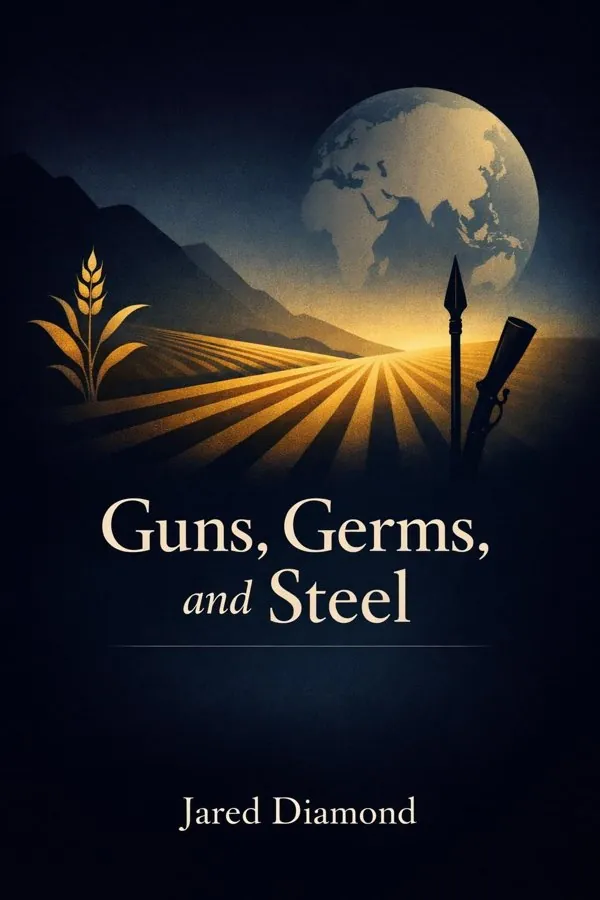
Guns Germs and Steel
Jared Diamond
10 min
Collapse: How Societies Choose to Fail or Succeed
Jared Diamond
10 min
The Third Chimpanzee: The Evolution and Future of the Human Animal
Jared Diamond
10 min
Upheaval: Turning Points for Nations in Crisis
Jared Diamond
10 minYou Might Also Like

The Structure of Scientific Revolutions
Thomas S. Kuhn
10 min
Genius
Harold Bloom
10 min
A Cultural History of the Medieval Age
Various Editors
10 min
A History of God: The 4,000-Year Quest of Judaism, Christianity and Islam
Karen Armstrong
10 min
A History of the World in 10½ Chapters
Julian Barnes
10 min
A Short History of Progress
Ronald Wright
10 minBrowse by Category
Ready to read Guns, Germs, and Steel: The Fates of Human Societies?
Get the full summary and 100K+ more books with Fizz Moment.