
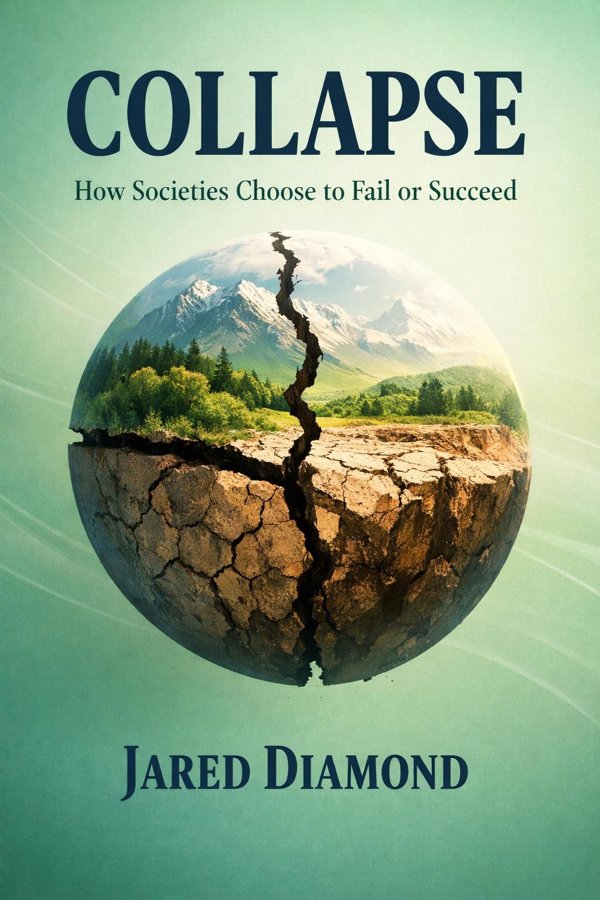
Collapse: How Societies Choose to Fail or Succeed: Summary & Key Insights
 10 min13 chaptersAudio available
What Is Collapse: How Societies Choose to Fail or Succeed About?
Collapse: How Societies Choose to Fail or Succeed by Jared Diamond is a civilization book spanning 13 pages. Collapse: How Societies Choose to Fail or Succeed is a comprehensive exploration of how past civilizations have collapsed due to environmental degradation, climate change, and poor political decisions. Jared Diamond examines societies such as the Maya, the Norse of Greenland, and modern examples like Rwanda, drawing lessons about sustainability and the choices that determine a society’s survival or downfall.
This FizzRead summary covers all 13 key chapters of Collapse: How Societies Choose to Fail or Succeed in approximately 10 minutes, distilling the most important ideas, arguments, and takeaways from Jared Diamond's work. Also available as an audio summary and Key Quotes Podcast.
Collapse: How Societies Choose to Fail or Succeed
Collapse: How Societies Choose to Fail or Succeed is a comprehensive exploration of how past civilizations have collapsed due to environmental degradation, climate change, and poor political decisions. Jared Diamond examines societies such as the Maya, the Norse of Greenland, and modern examples like Rwanda, drawing lessons about sustainability and the choices that determine a society’s survival or downfall.
Who Should Read Collapse: How Societies Choose to Fail or Succeed?
This book is perfect for anyone interested in civilization and looking to gain actionable insights in a short read. Whether you're a student, professional, or lifelong learner, the key ideas from Collapse: How Societies Choose to Fail or Succeed by Jared Diamond will help you think differently.
- ✓Readers who enjoy civilization and want practical takeaways
- ✓Professionals looking to apply new ideas to their work and life
- ✓Anyone who wants the core insights of Collapse: How Societies Choose to Fail or Succeed in just 10 minutes
Want the full summary?
Get instant access to this book summary and 100K+ more with Fizz Moment.
Get Free SummaryAvailable on App Store • Free to download
Key Chapters
Whenever we speak of a society’s collapse, we must first recognize the multitude of variables at play. To impose order upon this complexity, I identified five interrelated factors that together shape the fate of any civilization. The first is environmental damage—the direct impact humans have on the ecosystems that sustain them through deforestation, soil erosion, water mismanagement, or overhunting. Closely linked is the second factor, climate change, which can exacerbate environmental stress or render once-viable landscapes untenable. Third and fourth come external forces: hostile neighbors and the loss of friendly trade partners. These external influences determine whether a society can withstand environmental pressure or whether it is driven further into crisis. The final and most decisive factor is societal response—the ways people collectively perceive, interpret, and act upon warning signs.
This framework does not imply that collapse is inevitable when these forces align, but rather that the outcome depends profoundly on human choices. Decisions made by leaders, cultural attitudes toward innovation, and the capacity for collective learning all determine whether a society adapts or perishes. Throughout this book, I will use this schema to analyze not only the fates of ancient civilizations but also the risks confronting our modern world.
To understand the intersection of environment, economy, and human behavior in our time, I began close to home—in Montana. The vast landscapes of the American West reveal both natural beauty and deep fragility. Ranchers there face an array of intertwined problems: deteriorating soils, dependence on scarce water extracted through irrigation, and economic vulnerabilities linked to global market shifts. Mining has scarred much of the land, leaving toxic residues that persist for centuries, while logging and erosion add to the accumulated strain. These local challenges mirror the global dilemma: how to reconcile short-term economic survival with long-term ecological health.
In talking with ranchers, miners, and conservationists, I encountered genuine concern and profound conflict. Each group recognizes the fragility of the landscape, yet their livelihoods pull them toward different, often opposing, solutions. The situation in Montana serves as a microcosm—an emblem of how even prosperous societies can set themselves on an unsustainable path if they fail to grasp the interconnectedness of environmental and social systems. The lesson is that awareness, though necessary, is not enough. Societies must build the will to translate knowledge into action.
+ 11 more chapters — available in the FizzRead app
All Chapters in Collapse: How Societies Choose to Fail or Succeed
About the Author
Jared Diamond is an American geographer, historian, and author, best known for his interdisciplinary works that explore the interplay between environment, society, and human evolution. He is a professor of geography at the University of California, Los Angeles, and a Pulitzer Prize-winning author of books such as Guns, Germs, and Steel and Collapse.
Get This Summary in Your Preferred Format
Read or listen to the Collapse: How Societies Choose to Fail or Succeed summary by Jared Diamond anytime, anywhere. FizzRead offers multiple formats so you can learn on your terms — all free.
Available formats: App · Audio · PDF · EPUB — All included free with FizzRead
Download Collapse: How Societies Choose to Fail or Succeed PDF and EPUB Summary
Key Quotes from Collapse: How Societies Choose to Fail or Succeed
“Whenever we speak of a society’s collapse, we must first recognize the multitude of variables at play.”
“To understand the intersection of environment, economy, and human behavior in our time, I began close to home—in Montana.”
Frequently Asked Questions about Collapse: How Societies Choose to Fail or Succeed
Collapse: How Societies Choose to Fail or Succeed by Jared Diamond is a civilization book that explores key ideas across 13 chapters. Collapse: How Societies Choose to Fail or Succeed is a comprehensive exploration of how past civilizations have collapsed due to environmental degradation, climate change, and poor political decisions. Jared Diamond examines societies such as the Maya, the Norse of Greenland, and modern examples like Rwanda, drawing lessons about sustainability and the choices that determine a society’s survival or downfall.
More by Jared Diamond
Guns Germs and Steel
Jared Diamond
10 min
The Third Chimpanzee: The Evolution and Future of the Human Animal
Jared Diamond
10 min
Guns, Germs, and Steel: The Fates of Human Societies
Jared Diamond
10 min
Upheaval: Turning Points for Nations in Crisis
Jared Diamond
10 minYou Might Also Like
The Structure of Scientific Revolutions
Thomas S. Kuhn
10 min
Genius
Harold Bloom
10 min
A Cultural History of the Medieval Age
Various Editors
10 min
A History of God: The 4,000-Year Quest of Judaism, Christianity and Islam
Karen Armstrong
10 min
A History of the World in 10½ Chapters
Julian Barnes
10 min
A Short History of Progress
Ronald Wright
10 minBrowse by Category
Ready to read Collapse: How Societies Choose to Fail or Succeed?
Get the full summary and 100K+ more books with Fizz Moment.