
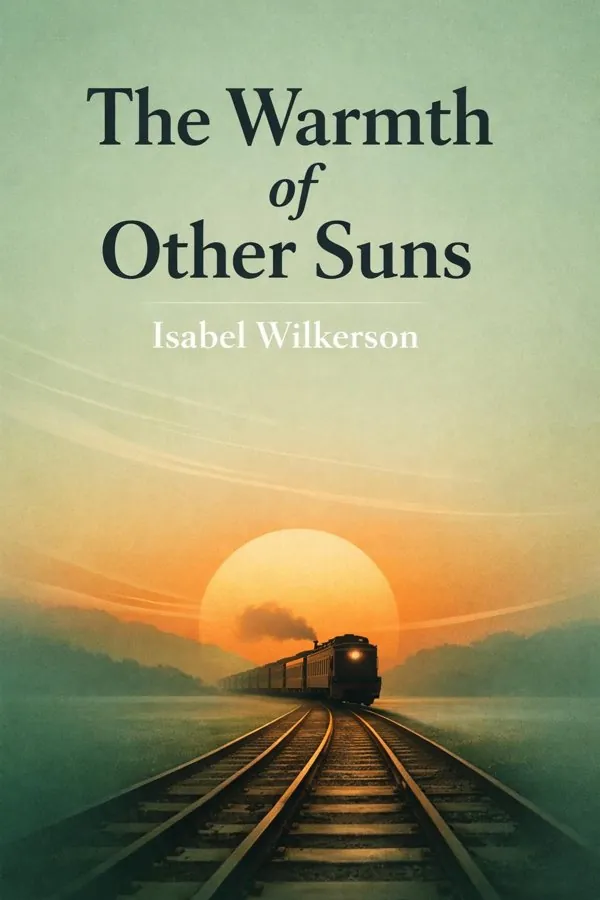
The Warmth of Other Suns: Summary & Key Insights
 10 min9 chaptersAudio available
Key Takeaways from The Warmth of Other Suns
Some movements begin with ambition; this one began with the need to breathe freely.
History often celebrates loud heroes, but Wilkerson reminds us that endurance itself can be a form of bravery.
Talent means little when a system is designed to waste it.
Sometimes migration is driven not only by danger, but by the hunger to become fully oneself.
Freedom is rarely reached in a single leap; more often, it is assembled through careful risk.
What Is The Warmth of Other Suns About?
The Warmth of Other Suns by Isabel Wilkerson is a history book published in 2010 spanning 10 pages. The Warmth of Other Suns tells the story of one of the largest internal migrations in American history: the movement of roughly six million Black Americans out of the Jim Crow South to the North, Midwest, and West between about 1915 and 1970. Rather than treating the Great Migration as an abstract demographic shift, Isabel Wilkerson makes it intimate and unforgettable by following the lives of three individuals—Ida Mae Gladney, George Starling, and Robert Foster—whose journeys reveal the fear, calculation, hope, and sacrifice behind this mass exodus. The book shows that migration was not simply about jobs or geography. It was about fleeing a rigid racial order that constrained where people could work, live, vote, travel, and dream. What makes this book matter so deeply is that it reframes modern American history. Wilkerson demonstrates that the Great Migration reshaped cities, politics, music, labor, family life, and the nation’s racial landscape. Her authority comes from years of reporting, archival research, oral histories, and narrative skill of the highest order. The result is both sweeping history and deeply human testimony—a work that helps readers understand not only where America has been, but why it looks the way it does today.
This FizzRead summary covers all 9 key chapters of The Warmth of Other Suns in approximately 10 minutes, distilling the most important ideas, arguments, and takeaways from Isabel Wilkerson's work. Also available as an audio summary and Key Quotes Podcast.
The Warmth of Other Suns
The Warmth of Other Suns tells the story of one of the largest internal migrations in American history: the movement of roughly six million Black Americans out of the Jim Crow South to the North, Midwest, and West between about 1915 and 1970. Rather than treating the Great Migration as an abstract demographic shift, Isabel Wilkerson makes it intimate and unforgettable by following the lives of three individuals—Ida Mae Gladney, George Starling, and Robert Foster—whose journeys reveal the fear, calculation, hope, and sacrifice behind this mass exodus. The book shows that migration was not simply about jobs or geography. It was about fleeing a rigid racial order that constrained where people could work, live, vote, travel, and dream.
What makes this book matter so deeply is that it reframes modern American history. Wilkerson demonstrates that the Great Migration reshaped cities, politics, music, labor, family life, and the nation’s racial landscape. Her authority comes from years of reporting, archival research, oral histories, and narrative skill of the highest order. The result is both sweeping history and deeply human testimony—a work that helps readers understand not only where America has been, but why it looks the way it does today.
Who Should Read The Warmth of Other Suns?
This book is perfect for anyone interested in history and looking to gain actionable insights in a short read. Whether you're a student, professional, or lifelong learner, the key ideas from The Warmth of Other Suns by Isabel Wilkerson will help you think differently.
- ✓Readers who enjoy history and want practical takeaways
- ✓Professionals looking to apply new ideas to their work and life
- ✓Anyone who wants the core insights of The Warmth of Other Suns in just 10 minutes
Want the full summary?
Get instant access to this book summary and 100K+ more with Fizz Moment.
Get Free SummaryAvailable on App Store • Free to download
Key Chapters
Some movements begin with ambition; this one began with the need to breathe freely. Wilkerson shows that the Great Migration was not merely a search for better pay or urban opportunity. It was a mass response to a Southern caste system that enforced racial hierarchy through law, custom, humiliation, and terror. Black Southerners faced disenfranchisement, debt peonage, arbitrary violence, educational deprivation, and constant social subordination. The question was not simply whether life elsewhere might be better, but whether life in the South could remain bearable at all.
By framing the migration as an escape from a total system, Wilkerson changes how readers interpret twentieth-century America. These migrants were not leaving home lightly. They were weighing the pain of separation against the certainty of constraint if they stayed. The decision often came after a triggering moment: a threat, an insult, a lynching, a blocked ambition, or the realization that one’s children would inherit the same confinement.
This perspective also clarifies how structural injustice drives personal choices. In modern terms, people still relocate because institutions fail them—whether due to violence, discrimination, lack of mobility, or political exclusion. Wilkerson’s insight encourages readers to see migration not just as movement, but as a social diagnosis. People leave when a place denies their dignity.
Actionable takeaway: When examining any major social movement, ask what invisible pressures made staying impossible, not just what visible opportunities made leaving attractive.
History often celebrates loud heroes, but Wilkerson reminds us that endurance itself can be a form of bravery. Ida Mae Gladney’s story begins in rural Mississippi, where she and her husband George worked the land under the exploitative conditions of sharecropping. Their labor enriched others while keeping them economically insecure and socially vulnerable. The system was designed to prevent advancement, making hard work a trap rather than a path upward.
Ida Mae’s migration to Chicago was not dramatic in the conventional sense. She was not a public leader or famous activist. Yet her journey captures the courage of ordinary people making extraordinary decisions. She and her family left behind a familiar world for a city they knew mostly by rumor and hope. In Chicago, the promises of the North proved mixed: there was more freedom than in Mississippi, but also overcrowding, discrimination, and economic struggle. Still, the move changed the horizon of what was possible for her children and grandchildren.
Her story illustrates a crucial lesson: social transformation is often built from millions of private acts of refusal. A family deciding not to remain in an unjust place can alter the future more than any speech. Readers can apply this insight to their own lives by recognizing that dignity is cumulative. Small decisions—where to live, what to accept, what to reject—shape long-term identity and opportunity.
Actionable takeaway: Do not underestimate the power of quiet, persistent choices; sometimes the most life-changing act is simply refusing to remain where you are diminished.
Talent means little when a system is designed to waste it. George Starling’s life reveals how Jim Crow crushed ambition before it could flower. Bright and capable, he pursued education and aspired to more than the agricultural labor expected of Black men in Florida. But the racial order of the South punished aspiration itself. When George tried to organize citrus pickers and challenge abusive conditions, he faced deadly retaliation. Leaving became not just a strategic decision, but an act of self-preservation.
His move to New York captures the migration’s emotional complexity. The North offered greater legal freedom and room for reinvention, but it did not erase loneliness, class barriers, or racial prejudice. George experienced both liberation and dislocation. He entered a world where he could move with more autonomy, yet he also carried the scars of the world he escaped. Wilkerson uses his story to show that migration does not simply replace one identity with another; it creates a layered self, shaped by both origin and destination.
George’s experience also speaks to a broader truth about institutions. When societies deny people the ability to develop their gifts, everyone loses. Communities lose leadership, industries lose talent, and history loses possibilities that were never allowed to emerge. This remains relevant today in conversations about educational inequality, labor exploitation, and unequal access to advancement.
Actionable takeaway: Pay attention to how systems suppress potential, and wherever you have influence, work to remove barriers before they turn talent into loss.
Sometimes migration is driven not only by danger, but by the hunger to become fully oneself. Robert Foster, a gifted physician from Louisiana, represents a different dimension of the Great Migration. Unlike Ida Mae and George, he was highly educated and professionally ambitious. Yet even with credentials and discipline, the South placed strict racial ceilings on his future. He could become accomplished, but not fully recognized; respected by some, but never truly equal.
His journey to California shows how the migration included not just laborers, but professionals, entrepreneurs, artists, and dreamers seeking a stage large enough for their abilities. In the West, Robert found more room to build a career, cultivate status, and inhabit a wider social world. Still, Wilkerson is careful not to romanticize this freedom. Racism persisted in subtler forms, and success did not erase the burden of navigating a society structured by racial assumptions.
Robert’s story broadens the book’s argument: oppression harms people across class lines, though in different ways. Formal achievement alone cannot neutralize a degrading system. This insight remains relevant for readers who assume merit automatically produces mobility. Many talented people still face institutional ceilings based on race, origin, or background.
Practically, Robert’s life encourages readers to think about environment as a multiplier. Skill matters, but context matters too. A person may need to change cities, industries, or networks to find the scale their ambition requires.
Actionable takeaway: If your growth is being capped by the limits of your environment, consider whether a strategic change in place or network could unlock the life you are trying to build.
Freedom is rarely reached in a single leap; more often, it is assembled through careful risk. Wilkerson emphasizes that departure during the Great Migration required planning, secrecy, timing, and nerve. Black Southerners often left with limited cash, incomplete information, and no guarantee of work or safety. They consulted train schedules, relied on letters from relatives, and slipped away before white employers or landlords could interfere. In some cases, even announcing plans to leave could provoke retaliation.
This makes the migration remarkable not only for its scale, but for the sophistication of those undertaking it. These were not passive victims carried by history. They were strategic actors reading conditions, gathering intelligence, and making complex decisions under pressure. Their journeys resembled other great human migrations in one essential way: people moved through uncertainty with a vision of a different life, however fragile.
The logistics of leaving also reveal the importance of social networks. One relative in Chicago, one boarding room in Harlem, one job lead in Los Angeles could make all the difference. Modern readers can see parallels in how communities today rely on informal support systems to navigate relocation, career shifts, or crisis.
The broader lesson is that courage and planning are not opposites. Brave choices are often supported by quiet preparation: saving money, building contacts, studying routes, and gathering facts before acting.
Actionable takeaway: When facing a high-stakes life change, combine hope with strategy—map your risks, cultivate allies, and prepare your exit before you need it.
Reaching a new city did not mean reaching equality. One of Wilkerson’s most important contributions is her refusal to portray the North and West as simple lands of redemption. Migrants escaped the explicit brutalities of Jim Crow, but they entered regions shaped by segregation, housing discrimination, workplace exclusion, and social suspicion. They were often confined to overcrowded neighborhoods, steered away from opportunities, and treated as outsiders by both whites and sometimes earlier Black residents.
This tension makes the book historically rich and emotionally honest. Migration improved life in crucial ways—greater voting access, more educational possibilities, less everyday terror—but it did not dissolve structural racism. Instead, many migrants traded one racial order for another, less openly violent yet still deeply constraining. Understanding this helps explain the development of urban inequality, segregated neighborhoods, and the frustrations that later fueled civil rights activism in northern cities.
The idea also offers a practical lens for today. People who move for safety or opportunity often discover that escape from one problem leads to confrontation with another. Whether in careers, relationships, or countries, transition is not the same as resolution. Progress may be real while still incomplete.
Wilkerson invites readers to hold two truths at once: migration was necessary, and migration was costly. It improved lives while exposing new hardships. Mature thinking requires that kind of complexity.
Actionable takeaway: Measure progress honestly—celebrate meaningful gains, but do not confuse a better situation with a just one.
When millions move, the nation they enter does not remain the same. Wilkerson argues that the Great Migration transformed America’s political, cultural, and social landscape. Black migrants reshaped northern and western cities through labor, entrepreneurship, religion, foodways, language, music, and civic life. They fueled industrial workforces, altered voting blocs, and laid the groundwork for new forms of Black urban culture that would influence the entire world.
The migration helps explain the rise of Chicago blues, the flowering of Harlem, the growth of Black political power in cities, and the changing character of places like Detroit, Philadelphia, Oakland, and Los Angeles. It also changed white America, often provoking backlash, suburban flight, and new methods of maintaining racial hierarchy outside the South. In other words, the Great Migration was not a Black story on the margins of national history. It was central to how modern America was made.
This insight matters because many readers are taught history in fragments: Southern racism over here, northern industry over there, civil rights somewhere later. Wilkerson weaves these into one continuous national story. For contemporary readers, the lesson is clear: demographic shifts reshape institutions, culture, and politics for generations.
In practical terms, anyone trying to understand present-day urban inequality, electoral coalitions, regional identity, or American popular culture benefits from understanding this migration. It is a master key to the twentieth century.
Actionable takeaway: To understand current social patterns, trace the large population movements that created them; today’s city maps often reflect yesterday’s acts of survival.
Statistics can explain scale, but stories explain consequence. One of the book’s greatest strengths is Wilkerson’s decision to anchor a vast historical phenomenon in the lives of three individuals. Ida Mae, George, and Robert are not symbolic placeholders; they are fully realized people whose fears, decisions, and compromises reveal how structure enters daily life. Through them, readers feel what it meant to weigh train fare, to hide plans, to navigate a strange city, to miss home, and to redefine success.
This narrative method does more than make the book readable. It changes the way history is understood. Structural forces—segregation, labor exploitation, housing exclusion, political disenfranchisement—can seem abstract until we see how they shape a person’s meal, marriage, workday, or child’s future. Wilkerson proves that the most powerful historical writing often moves between systems and souls.
There is also a practical communication lesson here. If you want others to care about a complex issue, pair the big picture with human detail. Whether in education, advocacy, management, or journalism, people grasp patterns more deeply when they can attach them to lived experience. A policy debate becomes clearer when connected to one family’s reality.
By interweaving three lives across decades, Wilkerson shows that empathy is not separate from analysis; it is one of analysis’s sharpest tools.
Actionable takeaway: When trying to understand or explain a major issue, look for the human stories that reveal how large systems are actually lived.
The past is not over when its travelers are gone. Wilkerson ends with a broader reflection on what the Great Migration left behind: transformed family lines, altered cities, unfinished trauma, and expanded possibility. The children and grandchildren of migrants inherited more than a new address. They inherited widened educational prospects, different political identities, urban cultural traditions, and sometimes the emotional residue of parents who had survived dispossession, fear, and dislocation.
The book’s legacy lies in showing that migration is generational. A decision made by one person under duress can shape descendants for decades. One train north may result in a grandchild attending college, entering public office, making art, or living with a sense of possibility unknown to prior generations. At the same time, patterns created by the migration—segregated neighborhoods, wealth disparities, regional tensions—still structure American life.
This dual legacy of injury and advancement is one reason the book remains so relevant. It encourages readers to examine their own family histories, not sentimentally, but analytically. Where did your opportunities come from? What earlier sacrifices, exits, constraints, or relocations made your life possible? Such questions build humility and historical awareness.
Wilkerson ultimately offers a moral lesson as much as a historical one: societies must reckon with the forces that drive people to uproot themselves if they hope to call themselves just.
Actionable takeaway: Study your family’s movements and turning points; understanding inherited journeys can clarify both your opportunities and your responsibilities.
All Chapters in The Warmth of Other Suns
About the Author
Isabel Wilkerson is an acclaimed American journalist and author known for her groundbreaking work on race, migration, and social hierarchy in the United States. She became the first African American woman to win the Pulitzer Prize in journalism for her reporting at The New York Times, where she served as Chicago bureau chief. Wilkerson is celebrated for combining meticulous historical research with vivid narrative storytelling, making large social forces feel immediate and human. Her bestselling books include The Warmth of Other Suns, a landmark history of the Great Migration, and Caste: The Origins of Our Discontents, which examines hidden systems of hierarchy. Her work has had a major influence on public conversations about American history, inequality, and collective memory.
Get This Summary in Your Preferred Format
Read or listen to the The Warmth of Other Suns summary by Isabel Wilkerson anytime, anywhere. FizzRead offers multiple formats so you can learn on your terms — all free.
Available formats: App · Audio · PDF · EPUB — All included free with FizzRead
Download The Warmth of Other Suns PDF and EPUB Summary
Key Quotes from The Warmth of Other Suns
“Some movements begin with ambition; this one began with the need to breathe freely.”
“History often celebrates loud heroes, but Wilkerson reminds us that endurance itself can be a form of bravery.”
“Talent means little when a system is designed to waste it.”
“Sometimes migration is driven not only by danger, but by the hunger to become fully oneself.”
“Freedom is rarely reached in a single leap; more often, it is assembled through careful risk.”
Frequently Asked Questions about The Warmth of Other Suns
The Warmth of Other Suns by Isabel Wilkerson is a history book that explores key ideas across 9 chapters. The Warmth of Other Suns tells the story of one of the largest internal migrations in American history: the movement of roughly six million Black Americans out of the Jim Crow South to the North, Midwest, and West between about 1915 and 1970. Rather than treating the Great Migration as an abstract demographic shift, Isabel Wilkerson makes it intimate and unforgettable by following the lives of three individuals—Ida Mae Gladney, George Starling, and Robert Foster—whose journeys reveal the fear, calculation, hope, and sacrifice behind this mass exodus. The book shows that migration was not simply about jobs or geography. It was about fleeing a rigid racial order that constrained where people could work, live, vote, travel, and dream. What makes this book matter so deeply is that it reframes modern American history. Wilkerson demonstrates that the Great Migration reshaped cities, politics, music, labor, family life, and the nation’s racial landscape. Her authority comes from years of reporting, archival research, oral histories, and narrative skill of the highest order. The result is both sweeping history and deeply human testimony—a work that helps readers understand not only where America has been, but why it looks the way it does today.
Compare The Warmth of Other Suns
More by Isabel Wilkerson
You Might Also Like



Featured In
Browse by Category
Ready to read The Warmth of Other Suns?
Get the full summary and 100K+ more books with Fizz Moment.