
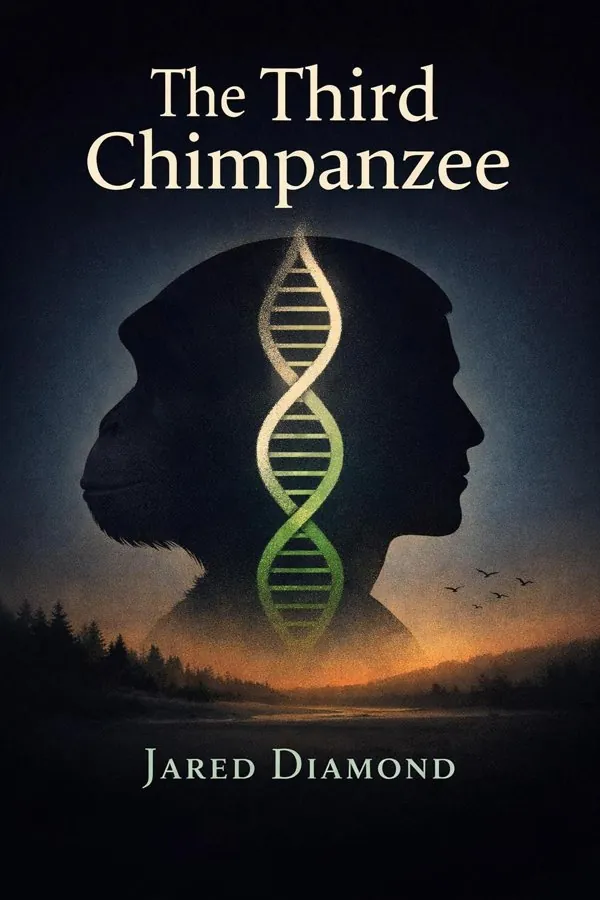
The Third Chimpanzee: The Evolution and Future of the Human Animal: Summary & Key Insights
 10 min10 chaptersAudio available
Key Takeaways from The Third Chimpanzee: The Evolution and Future of the Human Animal
The most unsettling truth about humanity may be that we are not as unique as we like to imagine.
Evolution is not a ladder of progress; it is a series of adaptations to changing environments.
If survival explains part of human evolution, mating explains much of the rest.
A tiny biological difference can create a civilizational explosion.
One of history’s greatest turning points was also one of its greatest trade-offs.
What Is The Third Chimpanzee: The Evolution and Future of the Human Animal About?
The Third Chimpanzee: The Evolution and Future of the Human Animal by Jared Diamond is a popular_sci book spanning 9 pages. What makes humans so extraordinary—and so dangerous? In The Third Chimpanzee, Jared Diamond tackles that question by starting with a humbling fact: genetically, we are astonishingly close to chimpanzees and bonobos. If our DNA differs so little from theirs, how did one ape lineage produce language, art, agriculture, technology, religion, genocide, and planetary-scale environmental damage? Diamond uses evolution, anthropology, biology, linguistics, and history to explore the small biological differences that created massive cultural consequences. He argues that humans are not separate from nature but one animal species whose unusual capacities have amplified both creativity and destruction. That makes the book more than a story of human origins; it is also a warning about human destiny. Diamond writes with the range of a scientist and the curiosity of a historian, drawing on his expertise as a geographer, physiologist, and scholar of human societies. The result is an accessible, provocative work that helps readers understand where we came from, why we behave as we do, and what our future may look like if our intelligence continues to outpace our wisdom.
This FizzRead summary covers all 10 key chapters of The Third Chimpanzee: The Evolution and Future of the Human Animal in approximately 10 minutes, distilling the most important ideas, arguments, and takeaways from Jared Diamond's work. Also available as an audio summary and Key Quotes Podcast.
The Third Chimpanzee: The Evolution and Future of the Human Animal
What makes humans so extraordinary—and so dangerous? In The Third Chimpanzee, Jared Diamond tackles that question by starting with a humbling fact: genetically, we are astonishingly close to chimpanzees and bonobos. If our DNA differs so little from theirs, how did one ape lineage produce language, art, agriculture, technology, religion, genocide, and planetary-scale environmental damage? Diamond uses evolution, anthropology, biology, linguistics, and history to explore the small biological differences that created massive cultural consequences. He argues that humans are not separate from nature but one animal species whose unusual capacities have amplified both creativity and destruction. That makes the book more than a story of human origins; it is also a warning about human destiny. Diamond writes with the range of a scientist and the curiosity of a historian, drawing on his expertise as a geographer, physiologist, and scholar of human societies. The result is an accessible, provocative work that helps readers understand where we came from, why we behave as we do, and what our future may look like if our intelligence continues to outpace our wisdom.
Who Should Read The Third Chimpanzee: The Evolution and Future of the Human Animal?
This book is perfect for anyone interested in popular_sci and looking to gain actionable insights in a short read. Whether you're a student, professional, or lifelong learner, the key ideas from The Third Chimpanzee: The Evolution and Future of the Human Animal by Jared Diamond will help you think differently.
- ✓Readers who enjoy popular_sci and want practical takeaways
- ✓Professionals looking to apply new ideas to their work and life
- ✓Anyone who wants the core insights of The Third Chimpanzee: The Evolution and Future of the Human Animal in just 10 minutes
Want the full summary?
Get instant access to this book summary and 100K+ more with Fizz Moment.
Get Free SummaryAvailable on App Store • Free to download
Key Chapters
The most unsettling truth about humanity may be that we are not as unique as we like to imagine. Diamond begins by reminding us that Homo sapiens is genetically close enough to chimpanzees and bonobos that calling us the “third chimpanzee” is not just provocative language but a biologically meaningful claim. This insight reframes the human story: instead of seeing ourselves as a species apart, we must understand ourselves as one branch of the ape family that took an unusual evolutionary path.
The key question is not why humans are animals, but why one animal species became capable of symbolic thought, complex cooperation, advanced tools, and global ecological impact. Diamond shows that the split between our ancestors and those of chimps happened relatively recently in evolutionary terms. Small genetic changes, accumulated over millions of years, produced major differences in posture, brain development, communication, and social organization. Evolution does not need giant leaps to create dramatic outcomes; tiny biological shifts can reorganize an entire way of life.
This perspective has practical consequences. It encourages humility in science, ethics, and politics. If humans are continuous with other animals, then studying primates helps explain our own aggression, sexuality, parenting, and status-seeking. It also deepens moral questions about how we treat other species and the environment. Seeing ourselves as evolved creatures rather than cosmic exceptions can make our behavior more understandable—and more accountable.
A useful application is to notice where “human nature” still reflects our primate heritage: coalition-building, territorial instincts, competition for status, and strong family bonds. These tendencies are ancient, but they are not destiny. Culture can redirect biology.
Actionable takeaway: Replace the idea of human exceptionalism with informed humility—study our animal inheritance to better understand both our strengths and our risks.
Evolution is not a ladder of progress; it is a series of adaptations to changing environments. Diamond explains human origins by tracing how climatic shifts, habitat changes, and selective pressures shaped the ancestors who eventually became Homo sapiens. Around six million years ago, ancestral ape populations diverged. Some lineages led to chimpanzees and bonobos, while others produced a variety of hominins, most of which eventually disappeared.
One of the most important developments was bipedalism. Walking upright freed the hands, changed energy use, and opened the door to carrying food, tools, and infants more efficiently. Later came increases in brain size, shifts in diet, greater social complexity, and more flexible behavior. But Diamond avoids telling a simplistic story of inevitable progress. Human evolution was messy, branching, and contingent. Many humanlike species once existed, and our own survival was never guaranteed.
This matters because it changes how we think about adaptation today. The traits that made humans successful did not emerge in isolation. They developed because our ancestors faced unstable conditions and responded creatively. Flexibility—not perfection—was our true advantage. That lesson applies to modern life, where rapid environmental and technological changes demand behavioral adaptability.
You can see this principle in everyday examples. Organizations that survive disruption are often not the strongest but the most adaptable. Individuals also benefit from evolutionary thinking: skills like learning quickly, cooperating broadly, and tolerating uncertainty remain essential in changing environments.
Diamond’s account also challenges myths of racial hierarchy or fixed human superiority. All modern humans descend from populations shaped by similar evolutionary processes. Our differences are recent and superficial compared with our shared inheritance.
Actionable takeaway: Treat adaptability as a core human strength—whether facing personal uncertainty, social change, or global crises, flexibility is more valuable than rigidity.
If survival explains part of human evolution, mating explains much of the rest. Diamond explores how sexual selection shaped distinctive human behaviors, especially our unusual mix of long-term pair bonding, concealed ovulation, high parental investment, and complex sexual norms. Compared with many primates, humans are strange: males often contribute substantially to offspring, females do not advertise fertility as openly, and sexual relationships are deeply entangled with emotion, status, and culture.
Diamond argues that these patterns emerged because human children are extraordinarily costly to raise. Large brains, long childhoods, and slow development created pressure for cooperative parenting. In that context, stable pair bonds and male provisioning could increase offspring survival. At the same time, sexual selection continued to reward attraction, competition, jealousy, and strategic behavior. Human mating systems therefore combine biology and culture in unusually intricate ways.
This framework helps explain enduring features of human life: romantic attachment, sexual conflict, beauty standards, family structures, and the intense emotions surrounding fidelity and reproduction. It also clarifies why human societies regulate sex so heavily. Because reproduction affects inheritance, kinship, alliance, and social order, nearly every culture develops norms around marriage, childrearing, and mate choice.
The practical value of Diamond’s argument is that it makes relationship behavior more intelligible without reducing it to instinct. Biology sets pressures, but culture interprets them differently. Modern examples include debates about parenting roles, dating expectations, reproductive technologies, and work-family balance. These are not departures from human nature; they are contemporary expressions of long evolutionary tensions.
Understanding our reproductive history can also promote compassion. Many conflicts between the sexes arise not because one side is irrational but because human mating evolved under competing interests and shared dependencies.
Actionable takeaway: In relationships and family life, assume that both biology and culture matter—better decisions come from understanding inherited pressures rather than pretending they do not exist.
A tiny biological difference can create a civilizational explosion. Diamond treats language and art as two of the most decisive thresholds in human history because they allowed humans to store, share, and amplify knowledge across generations. Other animals communicate, but human language is open-ended, symbolic, and precise enough to coordinate large groups, transmit abstract ideas, and imagine things that do not yet exist.
Once language became sophisticated, humans gained a powerful adaptive advantage. We could teach hunting techniques, preserve social rules, negotiate alliances, and develop myths that bound groups together. Art emerged alongside this symbolic capacity. Cave paintings, music, ornamentation, storytelling, and ritual were not decorative extras; they were ways of signaling identity, strengthening group cohesion, transmitting values, and exploring mental worlds beyond immediate survival.
Diamond’s deeper point is that culture became a second inheritance system. Genetic evolution is slow, but language and symbolism allow rapid cultural evolution. A tool improved by one generation can be taught to the next. A social rule or religious belief can spread faster than any gene. This is one reason humans transformed the planet so quickly.
In modern life, this insight remains urgent. Institutions, brands, nations, and communities all depend on shared stories. Leadership often succeeds not merely through power, but through the ability to communicate meaning. Art still shapes social identity, political emotion, and moral imagination. Even digital culture is an extension of the same symbolic explosion Diamond describes.
For individuals, the lesson is practical: your ability to communicate clearly and participate in shared narratives affects your influence more than raw intelligence alone. Language builds cooperation; art builds belonging.
Actionable takeaway: Invest in communication and storytelling skills—they are among the most powerful tools humans ever evolved for cooperation, learning, and lasting impact.
One of history’s greatest turning points was also one of its greatest trade-offs. Diamond examines agriculture not as an obvious step forward, but as a transformative shift that solved some problems while creating many others. For hunter-gatherers, life could be precarious, but diets were often varied and labor patterns flexible. Agriculture increased food production per unit of land, supporting larger populations and permanent settlements. Yet it also narrowed diets, increased disease exposure, intensified labor, and opened the door to social hierarchy.
Once people settled, surpluses could be stored, defended, taxed, and inherited. That changed everything. Villages became cities; specialization became possible; political authority expanded; class distinctions deepened. Agriculture made civilization possible, but it also made inequality more durable. Kings, priests, bureaucrats, and armies all depend, in some sense, on food surpluses generated by farmers.
Diamond’s analysis helps explain why many features of modern life—property systems, state power, economic inequality, and organized religion—grew out of the agricultural transition. Civilization did not simply emerge because humans became smarter. It emerged because settled food production changed population density, labor organization, and social control.
The modern application is straightforward. Technological progress still creates mixed outcomes. Innovations that increase productivity can also concentrate power. Just as agriculture generated both abundance and hierarchy, today’s digital and industrial systems produce convenience while also widening inequality and environmental strain.
Diamond encourages readers to resist simplistic narratives of progress. A new system should be judged not only by what it produces, but by what it costs in health, freedom, resilience, and fairness.
Actionable takeaway: When evaluating any “advance,” ask two questions—what new benefits does it create, and what hidden inequalities or dependencies does it introduce?
Human history is, in large part, the story of movement. Diamond explores how populations spread across the globe, adapted to varied environments, and diversified culturally while remaining members of a single species. From Africa, modern humans expanded into Eurasia, Australia, the Pacific, and the Americas, carrying with them language, tools, beliefs, and social structures that evolved further in new conditions.
This global dispersal matters because it undermines crude ideas about race and destiny. Geographic separation produced visible differences in appearance and culture, but these differences are shallow relative to our shared ancestry. Diamond is especially effective at showing how environment shapes opportunity. Groups living in different climates, ecosystems, and geographic settings had access to different plants, animals, and migration routes. Those factors influenced social development far more than any notion of biological superiority.
Migration also helps explain conflict and creativity. When populations move, they compete for territory, mix genetically, exchange technologies, and reshape identities. Trade routes, conquests, and diasporas have repeatedly transformed civilizations. In today’s world, debates over borders, nationalism, and multiculturalism often ignore how normal migration is in human history. Mobility is not an anomaly; it is a defining human pattern.
At a personal level, this chapter encourages a broader understanding of identity. Family histories often contain movement, adaptation, and blending. At a societal level, it supports policies and attitudes grounded in shared humanity rather than racial essentialism.
Diamond’s evolutionary view suggests that cultural diversity is real and important, but it exists within a single human family shaped by migration and adaptation, not fixed hierarchy.
Actionable takeaway: Challenge racial myths and simplistic national narratives by remembering that human populations have always moved, mixed, and adapted—and that shared ancestry is deeper than visible difference.
Human beings do not just evolve biologically; our societies evolve culturally. Diamond shows how customs, institutions, moral codes, and political structures emerge through a process that resembles natural selection. Some practices spread because they help groups survive, coordinate, and outcompete rivals. Others persist because they benefit elites, reinforce identity, or become embedded in tradition. Cultural evolution is faster than genetic evolution, which is why human societies can change dramatically in only a few generations.
This idea helps explain the diversity of human arrangements. Marriage rules, systems of justice, forms of government, economic norms, and religious practices are not random. They are shaped by environmental constraints, historical accidents, and competitive pressures between groups. Societies that organize cooperation effectively often gain military, economic, or demographic advantages. But Diamond also notes that not all successful traits are humane. A highly disciplined society may expand through violence or oppression.
Understanding cultural evolution has practical value in politics, business, and education. Institutions should be seen as adaptive systems, not timeless truths. Rules that once worked in one context may fail in another. Likewise, harmful norms can survive long after their original purpose disappears. This perspective invites reform grounded in evidence rather than reverence.
Modern examples include workplace cultures, online communities, and national policy systems. Practices spread when they reward participation, solve coordination problems, or signal belonging. That means culture can be intentionally shaped. Leaders influence evolution by changing incentives, stories, and habits.
Diamond’s deeper message is sobering: civilization is not guaranteed to become more moral over time. Cultural success and ethical wisdom do not always align.
Actionable takeaway: Evaluate social norms and institutions as evolving tools—keep what improves cooperation and human flourishing, and be willing to redesign what no longer serves either.
Technology is often praised as proof of human superiority, but Diamond treats it more carefully: it is an amplifier, not a moral achievement in itself. From stone tools to metallurgy to modern industry, humans have repeatedly extended their physical and cognitive reach through invention. Technology lets us hunt more effectively, store information, travel farther, and manipulate environments on an enormous scale. It is one of the main reasons a primate species came to dominate the planet.
Yet the same capacity that makes technology impressive also makes it dangerous. Every extension of power increases the consequences of human error, greed, and shortsightedness. Fire can cook food or destroy forests. Metal tools can cultivate fields or wage war. Industrial systems can raise living standards or destabilize climate. Diamond emphasizes that our species evolved to solve immediate problems, but our technologies now create long-term effects that exceed the intuitions shaped in small ancestral groups.
This mismatch remains one of the defining challenges of modern civilization. We can alter ecosystems, engineer weapons, and accelerate communication faster than we can build the wisdom to govern those powers well. Technological progress therefore cannot be judged by novelty alone. It must be assessed by its ecological, ethical, and social consequences.
The practical application is highly relevant today. Whether considering artificial intelligence, biotechnology, fossil fuels, or social media, the core question is the same: what kind of behavior does this tool reward, and what risks does it scale? Responsible innovation requires foresight, institutions, and moral restraint.
Diamond pushes readers to see technology not as destiny but as choice. Humans invent tools, but we also choose the systems and values that govern them.
Actionable takeaway: Before embracing any new technology, ask not only what it enables, but what human impulses it amplifies—and whether society is prepared to manage the consequences.
Among the darkest insights in the book is that humanity’s greatest accomplishments coexist with a unique capacity for organized destruction. Diamond examines genocide and environmental devastation not as historical accidents, but as outcomes rooted in human psychology, group behavior, and technological power. Humans form strong in-groups, mark outsiders, obey authority, and rationalize violence with ideology, fear, or self-interest. Under certain conditions, these tendencies can escalate into extermination.
Diamond does not claim genocide is inevitable, but he insists it is intelligible. Once societies classify others as less human, threatening, or disposable, moral restraints weaken. The same symbolic abilities that enable religion, law, and art can also justify conquest and mass killing. Likewise, environmental destruction often arises from ordinary motives—short-term gain, local competition, denial, and the assumption that nature is limitless. Humans need not be monstrous to cause catastrophe; they need only be shortsighted and organized.
This dual warning remains painfully current. Ethnic violence, dehumanizing propaganda, habitat loss, species extinction, and climate disruption all reflect the combination of tribal instincts and scaled-up power. Diamond’s contribution is to connect moral failure with evolutionary and ecological realities. We are capable of empathy, but also of narrowing it. We are capable of planning, but often toward destructive ends.
The practical lesson is vigilance. Genocide becomes possible when institutions weaken, rhetoric hardens, and empathy shrinks. Ecocide becomes likely when costs are delayed, dispersed, and politically convenient to ignore. Education, democratic norms, environmental accountability, and cross-group contact all help interrupt these trajectories.
Actionable takeaway: Watch for dehumanizing language and normalized environmental neglect early—catastrophe usually begins with habits of thought long before it becomes a visible event.
The central paradox of humanity is that the same species capable of Beethoven, mathematics, and medicine is also capable of nuclear war and ecological collapse. Diamond ends on a question rather than a triumph: can humans understand themselves well enough to survive their own success? Our intelligence gave us unmatched control over the planet, but it did not automatically give us wisdom, restraint, or long-term thinking.
The book’s future-oriented argument is not purely pessimistic. Diamond believes self-knowledge matters because many human dangers are predictable. We know we are prone to tribal conflict, status competition, denial of distant consequences, and overexploitation of resources. We also know we are capable of cooperation, foresight, science, and moral expansion. The future will be shaped by which parts of our nature our institutions encourage.
This is why the book remains timely. Problems such as biodiversity loss, climate change, weapons proliferation, and political polarization are not separate issues. They all emerge from the tension between ancient instincts and modern power. Humans still carry minds adapted for small groups and immediate rewards, yet we now inhabit a tightly connected world where local actions can have global consequences.
For readers, the application is both personal and civic. On the personal level, cultivate long-term thinking, curiosity, and humility about human bias. On the civic level, support institutions that reward cooperation across groups, respect scientific evidence, and account for future generations. Survival is not just a technical problem; it is a cultural and moral one.
Diamond’s ultimate message is demanding but hopeful: understanding the human animal is not an academic exercise. It may be the precondition for keeping that animal alive.
Actionable takeaway: Build habits and support systems that extend your time horizon—good futures depend on thinking beyond immediate advantage toward long-term human and planetary survival.
All Chapters in The Third Chimpanzee: The Evolution and Future of the Human Animal
About the Author
Jared Diamond is an American geographer, historian, and bestselling author whose work bridges evolution, ecology, anthropology, and world history. He has taught at UCLA and is known for explaining broad human patterns through environmental and biological factors rather than simple cultural assumptions. Originally trained in physiology and biophysics, Diamond later became widely recognized for his interdisciplinary approach to big historical questions. His major books include The Third Chimpanzee, Guns, Germs, and Steel, for which he won the Pulitzer Prize, and Collapse. Across his writing, Diamond examines how geography, resources, technology, and human behavior shape societies over time. He is especially valued for making complex scientific and historical ideas accessible to general readers.
Get This Summary in Your Preferred Format
Read or listen to the The Third Chimpanzee: The Evolution and Future of the Human Animal summary by Jared Diamond anytime, anywhere. FizzRead offers multiple formats so you can learn on your terms — all free.
Available formats: App · Audio · PDF · EPUB — All included free with FizzRead
Download The Third Chimpanzee: The Evolution and Future of the Human Animal PDF and EPUB Summary
Key Quotes from The Third Chimpanzee: The Evolution and Future of the Human Animal
“The most unsettling truth about humanity may be that we are not as unique as we like to imagine.”
“Evolution is not a ladder of progress; it is a series of adaptations to changing environments.”
“If survival explains part of human evolution, mating explains much of the rest.”
“A tiny biological difference can create a civilizational explosion.”
“One of history’s greatest turning points was also one of its greatest trade-offs.”
Frequently Asked Questions about The Third Chimpanzee: The Evolution and Future of the Human Animal
The Third Chimpanzee: The Evolution and Future of the Human Animal by Jared Diamond is a popular_sci book that explores key ideas across 10 chapters. What makes humans so extraordinary—and so dangerous? In The Third Chimpanzee, Jared Diamond tackles that question by starting with a humbling fact: genetically, we are astonishingly close to chimpanzees and bonobos. If our DNA differs so little from theirs, how did one ape lineage produce language, art, agriculture, technology, religion, genocide, and planetary-scale environmental damage? Diamond uses evolution, anthropology, biology, linguistics, and history to explore the small biological differences that created massive cultural consequences. He argues that humans are not separate from nature but one animal species whose unusual capacities have amplified both creativity and destruction. That makes the book more than a story of human origins; it is also a warning about human destiny. Diamond writes with the range of a scientist and the curiosity of a historian, drawing on his expertise as a geographer, physiologist, and scholar of human societies. The result is an accessible, provocative work that helps readers understand where we came from, why we behave as we do, and what our future may look like if our intelligence continues to outpace our wisdom.
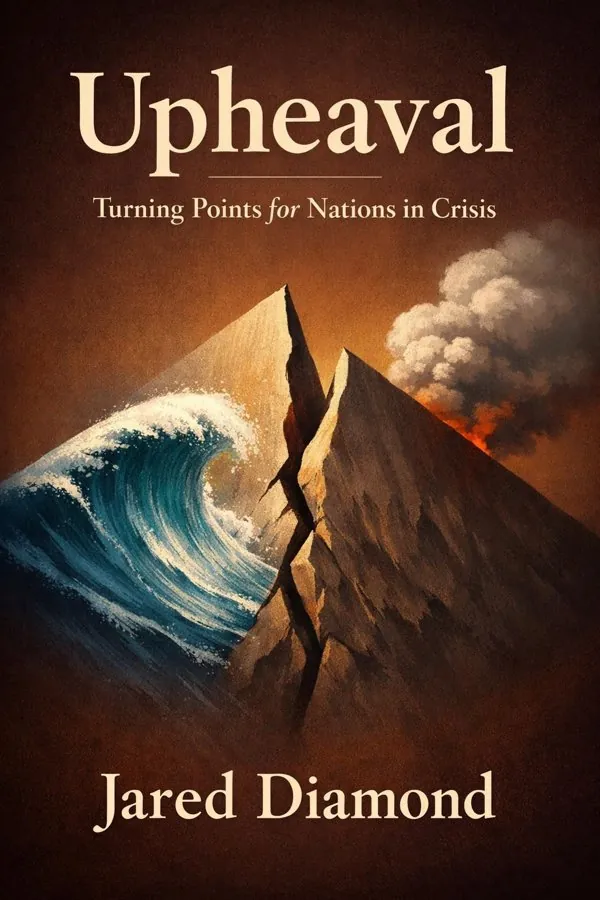
More by Jared Diamond
You Might Also Like

Structures: Or Why Things Don"t Fall Down
J.E. Gordon
10 min
The Road to Wigan Pier
George Orwell
10 min
Bonk: The Curious Coupling of Science and Sex
Mary Roach
10 min
First Bite: How We Learn to Eat
Bee Wilson
10 min
In Pursuit Of The Unknown: 17 Equations That Changed The World
Ian Stewart
10 min
Napoleon's Buttons: 17 Molecules That Changed History
Penny Le Couteur and Jay Burreson
10 minBrowse by Category
Ready to read The Third Chimpanzee: The Evolution and Future of the Human Animal?
Get the full summary and 100K+ more books with Fizz Moment.