
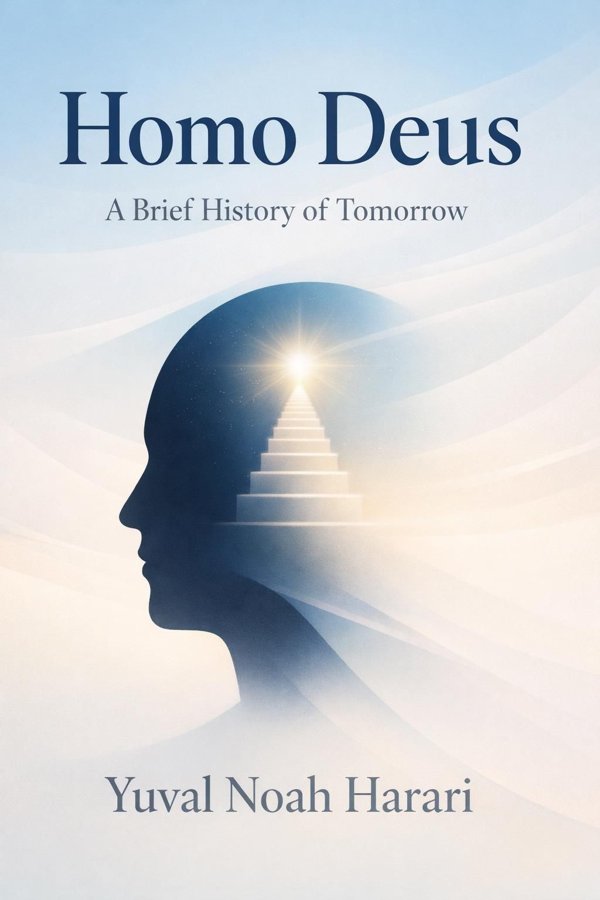
Homo Deus: Summary & Key Insights
 10 min9 chaptersAudio available
Key Takeaways from Homo Deus
The greatest revolution may begin when survival stops being our main concern.
Power is not only about governing nations; it is about reshaping the planet itself.
The modern world did not become secular by abandoning religion; it created a new one centered on human experience.
If your body and mind can be measured, predicted, and influenced, are you as mysterious as you think?
Every age has its sacred source of truth, and ours may be data.
What Is Homo Deus About?
Homo Deus by Yuval Noah Harari is a history book published in 2017 spanning 6 pages. What happens after humanity wins its oldest battles? In Homo Deus, Yuval Noah Harari argues that once famine, plague, and war become more manageable than at any previous point in history, human ambition does not disappear—it escalates. We begin aiming not merely to survive, but to upgrade ourselves. The next agenda, Harari suggests, is the pursuit of immortality, engineered happiness, and god-like power through biotechnology, artificial intelligence, and data systems. This is not a simple celebration of progress. It is a warning-filled exploration of how the same tools that promise liberation may also undermine freedom, equality, and meaning. Harari writes with the sweep of a historian and the curiosity of a futurist. Drawing on biology, religion, economics, politics, and computer science, he examines how humanist ideals shaped the modern world and why they may now be challenged by algorithms that know us better than we know ourselves. Homo Deus matters because it asks urgent questions about the future before it arrives: who will control technology, what will become of human agency, and how should we prepare for a world where intelligence is increasingly nonhuman?
This FizzRead summary covers all 9 key chapters of Homo Deus in approximately 10 minutes, distilling the most important ideas, arguments, and takeaways from Yuval Noah Harari's work. Also available as an audio summary and Key Quotes Podcast.
Homo Deus
What happens after humanity wins its oldest battles? In Homo Deus, Yuval Noah Harari argues that once famine, plague, and war become more manageable than at any previous point in history, human ambition does not disappear—it escalates. We begin aiming not merely to survive, but to upgrade ourselves. The next agenda, Harari suggests, is the pursuit of immortality, engineered happiness, and god-like power through biotechnology, artificial intelligence, and data systems. This is not a simple celebration of progress. It is a warning-filled exploration of how the same tools that promise liberation may also undermine freedom, equality, and meaning.
Harari writes with the sweep of a historian and the curiosity of a futurist. Drawing on biology, religion, economics, politics, and computer science, he examines how humanist ideals shaped the modern world and why they may now be challenged by algorithms that know us better than we know ourselves. Homo Deus matters because it asks urgent questions about the future before it arrives: who will control technology, what will become of human agency, and how should we prepare for a world where intelligence is increasingly nonhuman?
Who Should Read Homo Deus?
This book is perfect for anyone interested in history and looking to gain actionable insights in a short read. Whether you're a student, professional, or lifelong learner, the key ideas from Homo Deus by Yuval Noah Harari will help you think differently.
- ✓Readers who enjoy history and want practical takeaways
- ✓Professionals looking to apply new ideas to their work and life
- ✓Anyone who wants the core insights of Homo Deus in just 10 minutes
Want the full summary?
Get instant access to this book summary and 100K+ more with Fizz Moment.
Get Free SummaryAvailable on App Store • Free to download
Key Chapters
The greatest revolution may begin when survival stops being our main concern. For most of history, human beings were preoccupied with avoiding starvation, epidemic disease, and violent conflict. These threats never vanished, but Harari argues that modern states, scientific medicine, global trade, and industrial agriculture have reduced them enough to change the direction of human aspiration. Once societies no longer organize solely around staying alive, they start asking larger and more ambitious questions: how can we live longer, feel better, and become more powerful?
This shift creates what Harari calls a new human agenda. Instead of praying for rain and fearing plague, wealthy societies invest in anti-aging research, mental health optimization, gene editing, longevity science, and performance enhancement. Governments and corporations increasingly direct resources toward improving quality of life, not just preserving life. The move from survival to enhancement sounds positive, but it also opens ethical dilemmas. If life extension becomes possible, who gets access? If happiness can be chemically or digitally engineered, what happens to authenticity? If some people can enhance their intelligence or bodies, does inequality become biological as well as economic?
You can already see this agenda in everyday life: wearable health trackers, fertility technologies, personalized medicine, cognitive enhancers, and apps designed to optimize sleep, productivity, and mood. These are early signs of a civilization turning self-improvement into a central project.
The practical lesson is to pay attention not only to what problems technology solves, but to what new desires and inequalities it creates. Ask yourself regularly: am I using innovation to support a meaningful life, or am I being pulled into an endless race for optimization?
Power is not only about governing nations; it is about reshaping the planet itself. Harari describes the Anthropocene as an age in which human activity has become the dominant force on Earth. We redirect rivers, clear forests, alter the atmosphere, breed animals on an industrial scale, and transform ecosystems faster than natural evolution can respond. Humanity, once just another species, now acts like a planetary engineer.
This dominance reveals a striking contradiction. We often think of ourselves as separate from nature, yet our success comes from manipulating it so deeply that the distinction begins to blur. Agriculture replaced wild habitats with human-designed landscapes. Fossil fuels accelerated production while destabilizing climate systems. Industrial fishing, factory farming, and urban expansion changed the lives of billions of nonhuman creatures. Harari pushes readers to consider that human achievement has often depended on enormous suffering imposed on animals and ecosystems.
The Anthropocene is not just an environmental term; it is a moral and political challenge. If humans possess unprecedented power over life, do we also bear unprecedented responsibility? Climate policy, biodiversity protection, animal welfare, and energy transition are no longer niche concerns. They are central to how we define civilization.
In practical terms, this means recognizing that personal choices connect to large systems. Diet, travel, energy use, and consumer habits all participate in shaping the living world. Businesses and governments face similar questions when designing supply chains, cities, and technologies.
The actionable takeaway is simple: think like a steward, not just a consumer. Before supporting a product, policy, or lifestyle, ask what kind of planet it helps create—and for whom.
The modern world did not become secular by abandoning religion; it created a new one centered on human experience. Harari argues that humanism rose to prominence by placing individual feelings, desires, and choices at the center of moral and political life. Instead of looking to divine authority for meaning, modern societies increasingly trust the inner voice. The customer is always right, beauty is in the eye of the beholder, and voters know what is best for themselves. These ideas are not just slogans—they are the moral foundations of democracy, consumerism, and liberal culture.
Humanism has been extraordinarily successful because it gave meaning to modern institutions. Education teaches students to think for themselves. Markets reward products people want. Art values self-expression. Politics protects rights and autonomy. Even when people disagree, they often share one assumption: human feelings are the ultimate source of value.
Yet Harari sees a vulnerability inside this worldview. Humanism assumes that the individual is a coherent, sovereign decision-maker. But biology and psychology increasingly reveal that many decisions arise from unconscious processes, inherited biases, hormonal signals, and social conditioning. If our choices are less free and less unified than we imagined, the philosophical foundation of modern life becomes less secure.
This matters in ordinary life. We speak constantly about “being true to ourselves,” but we are also influenced by recommendation systems, marketing, peer pressure, and hidden habits. Humanism still offers dignity and moral concern, but it may no longer explain us fully.
The key takeaway is to respect human values while becoming more honest about how decisions are shaped. Practice reflection before major choices. Ask not only what you feel, but why you feel it—and who or what may be guiding that feeling.
If your body and mind can be measured, predicted, and influenced, are you as mysterious as you think? One of Harari’s most provocative ideas is that organisms may be understood as algorithms—systems that process information and produce outputs. In this view, the heart regulates blood flow, the immune system detects threats, and the brain constantly calculates probabilities, rewards, and responses. Human intuition can feel magical from the inside, but science increasingly explains it as data processing shaped by evolution.
This perspective changes how we think about intelligence and decision-making. If life is, at least partly, algorithmic, then nonhuman systems may match or outperform us in more and more domains. A music app predicts songs you will enjoy. A navigation system chooses a faster route than your own judgment. A medical model identifies disease patterns invisible to human doctors. None of these systems are conscious in the human sense, but they can still be effective decision tools.
Harari is not saying people are mere machines in a crude sense. He is highlighting that the gap between biological and artificial intelligence may be smaller than humanism assumed. Once you accept that choices can be modeled, optimized, and nudged, the door opens to a world where algorithms do not just assist people but govern key parts of life.
You can apply this insight by examining where algorithms already shape your behavior: shopping recommendations, social media feeds, hiring software, credit scores, and health alerts. These systems are not neutral; they embed assumptions and incentives.
The actionable takeaway is to become algorithmically literate. Understand which systems influence your choices, question their goals, and preserve spaces where human judgment—not just prediction—still matters.
A machine does not need feelings to outperform you. Harari draws a crucial distinction between intelligence and consciousness. Intelligence is the ability to solve problems, recognize patterns, and achieve goals. Consciousness is the ability to feel—to experience pain, joy, desire, or fear. Humans possess both, so we often assume they belong together. But AI suggests otherwise. Systems can be highly intelligent in narrow or even broad tasks without having any inner life at all.
This matters because economies reward performance, not consciousness. If an algorithm can diagnose illnesses more accurately, drive more safely, write faster reports, or detect fraud more efficiently, institutions may prefer it regardless of whether it “feels” anything. As a result, large segments of work could be transformed or displaced by systems that are capable but not sentient.
Harari pushes readers to see how unusual this is in historical terms. For centuries, human superiority seemed inseparable from uniquely human experiences such as judgment, creativity, and emotional insight. Yet machine learning systems now compose music, generate images, interpret legal documents, and converse persuasively. Whether they truly understand is philosophically debatable. Whether they are economically disruptive is not.
You can see the implications across sectors: automated customer support, AI-assisted coding, predictive maintenance, adaptive tutoring, and algorithmic investing. The challenge is not only job replacement but the redesign of institutions around machine strengths.
The practical takeaway is to develop capabilities that remain valuable in an AI-rich world: ethical reasoning, interdisciplinary thinking, emotional maturity, and the ability to work alongside intelligent tools. Don’t ask only, “Can AI do this?” Ask, “What human role becomes most important when AI can?”
The deepest fear about automation is not exploitation, but irrelevance. Harari argues that if artificial intelligence and biotechnology continue advancing, many people may no longer be economically necessary in the way industrial societies once required mass labor. In earlier eras, even poor populations were useful as soldiers, factory workers, or service employees. But if algorithms and robots perform these roles more cheaply and efficiently, whole groups could become marginalized not because they lack dignity, but because markets no longer need their labor.
Harari’s phrase “useless class” is intentionally provocative. He does not mean such people have no value as human beings. He means they risk becoming useless from the perspective of dominant economic systems. That distinction is morally crucial. A society that ties status, income, and meaning tightly to employment may struggle to care for people whose labor is no longer central.
Signs of this transition are visible in sectors already transformed by software, logistics automation, and AI-assisted services. The question then becomes political and cultural: how do we distribute resources, education, and purpose in a world where productivity is increasingly detached from human workers? Universal basic income, lifelong retraining, shorter workweeks, and public investment in care and creativity are possible responses—but none solve the deeper issue of meaning.
On an individual level, this idea encourages people to diversify their identity. If you define yourself only by your current job, technological change becomes existentially threatening. Skills matter, but so do relationships, civic participation, learning, and inner development.
The actionable takeaway is to future-proof your sense of worth. Build capabilities beyond routine labor, and cultivate a life whose meaning does not depend entirely on being economically optimized.
The next great inequality may be written into bodies, brains, and genes. Harari warns that advances in biotechnology could do more than heal disease; they may allow elites to enhance lifespan, cognition, physical ability, and emotional regulation. If that happens, the historic gap between rich and poor could widen into a biological gulf. Humanity would no longer merely have social classes. It could begin to split into different castes of capability.
Unlike older forms of inequality, enhancement would be self-reinforcing. Wealth buys better healthcare, better data, better education, and better offspring outcomes. If genetic editing, neural interfaces, anti-aging treatments, or premium cognitive upgrades remain expensive, the privileged could pass advantages across generations. What starts as optional enhancement could become a competitive necessity in education, work, and politics.
Harari’s argument is unsettling because it turns science fiction into a policy question. Should parents be allowed to enhance embryos? Should athletes or soldiers use biological upgrades? Should life-extending therapies be treated as public health tools or luxury products? Similar questions already appear in debates over IVF screening, personalized medicine, cosmetic procedures, and pharmaceutical enhancement.
This idea also challenges the comforting belief that technology naturally democratizes. Some innovations do spread widely, but others concentrate power. Access, regulation, public funding, and ethical norms determine whether innovation reduces suffering or intensifies hierarchy.
The practical takeaway is to support frameworks that treat transformative health technologies as matters of justice, not just consumer choice. When evaluating biotech progress, ask not only “Can we do it?” but “Who benefits, who is excluded, and what kind of society does this create?”
When old stories weaken, freedom expands—but so does confusion. Beneath its discussions of AI, biotechnology, and data, Homo Deus is also a book about meaning. Harari argues that modern societies have become extraordinarily powerful while remaining uncertain about purpose. Religion once offered cosmic narratives. Humanism replaced them with faith in individual experience. But if algorithms outperform human judgment and data systems shape desire, then even the modern story of self-directed meaning comes under pressure.
The result is a paradox of progress. We may gain more control over bodies, environments, and information while becoming less certain why any of it matters. A person can optimize productivity, track sleep, improve focus, and extend longevity, yet still feel spiritually empty. Technology can answer “how” with increasing precision, but it cannot reliably answer “why.” That question remains philosophical, ethical, and deeply personal.
Harari does not hand readers a simple replacement creed. Instead, he urges awareness. The future will be shaped not only by inventions, but by the stories we tell about what counts as a good life. If meaning is outsourced to markets, metrics, or machine recommendations, people may become efficient but hollow. If, however, individuals and communities consciously cultivate values, reflection, and compassion, technological power may serve rather than dominate human life.
In practical terms, this means making space for practices that resist constant optimization: conversation, study, art, meditation, service, and deliberate moral reasoning. These do not stop technological change, but they help anchor identity within it.
The actionable takeaway is to define success before systems define it for you. Choose values intentionally, revisit them often, and make sure your tools are serving your purpose—not replacing it.
All Chapters in Homo Deus
About the Author
Yuval Noah Harari is an Israeli historian, public intellectual, and professor at the Hebrew University of Jerusalem. Born in 1976, he studied history at the University of Oxford and became known for his ability to connect ancient history with modern technological and political questions. Harari rose to international prominence with Sapiens, followed by Homo Deus and 21 Lessons for the 21st Century. His work explores broad patterns in human history, from the rise of Homo sapiens to the future impact of artificial intelligence, biotechnology, and data. Writing in a clear, provocative style, he brings together insights from history, biology, economics, and philosophy. Harari is widely read by global audiences because he asks urgent questions about power, meaning, and the direction of human civilization.
Get This Summary in Your Preferred Format
Read or listen to the Homo Deus summary by Yuval Noah Harari anytime, anywhere. FizzRead offers multiple formats so you can learn on your terms — all free.
Available formats: App · Audio · PDF · EPUB — All included free with FizzRead
Download Homo Deus PDF and EPUB Summary
Key Quotes from Homo Deus
“The greatest revolution may begin when survival stops being our main concern.”
“Power is not only about governing nations; it is about reshaping the planet itself.”
“The modern world did not become secular by abandoning religion; it created a new one centered on human experience.”
“If your body and mind can be measured, predicted, and influenced, are you as mysterious as you think?”
“Every age has its sacred source of truth, and ours may be data.”
Frequently Asked Questions about Homo Deus
Homo Deus by Yuval Noah Harari is a history book that explores key ideas across 9 chapters. What happens after humanity wins its oldest battles? In Homo Deus, Yuval Noah Harari argues that once famine, plague, and war become more manageable than at any previous point in history, human ambition does not disappear—it escalates. We begin aiming not merely to survive, but to upgrade ourselves. The next agenda, Harari suggests, is the pursuit of immortality, engineered happiness, and god-like power through biotechnology, artificial intelligence, and data systems. This is not a simple celebration of progress. It is a warning-filled exploration of how the same tools that promise liberation may also undermine freedom, equality, and meaning. Harari writes with the sweep of a historian and the curiosity of a futurist. Drawing on biology, religion, economics, politics, and computer science, he examines how humanist ideals shaped the modern world and why they may now be challenged by algorithms that know us better than we know ourselves. Homo Deus matters because it asks urgent questions about the future before it arrives: who will control technology, what will become of human agency, and how should we prepare for a world where intelligence is increasingly nonhuman?
Compare Homo Deus
More by Yuval Noah Harari
You Might Also Like


Browse by Category
Ready to read Homo Deus?
Get the full summary and 100K+ more books with Fizz Moment.