
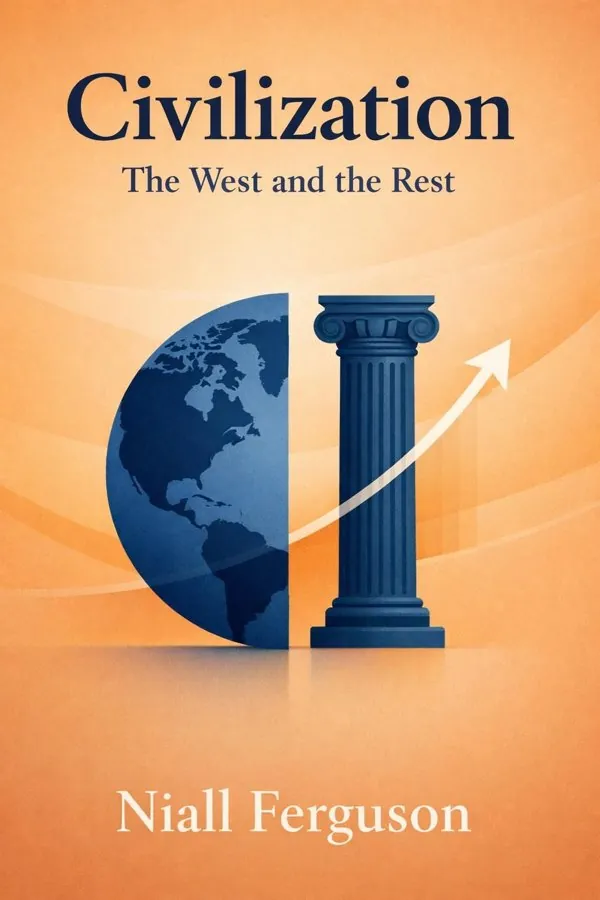
Civilization: The West and the Rest: Summary & Key Insights
 10 min9 chaptersAudio available
Key Takeaways from Civilization: The West and the Rest
Great civilizations do not always decline because they lack talent; often they stagnate because they face too little pressure to improve.
Knowledge changes history only when a society learns how to systematize, test, and apply it.
People invest in the future when they believe they can keep the rewards of their effort.
Power is not only a matter of armies and wealth; it is also a matter of who survives.
Civilizations do not rise only by producing more; they rise by creating populations eager to buy, imitate, and aspire.
What Is Civilization: The West and the Rest About?
Civilization: The West and the Rest by Niall Ferguson is a civilization book spanning 8 pages. Why did a cluster of relatively small Western states come to dominate much of the world after 1500, while older and often more advanced civilizations fell behind? In Civilization: The West and the Rest, historian Niall Ferguson tackles this huge question with ambition, narrative energy, and a provocative framework. His answer is not that the West was inherently superior, but that it developed six powerful institutional and cultural advantages—what he calls “killer applications”: competition, science, property rights, medicine, consumerism, and the work ethic. These gave Western societies unusual adaptability, wealth, military power, and global reach. The book matters because it challenges simplistic stories about Western success, imperialism, and modernity. Ferguson moves across continents and centuries, comparing Europe with China, the Islamic world, the Americas, and later rising powers in Asia. He also argues that the West’s dominance is no longer guaranteed, because the rest of the world has learned to adopt and adapt these same advantages. Ferguson writes with the authority of a leading historian of empire, finance, and global history, making this book both a sweeping interpretation of the past and a warning about the future.
This FizzRead summary covers all 9 key chapters of Civilization: The West and the Rest in approximately 10 minutes, distilling the most important ideas, arguments, and takeaways from Niall Ferguson's work. Also available as an audio summary and Key Quotes Podcast.
Civilization: The West and the Rest
Why did a cluster of relatively small Western states come to dominate much of the world after 1500, while older and often more advanced civilizations fell behind? In Civilization: The West and the Rest, historian Niall Ferguson tackles this huge question with ambition, narrative energy, and a provocative framework. His answer is not that the West was inherently superior, but that it developed six powerful institutional and cultural advantages—what he calls “killer applications”: competition, science, property rights, medicine, consumerism, and the work ethic. These gave Western societies unusual adaptability, wealth, military power, and global reach.
The book matters because it challenges simplistic stories about Western success, imperialism, and modernity. Ferguson moves across continents and centuries, comparing Europe with China, the Islamic world, the Americas, and later rising powers in Asia. He also argues that the West’s dominance is no longer guaranteed, because the rest of the world has learned to adopt and adapt these same advantages. Ferguson writes with the authority of a leading historian of empire, finance, and global history, making this book both a sweeping interpretation of the past and a warning about the future.
Who Should Read Civilization: The West and the Rest?
This book is perfect for anyone interested in civilization and looking to gain actionable insights in a short read. Whether you're a student, professional, or lifelong learner, the key ideas from Civilization: The West and the Rest by Niall Ferguson will help you think differently.
- ✓Readers who enjoy civilization and want practical takeaways
- ✓Professionals looking to apply new ideas to their work and life
- ✓Anyone who wants the core insights of Civilization: The West and the Rest in just 10 minutes
Want the full summary?
Get instant access to this book summary and 100K+ more with Fizz Moment.
Get Free SummaryAvailable on App Store • Free to download
Key Chapters
Great civilizations do not always decline because they lack talent; often they stagnate because they face too little pressure to improve. Ferguson begins with competition because he sees it as the foundational advantage that set the West apart from more centralized empires. Early modern Europe was politically fragmented: kingdoms, principalities, city-states, republics, and empires all competed for trade, territory, prestige, and innovation. That fragmentation was messy and often violent, but it also created a system in which failure in one place did not end experimentation everywhere.
In contrast, large centralized empires such as Ming China could achieve impressive feats of administration and culture, yet they were more vulnerable to top-down mistakes. If a ruler turned inward, suppressed commerce, or discouraged exploration, there were fewer alternative centers of power to challenge the decision. In Europe, however, merchants, inventors, dissenters, and political rivals could move elsewhere. If one state overtaxed or persecuted them, another might welcome them. That competitive environment encouraged naval development, financial innovation, military reform, and commercial expansion.
The concept applies far beyond geopolitics. Competition among firms drives better products. Competition among universities improves research. Competition among local governments can produce smarter policy. Monopolies, whether political or economic, often reduce urgency and reward complacency.
Ferguson’s larger point is not that competition is morally pure. It often brought war, exploitation, and instability. Yet it also forced adaptation. The West’s rise was linked not to harmony, but to a pluralistic landscape in which rivals continually pushed one another forward.
Actionable takeaway: If you want resilience and innovation—in an organization, market, or society—design systems that allow multiple actors to compete, experiment, and learn from one another.
Knowledge changes history only when a society learns how to systematize, test, and apply it. Ferguson argues that science was the West’s second great advantage, not because other civilizations lacked intelligence or technical skill, but because Europe developed institutions that transformed curiosity into cumulative power. From the Scientific Revolution onward, Western thinkers increasingly relied on observation, experimentation, publication, and verification. This created a culture in which ideas could be challenged, improved, and deployed.
Science mattered not only in laboratories but also on battlefields, ship decks, farms, and factory floors. Better cartography improved navigation. Advances in ballistics and engineering increased military effectiveness. Improved understanding of mechanics fed the Industrial Revolution. The ability to convert theory into technology gave Western states and businesses extraordinary leverage over rivals.
Ferguson emphasizes that science became especially powerful when paired with competition and commerce. Universities, scientific societies, patent systems, and printing networks made knowledge more portable and collaborative. In many non-Western societies, technical knowledge existed, but it was less often embedded in institutions that rewarded open inquiry and practical application at scale.
This idea still matters. A company that values data, testing, and iteration will usually outperform one driven by hierarchy and assumption. A nation that invests in research, education, and openness to criticism is more likely to remain innovative. Science in Ferguson’s sense is not just a body of facts; it is a disciplined method for correcting error.
His argument also carries a warning: societies that politicize truth, attack expertise, or neglect education weaken one of the key foundations of long-term success.
Actionable takeaway: Build habits and institutions that reward evidence over intuition—test claims, invite criticism, and turn knowledge into practical improvement.
People invest in the future when they believe they can keep the rewards of their effort. Ferguson treats property rights and the rule of law as one of the West’s decisive institutional breakthroughs. Economic growth did not emerge simply because people worked hard; it accelerated when legal systems protected ownership, enforced contracts, and limited arbitrary confiscation by rulers.
This distinction is crucial. Many societies had commerce, landholding, and wealth, but in places where rulers could seize assets unpredictably or where law operated unevenly, long-term investment remained fragile. In parts of the West—especially in Britain and later in North America—institutions evolved that gave merchants, landowners, and entrepreneurs stronger confidence. Courts, parliaments, charters, and legal precedents made economic life more predictable. Predictability lowered risk, and lower risk encouraged enterprise.
Ferguson also links these rights to broader political development. Secure property creates independent centers of wealth outside the state, which can then demand representation and accountability. That feedback loop supports more stable governance and stronger civil society. By contrast, where power is concentrated and law is arbitrary, innovation often gives way to rent-seeking and corruption.
The practical implications are visible today. Foreign investors prefer countries with dependable legal systems. Small business owners expand when contracts can be enforced. Families accumulate wealth when ownership is recognized and transferable. Even at a personal level, clear rules reduce conflict and make cooperation easier.
Ferguson does not argue that Western legal systems were perfectly fair. They often excluded women, colonized peoples, and the poor. But he contends that the underlying institutional logic—law above whim, rights above arbitrary power—was a major engine of Western ascendancy.
Actionable takeaway: Whether in business or public life, create clear rules, protect legitimate ownership, and reduce arbitrary decision-making to unlock trust and long-term investment.
Power is not only a matter of armies and wealth; it is also a matter of who survives. Ferguson identifies medicine as one of the West’s “killer applications” because advances in public health, disease control, and medical science dramatically expanded both human life and state capacity. Western societies did not simply become richer; they became better at keeping people alive, productive, and capable of collective action.
The importance of medicine becomes especially visible in imperial history. For centuries, disease was often a greater obstacle to conquest and settlement than military resistance. Tropical illnesses devastated outsiders. But as Western medicine improved—through vaccination, better sanitation, epidemiology, and drugs such as quinine—European powers gained a critical advantage in regions that had once been deadly to them. Public health also transformed cities at home, reducing mortality and supporting industrial urbanization.
Ferguson’s point is broader than colonial expansion. A society that lowers infant mortality, combats epidemics, and improves nutrition creates more stable families, stronger labor forces, and greater confidence in the future. Medicine also demonstrates the intersection of science and institutions: discoveries matter most when systems can distribute them widely.
The modern lesson is clear. Health is not a side issue in civilization; it is foundational infrastructure. Countries with strong healthcare systems, reliable sanitation, and effective vaccination campaigns are more resilient economically and politically. Businesses and schools learned similar lessons during global pandemics: health failures quickly become social and financial failures.
Medicine also reminds us that progress is uneven. The spread of medical knowledge improved millions of lives, yet access remains unequal. Ferguson’s framework suggests that adopting medical advances is one thing; building institutions that deliver them broadly is another.
Actionable takeaway: Treat health as a strategic priority—invest in prevention, public health systems, and science-based care, because long-term prosperity depends on biological security.
Civilizations do not rise only by producing more; they rise by creating populations eager to buy, imitate, and aspire. Ferguson’s chapter on consumerism argues that Western power was strengthened by a distinctive material culture in which ordinary people increasingly participated in markets for goods beyond bare necessity. This was not trivial luxury. Consumer demand stimulated production, innovation, trade, branding, and industrial scale.
In early modern and industrializing Europe, households began purchasing textiles, household goods, furniture, utensils, and later mass-produced products at increasing levels. The desire for comfort, novelty, fashion, and status pushed manufacturers to improve efficiency and expand output. Colonies and global trade networks supplied raw materials and new markets, reinforcing the cycle. Consumerism, in Ferguson’s account, turned economic growth into a self-reinforcing cultural process.
This helps explain why industrialization was not just about factories. It was also about habits of buying, comparing, displaying, and upgrading. A society with active consumers encourages experimentation in design, logistics, retail, and marketing. Demand becomes a developmental force.
The idea remains highly relevant. Today’s technology sector, fast fashion industry, and digital platforms all depend on consumer behavior as much as on invention. New products spread when they connect to aspiration and identity, not just utility. At the same time, Ferguson’s theme invites reflection on costs: debt, waste, environmental strain, and the reduction of citizenship to consumption.
Still, his central insight stands. Material culture helped democratize participation in economic life and accelerate industrial capitalism. The appetite for goods changed how societies worked, produced, and imagined success.
Actionable takeaway: To understand economic change, look not only at what organizations can supply, but at what people desire, signal, and repeatedly choose to consume.
Prosperity depends not only on institutions and technology but also on the moral habits that shape how people use them. Ferguson includes the work ethic among the West’s decisive advantages, drawing on the long-standing argument that certain strands of Protestant Christianity encouraged discipline, thrift, punctuality, literacy, and deferred gratification. Whether or not religion alone explains these traits, he argues that a culture emerged in parts of the West that treated hard work as both an economic necessity and a moral virtue.
This mentality mattered because industrial capitalism required more than capital. It required workers who would adapt to regimented time, entrepreneurs willing to reinvest profits, and families prepared to postpone immediate pleasure for future gain. A strong work ethic also reinforced educational effort and social mobility. Where such habits spread, productivity often rose.
Ferguson is careful not to claim that non-Western societies lacked industriousness. Rather, he suggests that the Western version of disciplined labor became tightly linked to institutions of schooling, religious life, and economic organization. Over time, this ethic was secularized. Even in less religious societies, norms of ambition, career-building, and self-improvement remained powerful.
The concept has obvious modern parallels. Start-up cultures celebrate intensity and sacrifice. Professional advancement often depends on reliability and sustained effort. Yet the idea can also become distorted, justifying overwork and neglect of family or health. A work ethic is productive when paired with purpose and sustainability, not burnout.
Ferguson’s broader point is that civilizations are shaped by values as well as structures. Economic incentives matter, but so do norms about time, duty, and reward.
Actionable takeaway: Cultivate disciplined habits—consistent effort, delayed gratification, and reliability—while ensuring that productivity serves long-term goals rather than becoming an end in itself.
The West’s greatest triumph may have contained the seeds of its relative decline: its institutions could be copied. Ferguson argues that Western dominance was never based solely on geography or ethnicity. It depended on transferable practices and institutions that other societies could learn, adapt, and eventually use to compete with the West itself. Once the “killer applications” became visible, ambitious leaders outside Europe and North America began importing them.
Japan is one of the clearest examples. During the Meiji era, it rapidly modernized by adopting Western military organization, industrial techniques, legal reforms, and educational models—without simply becoming Western in culture. Later, other Asian societies followed their own versions of this path. They borrowed science, state-building methods, market practices, and industrial discipline while preserving strong local identities.
This diffusion changes how we should think about global history. Westernization is not identical to modernization. A society can adopt capitalist tools, legal reforms, modern medicine, and scientific education without embracing every Western social norm or political ideal. Ferguson’s argument therefore undercuts simplistic civilizational binaries. The “rest” is not passive; it learns, selects, and innovates.
For leaders, the lesson is practical. Competitive advantage rarely remains exclusive forever. Best practices spread. Technologies diffuse. What matters over time is not merely having an advantage first, but continuing to improve after others catch up.
This idea also explains today’s world economy. Many of the most dynamic societies are those that mastered organizational forms once associated with the West and then executed them with greater speed or discipline. Success is less about civilizational essence than about institutional adoption and adaptation.
Actionable takeaway: Never assume your strengths are permanent—study what others are learning from you, and keep evolving before imitation turns into displacement.
A civilization can lose its edge not only because others grow stronger, but because it forgets what made it strong in the first place. Ferguson argues that the central drama of the modern era is no longer the rise of the West, but the relative decline of Western dominance as non-Western powers master the very systems that once gave the West its lead. The rise of China, the resurgence of Asia, and the spread of global capitalism all reflect this shift.
His warning is twofold. First, the “killer applications” are no longer uniquely Western. Science, markets, education, industrial discipline, and consumer capitalism have spread globally. Second, some Western societies appear increasingly uncertain about their own institutions. Debt, political polarization, weakening educational standards, complacency, and cultural self-doubt can erode long-term competitiveness.
Ferguson does not claim that Western decline is inevitable. Rather, he suggests that historical leadership requires continual renewal. Institutions that generated innovation can ossify. Legal systems can become overcomplicated. Welfare and consumption can outpace productivity. Cultural confidence can slip into either arrogance or guilt, both of which make strategic adaptation harder.
This argument remains relevant for businesses, universities, and nations alike. Organizations often fail after success because they become bureaucratic, defensive, or distracted. Rivals with fewer legacy constraints can move faster. History rewards those who stay hungry.
At a deeper level, Ferguson urges readers to abandon deterministic thinking. Civilizations rise and fall through choices, incentives, and institutional quality. Decline is not a fate; it is often a process of neglect.
Actionable takeaway: If you inherit strong institutions, do not romanticize them—reform and strengthen them continuously, because advantages disappear when they are taken for granted.
One of the book’s most important insights is methodological: to understand why one civilization surged ahead, we must compare systems rather than tell flattering stories. Ferguson resists explanations based on racial superiority or simple destiny. Instead, he asks why some institutions outperformed others at specific moments. This comparative approach is what gives the book much of its value, even when readers disagree with particular conclusions.
Rather than presenting the West as uniformly admirable, he highlights contingency, borrowing, and contradiction. Europe benefited from political fragmentation, but that same fragmentation caused devastating wars. Western science delivered progress, but also more efficient destruction. Property rights encouraged investment, but empire often denied such rights to colonized peoples. Consumerism expanded prosperity, but also fostered excess. The story is therefore not one of pure triumph, but of historically powerful arrangements that produced both gains and harms.
This matters because public debates about civilization often collapse into extremes: celebration without criticism, or condemnation without analysis. Ferguson’s framework invites a more disciplined question: which institutions generated adaptability, and under what conditions? That question is useful in education, policy, and organizational strategy. It shifts attention from slogans to mechanisms.
In practical terms, comparative thinking helps leaders avoid complacency. If another country educates engineers more effectively, or another company allocates capital more intelligently, pride is irrelevant. What matters is learning what works. History becomes a source of competitive intelligence rather than ideological comfort.
The broader takeaway is intellectual humility. Every civilization contains strengths and blind spots. Durable success comes from identifying working principles, not from assuming moral or cultural perfection.
Actionable takeaway: When judging societies or institutions, compare incentives, rules, and outcomes—not myths, labels, or inherited assumptions.
All Chapters in Civilization: The West and the Rest
About the Author
Niall Ferguson is a British historian and author renowned for his work on modern history, economic systems, empire, and global power. Educated at Oxford, he has held academic positions at institutions including Oxford University, Harvard University, and Stanford University, where he became known for bringing large historical questions to broad audiences. Ferguson has written influential books on the British Empire, financial history, war, networks, and international politics, and he is widely recognized for combining archival knowledge with bold, debate-provoking interpretations. His work often focuses on how institutions, markets, and political structures shape long-term historical outcomes. In Civilization: The West and the Rest, he applies that approach to one of history’s biggest questions: why the West rose, and whether its dominance can endure.
Get This Summary in Your Preferred Format
Read or listen to the Civilization: The West and the Rest summary by Niall Ferguson anytime, anywhere. FizzRead offers multiple formats so you can learn on your terms — all free.
Available formats: App · Audio · PDF · EPUB — All included free with FizzRead
Download Civilization: The West and the Rest PDF and EPUB Summary
Key Quotes from Civilization: The West and the Rest
“Great civilizations do not always decline because they lack talent; often they stagnate because they face too little pressure to improve.”
“Knowledge changes history only when a society learns how to systematize, test, and apply it.”
“People invest in the future when they believe they can keep the rewards of their effort.”
“Power is not only a matter of armies and wealth; it is also a matter of who survives.”
“Civilizations do not rise only by producing more; they rise by creating populations eager to buy, imitate, and aspire.”
Frequently Asked Questions about Civilization: The West and the Rest
Civilization: The West and the Rest by Niall Ferguson is a civilization book that explores key ideas across 9 chapters. Why did a cluster of relatively small Western states come to dominate much of the world after 1500, while older and often more advanced civilizations fell behind? In Civilization: The West and the Rest, historian Niall Ferguson tackles this huge question with ambition, narrative energy, and a provocative framework. His answer is not that the West was inherently superior, but that it developed six powerful institutional and cultural advantages—what he calls “killer applications”: competition, science, property rights, medicine, consumerism, and the work ethic. These gave Western societies unusual adaptability, wealth, military power, and global reach. The book matters because it challenges simplistic stories about Western success, imperialism, and modernity. Ferguson moves across continents and centuries, comparing Europe with China, the Islamic world, the Americas, and later rising powers in Asia. He also argues that the West’s dominance is no longer guaranteed, because the rest of the world has learned to adopt and adapt these same advantages. Ferguson writes with the authority of a leading historian of empire, finance, and global history, making this book both a sweeping interpretation of the past and a warning about the future.
More by Niall Ferguson

Doom: The Politics of Catastrophe
Niall Ferguson
10 min
The Square and the Tower: Networks and Power, from the Freemasons to Facebook
Niall Ferguson
10 min
Empire: How Britain Made the Modern World
Niall Ferguson
10 min
The Ascent Of Money: A Financial History Of The World
Niall Ferguson
10 minYou Might Also Like

The Structure of Scientific Revolutions
Thomas S. Kuhn
10 min
Genius
Harold Bloom
10 min
A Cultural History of the Medieval Age
Various Editors
10 min
A History of God: The 4,000-Year Quest of Judaism, Christianity and Islam
Karen Armstrong
10 min
A History of the World in 10½ Chapters
Julian Barnes
10 min
A Short History of Progress
Ronald Wright
10 minBrowse by Category
Ready to read Civilization: The West and the Rest?
Get the full summary and 100K+ more books with Fizz Moment.